
Hiring a full-service law firm to manage every minor detail of your legal case is no longer the only way to secure a win in court. For many litigants in 2026, it’s actually a strategic disadvantage to pay for administrative overheads you simply don’t need. I know that the prospect of court representation without a solicitor can feel daunting, especially when you’re worried about making a mistake in front of a judge or getting lost in complex legal terminology. You want the expertise of a seasoned advocate, but you don’t want the eye-watering hourly rates that typically come with traditional representation.
I’m here to tell you that professional advocacy is more accessible than you might think. By using the Direct Access scheme, you can hire a barrister directly for your hearings whilst managing the day-to-day administration yourself. This guide will show you how to take advantage of this modern approach to litigation, ensuring you get the professional courtroom presence you need with the benefit of fixed or transparent fees. We’ll walk through the 2026 rules and how you can stay in the driving seat of your own case.
Key Takeaways
- Understand your legal rights as a “litigant in person” and how to maintain full control over your case management.
- Discover how to secure expert court representation without a solicitor by instructing a barrister directly for specialist advocacy.
- Learn the essential steps for checking a barrister’s 2026 Direct Access accreditation and identifying the right specialism for your legal needs.
- Distinguish between “conducting litigation” and “courtroom advocacy” to effectively manage your legal budget and reduce unnecessary overheads.
- Explore how the Direct Access scheme applies to complex family, civil, and criminal law matters for both individuals and businesses.
Understanding Your Rights: Can You Go to Court Without a Solicitor?
I often speak with people who believe they face a binary choice: either pay for a full-service solicitor or walk into a courtroom entirely alone. This is a common misconception that I want to clear up immediately. In the UK legal system, you have a fundamental right to represent yourself, but this doesn’t mean you have to sacrifice professional expertise. The traditional model, where a solicitor acts as an intermediary between you and a barrister, is no longer the only way to access the justice system. In 2026, the legal landscape is more flexible than ever, allowing you to choose exactly which parts of your case you want to manage and which parts require a specialist’s voice.
If you choose to handle your own case administration, the court refers to you as a “Litigant in Person”. This status grants you the right to speak on your own behalf, file your own evidence, and cross-examine witnesses. However, the law also recognises your right to instruct an advocate. This shift in how we approach the law gained significant momentum through the Public Access Scheme, which was designed to open up the legal market and make high-level expertise available to everyone. By 2026, the rules governing this scheme have evolved to allow for a more streamlined, digital-first approach to instruction, making court representation without a solicitor a practical reality for thousands of people every year.
The Rise of the Litigant in Person
More individuals and small businesses are choosing to manage their own cases to avoid the high hourly rates of traditional firms. While the 2026 changes to legal aid means tests have made support available to more people, many still fall into the “justice gap” where they earn too much for aid but not enough to justify a £300-per-hour solicitor. Judges are accustomed to seeing self-represented parties, but they still expect you to follow the Civil Procedure Rules. The challenge isn’t just knowing the law; it’s the emotional pressure of speaking in front of a judge whilst trying to remember complex procedural steps. This is where the risk of a mistake is highest.
The Direct Access Alternative
Direct Access barristers provide the specialist advocacy you need without the requirement of a solicitor managing the entire process. This scheme is open to individuals, businesses, and even local organisations who need a professional to handle the “heavy lifting” in the courtroom. It’s a pragmatic solution for those who are organised enough to handle their own letters and filing but want a heavyweight expert to argue their case. Direct Access is a cost-effective route to professional courtroom representation that allows you to pay only for the expert advocacy you actually need.
Direct Access vs. Self-Representation: Choosing the Right Path
Deciding how to approach your hearing is a balance between your budget and the complexity of your legal issues. While you have a legal right to represent yourself in court, the reality of standing before a judge is often more stressful than people anticipate. You might know your facts inside out, but translating those facts into persuasive legal arguments requires a specific set of skills. This is where the “advocacy gap” becomes apparent. Many people manage the early stages of their case well, only to find that the pressure of the courtroom makes it difficult to present their evidence effectively. Securing court representation without a solicitor through the Direct Access scheme allows you to bridge this gap, ensuring your side of the story is told clearly and professionally.
Choosing the right level of support depends on your comfort with the legal process and the stakes involved. If you’re confident managing your own paperwork but want a heavyweight expert to speak for you, a barrister is the logical choice. It’s a cost-effective strategy that focuses your spending on the most critical part of the case: the hearing itself. If you’re currently weighing up your options, I can help you evaluate your case requirements to see if this model fits your needs.
McKenzie Friends vs. Professional Barristers
Some litigants choose to bring a McKenzie Friend to court. It’s important to understand that a McKenzie Friend is usually an unqualified individual who can sit with you, take notes, and offer quiet advice. They have no “right of audience,” meaning they cannot speak to the judge or cross-examine witnesses on your behalf. In contrast, a barrister is a qualified specialist with professional indemnity insurance and a strict duty to the court. When the legal arguments are complex or the opposition is aggressive, having a trained advocate who can stand up and speak for you is invaluable. A McKenzie Friend can be a comfort, but they cannot provide the expert advocacy required to win a difficult legal point.
When a Solicitor is Still Necessary
Direct Access isn’t a universal solution for every legal problem. If your case involves thousands of pages of evidence, requires the instruction of multiple expert witnesses, or involves intensive investigative work, a barrister might advise you that a solicitor is still necessary. This is because barristers generally don’t “conduct litigation,” which includes the day-to-day management of court deadlines and correspondence. I always tell my clients that if the administrative burden of the case becomes a full-time job, it’s time to bring in a solicitor to handle the management side. You can find a detailed breakdown of how these costs compare in my guide: Is a Barrister Cheaper Than a Solicitor? A 2026 Guide to Direct Access Costs.
How to Instruct a Barrister Directly: A 2026 Buying Guide
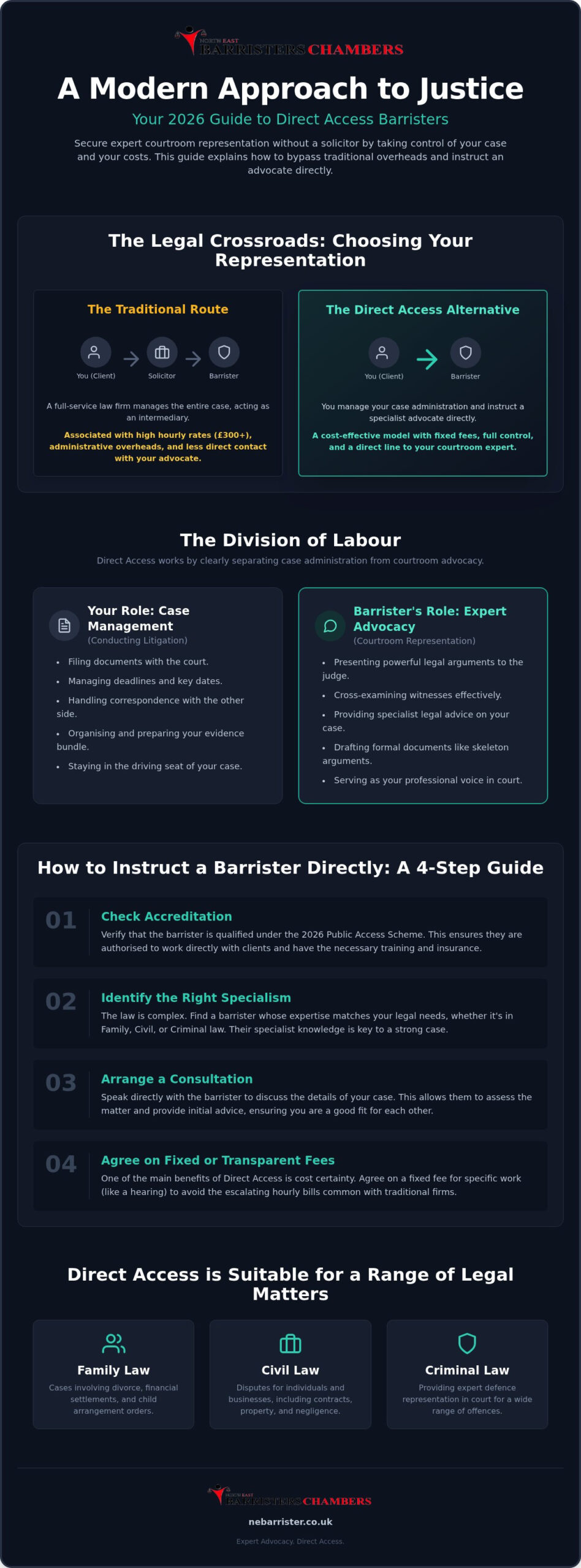
Instructing a barrister directly is a straightforward process, but it requires a methodical approach. Unlike the traditional route where a solicitor handles the vetting, you’re the one in charge of choosing your advocate. This means you must be clear about your requirements from the outset. Whether your matter falls under family, civil, or criminal law, the first step is always to ensure the barrister is accredited for the Public Access Scheme. Not all barristers take instructions from the public, so checking their 2026 accreditation status on the Bar Standards Board register is a non-negotiable first step.
Once you’ve identified a potential advocate, the process typically follows these five steps:
- Step 1: Identifying Specialism. Ensure the barrister’s expertise aligns with your case type, whether that’s a child arrangements order, a breach of contract, or a criminal defence matter.
- Step 2: Direct Access Accreditation. Confirm they have the specific training required to deal with the public without a solicitor intermediary.
- Step 3: The Case Summary. Prepare a concise, one-page summary of your facts and what you want to achieve. This allows for a quick assessment of your case’s suitability.
- Step 4: The Client Care Letter. This is your contract. It defines the scope of work, the fees, and the responsibilities of both parties.
- Step 5: Initial Consultation. A formal meeting, often via video link in 2026, to discuss strategy and provide a preliminary legal opinion.
Securing court representation without a solicitor is about more than just finding a lawyer; it’s about finding a partner for your litigation. I always suggest that clients look for an advocate who balances professional authority with a straightforward, pragmatic communication style.
Evaluating Expertise and Suitability
When you read a barrister’s profile, look for specific courtroom experience rather than just general legal knowledge. You want to see evidence of successful advocacy in cases similar to yours. Don’t be afraid to ask direct questions during your first contact. Ask about their familiarity with the specific court centre where your hearing will take place or how they handle aggressive opposition. A good Direct Access barrister will be honest about whether they’re the right fit for your specific needs.
Understanding Fee Structures
One of the primary benefits of this model is price transparency. Most Direct Access work is conducted on a fixed-fee basis, meaning you know exactly what you’ll pay for a specific hearing or document. This removes the anxiety of the “billable hour” often associated with traditional firms. Direct Access can often reduce legal costs UK by up to 50% compared to traditional routes. For a comprehensive breakdown of what you can expect to pay, including criminal barrister fees UK and how hourly rates compare to brief fees, I recommend reviewing our 2026 guide to Direct Access costs. I recommend budgeting for each stage of your proceedings separately to maintain full control over your legal spend.
Managing Your Case: Practical Tips for the Direct Access Client
Managing your own case is a significant commitment, but it’s the key to making the Direct Access model work for you. When you choose court representation without a solicitor, you’re stepping into the role of the “litigation manager.” I’ve seen many clients thrive in this role by staying organised and proactive. It’s important to remember that this is a partnership. I provide the specialist legal expertise and courtroom advocacy, whilst you handle the administrative foundation that makes my work possible. This division of labour is exactly what keeps your costs manageable and gives you full transparency over your legal spend.
To get the best results, you need to be meticulous with your evidence. I recommend organising your documents chronologically in a digital format. Clear, well-labelled witness statements and exhibits allow me to find the information I need quickly, which maximises the value of my time. Communication should be concise and focused. Rather than sending multiple emails throughout the week, try to compile your questions into a single, structured update. This ensures that our strategic discussions remain productive and that we stay focused on the “theory of the case”—the core narrative we want the judge to accept.
The Division of Labour
In a Direct Access arrangement, the boundaries of our roles are clearly defined. My job is to provide legal advice, draft the formal “grounds” or “pleadings,” and represent you in front of the judge. However, under current Bar Council regulations, I generally cannot “conduct litigation.” This means you’re responsible for filing papers with the court centre, paying court fees, and serving documents on the other side. By handling these administrative tasks yourself, you avoid the significant mark-up that traditional law firms charge for basic case management. It’s a pragmatic way to secure high-level advocacy without paying for a full-service infrastructure you don’t need.
Courtroom Strategy and Conduct
The courtroom is a formal environment with its own set of unwritten rules. When we’re in a hearing, my role is to be your voice. It’s vital to let your advocate speak without interruption, even if the other side says something you disagree with. I’ll always provide you with a way to pass me urgent notes quietly. Behaving professionally amongst other legal professionals and showing respect to the judge is essential for your credibility. I know that legal proceedings are emotionally taxing, but staying focused on the facts rather than the conflict will always serve you better. If you’re feeling overwhelmed by the administrative side of your case, contact me to discuss how we can streamline your case management.
Specialist Representation with North East Barristers Chambers
I believe that legal support should be straightforward and accessible. At North East Barristers Chambers, we’ve built a practice that prioritises the needs of the modern litigant. Choosing court representation without a solicitor shouldn’t mean compromising on the quality of your advocacy. Instead, it’s about stripping away the unnecessary layers of traditional legal firms to provide you with direct, expert advice when you need it most. We operate as an agile, independent chambers; this allows us to be more flexible and responsive than larger, more rigid corporate entities.
My goal is to provide a sense of clarity and relief in what is often a complex and stressful field. We aren’t a faceless corporate entity. We’re a team of seasoned professionals who understand that you need a straightforward solution-provider. By instructing us directly, you’re choosing a path that values your time, your budget, and your need for professional authority in the courtroom. We bring a modern, service-oriented mindset to every case, ensuring that you feel supported from the initial consultation through to the final hearing.
Specialisms: Family, Civil, and Criminal Law
We provide specialist support across the three main pillars of the UK legal system. If you’re dealing with sensitive domestic issues, our expertise in Family Law: Expert Representation for Family Matters ensures your voice is heard in divorce or custody proceedings. For those facing more serious challenges, our Criminal Law Court Representation: An Expert Guide to Direct Access in 2026 provides a robust defence strategy tailored to your specific circumstances.
In civil matters, we handle everything from contract litigation to property disputes. We work with you to identify the strongest legal arguments, drafting the necessary documents whilst you manage the case’s administrative filing. This collaborative approach ensures that even the most complex civil disputes remain manageable and cost-effective. We’ve helped individuals and businesses nationwide navigate these challenges with confidence and precision.
Why Choose Our Direct Access Service?
Reliability is the cornerstone of our practice. When you work with us, you aren’t just another case number; you’re a partner in a productive professional consultation. We offer fixed-fee transparency for many cases, which removes the fear of hidden costs and allows you to budget with confidence. Our national reach means that wherever your hearing is located amongst the UK court centres, you can access the same high standard of advocacy.
I take personal accountability for the quality of our service. We’ve removed the barriers that make traditional legal communications feel detached or intimidating. Instead, we offer a transparent, helpful, and straightforward service that brings clarity to complex situations. If you’re ready to secure professional court representation without a solicitor, we’re here to act as your friendly, authoritative guide through the legal process.
Secure Your Courtroom Advantage Today
You now have the tools to navigate the legal system on your own terms. We’ve explored how you can manage your own case administration whilst still benefiting from high-level advocacy in the courtroom. By understanding the distinction between conducting litigation and presenting a legal argument, you’ve seen that court representation without a solicitor is a strategic choice for the modern litigant. It’s about focusing your resources where they matter most: the moment you stand before a judge.
At North East Barristers Chambers, I provide Direct Access accredited advocacy across criminal, civil, and family law. I believe in fixed-fee transparency so you’re never left guessing about your legal spend. This agile approach ensures you get the professional authority you need without the traditional overheads of a full-service firm. I’m here to act as your guide and your voice, providing the straightforward solutions you need to move forward.
Instruct an expert barrister directly and take control of your case today. Taking charge of your legal journey is a significant step, but you don’t have to do it alone. I’m ready to help you achieve the clarity and relief you deserve.
Frequently Asked Questions
Can I really go to court without a solicitor in 2026?
Yes, you have a fundamental legal right to represent yourself or to instruct an advocate directly under the Public Access Scheme. The 2026 legal framework makes it easier than ever to bypass the traditional solicitor-led model for most civil, criminal, and family law matters. Whilst you will be responsible for the administrative side of your case, you can still have a professional barrister standing beside you in the courtroom.
What is the difference between a Litigant in Person and a Direct Access client?
A Litigant in Person manages their entire case alone, including all the speaking and legal arguing in court. As a Direct Access client, you still handle your own case management and paperwork, but you have hired a professional barrister to provide expert advice and advocacy. This gives you the benefit of specialist courtroom skills without the high overheads of a full-service law firm.
Is it cheaper to hire a barrister directly than to use a solicitor?
Instructing a barrister directly is almost always more cost-effective because you aren’t paying for two separate legal professionals. You avoid the duplication of fees that occurs when a solicitor is paid to instruct a barrister on your behalf. By taking on the administrative tasks yourself, you can focus your budget entirely on securing expert court representation without solicitor intermediaries.
What types of cases are not suitable for Direct Access?
Cases that involve exceptionally heavy litigation management or thousands of pages of evidence might not be suitable for this route. If a case requires significant investigative work or if a client is unable to manage their own court deadlines, a barrister will advise that a solicitor is necessary. This ensures the case isn’t put at risk by administrative errors or missed procedural steps.
Can a barrister help me with the paperwork if I don’t have a solicitor?
Yes, a barrister can draft your formal legal documents, including witness statements, grounds of claim, and skeleton arguments. However, they cannot “conduct litigation,” which means they won’t physically file these documents with the court or serve them on the other side. You’ll receive the drafted work from your barrister and then handle the delivery to the court centre yourself.
What happens if the other side has a solicitor and I only have a barrister?
You won’t be at a disadvantage during the hearing itself. Your barrister will handle all the legal arguments and cross-examinations, ensuring you are on an equal footing with the opposition’s advocate. The only practical difference is that the court and the other side’s solicitor will correspond directly with you for administrative matters rather than with a law firm.
Can I get legal aid for Direct Access barrister services?
No, Direct Access is a private, fee-paying service and is not available through the legal aid scheme. If you believe you are eligible for state-funded legal support based on the 2026 means test thresholds, you must find a solicitor who holds a legal aid contract. Direct Access is designed for those who are self-funding their case and looking for a more affordable way to access expert advocacy.
How do I pay a Direct Access barrister?
Most barristers provide their services on a transparent, fixed-fee basis for each stage of the case. You’ll typically pay for a specific task, such as an initial consultation or a day in court, in advance of the work being carried out. This model prevents the accumulation of unexpected hourly charges and allows you to maintain strict control over your total legal spend. For a full breakdown of what these fees look like in practice, our guide to how much a barrister costs and typical criminal barrister fees UK provides clear, up-to-date figures to help you plan your budget.
