
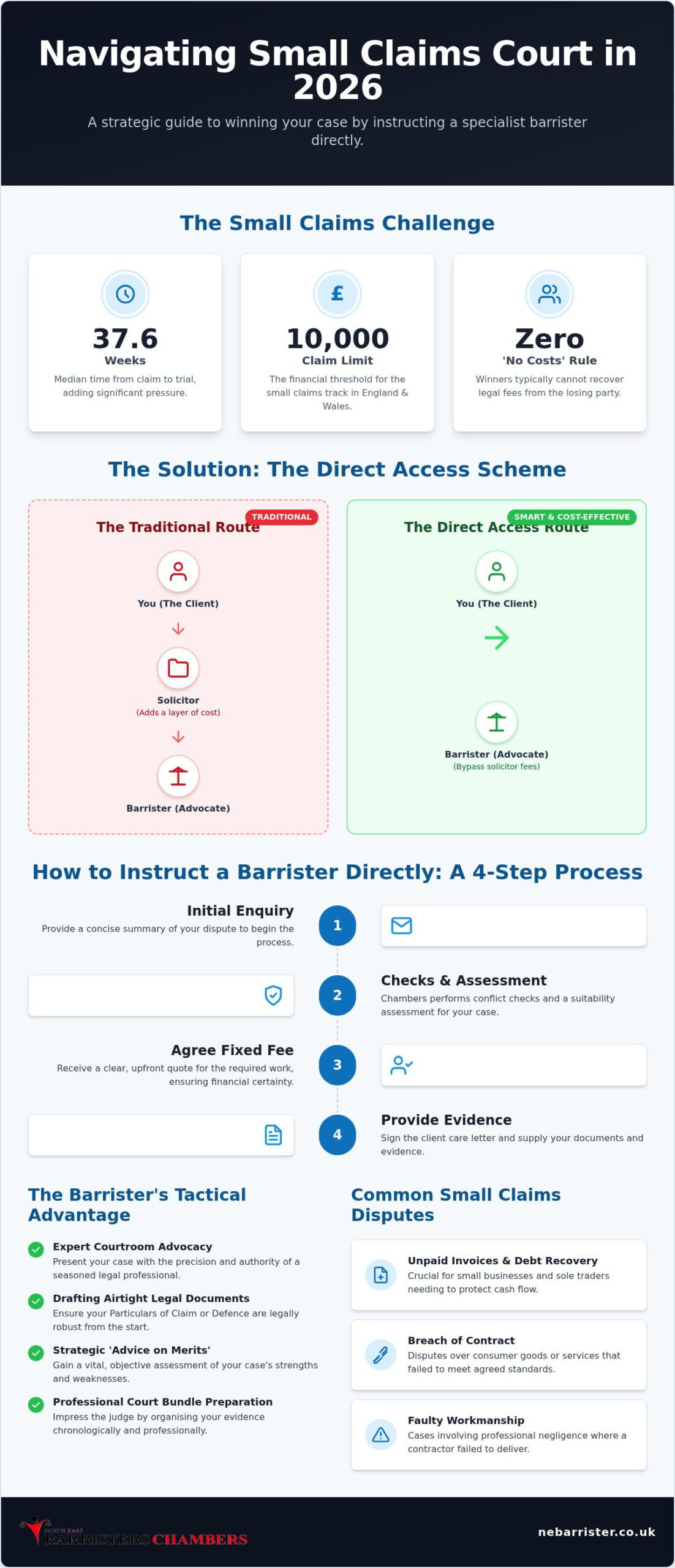
You don’t need a solicitor to have the sharpest legal mind in the room during a small claims hearing. Hiring a small claims court barrister through the Direct Access scheme is no longer a luxury reserved for complex corporate disputes; it’s a strategic necessity for anyone facing a £10,000 claim in 2026. I understand how daunting it feels to stand before a judge. You likely worry that your opponent’s legal team will use technicalities to trip you up, or that the cost of professional help will simply swallow your potential winnings. It’s a common fear, especially when the median time to trial is currently 37.6 weeks and the pressure to perform is high.
I agree that the legal system often feels like a maze designed to favour those with the deepest pockets. This guide helps you discover how to instruct a specialist barrister directly to win your small claims case whilst significantly reducing your legal expenditure. I’ll walk you through the 2026 procedural updates, explain how to manage your own witness statements, and show you how fixed-fee representation provides the certainty you need to secure a favourable settlement.
Key Takeaways
- Learn how the Direct Access scheme allows you to hire a small claims court barrister directly, bypassing solicitor fees and keeping your legal costs manageable.
- Understand why the ‘no costs’ rule in the small claims track makes fixed-fee advocacy the most pragmatic choice for protecting your financial interests.
- Discover the tactical advantages of having a specialist advocate present your case, ensuring you aren’t out-manoeuvred by your opponent’s legal team.
- Master the essentials of preparing a professional Court Bundle, including how to organise your evidence chronologically to impress the judge.
- Gain the confidence to navigate the 2026 court system with a clear strategy for securing a favourable settlement or winning your hearing.
What is the Small Claims Track and Why Use a Barrister?
The Small claims track is the standard route for most civil disputes in England and Wales where the financial value is £10,000 or less. I often see people assume that because the value is “small,” the law is somehow simpler. That’s a dangerous misconception. While the court environment is designed to be less formal than a multi-million pound trial, the legal principles remain rigorous. You’re still bound by the Civil Procedure Rules (CPR). These rules dictate everything from how you serve papers to how you present evidence. If you miss a deadline or fail to follow a court order, your claim can be struck out before you even see a judge.
One of the most critical factors to understand is the ‘no costs’ rule. In the small claims track, the winning party usually cannot recover their legal representative’s fees from the losing side. You might get your court fees back, but you won’t get a solicitor’s hourly rate. This is precisely why instructing a small claims court barrister directly is such a pragmatic choice. By removing the solicitor middleman, you access specialist advocacy at a price point that makes sense for the amount you’re claiming.
Common Disputes in the Small Claims Court
Disputes reach this track for many reasons. I frequently represent clients in matters involving:
- Unpaid invoices and debt recovery for small businesses or sole traders who need their cash flow protected.
- Breach of contract claims regarding consumer goods or services that didn’t meet the promised standards.
- Professional negligence and faulty workmanship disputes where a contractor has failed to deliver what was agreed.
The Reality of Being a ‘Litigant in Person’
Standing in court as a ‘litigant in person’ carries a heavy emotional toll. It’s difficult to remain objective when you’re arguing about your own money or reputation. I see self-represented parties make frequent mistakes, such as submitting hundreds of pages of irrelevant emails or failing to address the specific legal tests the judge must apply. A small claims court barrister acts as an expert filter. I can take your complex story and distill it into the precise legal arguments the court needs to hear. This objective distance often makes the difference between a frustrating loss and a successful settlement. It allows you to walk into the courtroom feeling prepared rather than overwhelmed by your opponent’s legal team.
Hiring a Small Claims Court Barrister via Direct Access
Hiring a small claims court barrister via Direct Access is often the most cost-effective decision you can make in a legal dispute. Traditionally, you’d hire a solicitor who would then hire a barrister for the hearing. This middleman approach adds a layer of cost that rarely makes sense for claims under £10,000. The Public Access Scheme, commonly known as Direct Access, lets you bypass that extra expense. You work with the barrister directly. While you take on some administrative tasks like filing papers or posting letters, I focus on the heavy lifting: the legal strategy and the courtroom battle.
Fixed-fee arrangements are the cornerstone of this service. Unlike solicitors who often bill by the hour, most direct access barristers provide a clear, upfront quote for specific tasks. This gives you financial certainty. You know exactly what the advocacy will cost before you commit. If you’re just starting your journey, you should first make a court claim for money via the official portal to get the process moving. Once the claim is issued, I can step in to ensure your case is presented with professional precision.
How to Instruct a Barrister Directly
The process is straightforward and designed for laypeople. I’ve broken it down into four clear steps. First, you make an initial enquiry and provide a concise summary of your dispute. Next, the chambers performs conflict checks and a suitability assessment to ensure I can legally and practically help you. Third, we agree on a fixed fee for the specific work required, whether that’s a one-off advice or full hearing representation. Finally, you sign a client care letter and provide your evidence. This structured approach ensures transparency from the very start.
What a Direct Access Barrister Can Do for You
I can assist at every stage of your claim to ensure you aren’t out-manoeuvred. This includes drafting formal ‘Statements of Case’, such as your Particulars of Claim or Defence, to ensure your legal position is airtight. I also provide a written ‘Advice on Merits’. This is a vital reality check to see if your case is actually winnable before you spend more time and money. Of course, the primary service is representation at the final hearing. I will cross-examine witnesses and argue the law on your behalf, giving you the best chance of success. If you’re looking for professional court representation, this direct route is the most efficient path forward.
Barrister vs Solicitor: Choosing the Right Path for Small Claims
Deciding between a solicitor and a small claims court barrister often comes down to one question: what part of the legal process do you actually need to pay for? Solicitors are excellent generalists. They manage high-volume litigation, handle daily correspondence, and act as project managers for your case. However, in the small claims track, where the value is capped at £10,000, paying for that level of administrative management can quickly become unviable. Barristers are different. We are specialist advocates who spend our lives in courtrooms. My role is to take the evidence you’ve gathered and turn it into a persuasive argument that wins over a judge.
There are times when a solicitor is still necessary, particularly for complex, document-heavy cases that require significant ongoing management. But for most small claims, you already know the facts of your dispute. You don’t need someone to manage your files; you need someone to win the argument. By instructing a barrister directly, you’re hiring a trial specialist who focuses on the legal principles that will actually decide the outcome of your case.
Evaluating the Total Cost of Representation
The primary reason the direct access barrister cost is often lower is the removal of the solicitor’s hourly rate. Solicitors typically bill for every email, phone call, and minute spent on your file. In a small claim, there’s a very real risk that your ‘legal spend’ will exceed the actual value of what you’re trying to recover. I prefer a more transparent approach. By using fixed fees for specific tasks, I provide you with legal certainty. You won’t face ‘bill shock’ at the end of the trial because you’ll know the exact cost of my representation before we even step into the building. This makes professional legal help accessible for disputes that might otherwise be abandoned due to high costs.
The Value of Specialist Advocacy
I focus on the ‘end game’ from day one. While a solicitor might spend months on procedural back-and-forth, a small claims court barrister looks at your case through the lens of the final trial. This courtroom-first perspective is invaluable during settlement negotiations. If the other side knows you have an experienced trial specialist on your team, they’re often more inclined to make a realistic offer. There’s also the undeniable impact of having a professional represent your interests to the Judge. While the environment is less formal, a judge still appreciates a concise, legally sound argument presented by someone who understands the nuances of the courtroom. It ensures your voice is heard and your evidence is given the weight it deserves.
Preparing for Your Small Claims Hearing
Preparation starts long before your hearing date. You must follow the Pre-Action Protocol, which involves sending a formal letter before action and giving the other side a fair chance to settle. Once the case proceeds, the most vital document is the ‘Court Bundle’. I often see cases falter because the evidence is a jumbled mess of loose emails and blurred photos. You should organise every contract, receipt, and message chronologically. This logical layout allows the judge to follow the narrative of your dispute without frustration. When you present a clean, indexed bundle, you’re already halfway to winning the judge’s respect.
Success in court depends on how well you’ve filtered your evidence. A small claims court barrister doesn’t just read your documents; they weaponise them. My role is to identify which specific email or contract clause proves your point and ensures the judge sees it at the exact right moment. If you’re feeling overwhelmed by the paperwork, you can instruct a barrister directly to review your evidence and handle the advocacy for you.
Drafting Effective Witness Statements
A witness statement is your opportunity to tell your story, but “less is more” is the golden rule. District Judges are incredibly busy and often deal with dozens of cases in a single day. They need clear, factual accounts rather than personal opinions or emotional venting. Stick to the facts: what happened, when, and who was there. Every statement must be backed by a ‘Statement of Truth’. I can help you refine these documents to ensure they are legally robust and concise, focusing only on the details that actually impact the legal outcome.
Courtroom Etiquette and Advocacy Tactics
Walking into a courtroom can be intimidating, even in the relatively informal small claims track. You’ll usually address the Judge as ‘Sir’ or ‘Madam’. When I represent you as your small claims court barrister, I handle the procedural nuances so you don’t have to. I manage the ‘bundle’ during the hearing, guiding the Judge to specific page numbers so they find key evidence quickly. This keeps the hearing moving efficiently and projects an image of professional competence.
Advocacy is about precision. During cross-examination, the goal is to ask short, focused questions that elicit specific facts, not to make long speeches. I focus on exposing inconsistencies in the opponent’s story whilst maintaining a professional and respectful tone. This strategic approach often reveals the truth far more effectively than an emotional argument. My courtroom experience allows me to pivot when a witness says something unexpected, ensuring your case remains on track regardless of how the evidence unfolds on the day.
Why Instruct North East Barristers for Your Case?
Choosing a small claims court barrister is a decision that balances legal expertise with financial pragmatism. I provide specialist civil law court representation that bridges the gap between complex legal theory and the practical realities of the courtroom. While my practice is rooted in a tradition of excellence, I operate with a modern, agile mindset. I provide national coverage, travelling to County Courts throughout the UK to ensure you have expert advocacy regardless of your location. My goal is to strip away the intimidation factor of the legal system and provide a straightforward path to resolution. Litigation is inherently stressful, but having a direct connection to your advocate provides a level of clarity that traditional solicitor-led models often lack.
I understand that “bill shock” is a major concern for anyone involved in litigation. That’s why I adopt a transparent approach to Direct Access fees. You’ll receive a clear, fixed-fee quote for each stage of your case, from initial advice to the final hearing. This transparency allows you to make informed business or personal decisions without worrying about escalating hourly rates. I focus on delivering value, ensuring that the cost of your small claims court barrister remains proportionate to the value of your claim. My service is designed to be accessible, flexible, and entirely focused on your specific objectives.
Our Professional Advocacy Standards
I maintain high standards of advocacy across several key areas of civil law, providing tailored solutions for both individuals and businesses. My expertise includes:
- Contract disputes involving complex terms, service level agreements, or disputed interpretations of verbal agreements.
- Debt recovery for small businesses facing stubborn late payers who are using the court process to delay settlement.
- Consumer law cases where high-value goods or professional services have failed to meet statutory requirements or promised standards.
I’ve built a track record of successful representation by focusing on the precise legal tests that judges apply. I don’t just present your story; I advocate for your interests with the authority and calm confidence that only a seasoned courtroom professional can provide. This specialist knowledge ensures that your case is framed correctly from the very first submission.
Next Steps: Starting Your Direct Access Journey
Starting the process is simple and efficient. To get a fast response, prepare a brief summary of your dispute and a timeline of key events. I’ll need to see any core documents, such as contracts, invoices, or previous correspondence, to assess the merits of your case. This initial review ensures we’re on the same page before you commit to any fees. Once I’ve reviewed your documents, I can provide a clear roadmap for your advocacy and a fixed-fee quote for the work required.
Enquire about Direct Access representation today to secure the expert advocacy you need for your small claims hearing.
Secure Your Courtroom Advantage Today
Navigating the small claims track doesn’t have to be a solo journey fraught with legal technicalities. By choosing the Direct Access route, you gain the strategic advantage of specialist advocacy whilst keeping your legal expenditure under control. We’ve explored how a well-organised court bundle and factual witness statements form the foundation of a successful claim. However, the final trial is where professional representation truly matters. A specialist small claims court barrister provides the objective filter and courtroom precision needed to out-manoeuvre your opponent and present your case with authority to the judge.
If you’re ready to move forward with confidence, you can Instruct a Direct Access Barrister for your Small Claims Case today. My practice provides expert court advocacy and national UK coverage with transparent fixed fees, ensuring you have the legal certainty required to protect your interests. You’ve already done the hard work of gathering your evidence; now let’s ensure it’s presented with the impact it deserves to secure the best possible outcome for your dispute.
Frequently Asked Questions
Can I use a barrister for a claim worth less than £10,000?
Yes, you can absolutely instruct a small claims court barrister for disputes under £10,000. In fact, many litigants find that professional advocacy is the only way to level the playing field when the opponent is a large company or has their own legal team. Because you aren’t paying for a solicitor’s overheads, direct access representation becomes a financially sound choice for claims that might otherwise be too expensive to pursue with traditional legal support.
How much does a small claims barrister cost on a direct access basis?
Direct access fees are typically structured as transparent fixed amounts rather than unpredictable hourly rates. The exact cost depends on the complexity of your dispute, the volume of evidence, and whether you require a one-off advice or full representation at a hearing. I provide a clear quote before any work begins, ensuring you have total budget certainty. This approach prevents the ‘bill shock’ often associated with traditional legal services, making expert advocacy accessible.
What happens if I lose my small claims case with a barrister?
If you lose, you’ll usually have to pay the amount claimed by the opponent, plus their court fees. You also remain responsible for your own barrister’s fees. Because of the ‘no costs’ rule in small claims, you won’t normally have to pay the other side’s professional legal fees. I always provide an ‘Advice on Merits’ early on to help you understand the risks of losing before you proceed with a full hearing.
Can a barrister help me with mediation before the court hearing?
Yes, I can provide expert guidance during the mediation process to help you secure a settlement without the need for a trial. Mediation is often a mandatory step in the small claims process, and having a barrister advise you on the strengths and weaknesses of your case can be invaluable. I can help you evaluate offers and draft settlement agreements that protect your interests, potentially saving you the time and stress of a full court hearing.
Do I have to pay my opponent’s legal fees in the small claims court?
In the small claims track, the general rule is that each party pays their own legal costs regardless of who wins. You will typically only be ordered to pay your opponent’s legal fees if the judge decides you have acted ‘unreasonably’ during the litigation. However, you may still have to pay fixed costs, such as court filing fees or limited witness expenses, if your case is unsuccessful. This rule makes small claims litigation lower risk.
How long does a typical small claims hearing last?
A typical small claims hearing usually lasts between one and three hours. The judge will have allocated a specific time slot based on the complexity of the issues. Simpler debt recovery matters might be resolved in under an hour, whilst complex breach of contract cases involving multiple witnesses can take a full morning or afternoon. I manage the evidence to ensure we stay within the court’s time limits whilst covering all essential points.
Can a barrister draft my Particulars of Claim for me?
Yes, drafting your Particulars of Claim or your Defence is a core service I provide. These ‘Statements of Case’ are the most important documents in your file because they set out the legal basis for your claim. A small claims court barrister ensures that your arguments are legally sound and focus on the correct principles from the start. Getting these documents right significantly improves your chances of a successful outcome or an early settlement.
Will my barrister attend the court in person or via video link?
This depends entirely on the directions issued by the specific County Court handling your case. While many small claims hearings have returned to being held in person, some courts still utilise video links or telephone hearings for shorter matters. I am equipped to represent you in either format. I provide national coverage and will travel to your local court if an in-person hearing is required, ensuring you have professional support by your side.
