
Your family home shouldn’t be the price you pay for a business failure that was beyond your control. When a liquidator alleges wrongful trading, the threat to your personal assets is immediate, making the early instruction of a specialist director disqualification barrister a critical step in your defence. I understand the sheer weight of facing complex UK insolvency legislation while worrying about the financial security of your family. It’s an intimidating position, especially when traditional solicitor-led legal teams feel prohibitively expensive and detached from your reality.
You’ll be relieved to know that a claim is not a foregone conclusion. You can successfully strike out or settle these demands by demonstrating proactive conscientiousness through the “Every Step” statutory defence. In this guide, I’ll walk you through the essential legal defences and tactical manoeuvres required to protect your livelihood. We’ll explore how to navigate the Insolvency Act 1986 with confidence and ensure you have the expert advocacy needed to reach a pragmatic, cost-effective resolution that secures your future.
Key Takeaways
- Identify the ‘Insolvency Point’ under Section 214 to understand exactly when your legal duties to creditors shifted.
- Utilise the ‘Every Step’ statutory defence by gathering contemporaneous evidence that proves you tried to minimise creditor losses.
- Recognise why liquidators often favour wrongful trading claims over fraudulent ones and how this affects your legal strategy.
- Learn the tactical steps to challenge a liquidator’s report and identify inaccuracies before they escalate into court proceedings.
- Secure expert advocacy and reduce your legal spend by instructing a director disqualification barrister through the Direct Access scheme.
Understanding the Risks of Wrongful Trading and Director Disqualification
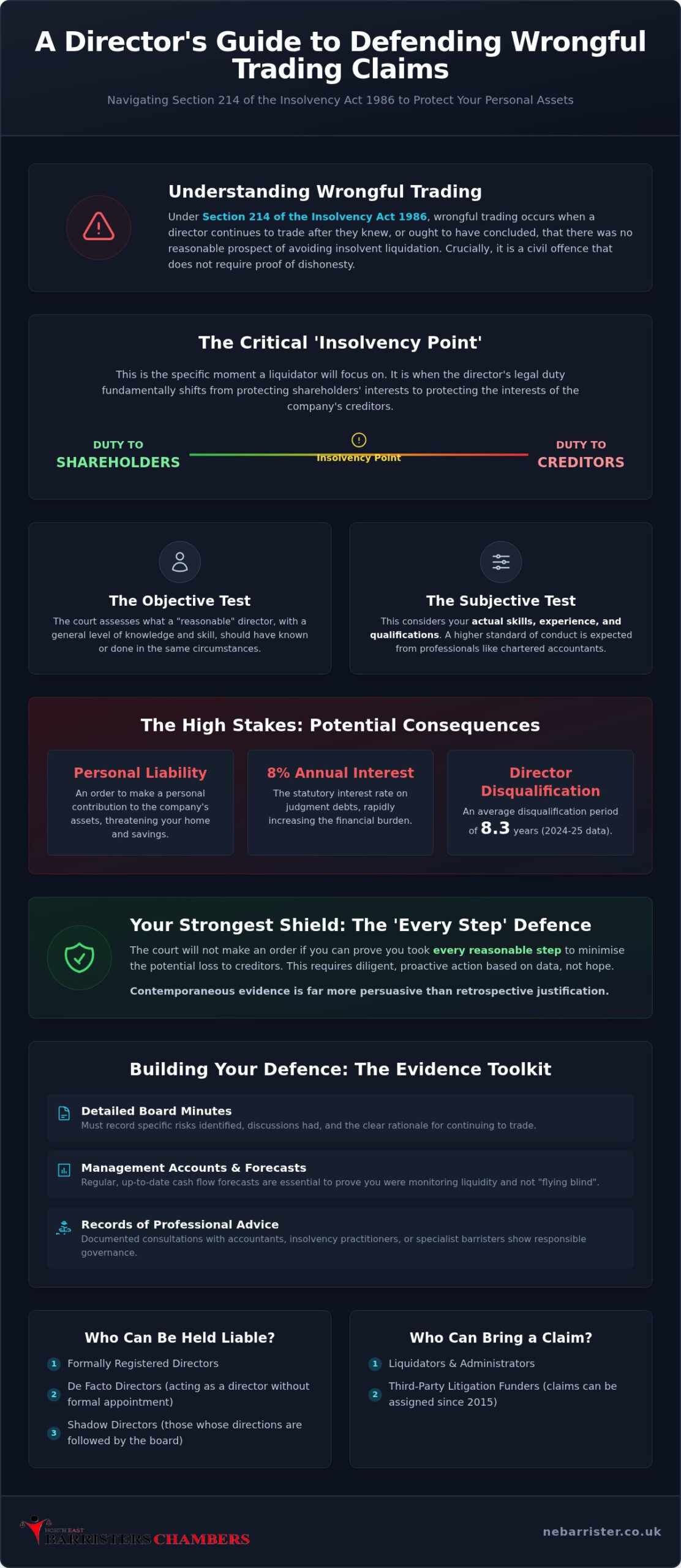
Section 214 of the Insolvency Act 1986 is the primary tool liquidators use to hold directors personally liable for company debts. Wrongful trading under UK insolvency law occurs when you continue to trade after you knew, or ought to have concluded, that there was no reasonable prospect of avoiding insolvent liquidation. It’s a civil offence that doesn’t require proof of dishonesty. Instead, it focuses on whether you failed to protect the interests of your creditors at the right time.
I often find that directors are caught out by the “Insolvency Point”. This is the specific moment when your legal duty shifts from the shareholders to the creditors. Liquidators pursue these claims aggressively to increase the “pot” of assets available for distribution. If a claim succeeds, the court can order you to make a personal contribution to the company’s assets. With the statutory interest rate on judgment debts currently at 8% per annum, a delay in addressing these claims can lead to a devastating financial burden that threatens your family home and personal savings.
The Objective and Subjective Tests
The court assesses your conduct using two distinct benchmarks. The objective test looks at what a “reasonable” director in your position should have known or done. The subjective test goes further; it considers your actual skills, experience, and qualifications. If you’re a chartered accountant or an experienced business leader, the court expects a higher standard of financial oversight. I’ve seen many cases where directors argue they were simply unaware of the mounting debts. However, “I didn’t know” is rarely a valid defence in a courtroom. The law assumes you have the tools to understand your company’s financial health; if you don’t, you are expected to find someone who does.
Who Can Bring a Claim?
While Liquidators and Administrators typically initiate these proceedings, the landscape changed significantly in 2015. These claims can now be assigned to third parties, including commercial litigation funders, which has led to a rise in legal actions. You don’t have to be a formally registered director to be at risk. Shadow directors and de facto directors, those who call the shots behind the scenes without a formal title, are equally vulnerable to prosecution. If you are facing such allegations, instructing a specialist director disqualification barrister via direct access is the most efficient way to secure expert advocacy. I can help you dismantle the liquidator’s arguments and protect your professional reputation from a disqualification period, which averaged 8.3 years in the 2024-2025 period.
The Every Step Defence: Minimising Creditor Loss
If you find yourself in the crosshairs of a liquidator, your strongest shield is the “Every Step” defence. Under Section 214 of the Insolvency Act 1986, the court won’t make an order for contribution if it’s satisfied that you took every reasonable step to minimise the potential loss to the company’s creditors. This is a high bar, but it’s achievable for directors who acted with integrity and foresight. The court doesn’t expect you to be a psychic who predicts a market crash; it expects you to be a diligent professional who reacts correctly when the numbers turn red.
The court doesn’t just want to hear your side of the story years after the event. It wants to see the paper trail you created when the crisis was unfolding. Retrospective justification often feels like an excuse to a judge. In contrast, contemporaneous evidence acts as a window into your mindset at the “Insolvency Point” we identified earlier. If you traded on with a genuine rescue plan, backed by professional advice, you’ve already laid the groundwork for a robust defence. Consulting a director disqualification barrister early on allows you to organise this evidence into a persuasive narrative that can halt a claim before it reaches trial. If you’re unsure if your documentation meets this standard, you can instruct an expert directly to review your case.
Essential Documentation for Your Defence
You need to demonstrate that your decisions were based on data, not just hope. A judge will look for specific documents that prove you were monitoring the situation daily. These include:
- Detailed board minutes: These should record the specific risks identified and the clear rationale for continuing to trade.
- Management accounts: Regular cash flow forecasts prove you were monitoring the company’s liquidity and weren’t “flying blind”.
- Specialist advice: Written evidence that you sought insolvency or legal counsel shows you were taking your duties to creditors seriously.
Actions That Demonstrate Conscientiousness
Taking “every step” involves active management of the company’s liabilities. It’s about showing the court that you didn’t just sit on your hands while the ship sank. Key actions include:
- Formal Restructuring: Proposing a Company Voluntary Arrangement (CVA) shows a structured, legal attempt to save the business.
- Creditor Engagement: Proactively negotiating with HMRC or key suppliers demonstrates that you weren’t ignoring your obligations.
- Immediate Cost Cutting: Halting non-essential expenditure and reducing overheads signals that you prioritised creditor interests over business expansion.
Wrongful vs Fraudulent Trading: Navigating Legal Thresholds
I’ve found that many directors conflate wrongful and fraudulent trading, yet the legal distinction is vast. Fraudulent trading requires a specific intent to defraud creditors. It’s a high bar for any liquidator to clear because it involves proving actual dishonesty. Because of this difficulty, liquidators almost always prefer wrongful trading claims. They don’t have to prove you were a rogue; they just have to prove you were negligent or failed to act when you ought to have known the company was doomed. While wrongful trading is a civil matter, fraudulent trading carries the risk of criminal sanctions, including unlimited fines or imprisonment.
If a liquidator suggests your conduct was fraudulent, the stakes rise significantly. A specialist director disqualification barrister is essential here to challenge any mischaracterisation of your business decisions. I can help you demonstrate that while the business failed, your actions remained within the bounds of civil law. You should also consult the official government guidance on director disqualification to understand the full spectrum of “unfit conduct” that the Insolvency Service monitors. My role is to ensure that a genuine, albeit unsuccessful, attempt to save a company isn’t twisted into an allegation of fraud.
The Burden of Proof
In civil insolvency litigation, the liquidator carries the burden. They must prove that a reasonable director with your specific skill set would have concluded liquidation was unavoidable at a certain point. While fraudulent trading requires proof beyond reasonable doubt for criminal conviction, wrongful trading is judged on a different scale. The burden of proof for wrongful trading claims is on the balance of probabilities. This means the court only needs to find it more likely than not that you failed in your duties. I work to shift this balance by highlighting the external factors that made your decisions reasonable at the time.
Negotiating Settlements
Settlement is often the most pragmatic outcome for everyone involved. I look for factual inaccuracies in the liquidator’s report to undermine their confidence in a trial. If we can show their evidence is weak or their timeline is flawed, we gain significant leverage. Mediation and Alternative Dispute Resolution (ADR) provide a private forum to resolve these disputes without the public exposure of a courtroom. High-quality expert court advocacy UK can often convince a liquidator that a settlement is better than a risky, expensive trial. By exposing the gaps in their assessment of the “Insolvency Point”, I can often secure a resolution that protects your assets and your reputation.
Tactical Steps for Defending a Liquidator’s Claim
Receiving a Letter of Claim or a Letter Before Action is a high-pressure moment. It marks the start of a formal process where the liquidator attempts to claw back funds from you personally. Your first move is critical. You must not ignore this correspondence; doing so often leads to a default judgment or an aggressive escalation in court. I recommend reviewing every line of the liquidator’s report immediately. These reports often contain factual inaccuracies, especially regarding the exact “Insolvency Point” or your specific actions during the crisis. Identifying these errors early allows us to challenge the very foundation of their claim before it gains momentum.
Responding to the Letter of Claim
Timing is everything. You usually have a limited window, often 21 or 28 days, to respond. Instead of rushing into a defensive admission, I use this period to request full disclosure. You have a right to see the evidence the liquidator is relying on. By asking for specific documents, we can often reveal gaps in their narrative. My advice is simple: avoid making any admissions of liability in these early stages. Every email or letter you send can be used against you in the High Court. Instead, focus on a neutral acknowledgement while you gather your evidence and assess your position.
This is the point where instructing a director disqualification barrister through the Direct Access scheme becomes invaluable. I can provide an objective assessment of the merits of your defence before you commit to expensive litigation. If the claim is fundamentally flawed, we can move to strike it out. If it has some merit, we can begin drafting a witness statement that specifically addresses the “Every Step” criteria. This statement must be precise; it’s a structured legal argument that links your board minutes and financial forecasts to the statutory protections available to you.
Preparing for the Courtroom
If the matter proceeds to a hearing, it will typically take place in the High Court. The environment is formal, and the scrutiny is intense. You will likely face cross-examination, where the liquidator’s counsel will pick apart your decisions with the benefit of hindsight. They will look for any instance where you prioritised your own interests, or those of your shareholders, over those of the creditors. This is why having a barrister who understands both civil litigation and complex insolvency law is vital. I can guide you through the process, ensuring you are prepared for the rigour of the courtroom and the technicalities of the law.
If you’ve received a Letter of Claim, don’t wait for the deadline to pass; contact me today to discuss your defence.
Instructing a Direct Access Barrister for Insolvency Defence
Facing a wrongful trading claim is a high-stakes battle for your personal financial survival. Traditionally, directors have felt forced into a two-tier legal system: hiring a solicitor who then instructs a barrister. This approach often leads to duplicated work and inflated invoices. By choosing to work with a director disqualification barrister directly, you remove the middleman and gain immediate access to the specialist who will actually argue your case before a judge. It’s a modern, agile way to manage a legal crisis without the corporate price tag.
I focus on providing a clear roadmap through the litigation process. Because I spend my time in the courtroom, I can offer a realistic assessment of trial risk that a solicitor might overlook. My goal is to protect your assets and your reputation through straightforward, tactical advice. You don’t need a faceless legal team; you need an expert advocate who understands the nuances of insolvency law and the pressures of running a business. This direct relationship allows us to reduce UK legal costs while maintaining the highest standard of advocacy.
Benefits of Direct Public Access
The most immediate advantage is clarity. You speak directly to me, ensuring nothing is “lost in translation” between different legal departments. This direct line of communication speeds up the preparation of your defence and ensures your voice is heard. The cost savings are also substantial. Without the overheads of a traditional law firm, I can offer competitive rates and, in many cases, fixed-fee quotes for specific stages of work. As a director disqualification barrister, I provide transparency that allows you to budget effectively, which is vital when your company is already in liquidation.
How to Start the Process
I’ve designed the engagement process to be as frictionless as possible. We start by gathering your essential records, specifically the board minutes and financial forecasts we discussed in previous sections. Once I’ve reviewed these, we’ll have an initial consultation to stress-test your “Every Step” defence. If the evidence is strong, I will help you draft a witness statement that stands up to the liquidator’s scrutiny. Whether you need a one-off advice session or full expert court representation, the first step is a simple conversation about your options. I am here to act as your guide, ensuring you navigate the complexities of insolvency law with confidence and clear-headed pragmatism.
Protecting Your Future and Your Assets
A wrongful trading claim doesn’t have to end in financial ruin or the loss of your professional reputation. By understanding the specific triggers of the Insolvency Act 1986 and preparing a defence based on the “Every Step” criteria, you can take control of the narrative. I’ve shown you that the “Insolvency Point” is often debatable and that your proactive steps to minimise creditor loss are your strongest legal shield. Success in these cases relies on early intervention and the ability to challenge a liquidator’s assumptions with precision.
Choosing to work with a specialist director disqualification barrister through the Direct Access scheme ensures you have expert court advocacy without the burden of unnecessary solicitor fees. I provide national coverage and a straightforward approach to complex litigation; helping you reach a pragmatic resolution that protects your personal assets. You don’t have to face these proceedings alone or unprepared. Instruct an expert Direct Access Barrister today to defend your claim and secure the specialist support you need to move forward with confidence. Better days are ahead when you have the right legal partner by your side.
Frequently Asked Questions
Can I be personally liable for company debts if the business fails?
Yes, you can be held personally liable under Section 214 of the Insolvency Act 1986. If a court finds you continued trading after the point when you knew insolvency was unavoidable, it can order you to contribute to the company’s assets. This contribution is usually equal to the increase in liabilities from that specific date. This debt is personal, meaning your private savings and assets are directly at risk.
What is the Every Step defence in wrongful trading?
This is a statutory defence where you prove you took every reasonable step to minimise creditor losses once you realised the company was insolvent. I help directors demonstrate this by presenting evidence of documented board meetings, professional advice sought, and proactive cost-cutting measures. The court assesses your conduct against what a reasonable director with your specific skills and experience would have done in the same situation.
How much does it cost to defend a wrongful trading claim?
Defending these claims involves costs that vary based on the complexity of the liquidator’s allegations. However, instructing a director disqualification barrister through the Direct Access scheme is a far more cost-effective alternative to traditional solicitor-led teams. I offer fixed-fee quotes for specific stages of work, such as initial advice or court representation. This transparency allows you to manage your legal spend without the surprise of uncapped hourly rates.
Can I instruct a barrister directly without a solicitor for insolvency cases?
You can certainly use the Direct Public Access scheme to bypass solicitors entirely for your defence. This allows you to work directly with me, the specialist who will actually argue your case in court. It removes a significant layer of legal fees and ensures your instructions are not lost in translation between different firms. I provide national coverage, acting as a straightforward solution-provider for directors facing high-pressure insolvency litigation.
What is the difference between wrongful trading and fraudulent trading?
The key difference is the intent behind your actions. Fraudulent trading is a criminal offence requiring proof that you intended to defraud creditors; a very high bar for a liquidator to clear. Wrongful trading is a civil matter that only requires proof of negligence or poor judgment. Liquidators prefer wrongful trading claims because they only need to prove their case on the balance of probabilities, making it easier to secure a contribution.
Will my professional indemnity insurance cover a wrongful trading claim?
Many Directors and Officers (D&O) insurance policies provide cover for the legal costs involved in defending these claims. However, they don’t usually cover the actual contribution order if you are found liable by the court. You should review your policy wording for specific insolvency clauses immediately. I can help you understand your position and provide the expert advocacy your insurer may require to support your defence throughout the proceedings.
Can a liquidator take my home if I am found liable for wrongful trading?
If a court orders you to pay a contribution and you lack the cash to satisfy that debt, your property could be at risk. A judgment debt is enforceable against your personal assets, including the equity in your family home. This is why building a robust defence based on contemporaneous evidence is so critical. My goal is to help you reach a pragmatic settlement or strike out the claim before such measures become necessary.
What happens if I cannot afford to pay a wrongful trading contribution?
Failure to meet a court-ordered contribution can lead to personal bankruptcy if the liquidator petitions for it. Additionally, the Insolvency Service may seek a disqualification order, which lasted an average of 8.3 years in the 2024-2025 period. Instructing a director disqualification barrister early allows us to negotiate with liquidators from a position of strength. We can often reach settlements that are more manageable and reflect your actual financial circumstances.