
What if you could bypass the traditional legal hierarchy and secure a specialist advocate for your court hearing without the standard double-layered fee structure? Facing a criminal charge is inherently stressful, and it’s natural to feel overwhelmed by complex court procedures. You’re likely worried about how to manage rising legal fees whilst ensuring your case is handled with the highest level of expertise. Hiring a direct access criminal barrister allows you to cut through that confusion. I understand that the distinction between solicitors and barristers often feels like an unnecessary hurdle when you simply need someone to stand up for you in court.
This guide explains how to instruct a specialist directly to secure expert representation whilst significantly reducing your costs. I’ll show you how the Public Access scheme works in 2026, providing a straightforward solution for those who are prepared to handle some administrative tasks themselves. We will explore the practicalities of direct instruction, the transparency of modern fee structures, and how you can access elite courtroom advocacy on a national scale. By the end of this article, you’ll have a clear roadmap for your defence, ensuring you feel supported and informed at every stage of the legal process.
Key Takeaways
- Understand how the Public Access scheme empowers you to bypass traditional solicitor routes and secure specialist advocacy directly.
- Gain clarity on the differences between courtroom advocacy and case litigation to manage your legal journey with confidence.
- Learn how instructing a direct access criminal barrister reduces your overall legal costs by removing the secondary layer of solicitor fees.
- Discover a step-by-step approach to organising your evidence and drafting clear instructions to assist your barrister in building a strong defence.
- Follow a simple process to check your case’s suitability and receive a transparent quote for expert national court representation.
Understanding the Role of a Direct Access Criminal Barrister
The legal system often feels like a closed shop, but the rules have changed to give you more control over your defence. Historically, you could only hire a barrister if a solicitor referred you first. This double-layered approach frequently added unnecessary costs and complexity to an already stressful situation. Today, the landscape is different. As a direct access criminal barrister, I provide a bridge between the complexity of the law and the practical need for a robust defence in court.
The shift began with the introduction of the Public Access Scheme, a regulatory framework that allows members of the public to instruct a barrister directly. This isn’t a shortcut; it’s a regulated, professional pathway designed to make expert legal minds more accessible. Direct Access is a cost-effective route to elite advocacy. To participate, a barrister must complete specific training and be registered with the Bar Standards Board (BSB) as a public access practitioner. This ensures you’re protected by the same high professional standards as any other legal client, including mandatory professional indemnity insurance.
What is the Public Access Scheme?
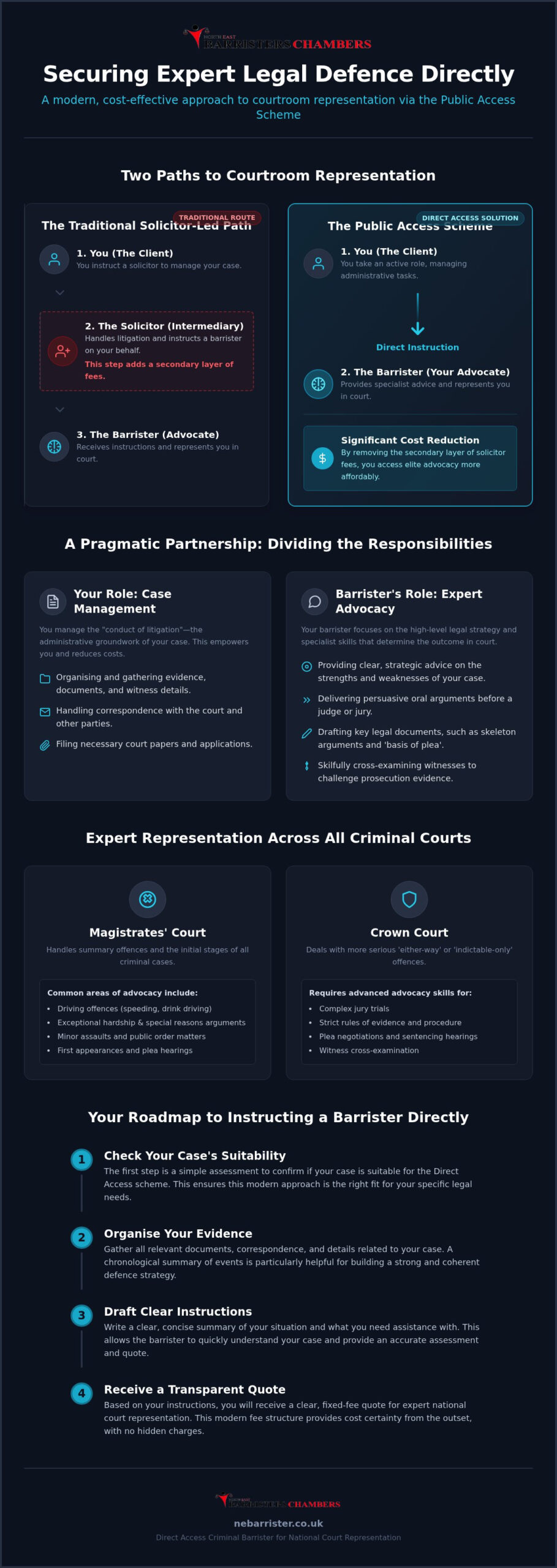
The scheme was designed to increase transparency and choice. It allows you to take an active role in your own case management. Whilst a solicitor usually handles the “conduct of litigation”—the administrative tasks like filing court papers or managing correspondence—the Public Access rules allow you to perform those tasks yourself. I then step in to provide the specialist advice and courtroom representation that defines the outcome of a case. It’s a pragmatic partnership where you manage the paperwork, and I manage the law.
The Barrister’s Core Competencies in Criminal Defence
Criminal law is uniquely suited to this model because it relies heavily on oral advocacy and the strategic analysis of evidence. I focus on the high-level tasks that require years of courtroom experience. These include:
- Strategic Advice: Providing a clear-eyed assessment of the prosecution’s case and identifying its weakest points early on.
- Expert Advocacy: Using persuasive oral arguments to represent your interests before a judge or jury.
- Cross-Examination: The skill of questioning witnesses to reveal inconsistencies in their testimony.
- Legal Drafting: Creating “skeleton arguments” and formal documents that frame the legal issues for the court.
I act as a straightforward solution-provider. I don’t hide behind legalese or archaic traditions. Instead, I offer a direct connection to the person who will actually be standing up for you in court. This transparency helps lower your anxiety and provides a manageable way to navigate the criminal justice system.
Criminal Court Representation: From Magistrates’ to Crown Court
Every criminal case begins in the Magistrates’ Court. For many, this is where the matter also concludes. However, the level of advocacy required changes significantly depending on the severity of the charge and the court level. Securing early advice from a direct access criminal barrister is often the most effective way to influence the direction of an investigation. I provide a consistent, authoritative voice from the first hearing through to the final verdict, ensuring your side of the story is told clearly and professionally.
Defending Charges in the Magistrates’ Court
The Magistrates’ Court handles summary offences, including minor assaults, public order matters, and most driving offences. Whilst these might seem less serious than Crown Court cases, the impact on your life can be profound. If you’re facing a driving ban, I specialise in presenting “exceptional hardship” or “special reasons” arguments to the Bench. These are technical legal submissions where precise advocacy is essential to protect your licence and your livelihood. For a deeper look at these procedures, you can read my guide to Criminal law court representation.
Advocacy and Representation in the Crown Court
More serious “either-way” or “indictable” offences are heard in the Crown Court. This environment is more formal and involves a jury trial, requiring a different tactical approach. The rules of evidence are strict; I manage the complexities of witness cross-examination and the drafting of “basis of plea” documents. If a trial isn’t the right path, I focus on plea negotiations to ensure the court hears the most favourable version of the facts. When a custodial sentence is a possibility, expert representation is non-negotiable to ensure every mitigating factor is presented to the judge.
Preparing for a trial is a search for inconsistencies in the prosecution’s case. Preparing for a sentencing hearing is different. It’s about humanising the defendant and providing the court with a pragmatic reason for leniency. Whether you need a robust trial defence or a persuasive mitigation speech, I provide the clarity you need to move forward. If you’re unsure which court your case will be heard in, I can help you understand the process during an initial consultation. I work nationally to ensure that high-quality advocacy is available regardless of where your hearing takes place.
Direct Instruction vs. The Traditional Solicitor Route
Choosing between the traditional route and direct instruction is about deciding how much control you want over your case. In the traditional model, you pay for both a solicitor and a barrister. This creates a buffer between you and your advocate. By hiring a direct access criminal barrister, you remove that buffer. You work directly with the person who will actually argue your case in court. This one-to-one relationship builds trust and ensures no detail is lost in translation during the preparation of your defence.
How Direct Access Helps You Reduce Legal Costs
The most immediate benefit is financial. Solicitors often charge high hourly rates for administrative tasks like filing letters or making phone calls. When you manage these yourself, you stop paying for that secondary layer of overheads. I often work on a fixed-fee basis for specific stages, such as providing initial advice or representing you at a hearing. This transparency allows you to reduce UK legal costs while maintaining access to high-level advocacy. You only pay for the expert legal work you actually need.
I’m often asked if a barrister can handle every aspect of a case. Whilst I provide the strategy and advocacy, I cannot legally “conduct litigation”. This means you act as a “litigant in person” for administrative duties. For most driving offences or straightforward criminal charges, this is perfectly manageable. However, if your case involves massive amounts of evidence, such as complex multi-defendant fraud, a solicitor’s administrative team might be essential. I’ll always be honest if I believe your case requires that extra support.
Managing the Case: Your Responsibilities as a Direct Client
Taking the direct route means you are responsible for the legwork. You’ll need to organise your evidence and handle correspondence with the court and the prosecution. I act as your strategic consultant and courtroom advocate. This arrangement works best if you’re comfortable with paperwork and clear communication. It’s a pragmatic trade-off. You provide the administrative effort; in return, you get direct access to a specialist who is entirely focused on your defence. This model empowers you to take ownership of your legal journey while securing the best possible representation in court.
Preparing Your Defence: A Practical Guide for Direct Clients
Instructing a direct access criminal barrister turns you into an active participant in your own defence. Since I don’t have a solicitor’s clerk managing your documents, the way you present your case to me is vital. Start by writing a clear, chronological “instruction” letter. This should be a factual timeline of events, from the moment of the alleged incident to your police interview and subsequent charges. Avoid emotional language; focus on what happened, who was there, and what was said. This document acts as my map through the evidence and ensures I understand your perspective before we even meet.
Organising Your Evidence and Documentation
You must create a master file containing every piece of evidence provided by the prosecution. This includes witness statements, forensic reports, and any digital evidence like CCTV or body-worn camera footage. Alongside this, gather your own “mitigating evidence” such as character references or proof of employment. Clear organisation of files can significantly reduce the time a barrister spends on review. When your documents are index-linked and easy to navigate, I can focus my energy on finding the legal loopholes that will benefit your case.
The Initial Consultation: Making the Most of Your Time
Our first meeting is where we define the strategy. To make this efficient, come prepared with specific questions about potential outcomes and court procedures. I need you to be completely honest about the facts, even the ones that feel damaging. My advice is only as good as the information I’m given. We will decide together whether we are aiming for a full acquittal or focusing on a persuasive mitigation to reduce a potential sentence. Setting these goals early ensures our efforts are aligned from the start.
Court deadlines are immovable. If the court requires a witness list or a defence statement by a certain date, prompt communication is essential to avoid being penalised. On the day of the hearing, expect a structured environment. Arrive early, dress professionally, and let me handle the talking once we enter the courtroom. If you’re ready to start building your case, you can book a consultation to discuss your defence strategy today. I travel nationally to represent clients, ensuring that expert advocacy is never out of reach.
Instructing a Barrister Directly: The Next Steps
Moving from understanding the theory to taking action is the final step in securing your defence. I aim to make the engagement process as transparent as the advocacy I provide in court. When you contact me, the first thing we do is determine if your situation fits the Public Access model. This isn’t just about my availability; it’s about ensuring you have the right level of support for your specific legal needs. I act as a straightforward solution-provider, removing the friction often associated with traditional legal instructions.
Suitability Assessment for Criminal Matters
Not every case is suitable for direct instruction. If a defendant is particularly vulnerable or if the case requires the extensive investigative resources of a firm, I have a professional duty to tell you. In such instances, a solicitor’s involvement is vital for your protection. However, for many individuals and businesses, the direct route is the most efficient way to manage a case. You can find more detail on these criteria in my Direct access barrister guide. If we proceed, I’ll guide you through the logistics to ensure there’s no friction in our partnership.
Securing Expert Advocacy Today
The process of hiring a direct access criminal barrister is designed to be business-like and efficient. Once we’ve discussed your case, I will provide a clear, written quote. If you’re happy to move forward, I will issue a “Client Care Letter”. This document is our contract; it outlines exactly what work I will do, the fees involved, and the timelines we’ll work to. It provides the legal certainty you need to feel confident in your representation from the outset. I don’t believe in hidden costs or vague estimates.
At North East Barristers Chambers, I take pride in being a mobile and modern practitioner. I travel nationally to meet the needs of my clients, bringing expert advocacy to whichever court your case is heard in. I’m not a faceless corporate entity. I’m a dedicated specialist who understands that behind every case file is a person looking for clarity and relief. If you’re ready to secure a robust and cost-effective defence, you can instruct a direct access criminal barrister today. Let’s work together to ensure your voice is heard where it matters most.
Secure Your Courtroom Advocacy Today
You now have the tools to navigate the criminal justice system with greater confidence and lower costs. By choosing a direct access criminal barrister, you take control of your legal journey and ensure your defence is built on a foundation of elite advocacy. We’ve explored how the Public Access scheme works, the importance of meticulous evidence organisation, and the strategic advantages of working directly with the person who will represent you in court. This model is a pragmatic choice for anyone looking for expert court representation without the traditional overheads of a solicitor firm.
I provide a national UK-wide service, bringing professional authority and straightforward solutions to clients across the country. My focus is on delivering direct instruction for cost-effective advocacy that doesn’t compromise on quality. If you’re ready to move forward, you can contact our specialist direct access barristers for expert criminal defence to discuss your next steps. Legal proceedings are challenging, but you don’t have to face them alone. With the right preparation and a specialist advocate by your side, you can approach your hearing with clarity and relief.
Frequently Asked Questions
Can I hire a criminal barrister directly for any type of offence?
You can hire a direct access criminal barrister for a wide range of offences, from minor driving matters to serious Crown Court trials. However, the Bar Standards Board requires me to assess each case for suitability. If a defendant is particularly vulnerable or if the case involves exceptionally high volumes of administrative work, I’ll advise you that a solicitor is necessary for your protection. Most straightforward criminal matters are perfectly suited for this direct route.
Is it cheaper to hire a barrister directly than to use a solicitor?
Instructing a direct access criminal barrister is typically more cost-effective because it eliminates the secondary layer of solicitor fees. You don’t pay for the administrative overhead of a large firm. Instead, you manage the paperwork yourself and pay only for the expert advocacy and advice you require. This model offers transparent, often fixed-fee pricing for specific stages of your case, making your legal costs far more manageable and predictable from the outset.
Will I have to speak for myself in court if I use a direct access barrister?
No, I will represent you and speak on your behalf during every court hearing. My role is to present your case, cross-examine witnesses, and make legal arguments to the judge or jury. Whilst you handle the administrative tasks like filing papers, you won’t be left to navigate the courtroom alone. You receive the same high-level advocacy as you would if a solicitor had instructed me on your behalf through traditional channels.
What happens if my criminal case is too complex for direct access?
If a case becomes too complex or involves extensive administrative demands, I have a professional duty to inform you. In these instances, you may need to instruct a solicitor to manage the litigation side of the case. I can still act as your advocate, but the solicitor would handle the day-to-day communication with the court and prosecution. This ensures you always have the appropriate level of support for your specific legal situation and protection.
Can a direct access barrister help me with an appeal against a conviction?
Yes, I can provide specialist advice on the merits of an appeal and represent you in the higher courts. This process involves a detailed review of the original trial transcripts and the identification of legal errors or fresh evidence. I’ll draft the necessary grounds of appeal and present the oral arguments to the judges. Securing an expert opinion early on is vital to determine if there are realistic prospects of success for your case.
Do I need to be eligible for legal aid to use a public access barrister?
No, the Public Access scheme is entirely separate from the legal aid system. North East Barristers Chambers does not provide legal aid services; we work on a private, self-funded basis. If you believe you’re eligible for state-funded legal assistance, you must contact a solicitor who is registered to provide it. Direct access is designed for those who wish to fund their own defence whilst reducing overall costs through a more direct professional relationship.
What documents do I need to provide when instructing a barrister directly?
You must provide the complete prosecution evidence pack, including witness statements, forensic reports, and any digital evidence like CCTV footage. I also require a clear, chronological timeline of events written in your own words. Providing these documents in an organised, index-linked format allows me to review your case efficiently. Additionally, I need standard identification documents to satisfy Bar Standards Board regulations before I can formally accept your instructions and begin the work.
Can a barrister represent me at the police station under the direct access scheme?
No, I cannot represent you at the police station under the direct access scheme. This stage of the criminal process usually requires 24/7 availability and falls under the category of emergency legal advice, which I don’t provide. If you’re facing a police interview, you should seek a duty solicitor or a private solicitor firm. My role begins once the initial investigation has concluded or when court proceedings have been formally initiated against you.
