
What if the choice between a five-figure solicitor’s bill and facing a barrister alone in court was actually a false one? If you’re currently staring down a legal dispute, you’ve likely felt the weight of that dilemma. I know how stressful it is to consider the alternatives to representing yourself in court when every quote you receive from a traditional law firm feels out of reach. You want professional results, but you don’t want to be bankrupted before you even step into the witness box.
I understand the fear of being outmanoeuvred by the other side’s legal team or getting lost in the dense thicket of the Civil Procedure Rules. It’s a common struggle; in fact, nearly half of all private law cases in early 2026 involved someone representing themselves. However, you don’t have to be just another statistic. In this guide, I’ll show you how to secure expert legal advocacy without the high overheads of a solicitor by using the Direct Access scheme. We’ll look at how you can bypass the middleman to get straight to the specialist advice you need, ensuring you stay in control of your case while gaining the professional edge required to win or settle favourably.
Key Takeaways
- Understand the evolving challenges of being a Litigant in Person and explore the most effective professional alternatives to representing yourself in court.
- Learn the critical differences between unregulated McKenzie Friends and qualified barristers, specifically regarding their rights to speak on your behalf.
- Discover how the Direct Access scheme provides a direct route to expert advocacy whilst removing the expensive overheads associated with traditional solicitor firms.
- Compare the fee structures of different representation models to find a transparent, cost-effective solution that fits your specific budget.
- Identify the key signs that it is time to hand over your case to a professional to ensure you achieve the best possible outcome for your hearing.
The Landscape of Legal Representation: Moving Beyond Self-Representation
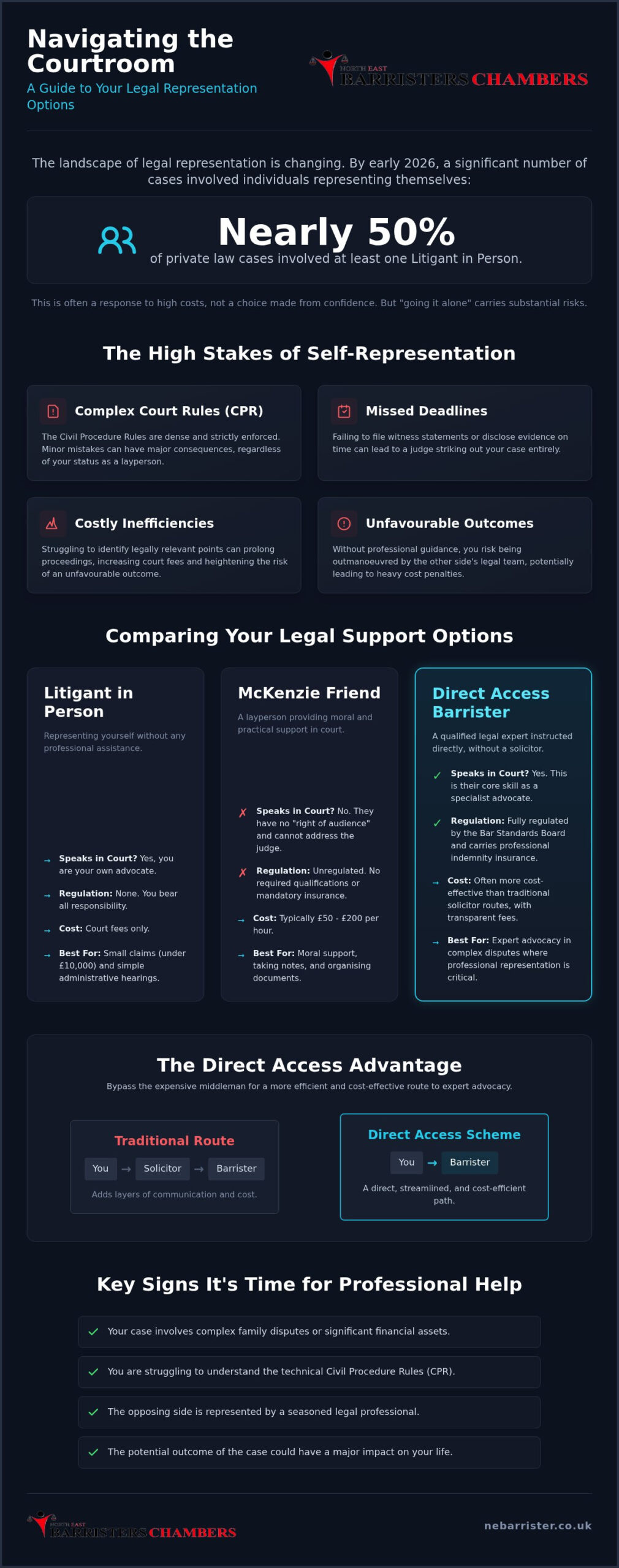
I’ve seen the shift in the UK court system firsthand. The number of people acting as a Litigant in Person (LiP) has surged in recent years. By 2026, nearly half of all private law cases involved at least one party without professional representation. This isn’t usually a choice made out of confidence; it’s a response to the steep costs of traditional solicitor firms. Whilst the right to represent yourself is a cornerstone of our justice system, many individuals are now looking for better alternatives to representing yourself in court as they realise the sheer complexity of the process.
The hierarchy of legal support in the UK has evolved. It’s no longer a binary choice between an expensive solicitor and going it alone. Finding viable alternatives to representing yourself in court is often about finding the right level of expertise for your specific needs. The emotional and financial toll of self-representation is high. You aren’t just managing paperwork; you’re managing the stress of potential failure and the risk of being outmanoeuvred by a seasoned professional on the other side. My goal is to show you that professional advocacy is more accessible than you might think.
The Risks of Going It Alone
The Civil Procedure Rules (CPR) act as the rulebook for our courts. They’re dense, technical, and strictly enforced. If you miss a deadline for filing a witness statement or fail to disclose evidence correctly, the consequences are severe. A judge can strike out your case or impose heavy cost penalties regardless of your status as a layperson. I often see self-represented parties inadvertently prolonging their own proceedings because they struggle to identify which points are legally relevant. This inefficiency doesn’t just waste time; it increases your court fees and heightens the risk of an unfavourable outcome.
When is Self-Representation Appropriate?
I’m always honest with my clients about when they genuinely don’t need a barrister. For small claims court matters where the value is under £10,000, representing yourself is often the most pragmatic choice. These hearings are designed to be informal, and judges frequently use plain English to guide you. It’s also appropriate for straightforward administrative hearings or cases where the primary goal is simple mediation. However, once a case involves complex family disputes or significant financial assets, the “DIY” approach becomes a high-stakes gamble that few can afford to lose.
Non-Professional Alternatives: McKenzie Friends and Support Groups
If you’re searching for alternatives to representing yourself in court, you’ll likely come across the term “McKenzie Friend”. This is a layperson who attends court to provide moral and practical support. They aren’t there to replace a legal professional, but they can make the experience of being a Litigant in Person feel less isolating. Whilst some McKenzie Friends are helpful friends or family members, a growing number are paid “professionals” who charge between £50 and £200 per hour. I’ve seen many people turn to these helpers as a middle ground, but it’s vital to understand exactly what they can and cannot do for you.
The most significant risk with paid McKenzie Friends is that the profession is entirely unregulated. Unlike a barrister, they don’t require specific qualifications, they aren’t overseen by the Bar Standards Board, and they don’t carry mandatory professional indemnity insurance. If they provide incorrect legal advice that causes you to lose your case, you have very little recourse. This lack of protection is why many litigants eventually decide to consult a qualified advocate who can offer guaranteed expertise and accountability.
The Role of a McKenzie Friend
A McKenzie Friend’s primary job is to provide moral support and help you stay organised. They can take notes during the hearing, quietly prompt you on points of law, and keep your bundles of evidence in order. However, they have no “right of audience”. This means they cannot address the judge, make legal submissions, or cross-examine witnesses. I’ve witnessed many litigants become distressed when the judge reminds their helper that they must remain silent. If your case requires someone to actually speak and argue on your behalf, a McKenzie Friend is not the right solution.
Support Through Court and Pro Bono Options
For those who only need help with the physical and administrative side of a hearing, “Support Through Court” is an invaluable charity. Their volunteers can’t give legal advice, but they can help you find the right courtroom, explain the paperwork, and provide a calming presence. You might also look into university legal clinics. These often provide initial case reviews by law students under the supervision of qualified staff. Whilst these are excellent alternatives to representing yourself in court for basic guidance, they don’t provide the high-level advocacy found through the Direct Access Scheme, which allows you to hire a barrister directly for the most critical parts of your case.
Direct Access Barristers: The Professional Middle Ground
Many people believe that legal representation is an “all or nothing” choice. You either pay a solicitor for full case management or you search for basic support for representing yourself in court. This binary view overlooks the Direct Access scheme. It’s one of the most effective alternatives to representing yourself in court because it provides elite advocacy without the solicitor’s overheads. By removing the traditional middleman, you communicate directly with the specialist who will actually argue your case. It’s a transparent, modern way to access the Bar.
This model offers a significant tactical advantage that laypeople often overlook. When you hire a barrister directly, you’re getting an expert to draft your position statements and skeleton arguments. These documents often determine the judge’s first impression before you even step into the courtroom. A well-drafted document can settle a case before it reaches a hearing. It’s a pragmatic way to secure professional results whilst staying in the driving seat of your own litigation. You get the expertise where it matters most.
How Direct Access Works
The process of instructing a barrister directly is straightforward and efficient. You provide the case papers, and I provide the legal expertise. I can offer written advice, draft your court documents, and represent you at hearings. It’s vital to understand the limits, though. Barristers cannot hold client money or manage the day-to-day administrative “conduct of litigation”, such as serving papers on the other side or corresponding with the court on your behalf. You remain the point of contact for the court, which keeps your costs significantly lower than a traditional firm.
Direct Access in Different Areas of Law
I apply this model across several complex fields to help clients achieve clarity and relief. In family law, I help parents navigate child arrangement orders and financial remedy disputes. For civil litigation, I handle everything from contract disputes to professional negligence claims. In criminal law, Direct Access allows for a robust defence in both the Magistrates and Crown Court. This breadth of expertise ensures that no matter the dispute, you have a specialist by your side. It’s a modern, agile way to approach the legal system in 2026.
Cost Analysis: Comparing Your Alternatives
I often find that people choose to represent themselves solely to save money. However, self-representation carries hidden financial risks that many don’t consider until it’s too late. Lost earnings from taking weeks off work to research law and the potential for expensive procedural errors can quickly mount up. When you’re looking at alternatives to representing yourself in court, you must weigh the upfront professional fee against the long-term risk of a “cost order”. If you lose a case due to a technical mistake, a judge might order you to pay the other side’s legal bills, which can be devastating.
My approach is built on providing a transparent, pragmatic middle ground. I believe that professional advocacy should be a tool for financial protection rather than a drain on your resources. By focusing on the specific stages where you need a specialist, we can keep the budget manageable whilst ensuring your case is handled with the necessary authority.
Solicitor Fees vs. Direct Access
Traditional law firms carry high overheads. You aren’t just paying for legal advice; you’re paying for their city-centre office space, large support teams, and administrative systems. One of the most frustrating aspects for clients is the “double-billing” trap. This happens when you pay a solicitor to prepare the case and then pay them again to instruct and brief a barrister. By choosing to work with me, you can reduce UK legal costs significantly because that middle layer is removed. My billing is direct and functional. I often use fixed fees for specific tasks, such as drafting a position statement or attending a hearing, so you have complete budget certainty from the start.
The Value of Expert Advocacy
The Return on Investment (ROI) for professional advocacy is clearest in high-stakes cases. A barrister is often cheaper than a solicitor over the life of a case because we focus specifically on the points that win hearings. I don’t spend hours on administrative tasks that you can handle yourself. Instead, I focus on the tactical decisions that prevent proceedings from dragging on for months. This efficiency saves you money on court fees and prevents the other side from seeking costs against you for unreasonable behaviour or delays. If you’re concerned about the financial impact of your case, I can provide a clear breakdown of how my services fit your budget. You don’t have to face the court alone to save money. Feel free to get in touch for a transparent quote on your representation.
Making the Transition: From Self-Representation to Professional Help
I often meet clients who have reached a “tipping point” in their legal journey. You might have managed the early paperwork yourself, but now you face a complex final hearing or a trial that feels overwhelming. Knowing when to stop and hire an expert is a tactical decision, not a sign of failure. It’s never too late to explore alternatives to representing yourself in court, even if your case has been active for months. The transition is about shifting the burden of advocacy to someone who understands the courtroom environment intimately, allowing you to focus on the facts of your case without the stress of procedural errors.
My goal is to make this handover as seamless as possible. I’ve found that a structured approach to the transition provides immediate clarity and relief. You don’t need to be intimidated by the process of bringing a professional on board mid-case; it’s a routine part of my practice that often changes the dynamic of the litigation in your favour.
The Handover Process
Organising your files is the first step to an efficient handover. I need to see all your correspondence and court orders arranged chronologically. This allows me to understand the timeline without wasting billable time searching for documents. You should also write a straightforward “instruction” letter. You don’t need to use legal jargon; just explain what has happened so far and what you hope to achieve. Once you’ve instructed me, we’ll notify the court and the other side of your new representation. This simple administrative step signals that you now have professional backing, which often encourages the other side to take a more pragmatic approach to settlement.
Working Effectively with Your Barrister
Transparency is essential for a successful partnership. I need to know about every step you’ve taken during your period of self-representation, including any mistakes or missed deadlines. My job is to fix these issues, not to judge them. To keep your costs manageable, we can utilise “unbundled” services. This means you continue to handle the basic administration whilst I focus on the high-level advice and advocacy. When preparing for our first consultation, bring your core bundle of evidence and a list of specific questions. This ensures we use our time together productively and focus on the results that matter to you.
If your case involves a police investigation or a court summons, the stakes are significantly higher. Securing a criminal law court representation specialist early on can prevent a minor issue from escalating into a life-changing conviction. Whether you’re dealing with family, civil, or criminal matters, finding the right alternatives to representing yourself in court is the most reliable way to protect your interests and secure a favourable outcome.
Securing Your Legal Future with Expert Advocacy
We’ve explored how the Direct Access scheme provides a professional middle ground, allowing you to bypass the traditional solicitor model whilst securing elite courtroom skills. You now understand that whilst non-professional helpers have their place, they cannot provide the regulated expertise or the right of audience that a barrister offers. By choosing direct instruction, you maintain control of your case and your budget, ensuring that your resources are focused on the tactical advocacy that wins hearings.
Finding viable alternatives to representing yourself in court is about balancing professional support with financial pragmatism. I provide specialist court representation nationally across the UK, covering criminal, civil, and family law. My practice is built on transparent fee structures that offer individuals and businesses the clarity and relief they need when facing the legal system. You don’t have to navigate the complexities of the courtroom alone or settle for unregulated advice.
Contact North East Barristers Chambers for a Direct Access consultation to discuss how I can lead your case to a favourable outcome. Professional help is more accessible than you think, and I’m ready to help you take the next step with confidence.
Frequently Asked Questions
Can I hire a barrister directly for any type of court case?
Yes, you can hire a barrister directly for most criminal, civil, and family law matters. The Direct Access scheme allows you to bypass a solicitor for many types of hearings. However, barristers cannot “conduct litigation”, which means you remain responsible for administrative tasks like serving papers. If a case is exceptionally complex or involves vulnerable individuals, I might advise that a solicitor is necessary to manage the day-to-day proceedings effectively.
Is a McKenzie Friend better than a barrister for family court?
A barrister is almost always the superior choice for family court because they possess a “right of audience”. Whilst a McKenzie Friend can provide moral support and take notes, they cannot speak to the judge or cross-examine witnesses. Barristers are also highly regulated and insured professionals. Choosing a qualified advocate provides a level of protection and expertise that an unregulated layperson simply cannot match when your parental or financial rights are at stake.
How much can I save by using a Direct Access barrister instead of a solicitor?
You save money by bypassing the solicitor’s administrative fees and office overheads. Direct instruction is one of the best alternatives to representing yourself in court when you want to avoid paying for two sets of lawyers to talk to each other. By hiring a barrister directly, you’re paying for high-level expertise rather than general case management. This model is ideal for those who can handle their own correspondence but need an expert for courtroom advocacy.
What happens if I start a case myself and then realise I need a lawyer?
You can bring a barrister on board at any stage of the litigation. Many clients begin as litigants in person but decide to seek professional help as the final hearing approaches. The process involves sending me your existing court bundle and a chronological summary of the case. I then take over the advocacy, which provides immediate relief and ensures that your arguments are presented to the judge in the most effective and legally sound manner possible.
Do I have to pay for a barrister upfront?
Yes, barristers generally require payment before they begin work on a specific task. This is a regulatory requirement because barristers don’t have the administrative systems to hold client money in escrow like solicitors do. We usually agree on a fixed fee for a consultation, document drafting, or a court hearing. This provides you with complete budget certainty, as you’ll know exactly what the cost is before any work is carried out on your behalf.
Can a barrister help me if the other side has a solicitor?
Yes, having a barrister is a powerful way to level the playing field if the other side has legal representation. A barrister is a specialist in courtroom strategy and the rules of evidence. I ensure that you aren’t intimidated or outmanoeuvred by the other side’s solicitor. Having an expert advocate to present your arguments clearly and forcefully to the judge is often the difference between a successful outcome and a costly failure.
What is the difference between a Litigant in Person and a McKenzie Friend?
A Litigant in Person is the person who is actually a party to the case and represents themselves. A McKenzie Friend is a layperson who assists that litigant by taking notes, organising papers, and offering quiet advice. The critical difference is that neither has the professional qualifications or the automatic right to address the court. Only a barrister or solicitor advocate can speak on your behalf and cross-examine witnesses during a formal hearing.
Is it possible to get a barrister for just one specific hearing?
Yes, hiring a barrister for a single hearing is one of the most effective alternatives to representing yourself in court for every stage. This “unbundled” approach allows you to manage the early paperwork yourself whilst securing professional advocacy for the most critical moments. You can instruct me for a specific trial, a financial dispute resolution, or a child arrangement hearing. This ensures you have elite representation exactly when the stakes are at their highest.
