
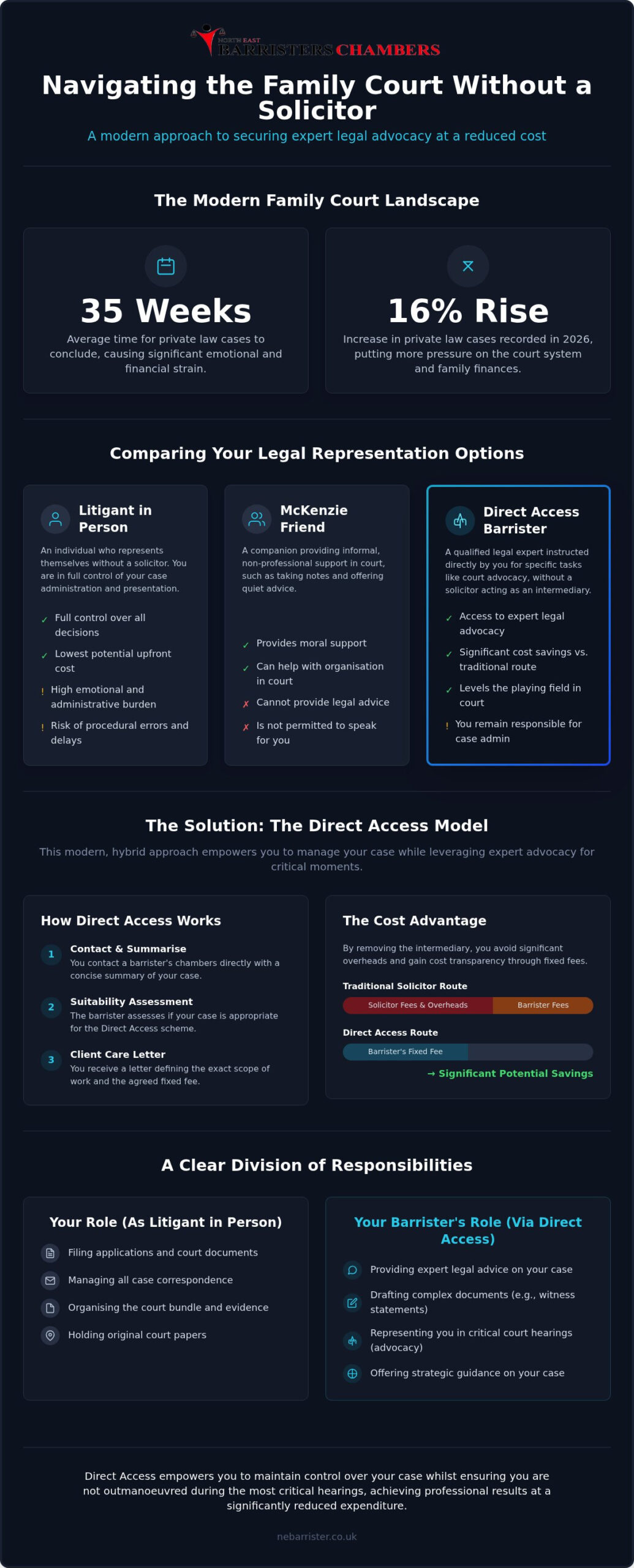
What if you could secure the highest level of courtroom expertise without the traditional, and often eye-watering, costs of a high-street solicitor? With private law cases now taking an average of 35 weeks to conclude and a 16% rise in cases recorded in 2026, the pressure on your finances and your well-being has never been higher. It’s completely natural to feel overwhelmed by the prospect of entering a family court without a solicitor, especially when you fear being outmanoeuvred by the other side’s legal team or buried under complex paperwork.
I understand that you want a fair outcome for your children and your finances without draining the very assets you’re trying to protect. This guide will show you how to navigate these proceedings effectively by instructing a barrister directly through the Direct Access scheme. You’ll discover how to manage your own case administration whilst securing expert advocacy for those critical moments in front of a judge. We’ll explore the practical steps of self-representation and how this modern approach provides the professional results you need at a significantly reduced expenditure.
Key Takeaways
- Understand your legal right to act as a Litigant in Person and how to maintain full control over your case proceedings.
- Discover how navigating the family court without solicitor involvement allows you to significantly reduce legal costs by instructing a barrister directly.
- Learn the vital distinction between the informal support of a McKenzie Friend and the expert legal advocacy provided by a qualified barrister.
- Master the practicalities of courtroom etiquette and the essential steps for organising a professional court bundle to support your case.
- Identify how to balance handling your own case administration with the strategic advantage of professional representation during critical hearings.
Navigating Family Court Without a Solicitor: The Reality of Self-Representation
I see more people than ever choosing to enter the family court without solicitor representation. This is often a pragmatic decision. With a 16% rise in private law cases recorded in 2026, the court system is under significant strain. High legal fees can quickly drain family assets that are better spent on your children’s future. By taking control of your own case, you ensure that every decision aligns with your personal priorities, but you must be prepared for the reality of the process.
What is a Litigant in Person?
A Litigant in Person is an individual who conducts their own legal proceedings without a solicitor or barrister. Under UK law, you have an absolute right to represent yourself. This means you’ll be responsible for filing applications, serving papers on the other side, and speaking in front of a judge. While the judge has a duty to ensure a fair hearing and may explain court processes to you, they cannot act as your legal advisor. They must remain neutral, which means you’re responsible for the legal arguments you present.
The Risks of Going It Alone
Representing yourself in family matters is emotionally taxing. I’ve seen how difficult it is to stay objective when discussing your children or your home. This emotional weight often makes it harder to spot the nuances in the other side’s arguments. There are also strict procedural hurdles to consider. With private law cases now taking an average of 35 weeks to conclude, a single missed deadline or a failure to follow the Civil Procedure Rules can cause significant delays to your case.
Beyond the paperwork, a lack of legal knowledge carries financial risks. You might inadvertently agree to an unfavourable settlement because you aren’t aware of the long-term legal implications. This is why many people now use a hybrid approach. They handle the day-to-day admin themselves but bring in professional advocacy for the courtroom. It levels the playing field, ensuring that even if you’re appearing in a family court without solicitor support for the whole journey, you aren’t outmatched during the most critical hearings.
The Direct Access Model: How to Instruct a Barrister Directly
I believe that the decision to enter a family court without solicitor representation shouldn’t mean you’re left without any professional guidance. The Public Access Scheme, commonly known as Direct Access, is a modern solution that bridges the gap between hiring a full-service law firm and going entirely alone. It allows you to bypass the traditional solicitor-led model, placing you in direct contact with the specialist who will actually argue your case before a judge.
When you represent yourself in court, you take on the administrative tasks that a solicitor would usually handle. This includes filing applications, managing correspondence, and organising your own evidence. In return, you only pay for the specific expertise you need from a barrister. A barrister can provide formal legal advice, draft complex court documents, and offer expert advocacy during hearings. They cannot, however, manage your financial funds or hold original court papers; those responsibilities remain with you as the litigant in person.
How Direct Access Works in 2026
The process is straightforward. You start by contacting a chambers and providing a concise summary of your family law matter. I then assess whether your case is suitable for the Direct Access route. Most family law cases are appropriate, provided you feel comfortable handling the basic administration. Once we agree to move forward, you’ll receive a ‘client care letter’. This document is vital as it defines the exact scope of work I’ll perform, ensuring there are no surprises regarding what’s included in your fee.
The Cost Advantage: Reducing Legal Fees
The financial benefits of this model are often the primary driver for my clients. Traditional law firms often charge high hourly rates to cover their significant overheads. In contrast, many barristers offer a fixed-fee structure for specific pieces of work, such as drafting a witness statement or representing you at a single hearing. This provides much-needed transparency and allows you to budget effectively for each stage of your case.
By cutting out the middleman, you can often secure the same level of courtroom expertise for a fraction of the total cost of a solicitor-and-barrister team. If you’re looking for more detail on how to manage your budget, I recommend reading this Reduce UK Legal Costs: Direct Access Guide 2026. This approach ensures your family’s assets stay where they belong whilst still securing court representation from a specialist advocate.
Comparing Your Options: Litigant in Person vs McKenzie Friend vs Barrister
Choosing how to present your case in a family court without solicitor representation is a critical strategic decision. You generally have three options: acting entirely as a Litigant in Person, bringing a McKenzie Friend for support, or instructing a barrister directly. Each route carries different rights of audience and levels of legal protection. While you might find A Guide to Representing Yourself in Family Court helpful for understanding the basics of self-representation, the quality of your courtroom advocacy often dictates the final court order.
The Limits of a McKenzie Friend
A McKenzie Friend is typically a layperson who sits with you in court to provide moral support, take notes, and help you organise your papers. It’s vital to understand that they do not have a right of audience. This means they cannot address the judge, examine witnesses, or make legal arguments on your behalf. I’ve seen many individuals rely on unregulated ‘professional’ McKenzie friends who charge fees but lack professional indemnity insurance or a formal complaints body. Without these safeguards, you have little recourse if the advice they provide is inaccurate or damaging to your case.
Why a Barrister is the Courtroom Specialist
Barristers are specialised advocates. Our entire training is focused on the art of persuasion and the technical application of the law. In 2026, staying updated on complex precedents, such as the Family Procedure (Amendment) Rules 2026, is a full-time job. A barrister provides a robust legal shield, handling the intense pressure of cross-examination whilst remaining emotionally detached from the conflict. This objectivity is essential in child arrangement cases, where personal emotions can often cloud your judgment or lead to confrontational behaviour that doesn’t assist your case in the eyes of a judge.
I often hear the concern that barristers are only for the wealthy. This is a persistent myth. By using Direct Access, you can hire a specialist for a single, fixed-fee hearing rather than paying for a solicitor’s ongoing hourly rates. This targeted approach ensures you have professional representation during the most pivotal moments of your case. It allows you to manage your own case administration whilst ensuring that when you stand before a judge, your arguments are presented with the authority and clarity that only a qualified advocate can provide. This hybrid model is often the most cost-effective way to secure a fair outcome for your family.
Essential Preparation for Your Family Court Hearing
I’ve found that the most effective way to manage a family court without solicitor involvement is to treat the hearing like a business meeting. This mindset helps you stay objective during a deeply personal process. Preparation is the foundation of a successful hearing. When you represent yourself, the responsibility for your paperwork falls squarely on your shoulders. You must arrive with a clear head and a well-organised set of documents. I recommend preparing a ‘Court Bundle’ which contains all previous orders, applications, and witness statements. Having these indexed and paginated ensures you can find specific information quickly when the judge asks a question.
Drafting Your Position Statement
Your Position Statement is perhaps the most important document for a short hearing. It’s a brief summary, usually no more than two pages, that tells the judge exactly what you want and why. I advise my clients to keep this factual and focused entirely on the child’s best interests. It’s not a place for personal grievances. You should use the ‘welfare checklist’ as your guide. Even if I’m not representing you in the hearing itself, I can help you draft this document to ensure your arguments are legally sound and persuasive. A well-drafted statement can often do the heavy lifting before you even open your mouth.
Courtroom Etiquette and Behaviour
The way you conduct yourself in the courtroom influences how the judge perceives your case. It’s essential to use the correct forms of address to show respect for the court’s authority. You should refer to a Circuit Judge as ‘Your Honour’, whilst a District Judge or Magistrate is addressed as ‘Sir’ or ‘Madam’. Punctuality isn’t optional. I suggest arriving at least 30 minutes early to find your courtroom and settle your nerves. Remember to bring at least three copies of any document you intend to rely on. One is for you, one for the judge, and one for the other party.
Managing your behaviour whilst the other party speaks is often the hardest part of self-representation. You’ll likely hear things you disagree with or feel are completely untrue. You must remain calm and silent. The judge will give you a specific turn to respond. If the emotional weight of the hearing feels too heavy, having a professional advocate by your side can drastically reduce the ‘fear factor’. It allows you to focus on the facts whilst I handle the high-pressure interactions. If you’re feeling overwhelmed by the upcoming proceedings, you can book court representation to ensure your case is presented with professional authority.
Securing Expert Advocacy: Why Direct Access is the Smart Choice
I view the relationship between a Direct Access barrister and a client as a strategic partnership. When you choose to navigate the family court without solicitor representation, you aren’t just looking for a mouthpiece. You’re looking for a specialist who can provide clarity amidst the noise of litigation. This model puts you in control, giving you the autonomy to manage your own affairs whilst having a seasoned advocate in your corner for the most challenging moments. It’s a modern, pragmatic way to handle family disputes that prioritises your family’s future over legal bureaucracy.
Entering a family court without solicitor support is a bold and often necessary step for many families. It requires a balance of self-reliance and professional insight. Direct Access provides exactly that. It’s the smart choice because it focuses resources where they matter most: on the expert advocacy that happens inside the courtroom. You’re no longer just a name on a file in a large firm; you’re a partner in your own legal strategy.
Tailored Legal Support
The Bar has evolved significantly by 2026. We now offer highly flexible, ‘unbundled’ services that adapt to your specific needs. You might feel confident handling the initial child arrangement applications but require expert assistance in complex Financial Remedy cases. Whether you need a one-off advice session or representation at a final hearing, this model allows you to pick and choose the support that fits your budget. It’s a pragmatic way to ensure your case has the technical precision it deserves without paying for overheads you don’t use.
Taking the Next Step
If you’re ready to start, I suggest preparing a simple case summary. This should include a basic timeline and your desired outcomes. Early advice is vital. It helps you avoid the procedural traps that often catch out those who try to handle everything themselves. Many clients wait until they’re overwhelmed before they decide to instruct a barrister directly, but seeking help early can prevent small issues from becoming major setbacks. I can review your summary and provide a clear roadmap for the hearings ahead.
You don’t have to face this process alone. Combining your intimate knowledge of your family’s needs with my courtroom experience creates a formidable team. It’s time to move away from the stress of ‘doing it all’ and towards a solution that provides both professional results and peace of mind. By taking this first step, you’re securing the expert advocacy needed to protect your children’s interests and your financial security.
Take Control of Your Family Court Journey
Navigating the family court without solicitor involvement is a practical path for many, but it shouldn’t mean sacrificing the quality of your courtroom representation. By choosing the Direct Access model, you’ve learned how to manage your own case administration whilst still securing the specialist family law knowledge that a barrister provides. We’ve explored how professional advocacy levels the playing field, ensuring your voice is heard clearly during those high-pressure hearings.
This approach isn’t just about reducing legal expenditure; it’s about making a strategic choice for your family’s future. You can handle the paperwork and the bundle, but when it’s time to stand before a judge, you deserve expert court advocacy. My role is to act as your courtroom specialist, providing cost-effective professional representation that focuses on securing a fair outcome for your children and your finances.
If you’re ready to move forward with confidence, I’m here to help. Instruct a Direct Access Barrister for your family court case today and ensure you have a dedicated specialist by your side. You can manage this process. You don’t have to face the courtroom alone.
Frequently Asked Questions
Can I really represent myself in family court without a solicitor?
You have an absolute legal right to represent yourself in the UK as a Litigant in Person. This allows you to manage your own case administration and applications directly with the court. However, appearing in a family court without solicitor support doesn’t mean you have to be alone in the courtroom. You can instruct a barrister directly for specific hearings to ensure you have professional advocacy when it matters most.
What is the difference between a barrister and a solicitor in family court?
Solicitors generally manage the ongoing administration, correspondence, and file preparation of a case. Barristers are specialist advocates who focus on courtroom representation and providing high-level legal opinions. In the traditional model, you hire a solicitor who then instructs a barrister. With Direct Access, you bypass the solicitor entirely. You handle the administrative tasks yourself and work directly with me for expert advice and representation during your court hearings.
How much does a Direct Access barrister cost for a family hearing?
Fees for Direct Access services are typically structured as fixed quotes for specific pieces of work, such as drafting a document or attending a hearing. This provides much more financial certainty than the open-ended hourly rates often charged by solicitors. The total cost depends on the complexity of your case and the duration of the hearing. I provide transparent pricing before any work begins, allowing you to budget effectively for each stage.
Can a barrister help me if I have already started my case as a Litigant in Person?
You can instruct a barrister at any point in your proceedings, even if you’ve already started as a Litigant in Person. Many people handle the initial applications themselves and only seek professional help when a complex hearing or a final trial approaches. I can step in to review your existing paperwork, provide a strategic second opinion, and represent you in court. It’s never too late to secure expert advocacy to protect your interests.
What is a McKenzie friend and do I need one if I have a barrister?
A McKenzie Friend is a layperson who provides moral support and helps you organise papers in court. They have no right to address the judge or examine witnesses. If you’ve instructed a barrister, you generally won’t need a McKenzie Friend for legal tasks, as I handle all courtroom advocacy and legal arguments. While some people still value the emotional support a friend provides, the barrister provides the actual legal shield and professional voice.
Can a barrister help with child arrangement orders and divorce finances?
I specialise in both child arrangement orders and complex financial remedy cases. Whether you’re disputing where your children should live or how to divide matrimonial assets, a barrister provides the technical expertise to navigate these sensitive issues. I can draft your witness statements, provide advice on the likely court outcome, and ensure your case is presented persuasively. This ensures that your financial security and your children’s welfare are protected by professional advocacy.
What happens if the other side has a solicitor and I don’t?
If the other party has a solicitor and you’re appearing in a family court without solicitor representation, you may feel at a disadvantage. While judges have a duty to ensure a fair hearing for unrepresented parties, they cannot give you legal advice. Instructing a barrister directly levels the playing field. It ensures that you aren’t outmanoeuvred by the other side’s legal team and that your arguments are presented with the same professional rigour as theirs.
How do I find a Direct Access barrister for my family court case?
You can find a Direct Access barrister by contacting a chambers directly or using the Bar Council’s Direct Access Portal. As a practitioner offering national coverage, I allow you to bypass the need for a solicitor referral. Simply provide a concise summary of your case and any upcoming hearing dates. I will then assess the suitability of your matter for the Public Access Scheme and provide a clear, fixed-fee quote for the representation you require.
