
What if you could bypass the solicitor’s office entirely and go straight to the expert who will actually stand up for you in court? Most people assume they must hire a solicitor before they can even speak to a barrister, but this traditional route often results in doubled costs and fragmented communication. When you’re preparing for a hearing, your main priority is securing specialist magistrates court representation that doesn’t break the bank. I know that facing a magistrate is a daunting prospect; the environment is formal and the legal jargon can be confusing.
I agree that the anxiety of rising legal fees shouldn’t stand in the way of your right to a robust defence. This guide will show you how instructing a barrister directly provides you with elite advocacy whilst significantly reducing your total legal expenditure. I’ll explain the direct access process in plain English and help you understand the specific changes to the 2026 legal landscape. You’ll gain a clear roadmap for your case, ensuring you feel prepared, supported, and confident throughout every stage of the proceedings.
Key Takeaways
- Learn how the direct access scheme allows you to bypass solicitor fees while securing specialist magistrates court representation for your hearing.
- Understand the distinction between summary, either-way, and indictable-only offences to better navigate the court process with confidence.
- Discover how early involvement from a barrister helps shape a more effective defence strategy for road traffic and public order allegations.
- Follow a practical, step-by-step guide to gathering the essential charge sheets and disclosure documents required for direct instruction.
- Find out how expert advocacy and professional mitigation can help reduce the severity of a sentence and improve your final outcome.
Navigating the Magistrates Court: Jurisdiction and Process
Nearly every criminal case in England and Wales starts at the Magistrates Court. It’s the engine room of the justice system, handling everything from minor traffic slips to the first stages of serious trials. Understanding the Magistrates’ Court jurisdiction and process is essential for anyone facing a charge. I’ve seen how quickly these hearings move; it’s easy to feel left behind if you aren’t prepared for the speed of the proceedings.
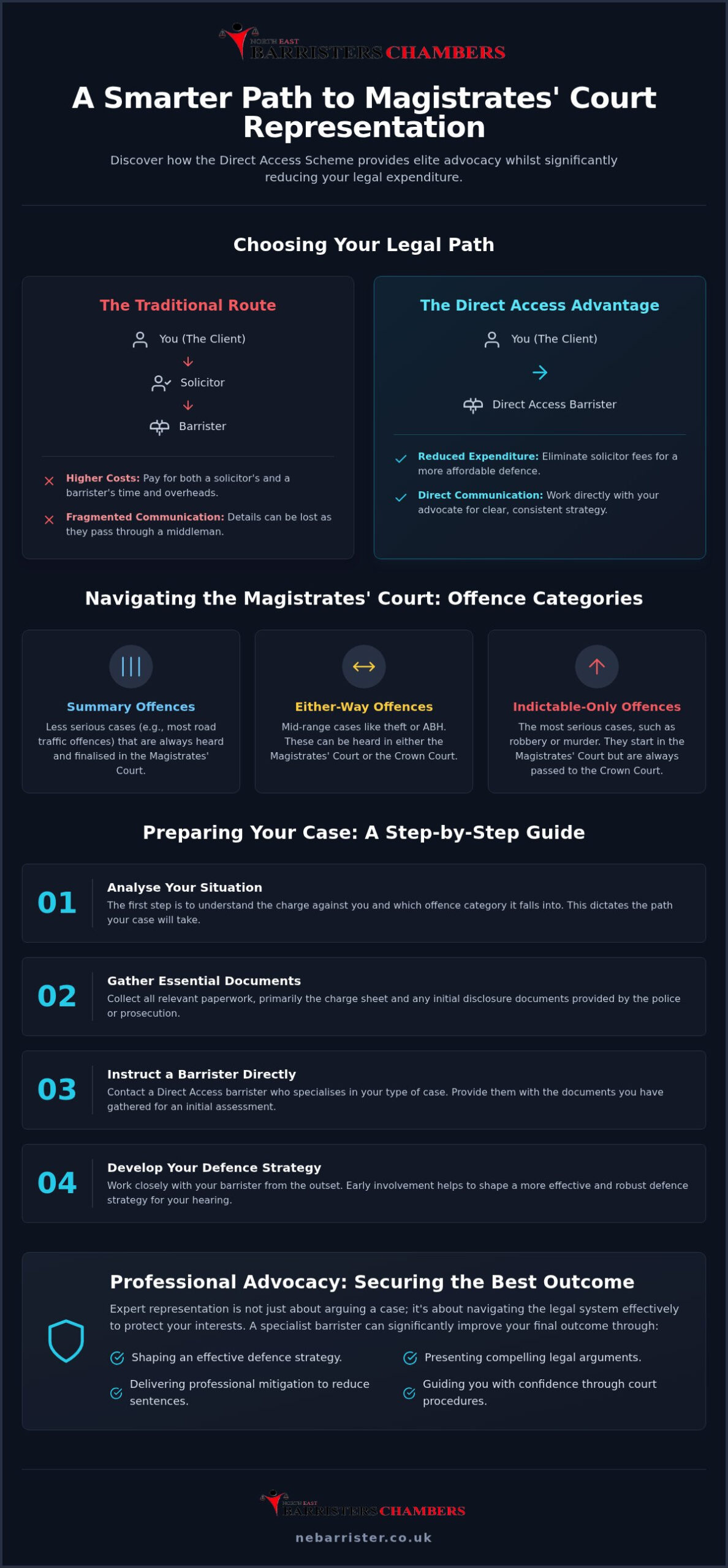
Cases fall into three categories. Summary offences are the most common and stay within this court. Either-way offences, like theft or assault occasioning actual bodily harm, give the court a choice of where the trial should happen. Indictable-only offences are the most serious and are quickly transferred to the Crown Court. This initial classification dictates how much time we have to prepare your case and what the potential outcomes might be.
Your first appearance is the most critical milestone. It isn’t just a formality; it’s when you enter a plea and when the court decides if you’ll be granted bail. Securing expert magistrates court representation for this hearing ensures your side of the story is heard before the bench makes these life-changing decisions. A mistake at this stage can lead to months of unnecessary stress or even a remand in custody.
The Layout of a Magistrates Court Hearing
The courtroom layout is designed for efficiency. You’ll face either three lay Magistrates or a single District Judge. A Legal Advisor sits in front of them, ensuring the law is followed correctly. The Prosecutor sits to one side, ready to present the police evidence. You will usually stand in the dock, a designated area for the defendant. I always guide my clients on court etiquette, such as addressing the Magistrates as ‘Your Worships’ and the District Judge as ‘Sir’ or ‘Madam’. It’s important to remain respectful and clear when you’re asked to confirm your details or enter your plea.
Summary vs Either-Way Offences
The ‘plea before venue’ procedure is a vital part of magistrates court representation for either-way offences. If you plead not guilty, the court decides if it can handle the case or if it needs to go to the Crown Court for a trial by jury. You also have the right to ‘elect’ Crown Court trial yourself. I work with you to decide which venue offers the best tactical advantage. Whilst the Crown Court has higher sentencing powers, the procedural differences can sometimes favour your defence. We’ll discuss these options carefully before you step into the courtroom to ensure you make the right choice for your future.
The Advantages of Direct Access Barrister Representation
Choosing the right path for your legal defence can be the difference between a stressful, expensive ordeal and a streamlined, successful outcome. Traditionally, you would hire a solicitor who then instructs a barrister on your behalf. This adds a layer of administrative cost and another person to brief. By opting for direct access, you secure specialist magistrates court representation while keeping your legal team lean and efficient. I work directly with you from day one, ensuring that the person building your case is the same person presenting it to the bench.
Barristers are specialist advocates. Whilst many solicitors are excellent lawyers, my entire professional life is centred on the art of persuasion in the courtroom. I understand how to present a case to a magistrate or a district judge in a way that is clear, concise, and compelling. This level of specialist focus often leads to better outcomes, whether we are arguing for an acquittal or a reduced sentence. You can find out more about how these venues function in this official government guide to Magistrates’ Courts.
Significant Reductions in Legal Expenditure
One of the most immediate benefits of direct instruction is the financial saving. You aren’t paying for a solicitor’s overheads or their time spent ‘managing’ the relationship between you and your advocate. Instead, you pay for the expert advice and courtroom skill you actually need. Most direct access barristers work on a fixed-fee basis. This provides you with total transparency and certainty over your costs, which is a relief when you are already dealing with the pressure of a court case. By eliminating the middleman, you can often secure higher-quality advocacy for a lower overall price.
Direct Communication and Case Continuity
In the traditional system, details can easily get lost in translation as information moves from you to a solicitor and finally to a barrister. When you instruct me directly, there is no middleman. I hear the facts of your case straight from you. This creates a much stronger rapport and allows me to spot nuances in your evidence that might otherwise be overlooked. This continuity is vital for complex magistrates court representation, where a single detail can change the entire direction of a trial. You get a single point of contact and the peace of mind that your advocate knows every inch of your file. If you are looking for a more personal and cost-effective approach, you might consider instructing a direct access barrister for your upcoming hearing.
Common Offences and Defence Strategies in 2026
Facing a charge in the Magistrates Court can feel like the odds are stacked against you. Whether it’s a road traffic matter or a more serious assault allegation, my role in providing magistrates court representation is to find the weak points in the Crown’s case. I don’t just accept the police witness statements at face value. Instead, I scrutinise the forensic evidence, the CCTV footage, and the procedural records to ensure the prosecution has met the high burden of proof required. Even if you feel the evidence is weighted against you, there are often technical or procedural defences that a layperson might miss.
In 2026, we see a heavy focus on digital evidence and automated enforcement. For theft or fraud charges, I look for a lack of “dishonesty,” which is a specific legal requirement that the prosecution must prove. In public order or assault cases, I often focus on the context of the incident, such as self-defence or a lack of intent to cause fear. Procedural flaws, like a failure to disclose key documents or a breach of the Police and Criminal Evidence Act (PACE), can lead to a case being dismissed before it even reaches a full trial. While the government provides resources for Representing Yourself in Court, these guides cannot replace the tactical nuance required to challenge a professional prosecutor.
Driving Offences and Exceptional Hardship
Driving offences carry a unique pressure because your livelihood is often at stake. I specialise in arguing against disqualification through exceptional hardship or special reasons. Exceptional hardship isn’t just about the inconvenience of losing your licence; it’s about the impact that a ban would have on others, such as your employer or family members who rely on you. Under 2026 case law standards, ‘special reasons’ are mitigating circumstances relating specifically to the commission of the offence that do not amount to a full defence but justify the court in not imposing the mandatory penalty or disqualification. I ensure these arguments are backed by concrete evidence and presented with the necessary legal weight.
Bail Applications and Custody Issues
Securing bail is a priority during your first appearance, especially in serious “either-way” cases. If the prosecution objects to your release, I argue forcefully against their concerns, whether they claim you might fail to surrender or commit further offences. I don’t just ask for bail; I propose a package of robust conditions that addresses the court’s specific anxieties. This might include residence at a fixed address, a tagged curfew, or a prohibition on contacting certain individuals. Effective magistrates court representation ensures that you maintain your liberty while your case progresses, allowing you to prepare your defence from home rather than a prison cell.
Preparing Your Case: A Step-by-Step Guide to Direct Instruction
Direct instruction is a collaborative process. I don’t just act as your voice in court; I act as your strategic partner from the moment you receive your summons. Most people feel overwhelmed by the volume of police paperwork, but I’ll guide you through exactly what’s needed. The first step is determining if your case fits the Public Access scheme. Most summary and either-way offences are perfectly suited for this route, provided you are comfortable handling some of the basic administration yourself. Effective magistrates court representation starts with this early, methodical preparation.
You’ll need to gather the Initial Details of the Prosecution Case (IDPC). This packet contains the charge sheet and the evidence the police intend to use against you. Once you have this, I’ll ask you to draft a clear, honest account of your version of events. I don’t need you to use legal terminology; I just need the facts as you remember them. We’ll then have an initial consultation to review this material and set the strategy for your hearing. This session is where we decide whether to challenge the evidence or focus on a strong mitigation plea.
Organising Your Case Papers
Structure is vital for a successful defence. I recommend organising your documents chronologically so we can see the timeline of events clearly. You should also start thinking about character references from employers or community members. These are particularly powerful if the court is considering your personal background during sentencing. I’ll review everything you provide and advise on which pieces of evidence are legally admissible. Not every detail you find relevant will be allowed in court, and my job is to ensure we only present material that strengthens your position.
What to Expect on the Day of the Hearing
Court days usually start early. I ask my clients to arrive at least 45 minutes before the scheduled hearing time to clear security and find the correct waiting area. We’ll meet in a private consultation room for a pre-hearing conference. This is our chance to finalise the plan and address any last-minute developments in the prosecution’s case. After the bench delivers its verdict, I’ll sit down with you to explain the decision and outline the next moves, whether that’s preparing for a future trial date or managing the terms of a sentence. If you’re ready to take control of your case, you can book a direct access consultation to begin our magistrates court representation strategy.
Professional Advocacy: Ensuring the Best Outcome
Advocacy isn’t just about reading from a script. It’s the art of reading the room and knowing when to push a legal point or when to appeal to the court’s sense of fairness. In the fast-paced environment of a busy hearing, the quality of your magistrates court representation is the single most influential factor in your case’s outcome. While the police and prosecution focus on the offence, I focus on you. I ensure the bench sees the human being behind the charge sheet, not just a case number. This personal approach is what sets specialist advocacy apart from a generic legal service.
North East Barristers Chambers delivers this high-level national expertise directly to you, bypassing the traditional delays and costs of a solicitor-led model. I bring the same level of specialist advocacy to a local Magistrates Court that is usually reserved for complex Crown Court trials. This direct connection means your defence is built on a foundation of professional authority and accessible, practical advice. You aren’t just another file; you’re a client who deserves a dedicated advocate who knows every nuance of your case.
The Art of Mitigation
When a guilty plea is entered or a conviction is secured, the focus shifts to the penalty. This is where the art of mitigation becomes vital. I use the Sentencing Council guidelines as a framework to highlight every possible factor that could lower your sentence. We look at things like genuine remorse, personal circumstances, or a lack of previous convictions. I present these facts in a way that aligns with the court’s legal duties while humanising your situation. By focusing on rehabilitation rather than just punishment, I can often steer the court toward more lenient options. A barrister’s plea in mitigation can change a custodial sentence to a community order. This single speech can be the difference between maintaining your current life and facing a period of imprisonment.
Securing Your Professional Future
A court appearance isn’t just about the immediate fine or order. It’s about the long-term impact on your reputation and your livelihood. A criminal record can restrict your ability to travel to certain countries or prevent you from holding specific professional licences. Investing in expert advocacy now is an investment in your future security. I work to minimise these long-term consequences by ensuring the court understands the wider implications of any sentence they impose. You can learn more about how to secure criminal law court representation that protects both your rights and your career prospects. Whether we are fighting for an acquittal or the lowest possible penalty, my goal is always to provide you with a clear path forward and the relief that comes with a resolved case.
Secure Expert Advocacy for Your Hearing
Facing a court date is a significant challenge, but you don’t have to navigate it alone or burdened by excessive costs. By choosing direct access, you’ve seen how easy it is to bypass redundant solicitor fees and work directly with a specialist advocate. This streamlined approach ensures that your case is built on expert courtroom skill and clear, honest communication from the very start. I provide national coverage and transparent fixed-fee structures, so you always know exactly where you stand financially and legally.
Your choice of magistrates court representation will define your experience in the courtroom and the outcome of your case. Whether we are challenging prosecution evidence or presenting a powerful plea in mitigation, my goal is to protect your reputation and your future. Don’t leave your defence to chance or settle for fragmented advice. You can instruct a direct access barrister for your Magistrates Court case today and benefit from specialist expertise delivered with a pragmatic, client-focused approach. I am here to guide you through the process and help you achieve the best possible result.
Frequently Asked Questions
Do I legally need a solicitor for a Magistrates Court hearing?
No, you aren’t legally required to have a solicitor for your hearing. The Direct Access scheme allows you to bypass the traditional solicitor route and hire a barrister directly. This is a practical solution for many defendants who are comfortable managing their own case administration. I handle the specialist advocacy and legal strategy, whilst you take care of the basic paperwork, ensuring your magistrates court representation is both expert and cost-effective.
How much can I save by using a direct access barrister?
You can save a significant amount by eliminating the need for a solicitor to act as an intermediary. Traditionally, you would pay both a solicitor and a barrister; direct access removes the solicitor’s fee entirely. My practice uses transparent fixed-fee structures, which means you know exactly what the representation will cost before we start. This approach provides financial certainty and ensures your budget is spent on the specialist advocate who will actually speak for you.
Can a barrister represent me for a drink driving charge?
Yes, I frequently represent clients for drink driving and other road traffic offences. These cases often hinge on technical evidence or “special reasons” arguments to avoid disqualification. Having a specialist barrister involved early allows for a thorough analysis of the prosecution’s evidence, such as breathalyser calibration or procedural errors. I focus on securing the best possible outcome for your licence and your livelihood through expert magistrates court representation.
What is the difference between a barrister and a solicitor in court?
The main difference lies in the area of specialisation. Solicitors are often generalists who manage the litigation process, gather evidence, and handle office-based administration. Barristers are specialist advocates who spend their professional lives in the courtroom. I focus on the art of oral persuasion and legal argument. By instructing me directly, you get the person with the highest level of courtroom experience to handle the most critical part of your case.
Will I have to speak in court if I have a barrister?
You’ll rarely need to speak for long periods when you have a barrister. You’ll be asked to confirm your name, address, and date of birth, and then to enter your plea. Beyond that, I do the talking for you. I present the legal arguments, cross-examine witnesses, and deliver the plea in mitigation. This relieves the pressure on you, ensuring that your case is presented professionally and clearly to the Magistrates or the District Judge.
Can I use a direct access barrister if I have already started with a solicitor?
You can switch to a direct access barrister even if you have already engaged a solicitor. You simply need to inform your current solicitor that you wish to terminate their services and handle the matter yourself via the Public Access scheme. I can then take over the advocacy for your upcoming hearings. It’s a straightforward process that allows you to take control of your legal expenditure and speak directly to your advocate.
What happens if my case is moved from the Magistrates Court to the Crown Court?
If your case is transferred to the Crown Court, I can continue to represent you. Many either-way or indictable-only offences follow this path. One of the greatest benefits of direct access is the continuity of service. You won’t have to brief a new person or build a new relationship. I’ll stay with you through every stage, from the first appearance in the Magistrates Court to the final trial or sentencing in the Crown Court.
How do I instruct a barrister directly for my first hearing?
Instructing me is a simple, step-by-step process. First, you should gather your charge sheet and the initial disclosure from the police. Once you have these documents, contact my chambers to arrange an initial consultation. We’ll discuss the facts of your case and I’ll assess if it’s suitable for direct access. If we proceed, I’ll provide a client care letter outlining the agreed fees and the scope of my work for your hearing.
