
Why are you paying for a middleman when your business’s future is on the line? Finding the right barrister for commercial litigation shouldn’t mean navigating a maze of escalating solicitor fees and frustrating communication delays. I understand the anxiety of facing a high-stakes dispute whilst watching your legal budget vanish into administrative overheads. You need a direct line to the expert advocate who will actually argue your case in court.
This guide reveals how to secure senior legal expertise and strategic advocacy through the Direct Access scheme. You’ll discover how to build a robust claim or defence strategy whilst significantly reducing your business legal costs. I’ll walk you through the 2026 framework for direct instruction, explaining the move toward transparent, fixed-fee structures and how to maintain total control over your litigation strategy. We’ll explore how this modern approach removes the friction of traditional legal hierarchies to put your business in the strongest possible position.
Key Takeaways
- Learn how the Direct Access scheme removes the need for a solicitor, allowing you to work directly with an expert to significantly reduce your business legal costs.
- Understand why instructing a barrister for commercial litigation provides a tactical advantage in the courtroom through expert advocacy and focused legal strategy.
- Discover the benefits of transparent, fixed-fee structures that offer budget certainty and eliminate the unpredictable nature of traditional hourly billing.
- Identify the specific types of commercial disputes, from breach of contract to shareholder disagreements, that are most suitable for direct barrister instruction.
- Gain a clear roadmap for preparing your documentation and assessing your case’s suitability for Direct Access to ensure a robust defence or claim.
What is a Barrister for Commercial Litigation?
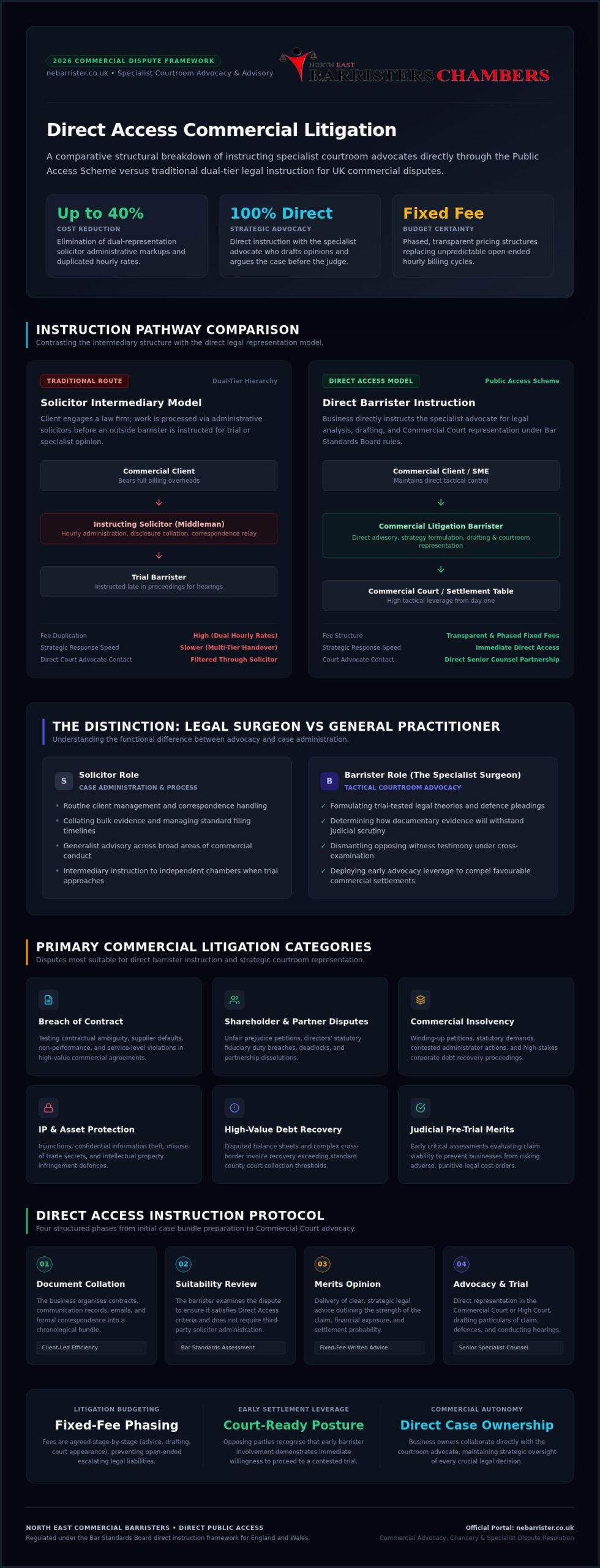
A barrister for commercial litigation is a specialist legal professional whose practice focuses on high-stakes business disputes. Unlike a general practitioner, these experts spend their time in the courtroom or drafting complex legal opinions. They provide the tactical edge needed when a disagreement over a contract or a shareholder dispute escalates. I often describe the role as being the specialist surgeon of the legal world. You wouldn’t ask your GP to perform heart surgery; similarly, you shouldn’t rely on general legal advice when your company’s assets are at risk.
In 2026, the demand for this expertise has never been higher. Commercial litigation requires more than just knowledge of the law. It demands a specific set of courtroom and negotiation skills. A barrister must be able to dismantle a weak argument under cross-examination whilst simultaneously finding the leverage needed to settle a claim on favourable terms. This dual capability makes them indispensable for businesses facing complex legal challenges.
The Distinction Between Advocacy and Administration
The main difference between a barrister and a solicitor lies in the nature of their work. Solicitors typically manage the day-to-day administration of a case. They handle correspondence, gather evidence, and manage the client relationship. A barrister, however, focuses on the advocacy. They determine how that evidence will play out in front of a judge. Having an advocate involved early in a commercial dispute changes the outcome for several reasons:
- Focused Strategy: They identify the winning legal arguments before the first letter of claim is even sent.
- Reduced Risk: Early analysis helps you avoid pursuing weak claims that could lead to punitive cost orders.
- Tactical Leverage: The mere presence of a senior advocate often encourages the opposing side to settle.
The UK legal market has shifted. Businesses now realise that early strategic advice prevents cases from reaching a full trial. This results-driven approach prioritises clarity over administrative box-ticking.
Direct Access: The Modern Route to Legal Expertise
Historically, you could only hire a barrister if a solicitor instructed them for you. This often meant paying two sets of legal fees for the same case. The Public Access Scheme changed this dynamic entirely. It allows businesses to bypass the solicitor intermediary and go straight to the source of legal expertise. For SMEs, this is a game-changer for budget management. It puts you in direct contact with the person who will actually argue your case.
Under current Bar Standards Board rules, a qualified barrister has the legal authority to represent you directly. This isn’t just about saving money. It’s about direct communication and faster decision-making. You get a clear, senior-level opinion without the lag of a middleman. If you want to understand the broader context of these services, you can read more in this Direct Access Barrister North East: A 2026 Guide to Public Access Legal Services. This modern route ensures that your business receives agile, authoritative representation from the very start.
Common Types of Commercial Disputes Handled by Barristers
Commercial disputes range from straightforward unpaid invoices to multi-million pound international trade disagreements. When you engage a barrister for commercial litigation, you’re hiring someone who understands the nuances of the Commercial Court and how judges interpret business law. My work often involves unpicking the complexities of shareholder disputes, partnership dissolutions, and high-value insolvency proceedings. These cases require a deep understanding of both statutory law and the practical realities of running a business.
I also frequently handle matters involving intellectual property rights and large-scale debt recovery where standard collection methods have failed. The goal is always the same: to protect your commercial interests whilst minimising the time you spend in legal limbo. If you’re facing a potential dispute, you can get in touch for a direct assessment of your case’s merits.
Contractual Disputes and Breach of Agreement
Barristers don’t just read contracts; they test them for weaknesses. I look for ambiguities that could be exploited or protected during a trial. Determining the likelihood of success early on is vital for any business owner who wants to avoid wasting capital on a losing battle. A repudiatory breach is a violation of contract terms so severe that it allows the innocent party to treat the entire agreement as terminated and seek damages for the loss of the bargain. Expert advice helps you decide whether to accept the breach and walk away or push for specific performance of the contract.
Professional Negligence and Liability
When a professional advisor, such as an accountant, surveyor, or architect, fails in their duty of care, the financial fallout for a business can be catastrophic. Strategic advocacy is essential here to prove that the advisor’s conduct fell below the required professional standard. These claims are often hard-fought by insurers, so having an advocate who understands the litigation process from the inside is a distinct advantage. If you’re dealing with a failure in professional service, you might find specific guidance in this guide on Professional Negligence Barrister: A Guide to UK Claims 2026. My role is to ensure your business is compensated for the losses caused by another professional’s mistakes.
Shareholder and Partnership Dissolutions
Disputes between business owners can be some of the most damaging and emotional cases in commercial law. Whether it’s a “minority prejudice” claim or a disagreement over the division of assets during a dissolution, you need a clear-headed strategy. I provide an objective view of the legal position, helping partners reach a resolution that protects the underlying business. This often involves high-stakes negotiation before the matter ever reaches a courtroom, saving all parties from the expense of a prolonged public battle.
The Benefits of Direct Access: Barrister vs Solicitor Costs
Instructing a barrister for commercial litigation directly is a logical step for any business focused on efficiency. Traditionally, the legal system required you to hire a solicitor first, who would then “brief” a barrister. This created an expensive hierarchy where you paid for two sets of professionals to handle the same case. By removing the middleman, you eliminate the administrative markup and ensure your budget goes towards expert advocacy rather than procedural management. I find that this direct relationship fosters a higher level of transparency from the very first meeting.
One of the most significant advantages is the shift in fee structures. Whilst solicitors often rely on open-ended hourly rates that can make budgeting impossible, barristers typically work on a fixed-fee basis for specific stages of work. This might include a fixed fee for a written opinion, a set price for drafting a letter of claim, or a “brief fee” for court representation. You can verify the credentials of any advocate through the Bar Council Direct Access Portal, ensuring you are working with a regulated professional who meets the highest standards of the UK Bar.
Significant Cost Reductions for SMEs
For small and medium-sized enterprises, the financial impact of Direct Access is substantial. My experience shows that businesses can save between 30% and 50% on their total legal spend by bypassing the traditional solicitor route. These savings come from avoiding the duplication of work. In a standard model, a solicitor spends hours preparing a file that the barrister must then bill hours to read and understand. Direct instruction cuts this waste. If you want to explore specific ways to protect your bottom line, my Reduce UK Legal Costs: Direct Access Guide 2026 provides a detailed breakdown of these financial benefits.
Direct Strategic Control
Beyond the cost, there is the tactical advantage of direct communication. In fast-moving commercial disputes, information can easily be lost in translation when it passes through multiple hands. When you speak directly to your trial lawyer, you ensure that the nuances of your business operation are understood and reflected in the litigation strategy. This agility allows us to respond to an opponent’s manoeuvres with much greater speed. It puts you in the driving seat of your own case, providing a level of clarity and relief that is often missing in the traditional, fragmented legal process.
How to Instruct a Commercial Barrister Directly
Instructing a barrister for commercial litigation through the Direct Access scheme is a straightforward process, but it requires a different approach than the traditional solicitor route. Because you are removing the middleman, you take on a more active role in the initial stages of the case. I work closely with my clients to ensure this transition is seamless. The goal is to get your case in front of a senior advocate as quickly as possible without unnecessary administrative delays.
The first step is always a preliminary enquiry. I need to understand the core of your dispute to determine if it’s suitable for direct instruction. If you’re ready to begin, you can submit your case details for a direct review to see how I can assist your business.
The Preliminary Enquiry and Suitability
When I assess a new commercial case, I look for clarity in the legal issues and the volume of evidence involved. Most breach of contract or shareholder disputes are perfectly suited for Direct Access. However, if a case requires heavy administrative litigation, such as managing thousands of physical documents or coordinating multiple third-party witnesses, I may recommend involving a solicitor. I have a professional duty to inform you if your case requires the administrative support of a solicitor to ensure your interests are properly protected. This transparency ensures that you always have the right level of support for the specific needs of your claim.
Organising Your Evidence for Success
To keep your legal costs low, it’s vital to organise your files before our first conference. A well-prepared bundle allows me to focus on the legal strategy rather than sorting through unorganised emails. I recommend following these steps to prepare your “brief”:
- Create a Chronology: List every key event, meeting, and piece of correspondence in date order. This is the most valuable document you can provide.
- Group Your Documents: Keep contracts, invoices, and email chains in separate, clearly labelled folders.
- Identify the Core Issue: Write a short summary of what you believe went wrong and what outcome you want to achieve.
By providing a clear timeline, you reduce the time I spend on initial review. This efficiency is what makes the Direct Access route so cost-effective for modern businesses.
The Client Care Letter and Court Prep
Once I accept your instructions, I will send you a Client Care Letter. This document is our formal contract. It outlines exactly what work I will do, the fixed fees we have agreed upon, and how we will communicate. From this point, our relationship is a collaboration. Whilst I handle the legal drafting and court representation, you remain the primary point of contact for the court’s administrative side. This partnership keeps you in total control of the litigation process, providing the clarity and relief that comes from knowing exactly how your defence or claim is being handled.
Strategic Advocacy: Why Choose North East Barristers Chambers
Choosing a barrister for commercial litigation is about more than just finding a legal expert; it’s about finding a partner who understands the pressures of modern business. At North East Barristers Chambers, I provide a service that balances professional authority with approachable pragmatism. I don’t operate as a faceless corporate entity. Instead, I offer a direct, personal connection that ensures you receive clear, reliable advice without the detachment found in traditional legal communications. My commitment is to be a straightforward solution-provider in a field that is too often over-complicated.
I pride myself on being an innovator who adapts to your specific needs. My practice is built on the pillars of criminal, civil, and family law, giving me a broad perspective on how different legal issues can intersect in a business context. Whether you’re defending a claim or pursuing a breach of agreement, I act as an agile and highly capable expert who guides you through every stage of the process with clarity and confidence.
A National Reach with Individual Focus
Whilst my brand is rooted in a specific identity, my practice as a barrister for commercial litigation offers comprehensive national UK coverage. I operate as an agile professional who travels to meet the needs of my clients, ensuring that expert advocacy is available wherever your business is located. This mobility allows me to provide a more responsive service than many traditional, static chambers. I also bring significant expertise in both the Magistrates’ and Crown Courts for regulatory commercial matters, providing a robust defence in even the most complex environments.
The structure of my chambers is designed to be lean and efficient. By avoiding the heavy overheads associated with larger sets, I can offer more competitive pricing without compromising on the quality of the advocacy. This transparency in legal fees is a core part of my service-oriented mindset. You get senior-level expertise and a dedicated advocate at a value that makes commercial sense for your business.
Your Next Steps in Commercial Litigation
Starting the process of direct instruction is the first step towards resolving your dispute and protecting your business’s future. You don’t have to navigate the complexities of the UK court system alone. I’m here to provide the strategic advice and courtroom punch you need to achieve a favourable outcome. The process is designed to be as frictionless as possible, moving quickly from our initial enquiry to active representation. If you’re ready to secure the expert advocacy your business deserves, you can contact us to discuss your commercial litigation requirements today. Let’s work together to build a robust strategy that delivers results.
Securing Your Business Future in 2026
Commercial disputes don’t have to be a drain on your company’s resources. By choosing to work directly with a barrister for commercial litigation, you are opting for a modern, agile approach that prioritises results over administrative hurdles. This guide has shown how removing the solicitor intermediary can significantly reduce your legal spend whilst giving you direct strategic control over your case. You no longer need to navigate a fragmented system to find the expert advocacy your business deserves.
I am committed to providing transparent, high-quality advocacy across the UK. Whether you are dealing with a breach of contract or a complex shareholder disagreement, you can rely on professional expertise that is both authoritative and accessible. With fixed-fee options for strategic advice and national UK-wide court representation, my practice is designed to provide the clarity and relief you need. My role as a Direct Access qualified expert is to ensure your business moves forward with the strongest possible legal footing.
Instruct a Direct Access Barrister for your commercial litigation today and take control of your legal strategy. Your business’s interests are my priority.
Frequently Asked Questions
Can I hire a barrister for commercial litigation without a solicitor?
Yes, you can instruct a barrister for commercial litigation directly through the Direct Access scheme. This modern approach allows businesses and individuals to bypass the traditional hierarchy of hiring a solicitor first. I provide legal advice and expert court representation directly to you, which streamlines communication and simplifies the entire process. It’s an efficient way to access senior legal expertise whilst maintaining total control over your case’s strategic direction.
Is a Direct Access barrister cheaper than using a traditional law firm?
Instructing a barrister directly is generally more cost-effective than using a traditional law firm. You avoid the expense of paying for two sets of legal professionals at the same time. Law firms often have higher overheads and administrative markups that are passed on to the client. By working directly with me, you benefit from a more transparent fee structure that focuses your budget on specialist advocacy and expert advice.
What types of commercial cases are suitable for direct instruction?
Most business disputes are well-suited for the Direct Access scheme. This includes breach of contract claims, shareholder disagreements, partnership dissolutions, and professional negligence cases. I also handle debt recovery and insolvency proceedings directly for my clients. If a case is primarily focused on legal argument and courtroom advocacy, it’s usually a prime candidate for direct instruction. I will always assess your specific case’s suitability during our initial enquiry.
Will a barrister handle the paperwork for my commercial claim?
I will draft all your formal legal documents, such as the Particulars of Claim or a Defence. Because I hold Conduct of Litigation authorisation, I can also handle much of the administrative paperwork and court filings that a standard Direct Access barrister cannot. This allows me to act as a “one-stop-shop” for your business. It removes the burden of you having to manage the court’s procedural requirements or hire a separate solicitor.
Can a barrister represent my company in the High Court?
Yes, I have full rights of audience to represent your company in any court in England and Wales. As a barrister for commercial litigation, I am specifically trained for high-stakes courtroom environments. Whether your case is heard in the County Court or the Business and Property Courts of the High Court, I provide the same level of senior-level representation. My focus is on delivering robust advocacy that protects your commercial interests at every level.
What happens if my commercial case becomes too complex for Direct Access?
I have a professional duty to advise you if a case becomes unsuitable for the Direct Access scheme. This might happen if the litigation requires extensive third-party disclosure or complex witness coordination that requires a larger team. If this occurs, I’ll explain the situation clearly and help you transition to a model where a solicitor is involved. This ensures your interests are always protected by the most appropriate legal structure for your specific needs.
How are barrister fees calculated for commercial litigation?
I typically use a transparent, stage-by-stage fixed-fee structure. This provides your business with budget certainty from the very start of our engagement. Fees are usually divided into set amounts for specific tasks, such as drafting an opinion or attending a court hearing. This approach is a pragmatic alternative to the unpredictable hourly rates often found in traditional law firms. It allows you to manage your legal costs with confidence and clarity.
Do I need to be a business owner to instruct a commercial barrister?
No, the Direct Access scheme is available to anyone involved in a commercial dispute. Whilst I frequently work with SMEs and corporate entities, I also represent individual partners, directors, or employees facing legal challenges. If you have a legal issue rooted in a commercial agreement or professional relationship, you can instruct me directly. I provide the same level of dedicated advocacy regardless of your specific role or the size of your business.