
What if the most effective way to protect your company wasn’t through a traditional law firm, but by bypassing the solicitor middleman entirely? Most directors feel trapped by escalating legal fees and layers of communication that leave them feeling like a passenger in their own litigation. It’s frustrating to watch costs spiral whilst you’re shielded from the specialist barrister for company law disputes who is actually arguing your case. I understand that fear of losing control over your business during a complex corporate conflict.
This guide shows you how to take back the reins by using the Direct Access model to resolve disputes efficiently. You’ll discover how to secure High Court-level advocacy and authoritative legal advice whilst significantly reducing your total legal expenditure. By cutting out unnecessary administrative layers, you gain a direct line to the advocate who will fight your corner. I’ll walk you through the 2026 rules, explain how to resolve director or shareholder conflicts, and outline a clear strategy for modern, cost-effective corporate dispute resolution.
Key Takeaways
- Learn how instructing a specialist barrister for company law disputes directly can significantly reduce your legal costs by removing the solicitor middleman.
- Understand the strategic approach to resolving complex shareholder conflicts, including unfair prejudice petitions under Section 994.
- Discover the benefits of direct communication with your advocate to ensure your business interests remain the priority throughout the litigation process.
- Follow a clear, step-by-step method for preparing your documents and engaging in Alternative Dispute Resolution to settle matters efficiently.
- Gain clarity on how to navigate the 2026 Direct Access rules to secure authoritative legal advice and expert court representation for your SME.
The Role of a Barrister for Company Law Disputes
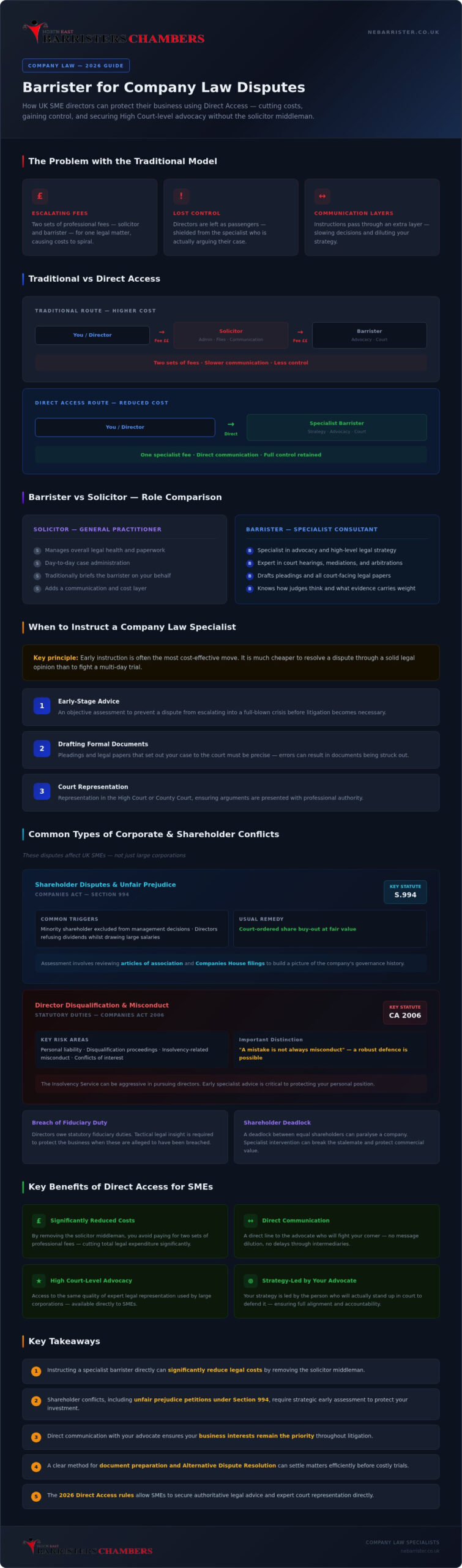
I’m often asked what makes my role different from that of a solicitor. As a barrister for company law disputes, I’m a specialist in advocacy and high-level legal strategy. While solicitors usually manage the day-to-day administration of a case, I spend the majority of my time in court or preparing for litigation. My focus is on the sharp end of the law. I’m here to provide a definitive opinion on your legal standing and to act as your voice during hearings, mediations, and arbitrations. My goal is to give you a clear path through complex company law principles and corporate governance issues. I don’t just process files; I build the arguments that resolve conflicts.
Barrister vs Solicitor: Understanding the Difference
The division of labour in the legal profession is often confusing for business owners. Think of a solicitor as a general practitioner who manages your overall legal health and paperwork. I’m the specialist consultant brought in for specific, high-stakes procedures. Traditionally, you had to hire the solicitor first, who would then “brief” me. Direct access changes this. It allows you to bypass the solicitor for many commercial matters. This means you aren’t paying for two sets of fees when one expert can handle the core legal challenge. I’m instructed for my specialist knowledge of the law and my experience with courtroom tactics. I know how judges think and what evidence will carry weight in a trial.
When to Instruct a Company Law Specialist
You don’t have to wait for a court date to seek my help. In fact, early instruction is often the most cost-effective move you can make. It’s much cheaper to resolve a dispute through a solid legal opinion than it is to fight a multi-day trial. I’m frequently involved in:
- Early-stage advice: I can provide an objective assessment to prevent a dispute from escalating into a full-blown crisis.
- Drafting formal documents: I draft the “pleadings” and other legal papers that set out your case to the court. These must be precise to avoid being struck out.
- Representation: I represent you in the High Court or County Court, ensuring your arguments are presented with professional authority.
Whether you’re facing a breach of fiduciary duty or a shareholder deadlock, I provide the tactical insight needed to protect your business. My role is to simplify the complex and ensure you stay in control of the narrative throughout the legal process. By working with me directly, you ensure that your strategy is led by the person who will actually stand up in court to defend it.
Common Types of Corporate and Shareholder Conflicts
Corporate conflicts aren’t always about international fraud or multi-billion pound takeovers. For most UK SMEs, the battle is closer to home. Whether it’s a deadlock between two equal shareholders or a director accused of overstepping their bounds, these issues can paralyse a company if left unresolved. As a barrister for company law disputes, I see how quickly internal friction can damage a firm’s value. My job is to identify the legal leverage points that can break the stalemate. I focus on practical outcomes that protect your commercial interests rather than getting bogged down in endless procedural loops.
Shareholder Disputes and Unfair Prejudice
A frequent source of conflict in private companies is “unfairly prejudicial” conduct under Section 994 of the Companies Act. This often happens when a minority shareholder is excluded from management decisions or when directors refuse to pay dividends whilst drawing large salaries. It’s not just about hurt feelings; it’s about the erosion of your investment. Common remedies usually involve a court-ordered share buy-out at a fair value. I help clients by providing an early assessment of a claim’s merit. I look at the articles of association and the Companies House official guidance on filings to build a clear picture of the company’s governance history. If you’re feeling squeezed out, I can help you understand your rights before you’re forced into an expensive legal corner.
Director Disqualification and Misconduct
Directors carry heavy statutory duties. If things go wrong, especially during insolvency, you might face personal liability or disqualification proceedings. The Insolvency Service can be aggressive, but I provide a robust defence against claims of misconduct. I advise on conflicts of interest and the specific fiduciary duties outlined in the Companies Act 2006. It’s vital to remember that a mistake isn’t always misconduct. If you’re concerned about your personal liability as a director, you can reach out for a direct consultation to discuss your specific situation.
Beyond internal management, I also handle derivative claims. This is where a shareholder brings a claim on behalf of the company itself, often because the directors refuse to sue for a wrong done to the firm. I also represent companies in contractual disputes with third-party suppliers or partners. These external conflicts require the same tactical precision as internal ones. When facing a derivative claim, having a barrister for company law disputes by your side ensures that the procedural hurdles don’t trip you up. My role is to ensure the legal strategy aligns with your commercial goals, keeping the business operational whilst we fight the legal battle.
The Strategic Advantage of Direct Access for SMEs
The traditional legal model often feels like a relay race where you pay for the baton to be passed. When you hire a barrister for company law disputes through a solicitor, you’re frequently paying for two professionals to review the same documents and attend the same meetings. Direct access changes the geometry of your legal team. It puts you at the centre of the strategy, working directly with the specialist who will actually present your case. This agile approach is particularly vital for SMEs where every pound and every hour counts. I’ve seen directors frustrated by the “black box” of traditional litigation; direct access provides the transparency you need to make informed business decisions.
Why Direct Access is More Cost-Effective
The most immediate benefit is the significant reduction in your total legal spend. By removing the solicitor middleman, you eliminate the duplication of work that plagues most corporate cases. I can provide faster turnaround times for legal opinions and drafting because there’s no administrative layer filtering our communication. My clients often prefer fixed-fee arrangements for specific stages of work, which provides the budget certainty that traditional hourly billing lacks. If you’re looking for ways to streamline your budget, you can find more information on reducing UK legal costs through this model. It’s a pragmatic shift from paying for process to paying for expertise.
Maintaining Direct Control of Your Case
Direct access empowers you to take the lead on your case. Whilst I provide the high-level legal strategy and courtroom advocacy, you handle the administrative tasks like filing papers or organising your internal files. This collaboration ensures that the person arguing your case has a direct, unmediated understanding of the facts. I don’t rely on a solicitor’s summary; I hear the details from you. This leads to more precise advocacy and a strategy that aligns perfectly with your commercial goals.
In a fast-moving dispute, this direct line of communication allows us to pivot quickly as new evidence emerges. You stay in the driving seat, ensuring that the litigation serves the business rather than the other way around. This model doesn’t just save money; it creates a more responsive legal partnership that fits the pace of modern commerce. By working together directly, we can focus on resolving the conflict and getting you back to running your company.
Navigating the Dispute Resolution Process Directly
Once you decide to instruct a barrister for company law disputes, the process follows a logical sequence designed to protect your commercial position. It begins with a thorough initial assessment of the merits of your claim. I don’t just look at the law; I look at the evidence. I examine your board minutes, emails, and shareholder agreements to determine if your case has a realistic prospect of success. This objective review is essential. It ensures you don’t waste resources on a battle that cannot be won or, conversely, gives you the confidence to push forward when you have the upper hand.
The Importance of Early Legal Advice
A formal “Counsel’s Opinion” is often the most powerful tool in your arsenal. This is a written document where I provide a definitive view on the law and the likely outcome of your dispute. By identifying the weak spots in your opponent’s corporate position early, we can often force a settlement before the first court fee is even paid. Securing specialist advice at the outset identifies the flaws in your opponent’s case and saves thousands in court fees by avoiding unnecessary litigation.
Mediation and Negotiation Tactics
Courts now expect parties to engage in Alternative Dispute Resolution (ADR) before a trial. Mediation is a structured negotiation where I act as your advocate to reach a private settlement. Barristers are often the best choice for high-stakes negotiation because we understand exactly how the same arguments would play out in front of a judge. We focus on structuring a settlement agreement that protects the company’s future and prevents further litigation. For a deeper look at the mechanics of this model, you can read my guide to court representation without a solicitor.
If mediation fails, we move to issuing or defending proceedings in the appropriate court. This involves drafting the claim form and particulars of claim, or a robust defence if you’re the one being sued. Trial preparation is a methodical process of refining arguments and preparing witness statements. At the final hearing, I provide the expert advocacy required to present your case to the judge. The transition from negotiation to the courtroom is seamless because I’ve been with you from the start. If you’re ready to begin this process, you can instruct me for an initial case assessment today to determine your next steps.
Instructing a Specialist for Your Company Law Matter
Taking the first step to resolve a corporate conflict doesn’t have to be intimidating. I’m committed to providing clear, jargon-free advice that helps you make sense of your situation without the dense legalese often found in traditional firms. My practice isn’t tied to a single location. I offer national reach, providing representation in courts across the United Kingdom. Whether your business is based in the south or the far north, I can act as your barrister for company law disputes. I focus on being a straightforward solution-provider. This means ensuring you understand the legal process and the fees involved from the very start of our engagement.
Preparing Your Brief for Direct Instruction
The key to a successful direct instruction is organisation. I need to see the full picture to give you the most accurate advice. This starts with “bundling” your documents into a logical format. You should organise your company records, internal emails, and signed contracts chronologically. A messy pile of digital files slows down the review process and can lead to missed details. I also ask for a clear summary of the dispute and your desired outcome. Learning how to instruct a barrister directly effectively will save you time and ensure we hit the ground running. Think of this brief as the tactical foundation of our strategy. It allows me to spot the legal leverage points in your case immediately.
Next Steps: Securing Your Representation
Once your documents are ready, we can move to the initial consultation and fee agreement. During this meeting, I’ll check my availability for your specific court dates and we’ll discuss the scope of work. This could range from a one-off legal opinion to full trial representation. We’ll also agree on a fee structure that provides the budget certainty you need. Before we begin any work, my chambers will perform a standard conflict-of-interest check. This is a routine but vital step to ensure I can represent you without any legal hurdles. My goal is to move quickly from our first contact to a clear plan of action. I want to resolve your dispute so you can return your full attention to running your company.
Resolving Your Corporate Conflict with Confidence
Resolving a company dispute doesn’t have to be a drain on your resources or your time. By choosing the Direct Access model, you’ve seen how to bypass unnecessary administrative layers and work directly with the specialist who will argue your case. This approach provides a clear, cost-effective path to resolving shareholder deadlocks or director misconduct claims without losing control of your business operations.
I’m here to provide professional and pragmatic legal advice that cuts through the complexity. Whether you need a formal Counsel’s Opinion to settle a matter early or expert representation in the High Court, my national UK court representation ensures you have specialist advocacy wherever your business is based. Engaging a specialist barrister for company law disputes directly is the modern, agile way to protect your commercial interests.
If you’re ready to secure your company’s future and move past this conflict, I can help. Instruct an expert barrister for your company dispute today to get the authoritative guidance you need. Let’s work together to find a straightforward solution that gets you back to what matters most: growing your business.
Frequently Asked Questions
Can a company instruct a barrister directly under the Public Access scheme?
Yes, corporate entities can instruct a barrister directly under the Public Access scheme. I’ve worked with many SMEs that choose this route to maintain direct control over their legal strategy. A director or authorised employee acts as the primary point of contact for the case. This removes the need for a solicitor to act as an intermediary, allowing the company to engage me for specific advice or court representation across the UK.
Is a barrister for company law disputes cheaper than a solicitor?
Instructing a barrister for company law disputes is often more cost-effective because it eliminates the duplication of fees. In the traditional model, you pay a solicitor to manage the case and a barrister to argue it. By hiring me directly, you only pay for the specialist advocacy and advice you actually need. My clients find that this streamlined approach significantly reduces their total legal expenditure whilst providing high-level expertise.
What documents do I need to provide when hiring a barrister directly?
You should provide all relevant company records, including the Articles of Association, shareholder agreements, and board minutes. I also need to see a chronological file of emails and any contracts central to the conflict. Organising these documents into a clear digital bundle before our initial consultation helps me assess the merits of your case quickly. This preparation ensures that our time is focused on developing a winning legal strategy for your business.
Can a barrister help with shareholder disputes and unfair prejudice claims?
I specialise in resolving shareholder conflicts, including unfair prejudice petitions under Section 994 of the Companies Act. I provide definitive legal opinions on whether a minority shareholder’s rights have been breached and represent companies or individuals in court. Whether you’re facing a deadlock or seeking a share buy-out order, I can guide you through the litigation process to achieve a pragmatic commercial resolution that protects your investment and your company’s future.
Will a barrister attend mediation on behalf of my company?
Yes, I frequently represent companies during mediation and other forms of Alternative Dispute Resolution. Mediation is often a faster and more private way to settle corporate conflicts than a full court hearing. I act as your advocate during these negotiations, using my experience of courtroom outcomes to secure the best possible settlement. My goal is to resolve the matter efficiently so you can get back to running your business without the distraction of litigation.
What happens if my company law case is too complex for direct access?
If a case involves heavy administrative burdens or extensive witness management, I’ll advise you honestly on whether a solicitor’s involvement is necessary. Direct access works best when the client can handle basic tasks like filing papers. If the litigation becomes too complex for this model, I can help you identify the specific support you need. My priority is ensuring you have the right level of representation for a successful and legally sound outcome.
Do barristers offer fixed fees for company law advice?
I often provide fixed-fee arrangements for specific stages of work, such as drafting a legal opinion or representing you at a single hearing. This provides your business with budget certainty and avoids the unpredictability of hourly billing. We’ll discuss and agree upon these fees before any work begins. This transparent approach ensures there are no surprises, allowing you to manage your company’s legal costs with confidence whilst receiving authoritative legal guidance.
Can I hire a barrister directly for an employment tribunal case involving my company?
Yes, you can instruct me directly for representation in employment tribunal cases. Whilst my focus here is on company law, my civil litigation expertise extends to defending companies against claims or resolving director-level employment disputes. Direct access allows you to secure specialist advocacy for these hearings whilst keeping your legal spend under control. I provide national coverage, representing businesses in tribunals across the United Kingdom to resolve these sensitive and often complex matters.