
Why are you paying for an expensive middleman when your construction project is already haemorrhaging money? It is a frustrating reality for many contractors and developers that legal stalemates often feel more complex than the engineering challenges themselves. You likely realise that escalating solicitor fees and dense contract jargon are only adding to the delay, making a swift resolution feel out of reach. I understand that when a project stalls, you need clarity and action, not more administrative layers.
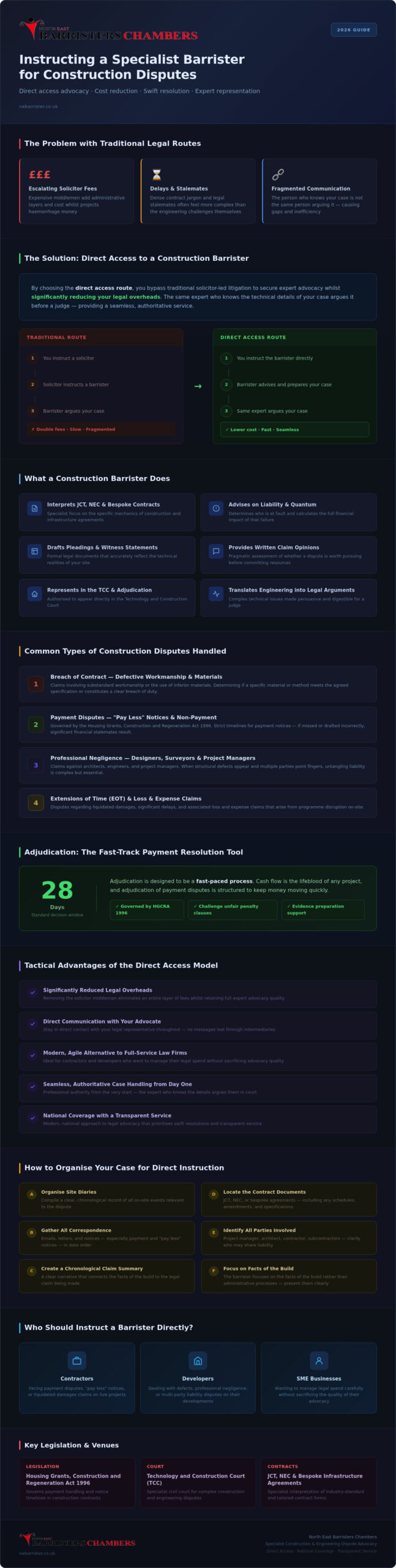
In this 2026 guide, I will show you how to resolve these conflicts efficiently by instructing a specialist barrister for construction disputes directly. By choosing the direct access route, you can bypass traditional solicitor-led litigation to secure expert advocacy while significantly reducing your legal overheads. I will walk you through the practical steps of engagement, the benefits of direct communication with your advocate, and how this modern approach ensures your case is handled with professional authority from the very start. Discover how to regain control of your project and protect your bottom line by working directly with a courtroom expert.
Key Takeaways
- Learn how instructing a specialist barrister for construction disputes directly provides the technical expertise needed to interpret complex JCT and NEC contracts.
- Discover the significant cost savings available by removing the solicitor middleman and communicating directly with your advocate.
- Identify the critical steps to organise your site diaries and correspondence to create a clear, chronological summary of your claim.
- Understand how to resolve common payment issues, including “pay less” notices and workmanship claims, through expert civil court representation.
- Explore the benefits of a modern, national approach to legal advocacy that prioritises swift resolutions and transparent service.
What is a Barrister for Construction Disputes?
I often meet clients who feel buried under a mountain of site reports and conflicting contract clauses. A barrister for construction disputes is a specialist advocate who cuts through that noise. I focus specifically on the complex intersection of construction law and dispute resolution, providing the technical and legal clarity needed to move a project forward. My role is to act as your senior legal representative, offering a level of expertise that goes beyond general civil litigation.
Unlike generalist practitioners, I spend my time interpreting the specific mechanics of JCT, NEC, and bespoke infrastructure contracts. This involves providing tactical advice on liability and quantum; essentially, I determine who is at fault and calculate the financial impact of that failure. I am authorised to represent you directly in the Technology and Construction Court (TCC). This ensures that the person who knows the technical details of your case is the same person arguing it before a judge, providing a seamless and authoritative service.
The Role of a Construction Barrister
My work begins long before we step into a courtroom. I draft formal legal pleadings and witness statements that accurately reflect the technical realities of your site. I also provide written opinions on the strength of your claim, giving you a pragmatic assessment of whether a dispute is worth pursuing. Whether it is an adjudication, arbitration, or a full court hearing, I provide the senior-level advocacy required to protect your interests. I focus on translating complex engineering issues into persuasive legal arguments that a court can easily digest.
When to Instruct a Barrister Directly
You don’t always need a full-service law firm to handle a claim. Instructing a barrister for construction disputes directly is particularly effective when a project faces liquidated damages or significant delays. If you are dealing with alleged professional negligence from an architect or engineer, I can provide the direct, expert guidance you need. It is a modern, agile alternative that reduces overheads whilst keeping you in direct contact with your legal representative. This model is ideal for contractors and developers who want to manage their legal spend without sacrificing the quality of their advocacy. I provide a straightforward path to resolution, focusing on the facts of the build rather than administrative processes.
Common Types of Construction and Engineering Disputes
Whilst international energy projects often dominate legal headlines, I find that most friction occurs within domestic and SME-level construction. These conflicts aren’t just about massive infrastructure; they’re about the daily reality of substandard workmanship, failing materials, and delayed timelines. When you’re managing a build, a breach of contract regarding the quality of work can halt everything. I help clients determine if a specific material or method meets the agreed specification or if it constitutes a clear breach of duty.
Typical issues I handle as a barrister for construction disputes include:
- Breach of contract claims involving defective workmanship or the use of inferior materials.
- Payment disputes, particularly those involving “pay less” notices and non-payment of invoices.
- Professional negligence claims against designers, surveyors, and project managers.
- Disputes regarding extensions of time (EOT) and associated loss and expense claims.
Contractual and Payment Disputes
Cash flow is the lifeblood of any project. I often see disputes arise from a misunderstanding of the Housing Grants, Construction and Regeneration Act 1996. This legislation governs how payments must be handled, including the strict timelines for issuing payment and “pay less” notices. If a notice is missed or drafted incorrectly, it can lead to significant financial stalemates. I provide strategic advice on adjudicating these payment disputes quickly to keep your cash flow moving. Adjudication is designed to be a fast-paced process; I help you prepare the necessary evidence to secure a decision within the standard 28-day window. I also help clients challenge unfair contract terms or penalty clauses hidden in bespoke agreements. If you are facing a payment deadlock, I can provide expert advocacy for your claim to resolve the matter efficiently.
Defects and Professional Negligence
Identifying liability in complex multi-party projects is rarely straightforward. When a structural defect appears, the project manager, architect, and contractor often point fingers at each other. I help you untangle these relationships to find exactly where the liability lies. This involves assessing the “standard of care” expected from a professional in their specific field. If a designer or surveyor has failed to meet this standard, you may have grounds for a claim. For a deeper look at this area, you can read my Professional Negligence Barrister Guide. I focus on providing a clear path through these technical arguments, ensuring you aren’t left carrying the cost of someone else’s mistake.
Tactical Advantages of the Direct Access Model
Direct access is a strategic shift in how you manage legal risk. When you hire a barrister for construction disputes directly, you remove the administrative layers that often slow down decision-making. I work with you to build a strategy that is both legally sound and commercially sensible. This direct line of communication ensures that the advocate standing in court has a first-hand understanding of your project’s specific pressures. It allows for a level of agility that traditional law firms often struggle to match, especially when project deadlines are looming.
I find that many clients value the transparency this model provides. You aren’t just a file number; you’re a partner in the litigation process. As your barrister for construction disputes, I provide the senior-level advocacy you need whilst keeping you fully informed of every tactical move. This approach eliminates the “ivory tower” perception of the Bar, replacing it with a pragmatic, service-oriented mindset that prioritises your project’s success.
Reducing Legal Costs for UK Businesses
The most immediate benefit is the impact on your bottom line. Bypassing a solicitor can effectively halve the hourly rate of your legal team. In the traditional model, you often pay for a solicitor to manage the file and a barrister to argue the case. Direct access allows you to focus your budget on high-level advocacy and specialist advice rather than administrative overheads. I often work on a fixed-fee basis, providing the budget certainty that developers and contractors require. This transparency is vital in an industry where margins are already tight. You can find more detail on how this works in my Reduce UK Legal Costs guide.
Strategic Focus and Personal Accountability
In a standard legal setup, technical details can get lost in translation as information passes from site managers to solicitors and finally to counsel. By speaking with me directly, you ensure that I understand every technical nuance of your site diaries and contract variations. I take personal responsibility for the success of your case. This direct link creates a higher level of accountability and allows for rapid action. If you need an urgent injunction to stop work or a quick response to a surprise adjudication notice, I can act immediately without waiting for a third party to relay instructions.
My focus is on aligning legal strategy with your commercial goals. I don’t just look at the law; I look at how a resolution affects your project timeline and future partnerships. This pragmatic approach ensures that we aren’t just fighting for the sake of it, but working towards a result that makes business sense. It provides clarity and relief in what is often a stressful and complex process.
How to Organise Your Case for Direct Instruction
I often tell my clients that the more work they do at the start, the less they pay in the long run. To instruct a barrister for construction disputes effectively, you need to become the curator of your project’s history. This isn’t just about filing papers; it’s about presenting a narrative that I can use to defend your position or launch a claim. I need to see the “story” of the site through your documents. Start by gathering your original JCT or NEC contract, any formal variations, and your site diaries. These diaries are often the deciding factor in delay claims, as they provide a contemporaneous record of what actually happened on the ground.
You also need to be clear about your objectives. Are you seeking a specific financial remedy for unpaid work, or are you defending against a liquidated damages claim? Once you have identified the outcome you want, you can contact the chambers to discuss your case. We will look at the facts together to ensure your dispute is suitable for the direct access scheme. This initial preparation ensures that when we speak, we are focusing on strategy rather than searching for missing emails.
Preparing Your Case Bundle
Your bundle should be a logical collection of evidence rather than a disorganised folder of files. I need to see high-quality photos of any alleged defects, all relevant email correspondence, and any expert reports from surveyors or engineers. In construction litigation, the timeline is your most powerful tool. It allows me to pinpoint exactly when a delay occurred and who was in control of the site at that moment. A well-organised bundle reduces barrister review time and ensures I can provide an accurate legal opinion without unnecessary delay.
The Direct Access Suitability Check
I believe in being transparent about the limitations of the direct access model. Whilst it is an excellent fit for many construction and engineering disputes, some cases still require the support of a solicitor. If your matter involves exceptionally heavy litigation support or requires a large team to manage thousands of physical documents, I have a professional duty to inform you if direct instruction is not appropriate.
We will use an initial consultation to determine the scope of work and the complexity of the legal issues. If the case is a good fit, I can provide a clear, fixed-fee quote for the work required. If you are ready to move forward, you can contact the chambers today to discuss your dispute and begin the suitability check. This straightforward process ensures you get the right level of advocacy for your specific needs.
Expert Advocacy with North East Barristers Chambers
I provide specialist representation in all UK civil courts and tribunals, focusing specifically on the needs of those navigating the complexities of construction law. My approach is built on approachable pragmatism. I don’t just quote statutes; I provide a results-driven strategy designed to get your project back on track. I believe that a barrister for construction disputes should be as grounded as the projects they represent. By offering transparent fee structures, I ensure that you receive high-level advocacy without the hidden costs often associated with traditional legal sets.
My service is truly national. I am a mobile practitioner who understands that construction disputes aren’t solved solely behind a desk. I am always willing to travel for site visits or hearings across the United Kingdom. Seeing a structural defect or a site delay first-hand allows me to build a more persuasive case for the courtroom. This hands-on involvement ensures that no technical detail is overlooked during the litigation process. It also builds a stronger connection between us, as you’ll be working directly with the advocate who will argue your case in front of a judge.
A Modern Approach to Legal Services
North East Barristers Chambers combines traditional excellence with 21st-century accessibility. I have built this practice to be agile and responsive, moving away from the detached nature of traditional legal communications. I prioritise Direct Access Barrister Services because they offer a more efficient route for commercial disputes. This model allows me to act as a friendly guide through what can otherwise be an intimidating process. I am an independent expert who works for you, providing the clarity and relief you need when legal stalemates threaten your business.
This modern approach means I am accessible and flexible. I don’t hide behind layers of administration. Instead, I offer a direct line of communication that ensures your commercial goals are always at the centre of our strategy. By choosing a chambers that embraces the direct access model, you’re choosing a partner who values your time and your budget as much as you do.
Securing Your Professional Representation
Starting the instruction process is simple and transparent. You can contact the chambers today to discuss the details of your claim and determine the best way forward. I am committed to providing clear, jargon-free communication throughout your entire case. You won’t find any archaic legalese here; I use plain English to explain your options and the risks involved. This commitment to transparency ensures you are always in control of your legal journey. If you are ready to move past a project deadlock, you can Instruct a barrister for your construction dispute now. I will provide the expert advocacy and professional authority needed to secure a swift and cost-effective resolution.
Take Control of Your Construction Claim
Resolving engineering and infrastructure conflicts doesn’t have to be a slow, expensive process that drains your project’s resources. By choosing the direct access model, you bypass unnecessary administrative layers and gain a direct line to the advocate who will fight your corner. I’ve shown how organising your site diaries and contracts is the first step towards a more cost-effective resolution. Whether you are dealing with a payment deadlock or a breach of contract, instructing a specialist barrister for construction disputes ensures your case is built on professional authority and technical precision.
I provide specialist civil law advocacy with national UK coverage, ensuring you have expert representation regardless of your project’s location. As a direct public access certified practitioner, I am here to provide the clarity and relief you need to move past legal stalemates. Don’t let a dispute derail your progress any longer. You can instruct an expert barrister for your construction dispute today to secure a pragmatic, results-driven outcome. I look forward to helping you protect your business and your bottom line.
Frequently Asked Questions
Can I hire a barrister for a construction dispute without a solicitor?
Yes, you can instruct a barrister for construction disputes directly through the Public Access scheme. This allows you to bypass the requirement for a solicitor, saving you the additional overhead of a second legal team. I work directly with contractors, developers, and homeowners to provide specialist advocacy. Whilst solicitors focus on file management, I provide the senior-level advice and court representation needed to resolve the conflict efficiently.
How much does a barrister for construction disputes typically cost?
Fees vary based on the complexity of the case and the volume of documentation involved. I typically work on a fixed-fee basis for specific stages of work, such as drafting a claim or representing you at a hearing. This provides businesses with greater budget certainty compared to the uncapped hourly rates often found in traditional law firms. I will provide a clear, transparent quote after an initial review of your case details.
What is the difference between a construction solicitor and a barrister?
A solicitor generally handles the day-to-day administration, correspondence, and gathering of evidence. In contrast, a barrister is a specialist advocate who focuses on the legal strategy and represents you in court or tribunals. By instructing me directly, you are hiring the person who will actually argue your case. This removes the middleman and ensures your strategy is delivered with professional authority by a specialist in construction law.
Can a direct access barrister help with construction adjudication?
Yes, I frequently assist clients with construction adjudication, which is a fast-paced process designed to resolve disputes within 28 days. I can help you draft the Referral Notice or the Response, ensuring your technical arguments are framed correctly under the Housing Grants, Construction and Regeneration Act 1996. My role is to provide the tactical advice needed to secure a favourable decision quickly, helping you maintain vital project cash flow.
What documents do I need to provide to a construction barrister?
You should provide a comprehensive bundle including the original contract, such as JCT or NEC, site diaries, and all formal correspondence regarding the dispute. Photos of defects and any expert reports from surveyors are also essential. A clear, chronological timeline of events helps me understand the history of the build. Providing these documents in an organised manner allows me to review your case quickly and provide accurate advice on the merits of your claim.
How long does it take to resolve a construction dispute through a barrister?
The timeline depends on the dispute resolution method chosen. Adjudication can provide a result in as little as 28 days, whilst court proceedings in the Technology and Construction Court may take several months or longer. My goal as a barrister for construction disputes is always to find the swiftest route to a resolution, whether through a negotiated settlement or formal advocacy. I provide a pragmatic assessment of timelines at the start so you can plan accordingly.
Will a barrister represent me in the Technology and Construction Court (TCC)?
Yes, I am authorised to provide court representation in the Technology and Construction Court and other civil tribunals across the UK. I handle all aspects of the hearing, from opening statements to the cross-examination of technical experts. This ensures that the specialist who helped build your legal strategy is the same person presenting it to the judge, providing a consistent and authoritative presence throughout the entire litigation process.
Is direct access suitable for complex multi-million pound claims?
Direct access is often suitable for high-value claims, provided you can manage the basic administrative tasks yourself. However, if a case involves thousands of documents or requires extensive litigation support, I have a professional duty to advise you if a solicitor is also needed. I assess every case on its individual merits during our initial consultation to ensure that the direct instruction model is the most effective way to protect your interests.