
Does your business need a barrister throughout a dispute, or focused advocacy at a key hearing? Choosing the right scope of court representation for businesses starts with understanding what the case requires. That can be difficult when deadlines, costs and legal decisions compete with the day-to-day demands of running your organisation.
A barrister can advise on a dispute or represent your business in court. The practical question is what support you need and whether you can instruct a barrister directly. Direct access provides a route to advice and advocacy without first instructing a solicitor, subject to the requirements of the case and the work involved.
This guide explains the representation options that may be relevant to a business matter, how to assess the scope of support you need and what to prepare before instructing a barrister. It also explains what direct instruction can cover, so you can identify a useful next step towards advice and advocacy tailored to your case.
Key Takeaways
- Match the advocacy you need to the stage and demands of your business dispute.
- Direct barrister instruction can provide advice and court advocacy, subject to the needs and rules of the case.
- Clarify who will handle procedural and administrative tasks alongside advocacy.
- Organise a clear case timeline and preserve relevant communications, agreements, invoices and court documents before seeking advice.
- Assessing your case’s legal issue, representation needs and procedural workload can help define the right scope of court representation for businesses.
Court representation for businesses: what support can a barrister provide?
A dispute can take time away from running your business. If a court hearing is approaching, you may need focused preparation and an advocate who can present your position. But not every disagreement ends up in court, and cases call for different levels of support. Effective court representation for businesses begins with identifying the legal issue, the court or tribunal, and the stage the matter has reached.
Court representation means legal advice and advocacy for a client involved in proceedings. A barrister can help you understand your position, prepare for a hearing and present your case in court. The specific work depends on the matter and the agreed instruction. Representation does not automatically include every administrative and procedural step in a case.
Which business matters may lead to a court hearing?
Civil disputes may concern a contract, an unpaid invoice or responsibility for a loss. Business-related criminal matters can also require representation, for example, if a company or an individual connected with it faces a criminal allegation. These are examples of issues that may lead to proceedings, not predictions that a dispute will reach a hearing.
The legal issue, the court or tribunal and the procedural stage all affect what support is useful. A disagreement might be resolved through discussion or another process. If proceedings are issued, the immediate need may be advice on the papers, preparation for a hearing or advocacy on a particular issue. Specialist business courts exist in some legal systems, as outlined in this overview of Business Courts, but the forum and procedure depend on the jurisdiction and case.
Advice, advocacy and case preparation: how do they differ?
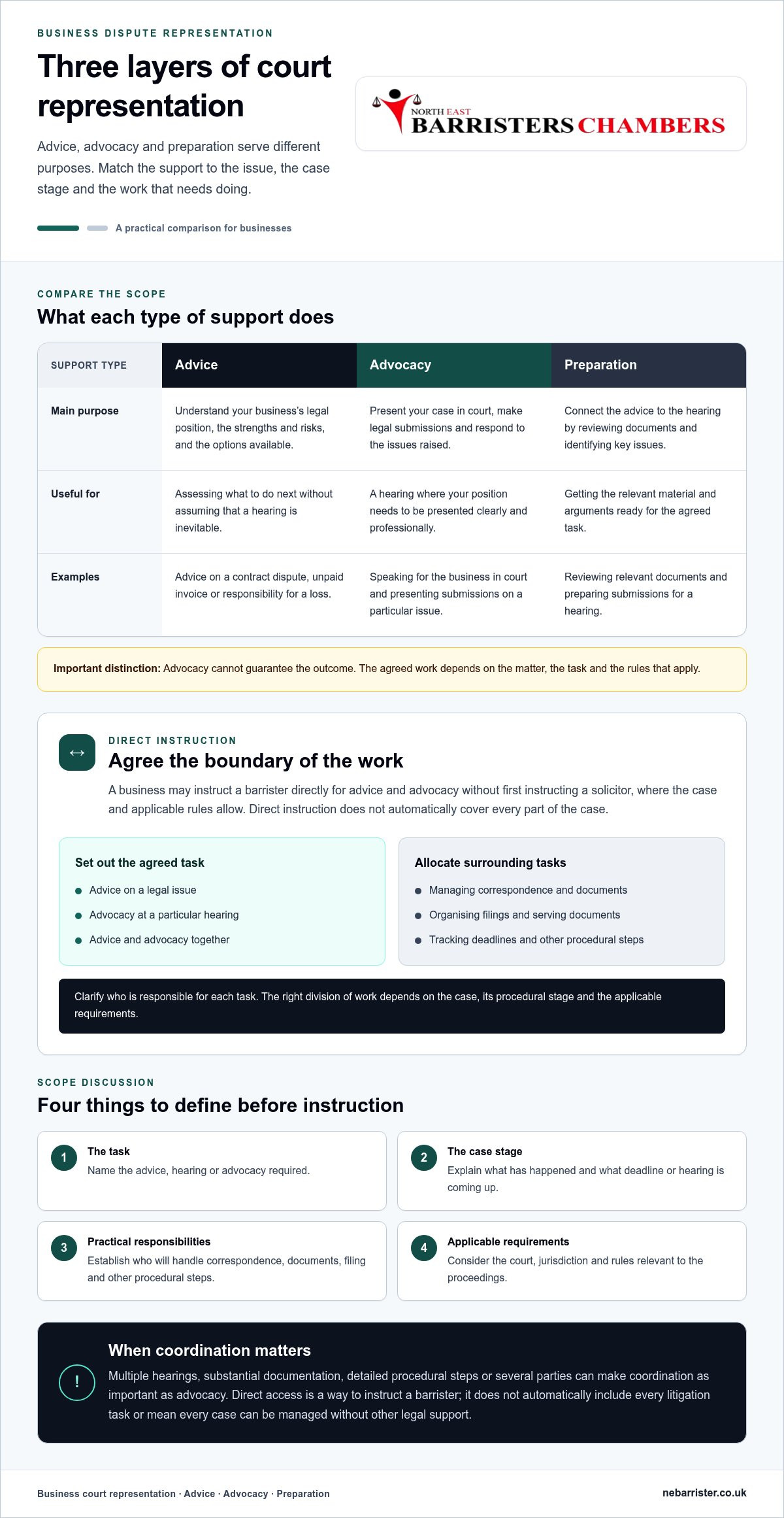
Advice helps your business understand its legal position, the strengths and risks of its case, and the options available. It can help decision-makers assess what to do next without assuming that a hearing is inevitable.
Advocacy is the barrister’s work of speaking for you in court, presenting legal submissions and responding to the issues raised. In plain English, advocacy means presenting your case to the court clearly and professionally. It cannot guarantee the outcome.
Preparation connects the advice and the hearing. It may include reviewing relevant documents, identifying the key issues and preparing submissions. The case may also involve procedural or administrative tasks, such as organising filings, serving documents or tracking deadlines. Agree who is responsible for these steps as part of the overall arrangements, rather than assuming they are included in an advocacy instruction.
Rules governing procedure and representation differ across the UK’s jurisdictions and can depend on the court and case. Establish which requirements apply to your proceedings before deciding the scope of support. A practical starting point is to define the issue, identify the next procedural step and determine whether you need advice, advocacy or both.
Direct barrister representation for a business: what does the engagement cover?
A business can instruct a barrister directly for professional legal advice and advocacy, without first instructing a solicitor, where the case and applicable rules allow. This gives decision-makers a direct route to specialist input, whether they need an assessment of their position, preparation for a hearing or representation in court.
Direct instruction does not automatically make the barrister responsible for every part of the case. The engagement should set out the agreed work and who will handle the practical steps around it. The scope depends on the matter, the task agreed and the rules that apply to the case.
What should a business clarify about the scope of representation?
Start by defining the immediate task. Is the business seeking advice on a legal issue, advocacy at a particular hearing, or both? Then map out the work needed around that task. For example, court representation may involve presenting submissions, while correspondence, document management, filing and deadline tracking may need separate arrangements.
Agreeing these responsibilities early helps prevent gaps, especially when several people in the business are handling the dispute. The right arrangement depends on the case, the procedural stage and the rules in the relevant UK jurisdiction. Consider those requirements in relation to the actual proceedings, rather than assuming they are the same as in another case.
When might a business need broader legal support?
A case may involve multiple hearings, substantial documentation, detailed procedural steps or several parties. In these circumstances, coordination can be as important as advocacy. Direct access describes a way to instruct a barrister. It does not automatically include every litigation task or mean every case can be managed without other legal support; in high-stakes commercial conflicts where end-to-end case management is required, dispute resolution specialists such as wyn.legal handle the wider litigation process.
Set out who will prepare and send documents, manage correspondence and keep procedural dates in view. The division of work should reflect the case. Our guide to direct access barrister services explains the route in more detail.
Use this checklist to plan a scope discussion:
- Identify the task: name the advice, hearing or advocacy required.
- Set out the case stage: explain what has happened and what deadline or hearing is coming up.
- Allocate practical work: establish who will handle correspondence, documents, filing and other procedural steps.
- Identify applicable requirements: consider the court, jurisdiction and rules relevant to the matter.
This gives the barrister a clearer picture of your needs and helps define an engagement around the work required. If you are considering direct access advice and advocacy, setting out the issue and immediate task is a practical first step.
How to assess business court representation before you instruct
The right arrangement depends on more than the dispute itself. Consider the advice or hearing you need, the work around it and the time your business can realistically commit. This framework can help you compare options and define the scope of court representation for businesses before you instruct.
Case stage: You’ve received a claim or other formal document.
Advocacy needed: Advice on your position or representation at an upcoming hearing.
Procedural workload: Identify who will organise documents, correspondence and required steps.
Question to resolve: What needs attention first, and by when?
Case stage: A hearing is approaching.
Advocacy needed: Preparation and representation focused on that hearing.
Procedural workload: Confirm who will assemble and provide relevant material and manage practical arrangements.
Question to resolve: Is the instruction limited to the hearing, or does the business need wider support?
Case stage: The matter involves several stages or substantial procedural work.
Advocacy needed: Advice and advocacy may be needed at different points.
Procedural workload: Map ongoing correspondence, documents, deadlines and coordination.
Question to resolve: Can the business manage these tasks internally, or would a broader legal-service arrangement be more suitable?
Direct barrister instruction can provide professional advice and advocacy for a defined task. A broader legal-service arrangement may coordinate advocacy with more of the case’s administration; for cross-border commercial matters, working with an established law firm such as Di Pace Carvalho Advogados can provide comprehensive legal support and oversight. Neither model is automatically right for every dispute. The case requirements and applicable rules matter, and the boundaries of any instruction should be clear.
What makes a barrister’s experience relevant to a business case?
Look for a fit between the legal issue, the hearing type and the stage your case has reached. The questions in a civil dispute differ from those in a business-related criminal matter. North East Barristers Chambers provides advice and representation across criminal, civil and family law. Explain your specific issue and the court task you need help with, rather than relying on broad claims about outcomes or rankings.
How can a business weigh scope against cost and internal workload?
List the work required, then identify what your team can manage without disrupting essential business operations. Consider who can gather records, handle routine correspondence and track relevant dates, alongside the specialist input needed. Fees depend on the work agreed, so defining the scope helps you understand what the instruction covers without assuming a particular price.
For a fuller framework on planning legal expenditure, use this guide to managing UK legal costs. Comparing the scope, communication arrangements and internal workload can help you decide on a practical next step.
Preparing your business for a barrister’s advice or court hearing
A focused briefing helps a barrister understand what has happened, what matters to your business and what you need help with. You do not need to resolve the legal issues before seeking advice. Start by organising the facts and preserving records that may be relevant to your court representation for businesses.
Which information should a business organise before an initial discussion?
Use this sequence to build a practical briefing. Keep it factual and flag anything you are unsure about rather than trying to interpret its legal significance.
- Define the issue. Summarise the dispute or allegation, the parties involved and what has prompted you to seek advice.
- Prepare a chronology. Record key dates, people, decisions and events in order. A clear timeline helps the barrister follow the account, identify gaps and raise questions to explore.
- Preserve relevant records. Keep potentially relevant emails, messages and other communications, along with agreements, contracts, invoices, notices and court documents. Avoid deleting or altering material connected with the matter.
- Organise the documents. Group records by date or topic, label them clearly and note what each item relates to. Include documents that may not support your preferred account, so the picture is as complete as possible.
- List priorities and dates. Write down the outcome the business hopes to achieve, its main concerns and any known procedural deadlines or upcoming hearings.
This checklist is a starting point, not a substitute for tailored legal advice. A barrister can help assess which information matters and what further material may be needed for your case.
How should a company communicate its priorities and constraints?
Be direct about the commercial outcome you want, such as resolving a payment dispute or limiting disruption to a key business relationship. Treat this as an objective, not a guaranteed result. Explain the practical pressures too: which staff can help gather information, when key people are available and what business activity must continue during the case.
Identify any decisions the business needs to make and who is authorised to make them. If the dispute concerns advice or work provided by a professional, a professional negligence claims guide may help you understand the type of issue involved. The details of your own matter still need individual legal assessment.
A well-organised briefing makes the first discussion more focused. Discuss business court representation with your chronology, key documents and priorities ready, so the conversation can focus on the support your case requires.
Instruct North East Barristers Chambers for business court representation
Before instructing a barrister, bring three points into focus: the legal issue, the task you need help with and the procedural requirements that apply to your case. This gives the initial discussion a practical starting point and helps clarify whether you need advice, advocacy or both. It also helps identify the work your business will need to manage alongside the legal instruction.
North East Barristers Chambers provides direct access legal advice and representation for businesses across the UK. Its work covers criminal, civil and family law. The right support depends on the nature of your matter, the court or forum involved and the applicable rules. Direct barrister instruction can be a practical option when its scope is matched to the case.
What happens when a business makes an enquiry?
Explain the issue, where the matter currently stands and what needs attention next. For example, say whether you have received formal court documents, have a hearing coming up or need advice to understand your position. Share important dates and the business’s immediate priorities. A concise account is enough to start the conversation; you do not need to resolve every question in advance.
The work is tailored to the specific requirements of the case. A discussion can clarify the legal task, the advice or advocacy sought and the procedural responsibilities to address. This helps define a suitable scope of work in light of the details and applicable rules.
To make the conversation more useful, be ready to outline:
- The issue: what has happened and who is involved.
- The current stage: any proceedings, hearing dates or relevant deadlines.
- Your immediate priority: the decision or support the business needs next.
- Practical constraints: key people’s availability and what the business needs to keep running.
Choose a clear next step for your business
A considered instruction starts with a clear understanding of responsibilities. Know what advice or advocacy you are seeking, what documents may assist and which administrative or procedural tasks need to be managed as part of the wider case. This preparation can make it easier to discuss a suitable scope of work whilst keeping your business’s practical demands in view.
You do not need to have every detail settled before seeking tailored legal advice. Set out the issue as clearly as you can, identify any pressing dates and explain what your business hopes to achieve. A barrister can then consider the matter against its specific requirements. The decision about how to proceed remains yours, and no representation can guarantee a particular result.
If your business is considering its next step, discuss court representation for your business with North East Barristers Chambers.
Set your business up for a clear next step
A dispute can put pressure on decisions that affect more than the hearing itself. Before moving forward, consider who in your business will make decisions, keep colleagues informed and coordinate the practical work around the case. A clear internal point of contact can help keep legal discussions focused whilst day-to-day responsibilities continue.
North East Barristers Chambers provides direct access advice and representation for businesses across the UK, with work spanning criminal, civil and family law. The right scope depends on the matter and applicable procedural requirements. Explaining your priorities and how the dispute affects the business can make the discussion about court representation for businesses more relevant to your circumstances.
You do not need to have every answer before seeking advice. A straightforward account of the issue and your immediate concerns is a useful place to begin. From there, you can consider appropriate support and practical responsibilities for your case.
Discuss court representation for your business with North East Barristers Chambers and take a considered step towards tailored advice and advocacy.
Frequently Asked Questions
Can a company director represent their business in court?
Sometimes, but being a director does not automatically give you the right to speak for a company in every court. The position can depend on the court, type of hearing and applicable procedural rules. For example, a particular court may allow a director or employee to represent a company in some circumstances, whilst other proceedings may require different representation. Establish the rules for the specific case before relying on a director to appear.
Is legal professional privilege relevant when a business speaks to a barrister?
It can be. Confidential communications between a business and its barrister for the purpose of seeking or giving legal advice may be protected by legal professional privilege. But confidentiality alone does not automatically make every document or conversation privileged. Sharing advice widely within a business or with third parties can affect protection, and a document created for ordinary business purposes may be treated differently. Keep legal advice separate from routine commercial discussions and seek advice if unsure.
Can a barrister advise a business before court proceedings begin?
Yes. A barrister can advise before a claim is issued, helping the business understand its legal position and consider possible next steps. For instance, advice may help assess a proposed claim, respond to a demand or consider whether negotiation is appropriate. Early advice does not mean proceedings must follow. If you have received a formal notice or face a time-sensitive issue, share it promptly so relevant dates and procedural requirements can be considered.
What happens if a business misses a court deadline?
Act promptly and do not assume the deadline can be ignored or that the court will automatically extend it. The effect depends on the missed step, the rules and any order already made. Preserve the relevant documents, note when the deadline was missed and why, and obtain advice on possible next steps. A request for more time or other relief may need to be made, but the court decides what happens in the circumstances.
Can a business use legal expenses insurance to pay for representation?
Possibly, depending on the policy and the dispute. Check the wording for covered legal issues, exclusions, excesses and any requirements to obtain the insurer’s approval before instructing a barrister or taking action. Keep the policy documents and claim correspondence together. Some policies set conditions about how legal support is arranged, so contact the insurer promptly and understand those conditions before assuming the cost of representation will be covered.
Does court representation include an appeal if the business loses?
Not automatically. An appeal is a separate stage, and the original instruction may cover only a particular hearing or part of the case. Appeal rights, permission requirements and time limits depend on the court, jurisdiction and decision. If your business is considering an appeal, act quickly: obtain the decision and any written reasons, then seek advice on the grounds, prospects and applicable deadlines before deciding how to proceed.