
What if a will feels deeply unfair, but that alone isn’t a legal reason to set it aside? If you’re looking for challenging a will UK grounds, it helps to separate a concerning outcome from evidence of a legal defect. It’s understandable to question a decision that seems out of character or leaves someone close to the deceased with nothing, but suspicion and unfairness don’t automatically prove a will is invalid.
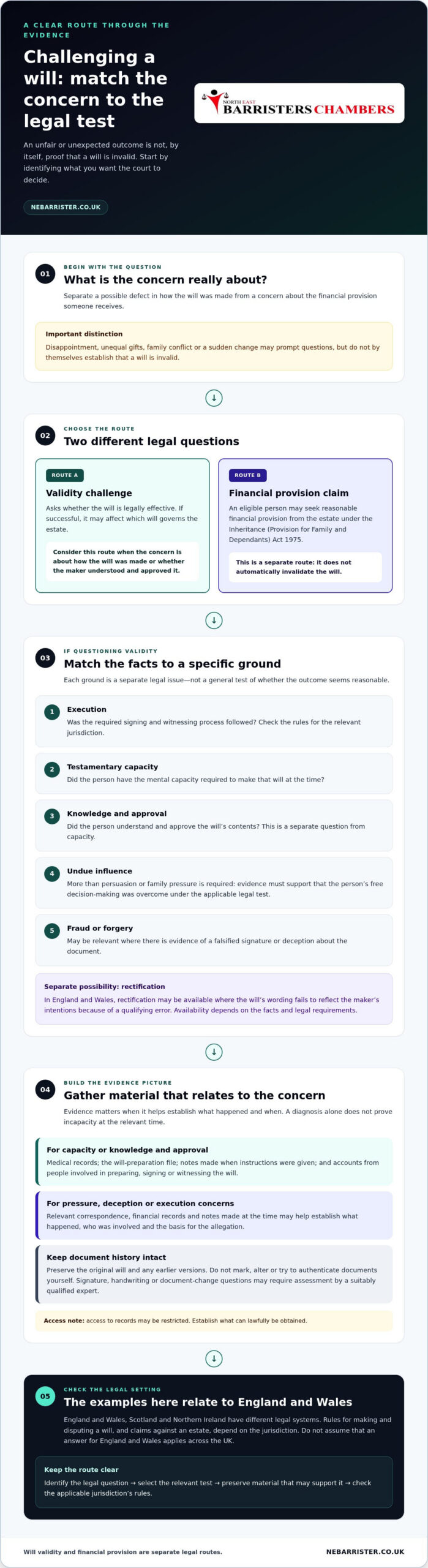
The first step is to identify which legal route may fit. A validity challenge might involve lack of testamentary capacity, undue influence, fraud or problems with signing and witnessing. A separate claim under the Inheritance (Provision for Family and Dependants) Act 1975 may seek reasonable financial provision, even if the will is valid.
This guide explains the main legal tests, the evidence that could matter and practical steps to take. It also covers deadlines, potential costs and why delay can make a dispute harder to resolve. The right approach depends on the facts and the relevant jurisdiction, so prompt, case-specific advice can help you assess the risks before deciding what to do next.
Key Takeaways
- An unexpected or unfair outcome may not, by itself, make a will legally invalid.
- Use the grounds covered here to identify which legal test may fit your concerns.
- Records and correspondence may help clarify what happened when the will was made.
- Organise key documents and dates, and avoid actions that could complicate a dispute.
- A barrister may advise on the merits or represent you. Direct access depends on the case and work required.
Challenging a will in the UK: what does a legal challenge involve?
A legal challenge to a will’s validity disputes whether it is legally effective. It is not simply a request to change an outcome because it seems unfair. The phrase challenging a will UK grounds also raises an important point: England and Wales, Scotland, and Northern Ireland have different legal systems. The rules for making and disputing a will, and for claims against an estate, depend on the jurisdiction. The examples below relate to England and Wales. Check the relevant rules before applying them elsewhere.
A will contest is a formal objection raised against the validity of a will. The legal issues can include whether the person had capacity or was pressured. Any concern needs to be assessed against the applicable law and supported by relevant facts.
Who may have grounds to challenge a will?
A family connection doesn’t automatically give someone a successful claim. Whether you can bring a case depends on the type of claim, your legal interest and the applicable jurisdiction’s rules. Someone named in the current will may be affected if it is found invalid. A person who would benefit under an earlier will may also have an interest in disputing a later one. A potential dependant may instead consider a claim for financial provision, if eligible. These routes have different requirements.
Is an unfair will automatically invalid?
No. Disappointment, unequal gifts and family conflict may explain why a will is questioned, but they don’t by themselves establish a legal defect. In England and Wales, a person generally has freedom to choose who receives their estate, subject to certain claims for reasonable financial provision. Scotland has distinct rules, including potential legal rights for certain close family members. Northern Ireland has its own legal framework too. Don’t assume an answer for England and Wales applies across the UK.
A sudden change or the exclusion of a close relative may be a reason to ask questions, but it is not proof that the will is invalid. First identify whether the concern is about how the will was made or about the provision someone receives from the estate.
Validity challenge: asks whether the will is legally effective. If successful, it may affect which will governs the estate.
Financial provision claim: seeks reasonable provision from the estate for an eligible person. It does not automatically invalidate the will.
What are the main grounds for challenging a will, and what evidence matters?
The relevant grounds depend on the jurisdiction. The examples below relate to England and Wales. Scotland and Northern Ireland have different rules, so check the applicable law before relying on them. In England and Wales, a will may be challenged over execution, testamentary capacity, knowledge and approval, undue influence, or fraud and forgery. Each is a separate legal issue, not a general test of whether the outcome seems reasonable.
Execution: a challenge may question whether statutory signing and witnessing formalities were followed. Check the requirements for the relevant jurisdiction rather than assuming the process is the same across the UK. Capacity: the question is whether the person had the mental capacity required to make that will at the time. Knowledge and approval is a separate issue: did the person understand and approve the will’s contents? A person might have capacity but still have a genuine issue about whether they knew what the document said.
Undue influence means more than persuasion or family pressure. The evidence must meet the applicable legal test and support the allegation that the person’s free decision-making was overcome. Fraud or forgery may be relevant if, for example, there is evidence that a signature was falsified or the person was deceived about the document. In England and Wales, rectification may be a separate possibility where the will’s wording fails to reflect the maker’s intentions because of a qualifying error. Its availability depends on the facts and legal requirements.
What evidence may support a capacity or knowledge-and-approval challenge?
Potentially relevant material includes medical records, the will-preparation file, notes made when instructions were given, and accounts from people involved in preparing, signing or witnessing the will. Access to records may be restricted, so establish what can lawfully be obtained. A diagnosis alone doesn’t prove incapacity at the relevant time. The person’s abilities and circumstances when the will was made matter.
How can evidence of undue influence, fraud or execution problems help?
Keep relevant correspondence, financial records and notes made at the time. They may help establish what happened, who was involved and the basis for any allegation of pressure or deception. Preserve the original will and any earlier versions. Don’t mark, alter or try to authenticate documents yourself. Questions about signatures, handwriting or document changes may require assessment by a suitably qualified expert.
Key point: each ground requires evidence relevant to its own legal test. Financial provision is a different route from invalidating a will. In England and Wales, eligible applicants may consider the Inheritance (Provision for Family and Dependants) Act 1975.
If the documents raise specific concerns, a barrister may be able to advise on the merits and evidence. Read about direct access barrister advice.
Will challenge or Inheritance Act claim: which route fits the problem?
The right route depends on what you want the court to decide. A validity challenge argues that a will, or part of it, should not take effect because of a legal defect. A financial provision claim accepts that the will may be valid but asks whether the estate should provide more for an eligible person. This distinction is central to understanding challenging a will UK grounds. The Gazette also outlines common grounds for challenging a will.
| Question | Validity challenge | Financial provision claim |
|---|---|---|
| Legal objective | Dispute whether the will is legally effective. | Seek reasonable financial provision from the estate, not automatic invalidation of the will. |
| Who may qualify? | Someone whose legal or financial interest may be affected, depending on the claim and applicable law. | In England and Wales, a person within a category set out in the Inheritance (Provision for Family and Dependants) Act 1975, subject to its criteria. |
| Typical evidence | Material about how the will was made, such as records relating to execution, capacity, instructions, influence or alleged fraud. | Evidence about the applicant’s relationship with the deceased, dependency and financial circumstances, alongside information about the estate. |
| Possible outcome | The will may be held invalid, which could affect whether an earlier will or intestacy rules apply. | The court may order financial provision if the legal test is met; the will is not thereby automatically invalidated. |
When might a validity challenge be the relevant route?
Consider this route if the concern is about the will-making process: whether signing and witnessing requirements were met, whether the person had capacity, whether they understood and approved the contents, or whether pressure, fraud or forgery affected the will. Evidence must relate to the relevant legal test. A sudden change or suspicious circumstance may justify investigation, but it does not prove wrongdoing or predict the outcome.
When might a financial provision claim be considered?
In England and Wales, the 1975 Act may allow eligible people, including certain family members and dependants, to seek reasonable provision. Eligibility depends on statutory criteria, not simply on being related to the deceased. The applicant’s financial position and the estate’s circumstances may be relevant, but neither guarantees an award.
Time limits can be strict. Under the Act in England and Wales, a claim generally must be issued within six months of the grant of probate or letters of administration. The court may permit a late claim, but an extension is not guaranteed. Check the grant date promptly. Scotland and Northern Ireland have different legal frameworks, so verify eligibility, deadlines and available remedies for the jurisdiction concerned.
How to assess a will challenge: evidence, deadlines and practical risks
Start with the practical facts before deciding whether to dispute the estate. The right procedure depends on where the deceased lived, where the will was made and which law applies. Scotland, Northern Ireland, and England and Wales have distinct rules. Advice based on the wrong jurisdiction can send you down the wrong route.
- Identify the jurisdiction. Note where the deceased lived and where the estate is being administered. Don’t assume that “UK” means one set of probate rules.
- Obtain the will and probate information. Keep a copy of the current will, any earlier versions available to you, and details of whether a grant has been issued.
- Record key dates. Note the date of death, when you received or discovered relevant information, and the date of any grant. These dates may matter for deadlines or the estate’s procedural position.
What documents should you gather before seeking advice?
Collect relevant correspondence, will-preparation records, medical or financial information you can lawfully access, and details of people who may have witnessed instructions or signing. Organise material by date and source. Write a factual timeline, separating what you saw or heard yourself from assumptions and second-hand accounts. Preserve originals and avoid annotating, altering or marking documents.
Keep communications measured. Don’t approach potential witnesses in a way that could be seen as pressuring them or shaping their account. Record their names and what they may know, then seek advice about appropriate next steps.
Why should you check time limits and procedural position early?
Different claims have different time limits. In England and Wales, a claim under the Inheritance (Provision for Family and Dependants) Act 1975 generally must be issued within six months of the grant of probate or letters of administration. Other claims and jurisdictions may follow different rules. Note the grant date and seek prompt advice. Don’t rely on a general online deadline to decide what applies to your case.
Check promptly whether a grant has been issued and whether a caveat or other step is appropriate. In England and Wales, a caveat can prevent a grant from being issued, but whether it is suitable depends on the circumstances and current procedure. It doesn’t resolve the dispute. Get case-specific advice before taking procedural action, particularly if the estate may soon be distributed.
Disputes can involve uncertain evidence, legal costs and lasting strain between relatives. These risks don’t mean a claim will succeed or fail. A focused review of the challenging a will UK grounds that may apply can help clarify what evidence is missing and which options are proportionate. For background on resolving disputes, see this guide to resolving probate and will disputes directly.
For an assessment of the legal merits or evidence, read about direct access barrister advice.
Getting advice on challenging a will: when a barrister may help
Once you’ve identified a possible legal issue, a barrister may help assess whether the evidence supports a recognised ground, explain the relevant legal test and outline procedural options. For example, they could consider how a will was prepared, whether records support a concern about capacity, or what evidence may be needed to address an allegation of undue influence. This advice can help you understand the strengths and gaps in the material without assuming that a dispute should go to court.
North East Barristers Chambers provides direct access legal advice and court representation in civil matters. A barrister may be instructed directly where the case and work are suitable. The proposed barrister must be able to accept the case under the applicable rules, and the work needed must be within the agreed scope. Read the UK direct access barrister guide for more information about direct instruction.
What can a directly instructed barrister do in a will dispute?
Depending on the case and agreed instructions, a barrister may review documents, advise on legal merits and evidence, and provide representation where appropriate. Be clear about whether the dispute concerns validity, financial provision or both. Establish what advice or advocacy is included and whether other professional support may be needed for tasks outside the barrister’s agreed role—such as when an estate involves corporate assets or commercial agreements where contract drafting support from MAR Legal may be required.
What should you ask before choosing professional support?
Be clear about responsibilities from the outset. Ask:
- Can the barrister accept this particular dispute under direct access rules?
- What documents should I provide, and what work will the instruction cover?
- Who will handle correspondence, court filings and any work outside that scope?
- How will costs be explained and managed as the matter progresses?
These questions help you understand the practical arrangement before committing to a course of action. For wider planning, see this guide to reducing UK legal costs.
You don’t have to decide immediately whether to litigate. A sensible next step is to organise the will, key dates and relevant records, then seek a focused view on which challenging a will UK grounds may apply. Explore direct access advice for your will dispute with North East Barristers Chambers.
Take a clear, informed next step
The key to assessing challenging a will UK grounds is matching your concern to the right legal route. A validity challenge questions whether the will is legally effective; a financial provision claim seeks reasonable provision for an eligible person. They require different evidence and can have different deadlines. The applicable rules also depend on whether the estate is being dealt with in England and Wales, Scotland or Northern Ireland.
Before acting, organise the will and relevant records, note important dates, and check whether probate has been granted. A barrister may help assess the legal merits, identify evidence to clarify and advise on advocacy where appropriate. Direct access depends on the case, work required and applicable rules.
North East Barristers Chambers provides direct access legal advice and court representation nationally, including in civil law matters. Discuss your will dispute with North East Barristers Chambers to explore the legal advice and representation available through direct access.
Frequently Asked Questions
Can I challenge a will in the UK if I have been left out?
Being left out of a will doesn’t automatically make it invalid. To challenge its validity, you need evidence supporting a recognised legal ground, such as defective execution, lack of testamentary capacity or undue influence. Depending on your relationship with the deceased and your circumstances, you may instead qualify to seek financial provision from the estate. Eligibility and legal tests differ across England and Wales, Scotland, and Northern Ireland, so establish which jurisdiction applies.
What are the main grounds for challenging a will?
Possible challenging a will UK grounds include failure to meet legal signing and witnessing requirements, lack of testamentary capacity, lack of knowledge and approval, undue influence, and fraud or forgery. In limited circumstances, rectification may also be available. The relevant route depends on the facts, evidence and applicable jurisdiction. An unequal distribution or a sudden change from an earlier will may raise questions, but neither proves a legal defect by itself.
Can you challenge a will because you think someone pressured the deceased?
You may be able to challenge a will if evidence supports an undue influence claim under the relevant legal test. Suspicion, persuasion or a close relationship alone may not be enough. Relevant material could include messages made at the time, accounts from people involved in the will-making process, or records that help explain events. These claims are fact-sensitive. Preserve what you have and seek case-specific legal advice before making accusations or contacting potential witnesses.
How long do you have to challenge a will in the UK?
There isn’t one deadline for every will dispute across the UK. In England and Wales, a claim under the Inheritance (Provision for Family and Dependants) Act 1975 generally must be issued within six months of the grant of probate or letters of administration. Other claims and jurisdictions may follow different rules. Note the grant date and seek prompt advice. Don’t rely on a general online deadline to determine the time limit for your case.
Can I contest a will before probate is granted?
Possibly, but the appropriate step depends on the dispute and jurisdiction. In England and Wales, a caveat may be relevant in some cases before a grant is issued. It can affect the probate process, so understand its purpose, consequences and what must follow before taking this step. Check whether a grant has been applied for or issued, and get prompt, case-specific advice if you’re concerned the estate may soon be administered.
Do I need a solicitor to challenge a will?
Not necessarily in every case. A barrister may be instructed directly to advise on the legal issues or provide representation where appropriate, but direct access depends on the case, work required and applicable rules. Establish who will handle documents, correspondence and court filings, and what tasks fall outside the barrister’s role. North East Barristers Chambers provides direct access advice and court representation.