
Could a driving allegation put more than your licence at stake? A possible ban or penalty points may affect your work, caring responsibilities and day-to-day plans. If you’re looking for a barrister for driving offences, you may be unsure how serious the allegation is, what happens next or what to prepare.
Court procedure and deadlines can feel unfamiliar. The right support depends on the allegation, the evidence and the stage your case has reached. A barrister can advise you on the legal issues and represent you in court. Direct access lets you instruct a barrister without first instructing a solicitor, although you may need to manage some case administration yourself.
This guide explains what a driving offences barrister can do, how to consider the right type of representation and what to organise before seeking advice. It also covers practical questions to clarify, including which documents to gather, how to track key dates and how to explain the impact a driving penalty could have on your responsibilities.
Key Takeaways
- An allegation isn’t a finding of guilt. Understand what you’re accused of before drawing conclusions about your licence or work.
- A barrister for driving offences can review your case, advise you or provide advocacy at a hearing, depending on the agreed scope.
- Direct access can provide advice or representation without a solicitor, but you may need to handle some correspondence, documents and procedural steps yourself.
- Note deadlines, keep official correspondence and relevant documents, and write down what happened while the details are clear.
- When seeking advice or representation, explain the allegation, the case stage and the help you need.
Facing a Driving Offence Allegation? Understand the Stakes Before Choosing a Barrister
A driving offence allegation can leave you wondering what will happen in court, whether you could lose your licence and how the case might affect your work. Before instructing a barrister for driving offences, identify the exact allegation, the stage the case has reached and the jurisdiction where it is being dealt with.
An allegation is not a finding of guilt. The prosecution must establish its case through the relevant legal process, and the outcome depends on the circumstances and evidence. Possible consequences vary according to the offence, the evidence, any relevant driving history and the law that applies. Don’t assume that allegations with similar labels will follow the same process or lead to the same result.
The law and procedure differ between England and Wales, Scotland and Northern Ireland. That matters when you read general guidance or prepare to discuss your case. Advice should reflect the jurisdiction where the allegation is being dealt with.
Which driving offences may call for specialist advice?
Motoring allegations include speeding, driving without insurance, drink or drug driving, careless driving and dangerous driving. Other examples include driving whilst disqualified and failing to identify a driver when required. Each allegation raises different factual and legal questions. The offence named in a notice or charge is an important starting point, but it does not by itself explain the strengths or issues in the case.
The seriousness and procedural route depend on the specific allegation and circumstances. Dangerous driving, for example, is distinct from careless driving; the Dangerous Driving Offences in the UK overview describes its legal context. Evidence may also need careful consideration, such as what a witness saw, what a camera recorded or how the police obtained information. Don’t predict a penalty from the offence label alone.
Why can a motoring case affect more than your licence?
A driving ban or other licence consequence may affect more than how you travel. If driving is part of your job, your ability to work could be affected. You may also rely on a car to care for someone, attend appointments or manage everyday responsibilities. Explain these circumstances when seeking advice, while bearing in mind that their relevance depends on the case and the applicable law. They don’t determine the legal outcome by themselves.
An allegation is not a conviction or court finding. It is a claim that must be dealt with through the relevant legal process. Keep that distinction in mind as you gather information. Note any court date or response deadline, retain official correspondence and make a clear record of what happened. The case stage, evidence and practical impact help you identify what to ask a barrister and what support you need.
How a Driving Offence Barrister Can Help at Each Stage
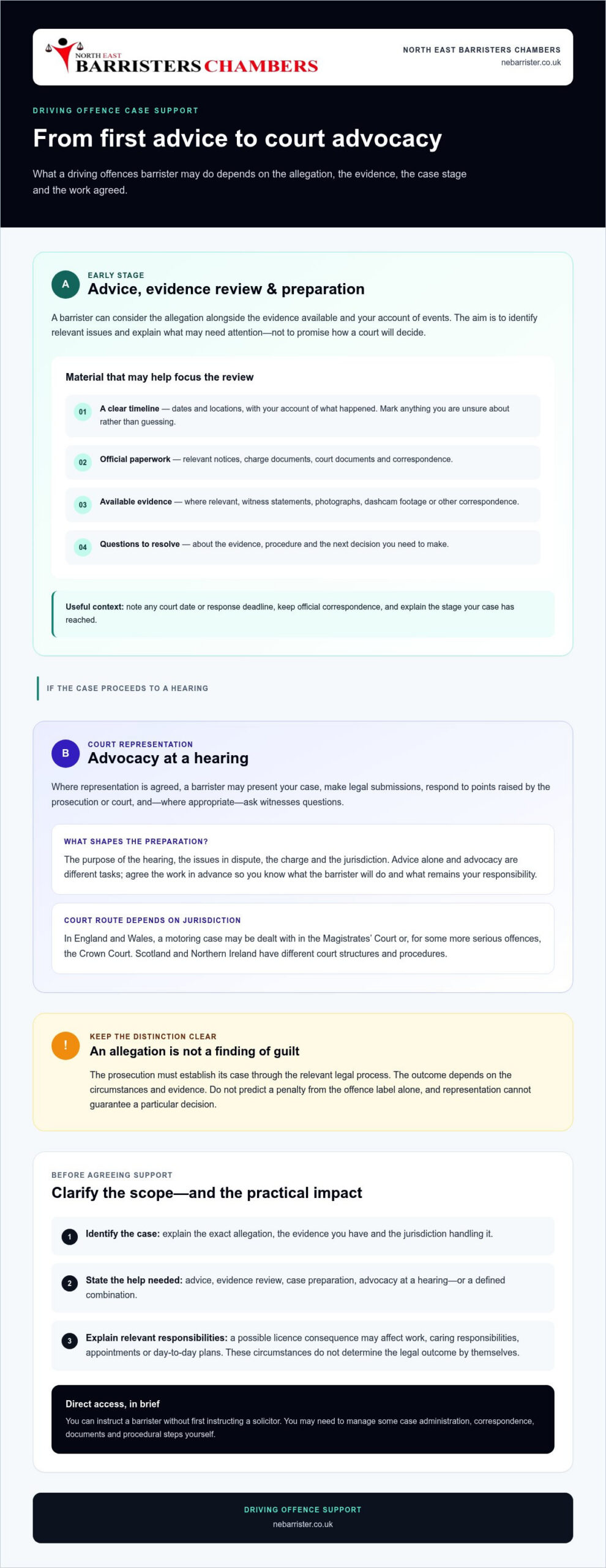
A driving offences barrister can advise on a motoring case and, where agreed, represent you in court. The work depends on what you need and when you seek help. Early advice may focus on understanding the allegation and evidence. If the case proceeds to a hearing, the work may include preparing and presenting your position to the court.
Advice and advocacy are different tasks. Advice involves examining the legal and factual issues and explaining your options. Advocacy involves speaking for you at a hearing, making submissions and, where appropriate, asking witnesses questions. Agreeing the work in advance helps you understand what the barrister will do and what remains your responsibility.
Advice, evidence review and case preparation
At an early stage, a barrister can consider the allegation alongside the available evidence and your account of events. Depending on the case, that material might include a charge or notice, witness statements, photographs, dashcam footage or correspondence. The purpose is to identify the relevant issues and explain what may need attention, not to promise how a court will decide.
Make the review more focused by preparing:
- A short timeline of events, including dates and locations.
- All relevant official correspondence and court documents.
- Your account of what happened, noting anything you’re unsure about rather than guessing.
- Questions about the evidence, procedure and the next decision you need to make.
This information helps the barrister explain which questions matter, what further material may be useful and how the case stage affects the work required. An initial advice discussion may need different preparation from a case listed for trial.
Advocacy in the Magistrates’ Court or Crown Court
Court representation is distinct from advice alone. At a hearing, a barrister may present your case, make legal submissions and respond to points raised by the prosecution or the court. The preparation depends on the hearing’s purpose and the issues in dispute. Representation cannot guarantee a particular decision.
In England and Wales, a motoring case may be dealt with in the Magistrates’ Court or, for some more serious offences, the Crown Court. Scotland and Northern Ireland have different court structures and procedures, so the same route does not apply across the UK. The charge and jurisdiction determine which court is involved and what procedure applies.
If you’re assessing the possible effect on your licence, GOV.UK provides information about UK driving penalties and bans. A barrister can explain how the relevant rules relate to your case. To discuss the work you may need, share the allegation, current stage and any hearing date when seeking direct access barrister advice.
Direct Access or a Solicitor: How to Decide What Your Driving Case Needs
Direct access lets you instruct a barrister yourself for legal advice or advocacy, without first instructing a solicitor. It can be a practical route in some driving cases. Whether it fits depends on the issues, the work required and whether you can manage the administrative steps that remain your responsibility.
The main difference is who coordinates the case. A barrister focuses on legal advice and courtroom advocacy within the agreed scope. In a solicitor-led route, the solicitor generally manages case administration and may instruct a barrister for specialist advice or a hearing. A barrister instructed directly does not automatically take on every task a solicitor might handle.
| Consideration | Direct barrister instruction | Solicitor-led route |
|---|---|---|
| Advice and advocacy | A barrister can advise you and represent you at an agreed hearing. | A solicitor may advise and manage the case, and may instruct a barrister for advocacy. |
| Case administration | You may need to manage some correspondence, documents and procedural steps yourself. | The solicitor generally coordinates case administration within the agreed service. |
| Practical fit | May suit a clearly defined need, such as advice on an issue or representation at a hearing. | May be more appropriate where the case needs continuing coordination or substantial administration. |
When might direct access be a practical route?
If you have a specific question about the evidence or need representation at a defined hearing, direct access may provide a focused way to obtain barrister input. A clear scope of work and confidence handling documents and deadlines can make this route easier to manage. Cases involving substantial ongoing administration may need a different arrangement. The criminal law court representation guide explains how direct instruction can work in practice.
Before choosing a barrister for driving offences, consider the case’s complexity, its current stage and the tasks still to be completed. Be realistic about the time you can give to correspondence, organising documents and meeting court deadlines. When seeking advice, describe the allegation and the work you need so the discussion can focus on whether direct access fits your case.
What should you clarify about scope and fees?
Before proceeding, make sure you understand what the agreed work covers and what it doesn’t. Clarify who will prepare or send documents, who will track key dates, whether the instruction includes advice, a hearing or both, and what happens if the case changes. Ask how the fee is calculated and what work could lead to additional charges. The direct access legal costs guide can help you understand the points to consider.
A clear division of responsibilities helps prevent missed tasks and mismatched expectations. Direct access provides a route to barrister advice and advocacy, but it does not automatically transfer every procedural responsibility. Confirm the scope in writing so you know what support you’re receiving and what you need to manage yourself.
How to Prepare Before Seeking a Driving Offence Barrister
An organised account helps a barrister understand your driving case and the support you’re seeking. Start with urgent dates, then gather the paperwork and note what happened. You don’t need to resolve every question before seeking advice. Keep your account factual, and mark anything you’re unsure about rather than filling gaps from memory.
For an initial case review, note the allegation, jurisdiction, current stage, key dates, relevant documents, your account of events and the help you need. This gives a barrister for driving offences a useful starting point and helps identify any information still needed.
Build a clear timeline and gather relevant paperwork
Write down events in chronological order. Include dates, locations, when you received correspondence and what happened at each stage. If you can’t remember an exact date, say so. A timeline can help distinguish what you recall directly from what you learned later.
Gather relevant material where available, such as:
- Notices, charge documents and letters from the court or police.
- Any hearing notice, including the date, time and court details.
- Relevant driving records or previous correspondence about the allegation.
- Documents or recordings connected with events, such as photographs or dashcam footage.
Keep original documents and recordings unchanged, and make copies for your own reference. Don’t delete, edit or withhold material. Evidence differs between allegations, so follow legal advice about what is relevant and how it should be disclosed. If a document appears incomplete or confusing, note the issue rather than altering it or treating your interpretation as a legal conclusion.
Identify the practical issues you need advice on
Record the current procedural stage and any date by which you’re expected to respond or attend court. Don’t ignore official correspondence or assume a deadline can be extended. If a date is unclear or close, flag it promptly when seeking advice. Include where the case is being dealt with, as procedures vary by jurisdiction.
Write down the questions you need answered. For example: What does the allegation mean? What happens at the next hearing? What documents should be available for review? Explain any practical consequences too, such as relying on driving for your employment, caring duties or regular travel. These details help frame the advice, although their relevance depends on the case and applicable law.
Direct access provides a route to barrister advice where it fits the case. Understanding the instruction process can help you organise your information and clarify the support you need. The direct access barrister guide explains the route in more detail.
Once your notes and documents are in order, discuss your driving allegation and the advice or representation you need.
Instruct North East Barristers Chambers for Driving Offence Advice or Representation
North East Barristers Chambers provides criminal law advice and court representation for driving offence matters through direct access. To begin a useful discussion, explain the allegation, the stage it has reached and the specific help you’re seeking. This gives the barrister a clearer picture of the work involved.
The right scope depends on the facts, the procedure and your needs. You may be seeking advice on a particular issue, help understanding the next step or representation at a hearing. These are different tasks. An enquiry is an opportunity to describe your situation and identify the support you want, not a guarantee of a particular outcome.
What to include when making an enquiry
Keep your initial summary brief and factual. Include the offence you’re accused of, the jurisdiction and any key dates. If a hearing is listed, give the date and court details shown on the notice. Mention any deadline in official correspondence, even if you’re unsure what action it requires.
State what you want advice or representation to cover. For example, you might need an initial view of the case materials or advocacy at an upcoming hearing. Explain any immediate practical concern, such as driving being important for work or caring responsibilities. That context can help shape a useful discussion about the case and the work required.
At the enquiry stage, provide enough information to identify the matter and its urgency. Avoid sending unnecessary sensitive personal information or large volumes of documents before receiving instructions about what is needed and how to provide it. Keep original records unchanged and retain copies of any correspondence you send.
Agree the work and take the next step
Before work begins, make sure you understand the proposed scope. Clarify whether the instruction covers advice, document review, preparation for a hearing or advocacy in court. Ask who is responsible for administrative tasks and key dates, and what you’ll need to do yourself. Direct access does not automatically transfer every case-management responsibility to the barrister.
Agree the fee basis and what the work covers before proceeding. If the case develops or you need additional support, clarify how a change to the instruction will be handled. Clear expectations help you understand the service and responsibilities from the outset. Representation can provide legal advice and advocacy, but no barrister can guarantee what a court will decide.
If you’re ready to discuss your driving allegation, its current stage and the assistance you need, contact the Chambers to take the next step.
Take the Next Step with a Clear Plan
You don’t need to resolve every uncertainty before seeking legal advice. Turn what you know into a clear account of the allegation, the current stage and the question you need answered. This gives the discussion a practical focus and helps identify the support that fits your circumstances.
North East Barristers Chambers provides direct access criminal law advice and court representation to individuals across the UK. If you’re considering a barrister for driving offences, the discussion can focus on your case and the work you need, without assuming a particular outcome.
Bring your key dates and relevant documents together, then take the next step. Discuss your driving offence case and representation options with North East Barristers Chambers.
Frequently Asked Questions
Can I instruct a barrister directly for a driving offence?
Yes. Direct access allows you to instruct a barrister without first instructing a solicitor. A barrister for driving offences can provide advice or court representation within the agreed scope. Before proceeding, clarify which administrative tasks you’ll need to manage and what documents the barrister needs to review.
Do I need a solicitor as well as a driving offence barrister?
No, you don’t automatically need a solicitor as well. You can instruct a barrister directly for agreed advice or advocacy. Under a direct access arrangement, the barrister doesn’t conduct litigation, so tasks such as managing court paperwork or serving documents may need to be handled separately. Consider whether you can manage those responsibilities, particularly if your case needs ongoing administration as well as specialist advocacy.
Can a barrister represent me in the Magistrates’ Court for a motoring offence?
Yes, a barrister can provide representation at a Magistrates’ Court hearing in England and Wales, subject to the case and agreed instruction. The type of hearing matters: an initial appearance, a trial and a sentencing hearing involve different preparation and advocacy. Check the court named on your paperwork and the hearing purpose. Court structures and procedures differ elsewhere in the UK, so jurisdiction matters.
What should I do after receiving a court letter about a driving offence?
Read the letter carefully and note any response date, hearing date, court details and instructions. Keep the complete letter, including any enclosures, and don’t assume you can miss a date or obtain an extension. If anything is unclear, seek legal advice promptly and explain exactly what the letter asks you to do. Keep a record of when it arrived and any steps you take.
Can a driving offence barrister help me keep my driving licence?
A barrister can assess the allegation, evidence and applicable law, then advise on arguments or relevant information for your case. No barrister can guarantee that you’ll keep your licence or avoid a ban. If losing the ability to drive could affect your job or caring responsibilities, explain the practical impact clearly. Its legal relevance depends on the offence, circumstances and rules that apply.
What documents should I provide to a barrister about a driving offence?
Start with the charge or notice, court correspondence and any document that states a deadline or hearing date. Include relevant evidence you hold, such as photographs, video or messages connected with the events. Send complete, legible copies rather than selected pages, and keep originals unchanged. Follow instructions about how to share sensitive material, and don’t edit, delete or leave out information that may be relevant.
How quickly should I seek advice after being charged with a driving offence?
Seek advice as soon as you can after receiving a charge or court notice, especially if it gives a response deadline or hearing date. Early advice leaves more time to understand what is required and prepare for the next step. If a date is close, make that clear in your enquiry and provide the exact wording from the notice. Don’t wait for every document before flagging an urgent deadline.