
A damaging review, social media post or workplace message can spread quickly, but hurtful or unfair words aren’t automatically defamation. Understanding defamation of character UK law means looking at what was said, who it referred to, who saw or heard it, and the harm it caused. The legal rules also differ across England and Wales, Scotland and Northern Ireland, so the right answer can depend on where a claim is brought.
If you’re unsure whether criticism has crossed the line, the key question is not simply whether it upset you. In England and Wales, a claimant must establish serious harm to reputation, and a publisher may have defences such as truth, honest opinion or public interest.
This guide explains the main legal tests, how jurisdiction and time limits can affect your options, and what evidence to preserve before responding. It also sets out practical steps to avoid making matters worse and explains how a barrister can assess the strengths and risks of a civil claim or provide representation where appropriate.
Key Takeaways
- Defamation of character UK law concerns statements that harm someone’s reputation in the eyes of others, not simply words that cause offence.
- A claim involves questions of publication, identification and defamatory meaning; in England and Wales, the claimant must also show serious harm.
- Truth, honest opinion, public interest and privilege may provide defences, but each has legal requirements and depends on the facts.
- Preserve screenshots, URLs, dates, messages and details of who saw the statement, and avoid an impulsive public reply.
- A barrister can assess the evidence, legal arguments and practical options. Suitable work can be instructed through direct access.
What does defamation of character mean under UK law?
Defamation is the communication of a statement that harms someone’s reputation in the eyes of other people and meets the legal test in the relevant UK jurisdiction. “Defamation of character” is common wording, but it isn’t a separate type of claim. A statement may be insulting or upsetting without being defamatory.
In short, defamation is a statement shared with others that damages reputation in a way the law recognises, not simply a statement that is false or offensive. Context matters: a court considers the words as a whole, who they appear to refer to and how an audience would understand them. The rules are not identical across England and Wales, Scotland and Northern Ireland. For historical background on English defamation law, including the Defamation Act 2013, see this overview.
What is the difference between libel and slander?
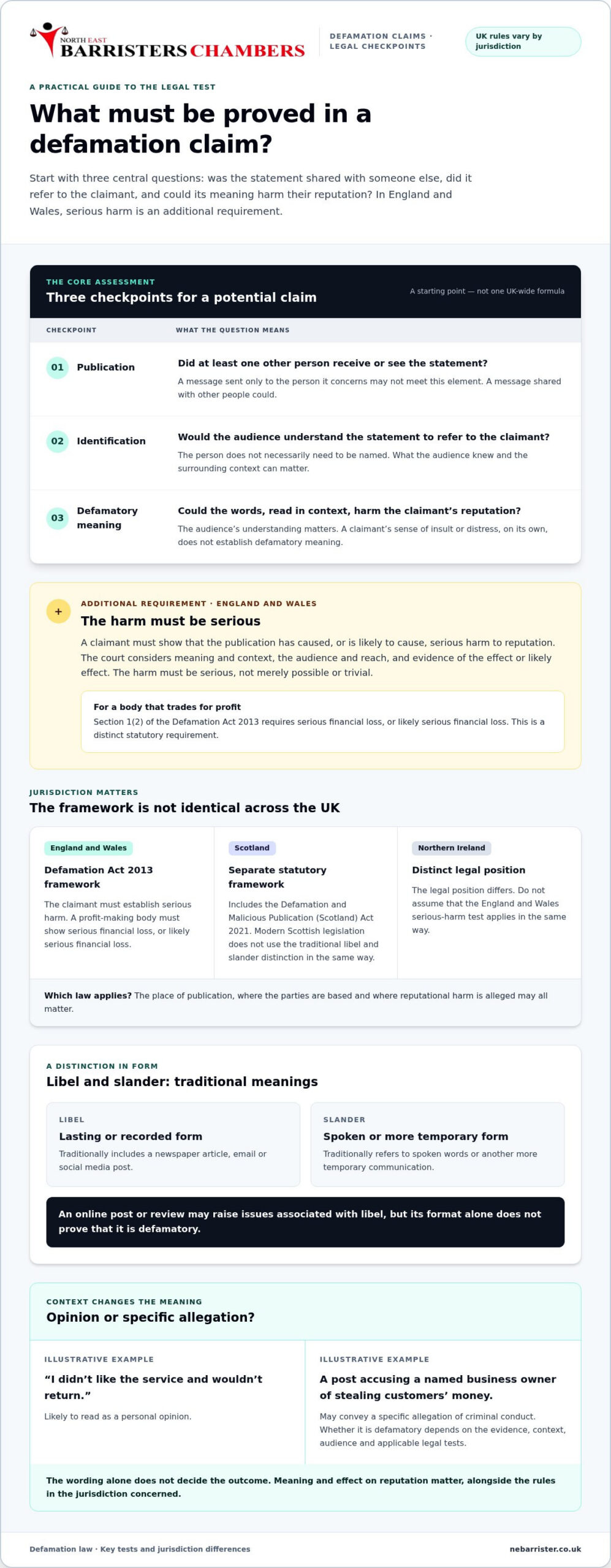
Traditionally, libel refers to defamation in a lasting or recorded form, such as a newspaper article, email or social media post. Slander traditionally refers to spoken words or another more temporary form of communication. An online post or review may therefore raise issues associated with libel, but its format alone doesn’t prove it is defamatory.
The distinction can affect how a dispute is analysed, and the legal approach differs between UK jurisdictions. In Scotland, for example, modern legislation does not use the traditional libel and slander distinction in the same way. The words, their reach and their likely effect still need close examination.
Does an insulting or false statement automatically count as defamation?
No. A blunt review, personal insult or inaccurate comment may cause real upset without meeting the legal test. The relevant questions include what the statement meant in context, whether readers or listeners would understand it to refer to the claimant, who received it, and whether it caused the kind of reputational harm recognised by law. In England and Wales, a claimant must also meet the serious-harm requirement.
Illustrative example: A customer writes, “I didn’t like the service and wouldn’t return.” That is likely to read as a personal opinion. A post accusing a named business owner of stealing customers’ money may convey a specific allegation of criminal conduct. Whether that allegation is defamatory depends on the evidence, context, audience and applicable legal tests. The wording alone does not decide the outcome.
So, defamation of character UK law is not a simple test of whether a statement is unkind or untrue. Its meaning and effect on reputation matter, alongside the rules in the jurisdiction concerned.
What must be proved in a defamation claim under UK law?
A person considering a defamation claim will usually need to examine three central questions: was a defamatory statement communicated to someone else, did it refer to the claimant, and did it carry a meaning capable of harming their reputation? The precise legal test depends on the jurisdiction, so these questions are a starting point rather than a single UK-wide formula.
- Publication: at least one person other than the claimant must have received or seen the statement. A private message sent only to the person it concerns may not meet this element, though a message shared with others could.
- Identification: the statement must be understood to refer to the claimant. A person can potentially be identifiable without being named, depending on what the audience knew and the surrounding context.
- Defamatory meaning: the words, read in context, must convey a meaning that harms the claimant’s reputation. A claimant’s sense of insult or distress alone does not establish this.
These elements are only part of the assessment. In England and Wales, for example, a claimant must also establish serious harm. The official text of the Defamation Act 2013 sets out that requirement and other rules applying in that jurisdiction.
How does the serious-harm test work in England and Wales?
The court considers the statement’s meaning and context, its audience and reach, and the evidence of its effect or likely effect on reputation. The harm must be serious, not merely possible or trivial. For a body that trades for profit, section 1(2) of the Act requires serious financial loss, or likely serious financial loss. This is a distinct statutory requirement, not simply the test applied to an individual.
In England and Wales, a defamation claimant must show that the publication has caused or is likely to cause serious harm to reputation; a profit-making body must show serious financial loss.
Do the same defamation rules apply across the UK?
No. The Defamation Act 2013 framework applies to England and Wales. Scotland has a separate statutory framework, including the Defamation and Malicious Publication (Scotland) Act 2021, while Northern Ireland has a distinct legal position. Rules and terminology can differ, so don’t assume that the England and Wales serious-harm test applies in the same way elsewhere.
The place of publication, where the parties are based and where reputational harm is alleged may all matter when working out which law applies. Defamation of character UK law is best assessed with the relevant jurisdiction in view. A barrister can analyse the evidence and legal issues in a civil dispute. Direct-access civil law advice can help you understand your options.
Which defamation defences and misconceptions should you understand?
A statement may damage someone’s reputation and still be defensible under the applicable law. The main defences recognised in England and Wales include truth, honest opinion, publication on a matter of public interest and privilege. Each has legal requirements. None applies automatically just because a publisher believes they acted fairly or chose careful wording.
A common misconception is that proving a statement false is enough to win a claim. It isn’t. The claimant must establish the relevant legal elements, including serious harm in England and Wales, and a defence may still apply. The Defamation Act 2013 explanatory notes provide background on several statutory defences in that jurisdiction. Rules differ elsewhere in the UK, so the applicable law matters.
What are the main defences to a defamation claim?
- Truth: this defence concerns whether the imputation, or damaging meaning, complained of is substantially true. Minor inaccuracies may not necessarily defeat it, but the central allegation must be supported by evidence.
- Honest opinion: this can protect a genuine opinion, rather than a statement presented as fact, where the legal conditions are met. The opinion’s basis and whether an honest person could have held it may matter.
- Public interest: this may apply to publication on a matter of public interest where the publisher reasonably believed publishing it was in the public interest. The subject and the steps taken before publication can be relevant.
- Privilege: some statements made in protected settings, such as court proceedings, may be covered by absolute or qualified privilege. The protection depends on the setting and circumstances.
These summaries are not a substitute for the statutory wording or a jurisdiction-specific assessment. Whether a defence applies turns on the facts and evidence, not simply on how a publisher describes their actions.
Is fair criticism always protected from a defamation claim?
No. There can be a meaningful difference between “I thought the service was poor”, which reads as an opinion, and “the owner falsified the accounts”, which asserts a specific fact. But calling a statement “my opinion” doesn’t settle its meaning. A court may consider the full wording, surrounding context, any stated basis for the view and how the intended audience would understand it.
If you’re facing a claim or considering one, the practical question is not just whether the statement was unfair or untrue. It is how the words would be understood and whether the evidence supports a defence under the relevant law. Direct-access civil law advice can help clarify the arguments and practical options in a dispute.
What should you do if you face a defamation allegation or damaging statement?
Whether you’ve received a legal allegation or found a damaging post about yourself, act carefully rather than responding in anger. First, preserve what happened. Then consider the wording, its audience and the outcome you want, such as a correction, removal or apology. Formal legal action is one possible route, but the right response depends on the facts.
What evidence should you preserve?
Keep the material in its original form where possible, before asking for its removal or entering a dispute. A screenshot alone may not capture important context, so save the URL and related messages or documents as well.
- Save the original statement: take screenshots showing the full post, account name, platform and surrounding conversation. Keep copies of emails, messages or documents.
- Record publication details: note the date and time you saw it, where it appeared, any available information about views or sharing, and who may have seen or received it.
- Track changes: preserve evidence of edits, deletion, corrections or an apology, with dates where available. Keep communications about the statement as well.
- Pause before replying publicly: an impulsive response can spread the allegation further or create a separate dispute. Avoid threats or repeating the allegation while deciding what to do.
In England and Wales, the general limitation period for a defamation claim is one year from the date of first publication. This isn’t a personal deadline calculation: exceptions and rules about later or repeated online publication can be complex, and time limits differ across jurisdictions. Get the position checked promptly rather than assuming a repost resets the clock or that the same period applies throughout the UK.
Depending on the circumstances, a proportionate next step may involve requesting removal, seeking a correction or apology, discussing resolution, or considering proceedings. Keep the evidence even if the material is removed, as its content and publication details may still matter.
How can a barrister help assess a defamation dispute?
A barrister can analyse the statement’s meaning, evidence of publication and harm, possible defences and available options. The agreed work and the barrister’s role depend on the case. Direct access means that, for suitable work, you may instruct a barrister directly for legal advice or advocacy.
Advice can help you weigh the strengths, risks and next steps before making a formal response. For advice on a civil defamation dispute, explore direct-access barrister advice.
When can a barrister help with a defamation of character dispute?
A barrister can help you understand the legal issues in a civil defamation dispute and decide what to do next. They can assess how a statement may be understood, consider evidence of publication and reputational harm, examine possible arguments or defences, and explain practical options. This assessment can help you weigh the strengths and risks before choosing whether to respond, seek a resolution or pursue a claim.
The right advice depends on the facts and the jurisdiction. Defamation of character UK law is not identical across the UK, so a barrister’s assessment should take account of where the dispute may be heard and which rules apply. A barrister may also provide advocacy or court representation where appropriate.
What can direct access mean for a civil defamation matter?
Direct access means that, for suitable work, you may instruct a barrister directly rather than first instructing a solicitor. This can include advice on the merits of a potential claim or response, and advocacy where appropriate. It doesn’t mean every case or task can proceed without a solicitor. The needs of the case determine whether other support is required.
Be clear about the work you’re asking the barrister to do. The agreed scope might cover an initial assessment, advice on evidence and arguments, or representation at a particular stage. For more on how direct access may relate to legal costs, see the guide to direct access legal costs.
What should you prepare before seeking legal advice?
A concise, organised summary helps make an initial discussion more focused. Gather the relevant material and set out what has happened, rather than trying to decide the legal answer yourself. Include:
- A short timeline, with dates of the statement, any edits or removals, and key events that followed.
- Copies of the statement and related messages, along with URLs, platform details and information about who may have seen it.
- The impact you say it has had on your reputation, including any specific consequences you can explain.
- Any steps already taken, such as asking for a correction or removal, and any response received.
Keep the account factual and include information that may not support your preferred view. A barrister can consider the overall picture and explain realistic next steps without promising a particular outcome. If you’re considering advice or representation in a civil dispute, explore direct-access barrister advice.
Take a clear, practical next step
A damaging statement isn’t automatically defamation. The meaning, audience, publication and impact all matter, as do the legal rules in the relevant UK jurisdiction. In England and Wales, serious harm is a key requirement, while truth, honest opinion, public interest and privilege may provide defences when their legal conditions are met.
If you’re dealing with a disputed statement, preserve the original material and details of where and when it appeared. Avoid an impulsive public response, and don’t assume that removing a post or proving it false settles the legal position. The time limit and available options depend on the circumstances, so consider getting advice promptly.
Understanding defamation of character UK law can help you ask focused questions and weigh your next move. A barrister can assess the evidence, arguments and practical options. For suitable work, individuals and businesses can instruct a barrister directly for civil law advice and advocacy. Explore direct-access barrister advice and take an informed step towards resolving the dispute.
Frequently Asked Questions
What is defamation of character under UK law?
Defamation is a statement communicated to someone else that harms a person’s reputation in the eyes of others and meets the relevant legal test. “Defamation of character” is a common phrase, not a separate legal claim. A statement can be upsetting or inaccurate without being actionable. Its meaning, audience, identification of the person concerned and reputational impact all matter, and the rules vary across UK jurisdictions.
Is it defamation if someone says something false about me online?
Not necessarily. A false online statement may be defamatory, but being untrue alone doesn’t establish a claim. The post must refer to you, be communicated to at least one other person and convey a meaning capable of harming your reputation. In England and Wales, you must also show serious harm. Preserve the post, URL, date and context, and avoid replying publicly before considering your options.
Can I sue someone for defamation in the UK?
You may be able to bring a claim if the legal requirements in the relevant jurisdiction are met. In England and Wales, this generally involves proving publication to someone else, identification, defamatory meaning and serious harm. Evidence, available defences and the time limit also matter. Defamation of character UK law is not one uniform UK-wide test, so an assessment should consider where the claim would be brought and which rules apply.
How long do I have to bring a defamation claim?
In England and Wales, the general limitation period is one year from the date of first publication. This isn’t a personal deadline calculation: exceptions and rules about later or repeated online publication can be complex. Scotland and Northern Ireland have distinct legal frameworks, so don’t assume the same period applies. Seek advice promptly and have the relevant dates and publication history checked before deciding that a claim is in time.
What are the defences to a defamation claim in England and Wales?
Main defences include truth, honest opinion, publication on a matter of public interest and privilege. Truth concerns whether the damaging imputation complained of is substantially true. Honest opinion must meet legal conditions, while public-interest publication and privilege depend on the circumstances. None is automatic, and using “in my opinion” won’t guarantee protection. The meaning of the statement, its context and supporting evidence all need careful consideration.
Does UK defamation law apply in the same way in Scotland and Northern Ireland?
No. The Defamation Act 2013 framework applies to England and Wales. Scotland has a separate statutory framework, including the Defamation and Malicious Publication (Scotland) Act 2021, while Northern Ireland has its own distinct legal position. The tests, terminology and procedure may differ. If a statement or its audience crosses borders, don’t assume that one jurisdiction’s rules settle the issue across the whole UK.
What should I do if someone accuses me of defamation?
Stay calm and preserve the statement, related messages, publication details and any correspondence about the allegation. Avoid repeating the disputed words publicly or sending an impulsive reply. Consider what outcome may resolve the issue, such as a correction or removal, but don’t admit liability or make promises before understanding the position. A barrister can assess the wording, evidence, possible defences and practical options; suitable advice or advocacy may be instructed directly.