
Going straight to court may feel like the clearest response to a business dispute, but it isn’t always the best route. The right choice among business dispute resolution options depends on the outcome you need: a negotiated agreement, a way to preserve a working relationship or a formal decision that may be enforceable.
It’s understandable to worry that a dispute will absorb management time, increase costs or damage a commercial relationship. Negotiation, mediation, arbitration and court proceedings each involve different levels of control, formality and certainty. They also differ in who decides the outcome and what steps may be needed to make an agreement binding or enforce a decision.
This guide compares the main options and their practical trade-offs, with questions to ask before choosing a process or starting a claim. It also explains when focused legal advice or court representation may help you assess your position. A barrister may be instructed directly for suitable work, but direct access won’t cover every legal or procedural task. The aim is to help you choose a next step based on the outcome your business needs, rather than assuming every dispute belongs in court.
Key Takeaways
- Compare business dispute resolution options by the outcome you need, the level of control you want and the demands each process may place on your business.
- Check whether your contract sets out a dispute process, and review deadlines before deciding how to proceed.
- Find out who makes the decision in each process, whether the outcome can bind the parties and what may be required to enforce it.
- Before agreeing to mediation, consider how any settlement will be recorded and whether its terms address each issue clearly.
- Gather key documents and a short chronology before seeking advice. A barrister may be able to advise or represent you directly where the work is suitable.
Business dispute resolution options: what are the main routes?
Business dispute resolution options are ways to address a disagreement and seek an outcome. They range from direct discussion to a decision by an independent third party or court. Negotiation, mediation, arbitration, adjudication and litigation each have a different balance of control, privacy and formality. Not every route will suit every dispute. The agreement, type of dispute, urgency and jurisdiction can all affect what’s available or appropriate.
Negotiation, mediation and arbitration are commonly grouped under Alternative dispute resolution (ADR). Adjudication and court proceedings have distinct procedures. Treat any overview as a starting point: legal rules and processes differ across England and Wales, Scotland, and Northern Ireland.
What is the difference between informal and formal resolution?
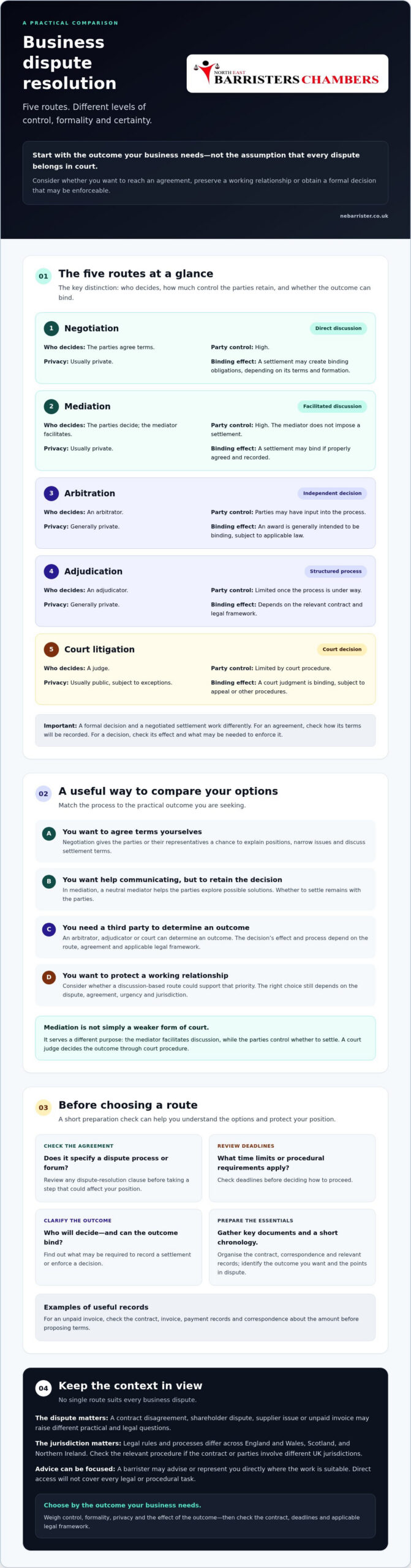
Negotiation is direct discussion between the parties or their representatives. Mediation adds a neutral facilitator, but the parties remain in control of whether to settle. By contrast, an arbitrator, adjudicator or court can determine an outcome. Arbitration and adjudication usually take place outside court, but their procedures and the effect of a decision depend on the applicable agreement and legal framework.
| Route | Who decides? | Party control | Privacy | Can the outcome bind? |
|---|---|---|---|---|
| Negotiation | The parties agree terms | High | Usually private | A settlement may create binding obligations, depending on its terms and formation |
| Mediation | The parties decide; the mediator facilitates | High | Usually private | A settlement may bind if properly agreed and recorded |
| Arbitration | An arbitrator | Parties may have input into the process | Generally private | An award is generally intended to be binding, subject to applicable law |
| Adjudication | An adjudicator | Limited once the process is under way | Generally private | Depends on the relevant contract and legal framework |
| Court litigation | A judge | Limited by court procedure | Usually public, subject to exceptions | A court judgment is binding, subject to appeal or other procedures |
Which business disputes might need a tailored route?
A contract disagreement, shareholder dispute, supplier issue or unpaid invoice may raise different practical and legal questions. A business may prioritise keeping a supplier relationship, for example, while a payment dispute may call for a clear decision about what is owed. These examples don’t determine which route is right. Check the agreement for a dispute-resolution clause, including any specified process or forum, before taking a step that could affect your position. If the contract or parties involve different UK jurisdictions, verify the relevant procedure and legal rules for the case.
How negotiation, mediation, arbitration and court proceedings work
The practical differences between business dispute resolution options often come down to who controls the outcome and how much structure the process requires. Preparation matters in every route. Organise the relevant contract, correspondence and records, then identify the outcome you want and the points the other party disputes.
When can negotiation or mediation be a sensible first step?
Negotiation gives the parties, or their representatives, a chance to set out their positions, narrow the issues and discuss settlement terms. It can be informal, but preparation helps. Decide what you need, where you may be willing to compromise and which documents support your position. For an unpaid invoice, for instance, check the contract, invoice, payment records and any correspondence about the amount before proposing terms.
Mediation introduces a neutral mediator who helps the parties communicate and explore possible solutions. The mediator doesn’t decide the dispute or impose a settlement. Any agreement depends on the parties, the arrangements for mediation and how the terms are recorded. Acas provides practical information about Acas dispute resolution services, including approaches to resolving disputes.
When might arbitration, adjudication or litigation be considered?
In arbitration, an arbitrator considers the issues within the scope of the parties’ agreement and makes a decision. The agreement and any applicable rules shape the process. Check what they say about the arbitrator’s powers, the effect of an award and whether court support may be available. Don’t assume the same rules apply to every arbitration.
Adjudication is particularly associated with construction disputes. Whether it’s available, and what effect a decision has, depends on the contract and relevant legal framework. Court proceedings involve starting a formal claim under the applicable court procedure. A judge determines the issues if they aren’t resolved beforehand. Court processes can require structured evidence and formal documents, and proceedings are generally open to the public, subject to exceptions.
- Negotiation: The parties discuss terms directly. They retain control, and preparation depends on the issues and evidence.
- Mediation: A mediator facilitates discussion but doesn’t decide the dispute. The parties control whether to settle, and should check the arrangements and privacy in advance.
- Arbitration: An arbitrator decides matters within the agreed scope. The process is generally private, but the agreement and applicable rules govern procedure and legal effect.
- Adjudication: An adjudicator decides the dispute under the relevant framework. Check the contract and rules for the process, decision and its effect.
- Court proceedings: A judge decides the claim under formal procedure. The parties have less control over the outcome and should prepare for court requirements.
No route guarantees a particular result or timetable. If you’re weighing up a civil dispute, a barrister may be able to provide focused advice or court representation where the case and requested work are suitable. You can read about direct access barrister advice and clarify the scope of work before deciding whether it fits your situation.
How to compare business dispute resolution options for your situation
Start with the result your business needs, not the name of a process. Do you need payment, a workable change to a contract, a continuing commercial relationship or a decision that settles disputed issues? The answer can help you judge whether an agreement through discussion is realistic or whether you may need a binding determination.
Which factors should a business weigh before choosing?
Use this checklist to identify what matters most before committing to a route:
- Desired outcome: Is there room for a practical compromise, or do you need an independent decision?
- Urgency and deadlines: Check relevant time limits and any steps required by the contract. Don’t assume that negotiations pause a deadline.
- Business relationship: Consider whether preserving a supplier, customer or shareholder relationship is a priority.
- Privacy: Decide how important confidentiality is, and check what the proposed process can and can’t keep private.
- Evidence and claim value: Assess what documents, records or witness evidence support your position. Consider whether the practical value of pursuing the claim justifies the demands involved.
- Contract and forum: Review dispute clauses and any specified forum. Procedure can depend on the agreement and the UK jurisdiction involved.
Legal spend also varies. It depends on the dispute, chosen process, preparation required and whether you have representation. Consider management time as well as direct legal spend. Planning how to reduce UK legal costs can include clarifying the issues early and asking what work each route is likely to require.
What questions can help narrow the options?
Before deciding, ask who controls the outcome and whether a settlement needs everyone’s agreement. If discussions fail, can you move to another route, and are there contract terms or procedural requirements to follow first? Also ask what documents must be prepared, who will make decisions for the business and how much internal time the process could take.
If arbitration is under consideration, check the agreement and applicable rules rather than assuming how the process or award will work. The Chartered Institute of Arbitrators provides background on dispute resolution. Focused legal advice may help assess the contract, evidence, potential merits and available next steps, including whether a binding decision is necessary. A barrister may be instructed directly for suitable work, but confirm the scope and suitability of the specific task. You can explore direct access barrister advice as one possible route to that advice.
Is mediation weaker than court? Understand control and enforceability
No. Mediation isn’t inherently ineffective; it works differently from court proceedings. A mediator helps the parties discuss the dispute and explore settlement, but can’t impose an agreement. The parties retain control over whether to settle and what terms to accept. If they reach agreement, its practical strength depends on how clearly it’s recorded and whether the terms are legally effective.
A mediated settlement isn’t automatically equivalent to a court judgment, arbitration award or adjudicator’s decision. Those outcomes come from a third party deciding some or all of the dispute under a particular legal or contractual framework. Their effect, and the available steps to enforce or challenge them, depends on the route, agreement and jurisdiction. Don’t assume the same rules apply in England and Wales, Scotland and Northern Ireland.
What happens if mediation does not lead to agreement?
If talks end without settlement, the parties may consider another route, subject to their contract and any applicable legal requirements. Mediation can still help clarify which issues are agreed, what remains contested and what evidence may be needed. It doesn’t, by itself, decide the dispute.
Keep an eye on deadlines. Don’t assume that trying to settle pauses a time limit or removes the need for an urgent protective step. If a deadline or immediate business risk may be involved, seek legal advice promptly about the position and available options.
When can a decision or settlement be binding?
A settlement depends on agreement between the parties. Before signing or confirming terms, check that they identify what each party must do, by when, and how the settlement deals with the issues in dispute. The wording, the way the agreement is made and the law that applies can affect its legal effect and enforcement. Get advice if the terms are unclear or the consequences are significant.
A court judgment is a formal court decision, subject to applicable procedures such as appeal. An arbitration award or adjudication decision has a different basis: its effect depends on the relevant agreement, rules and legal framework. Some adjudication decisions, particularly in construction contexts, may have a different status from a final court judgment. The route doesn’t guarantee that enforcement will be straightforward, and challenge rights vary.
So, compare business dispute resolution options by asking what happens if the other party doesn’t comply, whether the outcome can be challenged and what enforcement steps may be available in the relevant jurisdiction. A barrister may be able to advise on the merits, process and court representation where the case and requested work are suitable. Discuss direct access barrister advice to clarify whether that work may fit your dispute.
Choosing a route and getting focused legal advice
Once you’ve considered the possible business dispute resolution options, take practical steps to protect your position and prepare for a useful assessment. Keep relevant records, review the contract, decide what outcome the business is seeking and check for deadlines or urgent obligations. Don’t assume that ongoing discussions will pause a time limit.
What should a business prepare before seeking advice?
A concise, organised summary is often more useful than a large collection of unlabelled documents. Bring together:
- The contract and any relevant amendments or terms.
- Invoices, payment records, correspondence and other documents connected with the dispute.
- A short chronology showing key events, decisions and communications.
- The names of the parties involved, the outcome you want and the financial exposure or other business risks.
- Any dates for required action, meetings, payments or responses.
Be ready to explain what has already been discussed and whether a resolution has been proposed. Before sending confidential or sensitive material, ask how to provide it and what information is needed for the initial assessment.
Could direct access barrister advice fit a business dispute?
A barrister may be able to advise on the merits of a civil dispute, explain possible routes and provide court representation where appropriate. Some clients can instruct a barrister directly without a solicitor. Direct access isn’t suitable for every dispute or every task, however. Suitability depends on the case and the work required, so confirm the scope before proceeding.
North East Barristers Chambers provides direct access legal advice and representation in civil law matters for businesses, subject to suitability. The chambers doesn’t provide solicitor services, and direct instruction isn’t a substitute for every task a solicitor may undertake. If your matter may require work outside the agreed scope, clarify who will handle it and what arrangements may be needed.
For further background, see the direct access barrister services guide and the business contract dispute barrister guide. These resources may help you consider whether direct access advice is relevant to your situation.
Discuss whether direct access advice may suit your dispute. An initial discussion can help clarify the work you need and whether direct instruction is suitable for your circumstances.
Choose your next step with confidence
The right business dispute resolution options depend on the outcome your business needs, the terms of your agreement and whether you need an agreed settlement or a formal decision. Negotiation or mediation may give parties room to shape a solution, while arbitration, adjudication or court proceedings involve a decision-maker. Check how any settlement or decision will take effect and whether it can be enforced.
Before choosing a route, preserve relevant records, review the contract and check for deadlines. Focused legal advice can help you assess the dispute, understand the available options and identify what preparation may be needed. North East Barristers Chambers provides direct access barrister advice and representation for suitable civil matters to individuals and businesses across the UK. Direct instruction isn’t suitable for every case or task, so clarify the scope first.
Discuss whether direct access advice may suit your business dispute. A clear assessment can help you take a considered next step.
Frequently Asked Questions
What are the main business dispute resolution options?
The main business dispute resolution options include negotiation, mediation, arbitration, adjudication and court proceedings. Negotiation lets parties discuss a solution directly. In mediation, a neutral person facilitates discussion but doesn’t decide the outcome. An arbitrator or adjudicator makes a decision under the relevant agreement or framework, while a court determines a formal claim. Check your contract, the dispute and the relevant UK jurisdiction before choosing a route.
Is mediation legally binding in a business dispute?
Mediation itself doesn’t impose a binding decision. The parties decide whether to settle, and the legal effect of any settlement depends on how it’s agreed, recorded and worded, as well as the law that applies. Make sure the terms clearly identify what each party must do and resolve. If the agreement’s effect or enforcement matters, get advice before signing or relying on it.
Can a business resolve a dispute without going to court?
Yes. A business may resolve a dispute through negotiation or mediation, or use arbitration or adjudication where the relevant agreement and legal framework allow. These routes don’t all work in the same way: mediation needs the parties’ agreement to settle, whereas arbitration and adjudication involve a decision-maker. Check contract requirements and deadlines before proceeding, and consider whether a settlement or decision will address the dispute effectively.
When should a business choose arbitration instead of litigation?
Arbitration may be worth considering where the parties’ agreement provides for it or they otherwise agree to use it, and a private decision-making process suits the dispute. An arbitrator determines issues within the agreed scope. Before choosing arbitration over court proceedings, check the agreement, applicable rules, likely preparation and the award’s legal effect. The right choice depends on the case; legal advice can help assess the trade-offs.
What happens if a business dispute resolution clause is ignored?
Ignoring a dispute-resolution clause may lead the other party to argue that the agreed process should be followed. The effect depends on the clause’s wording, the dispute, the proceedings and the applicable law. Don’t assume a clause is optional or that it automatically prevents court action. Review the contract and seek advice before starting a claim or refusing a process, especially if a deadline may apply.
Can I instruct a barrister directly for a business dispute?
Yes, businesses may instruct a barrister directly for suitable legal advice or representation, without a solicitor. Whether direct access is appropriate depends on the dispute and the specific work needed, and it won’t cover every legal or procedural task. North East Barristers Chambers provides direct access advice and court representation in civil matters across the UK. Confirm the proposed scope and suitability before instructing counsel.
How do I choose between mediation and court proceedings?
Consider whether you’re willing to negotiate, how important the business relationship is, what outcome you need and whether you require a decision imposed by a judge. Mediation gives parties a chance to agree terms but doesn’t guarantee settlement. Court proceedings follow formal rules and a judge determines the claim if it isn’t resolved. Review contract terms, evidence and deadlines, and get advice if you’re unsure which process fits.