
If you’re looking for a barrister to review my case, you may want a clear view of your options before deciding what to do next. A case review should assess the issues and information available, not promise a particular outcome.
You may be unsure which documents matter, how strong your position is or whether a deadline makes the matter urgent. A focused discussion can help turn those concerns into practical questions and next steps.
This article explains what a barrister may assess in criminal, civil or family matters, what information to prepare and what to ask about the proposed work. You’ll also learn how to clarify the scope of any further help before deciding whether to proceed. The right approach depends on the facts of your case and the UK jurisdiction involved, so the aim is a realistic plan, not a guaranteed result.
Key Takeaways
- A barrister can review the facts and documents within an agreed scope, highlighting issues that may need attention.
- Evidence is assessed in context, including when it was created, who provided it and whether key facts are disputed.
- A case review can help you understand prospects and options, but no barrister can guarantee the outcome.
- Prepare a clear timeline, relevant records and questions. Flag any court dates, orders or response deadlines.
- Use the advice to weigh practical next steps, then clarify the scope of any further work before deciding whether to proceed.
What does it mean to ask a barrister to review my case?
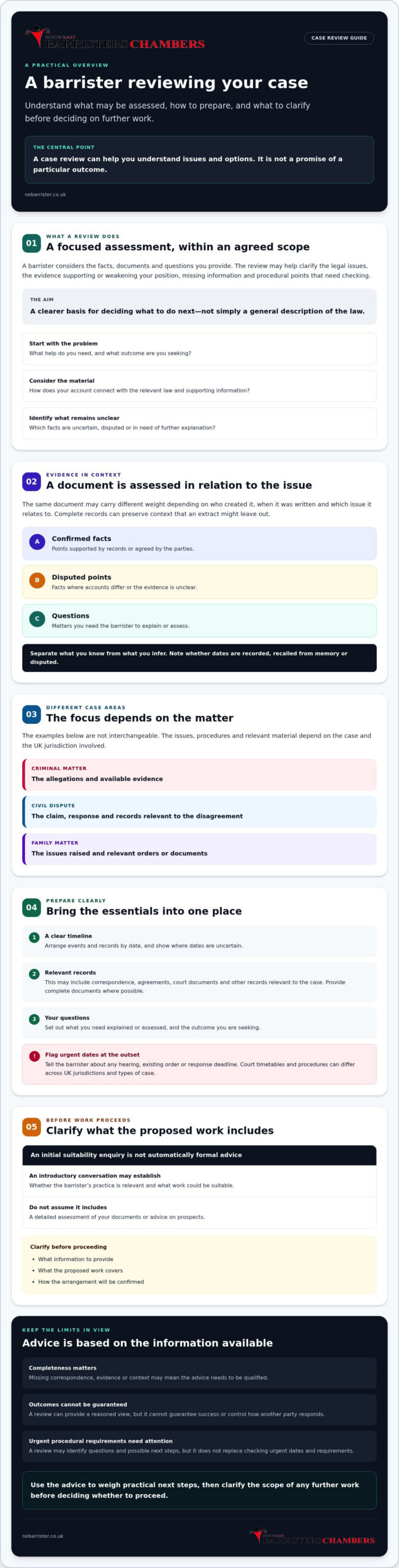
A case review is an assessment of the facts, documents and questions you provide, limited to the work agreed with the barrister. It may help you understand the legal issues, what evidence supports or weakens your position, what information appears to be missing and which procedural points need checking. The aim is to give you a clearer basis for deciding what to do next, rather than simply describing the law in general terms.
If you’re looking for a barrister to review your case, first clarify whether the discussion is an initial suitability enquiry or formal legal advice. An introductory conversation may establish whether the barrister’s practice is relevant and what work could be suitable. Don’t assume it includes a detailed assessment of your documents or advice on prospects. Ask what information to provide, what the proposed work covers and how the arrangement will be confirmed before proceeding.
A barrister is a specialist legal professional whose work may include advising clients and representing them in court. For background, see What is a barrister? The precise role and available work depend on the case and the agreed instructions.
What can a barrister assess in my case?
The assessment usually starts with the problem you need help with and the outcome you’re seeking. The barrister can then consider the relevant law alongside your account and supporting material. They may check whether the timeline is clear, whether documents support key events, and which facts are agreed, disputed or still need explanation.
The focus varies by area of law. In a criminal matter, the review may consider the allegations and available evidence. In a civil dispute, it may examine the claim, response and records relevant to the disagreement. In a family matter, it may consider the issues raised and any relevant orders or documents. These examples aren’t interchangeable: procedures depend on the case and jurisdiction.
What a case review cannot promise
A review can provide a reasoned view based on the information available, but it can’t guarantee success or control how another party responds. Its usefulness also depends on the accuracy and completeness of what you provide. If important correspondence, evidence or context is missing, the advice may need to be qualified.
A review should not replace checking urgent dates. Court timetables, procedures and deadlines can differ across UK jurisdictions and types of case. If you have a hearing, an existing order or a response deadline, flag it at the outset and ask what applies to your matter. A barrister’s assessment can help identify questions and possible next steps, but urgent procedural requirements need attention in their own right.
How does a barrister assess the facts, evidence and legal issues?
A barrister’s assessment is more than a quick read-through of documents. The aim is to connect the problem you’re facing with the available evidence, the relevant law and the outcome you want. A barrister reviewing your case can help identify which points appear well supported, where your account is uncertain and what needs clarifying before you decide how to proceed.
Legal advice depends on both the facts provided and the law that applies to those facts. The same document may carry different weight depending on who created it, when it was written and which issue it relates to. The barrister will also need to understand what you want to achieve. Advice about responding to a claim may focus on different questions from advice about pursuing one.
Which documents and evidence may matter?
Useful material depends on the case, but may include correspondence, agreements, court documents and records arranged by date. Provide complete documents where possible. A single page or selected extract can omit qualifications, earlier messages or later replies that change the context.
Help the barrister distinguish what you know from what you infer. For example, note whether a date is confirmed by a record, recalled from memory or disputed by someone else. You can organise your material under three headings:
- Confirmed facts: points supported by records or agreed by the parties.
- Disputed points: facts where accounts differ or evidence is unclear.
- Questions: matters you need the barrister to explain or assess.
This makes gaps easier to spot and helps prevent assumptions or conclusions from being mistaken for evidence.
How does the legal issue affect the assessment?
The relevance of evidence depends on the legal question. In a criminal matter, the allegations and evidence are considered in that context. In a civil dispute, the focus may be on the basis of a claim or response and the records relating to it. In a family matter, the issues and relevant documents will differ again. These examples are not a guide to the legal test in an individual case.
The applicable rules and procedure depend on the case type and the UK jurisdiction involved. If a document refers to a hearing, court order or deadline, include it and ask the barrister to explain what it means for your matter. A general explanation cannot replace advice based on your specific circumstances.
Before sending documents, ask what material is needed and what the review is intended to cover. To enquire about direct-access legal advice, set out the issue and the practical question you want answered, then confirm the proposed scope before proceeding.
Will a barrister’s case review tell me whether I can win?
A barrister can assess the apparent strengths and risks of your case, but can’t promise that you’ll win. The advice is a reasoned view based on the information available at the time. It isn’t a guarantee and can’t control what the other party says or what a court decides.
People searching for a barrister to review their case may hope for a definite yes or no. In practice, a useful review is more likely to explain what supports your position, where it may be challenged and what remains uncertain. That can still help you make decisions with a clearer view of the risks, rather than relying on guesswork.
What does a realistic assessment of prospects mean?
A barrister may identify favourable points, weaknesses in the evidence, gaps that need addressing and arguments the other party could raise. The assessment depends on the facts and documents supplied. It may change if new evidence appears, an important fact is disputed or the other party provides information you haven’t seen.
There’s no universal percentage or scoring system that can reliably predict the result of every case. Ask the barrister to explain the reasoning behind their view, the assumptions it relies on and what further information could change it. If a question can’t be answered from the material available, ask what would be needed to assess it more fully.
When might further advice or representation be needed?
A review may be enough to clarify your options, or it may point to further work. Depending on the case and what has been agreed, this could involve additional legal advice, work on documents, advice about possible negotiation or court representation. These are possibilities, not automatic steps. Confirm the proposed scope and suitability before deciding whether to proceed.
Sometimes the key value is knowing what not to do yet. The advice may identify missing information, a risk that needs attention or a question to resolve before taking a larger step. If a court date or deadline is approaching, raise it promptly and check what applies in the relevant jurisdiction. A review should not be treated as a substitute for acting on urgent procedural requirements.
A case review offers a reasoned assessment of the information available, not a guaranteed outcome. Its purpose is to help you understand the strengths, uncertainties and possible next steps, so you can decide what further help, if any, is appropriate.
How should I prepare before asking a barrister to review my case?
A little organisation can make an enquiry more focused. You don’t need to decide the legal answer yourself. Explain what has happened, what decision you need help with and any dates that could affect your options.
- Identify the issue. Summarise the dispute, allegation or family matter in a few sentences, and say what you need advice about.
- Make a timeline. List key events in date order, noting where dates are approximate or disputed.
- Gather relevant records. Collect correspondence, agreements, court documents and other material that explains the issue. Remove duplicates, but keep documents complete and clearly labelled.
- List your questions. Write down what you need to understand, such as the options available, the risks or what information is still missing.
Flag any hearing dates, existing orders and response deadlines at the start. If you’re asking a barrister to review your case, make any urgency clear rather than assuming it will be apparent from the paperwork.
What should I send for an initial discussion?
Prepare a short factual summary, the key dates and the documents that best explain the issue. Identify each document and why you think it matters. Don’t send sensitive material through a channel until you’ve confirmed how the chambers wants to receive it and what arrangements are available for secure submission.
What questions should I ask the barrister?
Before agreeing to the work, clarify the practical details. Ask:
- What will the review cover, and what falls outside its scope?
- Will the advice be given in writing, in a conference or in another agreed format?
- What further information or documents are needed, and what uncertainties may remain?
- What work is proposed, what is the fee basis and what is the expected timescale?
- What further help might be possible if the review identifies a need for it?
Also ask how confidentiality is handled at the enquiry stage. Confirm what you’re agreeing to, including the scope, fees and timing, before formal work begins.
How do I decide whether the review is the right next step?
Match the request to the decision you need to make. If you want advice on a criminal, civil or family matter, explain the issue and check that it fits the barrister’s practice area. The appropriate scope depends on your circumstances, so use the initial discussion to establish whether the proposed review can address your questions.
Once you’re ready to explain your situation and ask about suitability, you can Discuss your case enquiry.
What happens after a barrister reviews my case?
Once you receive the advice, use it to decide on a proportionate next step. That might mean gathering missing information, responding to an issue, seeking further advice or considering court representation. The review helps you understand your options, but does not promise what will happen if you act on them.
Before making a decision, separate the advice into three parts: what the barrister has concluded, what remains uncertain and what actions they recommend. If the reasoning or a term in the advice isn’t clear, ask for an explanation. A focused question may help you understand whether further work is needed.
How can I compare the advice with my immediate needs?
Check the advice against the decision you need to make. For example, do you need to respond to a claim, prepare for a hearing or decide whether to take a particular step? Review any dates, orders or deadlines again. Don’t assume a review changes a deadline or that it’s safe to wait. Confirm what applies to your case and the relevant UK jurisdiction before acting or delaying.
Consider whether the recommended action fits your circumstances and the scope of the review. If it doesn’t address a key question, ask whether that question can be answered from the material already provided or whether more information is needed.
Can the same barrister provide further advice or representation?
Further work may be possible, but it depends on the case, the barrister’s suitability and availability, and what both sides agree. Before additional work starts, clarify the deliverables, responsibilities, fee basis and timing. Ask who will handle practical tasks such as correspondence or submitting documents rather than assuming those responsibilities are included.
For direct-access work, check what the proposed arrangement covers and whether it is suitable for your situation. If you’re considering representation, confirm that separately. A review does not automatically include further advice or a court appearance.
A barrister’s assessment should help you see a practical route forward, including points that still need attention. If you’d like to discuss whether a barrister is suitable to review your case, make an enquiry and clarify the proposed work before deciding whether to proceed.
Take the next step with a clearer view
A barrister’s review can turn your account, documents and questions into a practical assessment of the issues and possible next steps. It can identify strengths, risks and information still needed, but it can’t guarantee a result. Before proceeding, clarify the review’s scope and raise any important dates or deadlines.
If you’re considering asking a barrister to review your case, focus your enquiry on the decision you need help making. A concise summary and well-organised records can make it easier to discuss whether the proposed work fits your situation.
North East Barristers Chambers provides direct-access legal advice and court representation to individuals and businesses across the UK. Its practice areas include criminal, civil and family law. The right help depends on your case, so confirm suitability, scope and next steps before deciding to proceed.
Discuss whether a barrister can review your case and ask what work may be appropriate. A clear enquiry is a practical first step towards making an informed decision.
Frequently Asked Questions
Can a barrister review my case without a solicitor?
Yes, you can instruct a barrister directly for legal advice and, where suitable, court representation without first instructing a solicitor. This is known as direct access. It isn’t appropriate for every case, and the barrister may explain that other support is needed. Before agreeing to proceed, confirm what the barrister can do, what practical tasks remain your responsibility and whether the proposed work fits your matter and jurisdiction.
What documents should I send a barrister to review my case?
Send documents that explain the issue, such as relevant correspondence, agreements, court papers, orders and records arranged by date. Include complete documents rather than selected extracts, so the context isn’t lost. A short factual summary and timeline can help the barrister understand what happened. Separate confirmed facts from disputed points and questions. Before sharing sensitive information, confirm what is required and how to submit it securely.
Can a barrister tell me whether I will win my case?
A barrister can give a reasoned assessment of your case’s strengths, risks and uncertainties, but can’t guarantee whether you’ll win. The view depends on the information available and may change if new evidence emerges or the other party responds differently than expected. Ask what assumptions the assessment relies on, which points remain unclear and what further information could affect the advice. Court outcomes are not within the barrister’s control.
How much does it cost to ask a barrister to review my case?
The fee depends on the barrister, the complexity of the case and the work you’re asking them to complete. A short discussion to establish suitability may not include a detailed review or formal advice, so clarify what is covered. Before instructing a barrister, ask for the proposed fee basis, any additional costs, the agreed scope and when payment is due. North East Barristers Chambers can confirm fees for the specific work proposed.
How long does a barrister take to review a case?
There isn’t one standard turnaround time. Timing can depend on how much material needs review, whether the papers are complete, the complexity of the issues and the barrister’s availability. If you have a hearing or response deadline, raise it at the first enquiry and ask whether the proposed timing is workable. Confirm the expected delivery date before agreeing to the review, and don’t assume it changes any existing court deadline.
Can I ask a barrister to review an ongoing court case?
Yes, a barrister may be able to advise on an ongoing case or consider court representation, subject to suitability, availability and an agreed scope. Provide current court documents and identify upcoming hearings, orders and deadlines straight away. Confirm who is responsible for correspondence and filing documents, as direct access does not automatically include every case-management task. Procedures vary by case type and jurisdiction, so check what applies to yours.
What happens after a barrister has reviewed my case?
Use the advice to decide on a proportionate next step, such as clarifying an evidence gap, seeking further advice or considering representation. Ask for clarification if the reasoning or recommended actions aren’t clear, and check any deadlines before acting or delaying. Further work isn’t automatic. If it may be appropriate, agree exactly what it covers, who is responsible for each task, the fee basis and the timing before it begins.