
A business failure does not make you automatically liable for corporate debts, yet receiving a hostile letter from an insolvency practitioner often feels like an immediate threat of personal bankruptcy. If you are facing wrongful trading claims, it is easy to panic and confuse civil insolvency proceedings with criminal allegations of fraud. You spent months working tirelessly to save your company; seeing that commercial struggle weaponised against your personal assets is exhausting and deeply stressful.
You don’t have to accept aggressive liquidator demands at face value. This guide explains how liability arises under section 214 of the Insolvency Act 1986, the strict tests liquidators must satisfy, and how the statutory “every step” defence protects your personal wealth. We will also examine how instructing an independent direct access barrister provides specialist court advocacy whilst avoiding the escalating fees of traditional multi-tiered law firms. Here is what you need to know to take control of your position, challenge liquidator claims, and safeguard your professional reputation.
Key Takeaways
- Understand the precise statutory threshold for wrongful trading claims under section 214 of the Insolvency Act 1986, separating commercial misfortune from personal civil liability.
- Identify the legal point of no return by analysing how courts evaluate cash flow and balance sheet insolvency during critical trading periods.
- Learn how to substantiate the statutory every step defence, demonstrating that continuing to trade was a measured effort to minimise creditor losses.
- Uncover how liquidators calculate personal liability under the net deficiency principle and what procedural standards they must meet before issuing proceedings.
- Discover how instructing an independent direct access barrister provides robust courtroom advocacy and strategic dispute management without the overhead of traditional multi-tiered law firms.
What Constitutes a Wrongful Trading Claim Under UK Law?
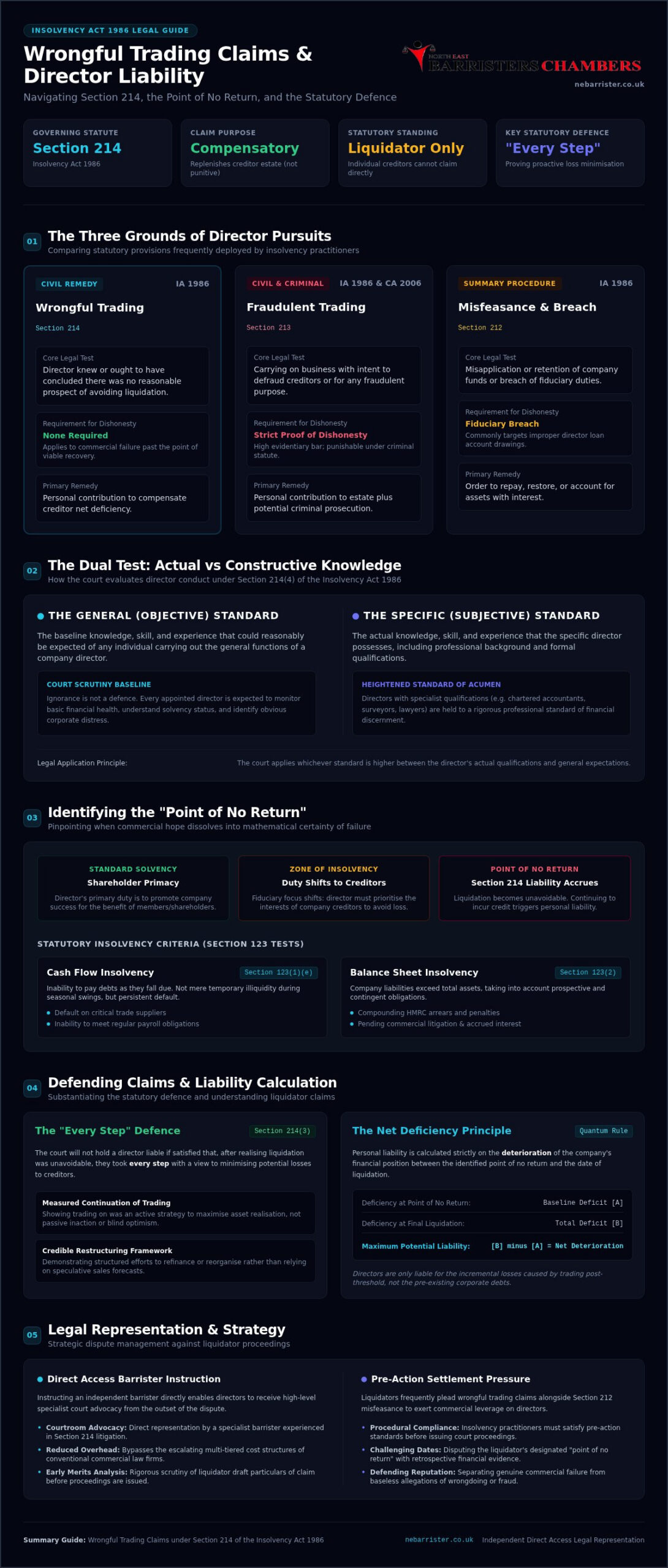
When a limited liability company approaches collapse, the statutory shield protecting directors from personal liability begins to weaken. Governed by section 214 of the Insolvency Act 1986, wrongful trading is a civil remedy designed to compensate company creditors for losses sustained when a company continues trading past the point of viable recovery. The primary purpose of this provision is compensatory rather than punitive, focusing on replenishing company assets rather than punishing dishonesty.
Once a company enters the zone of insolvency, a fundamental shift occurs in corporate governance. The standard statutory duty to promote the success of the company for the benefit of its shareholders shifts towards prioritising the interests of creditors. Crucially, individual creditors cannot bring wrongful trading claims directly. Only an appointed liquidator (or, in specific instances, an administrator) possesses the statutory standing to initiate these proceedings on behalf of the insolvent estate.
The Legal Test: Actual vs Constructive Knowledge
To establish liability, a liquidator must prove that a director knew, or ought to have concluded, that there was no reasonable prospect of avoiding insolvent liquidation. The court applies a dual objective and subjective test under section 214(4):
- The General (Objective) Standard: The minimum knowledge, skill, and experience reasonably expected of someone carrying out your general directorship role.
- The Specific (Subjective) Standard: The actual knowledge, skill, and experience you possess, including professional qualifications in finance, law, or technical trades.
If you hold specialised qualifications, such as being a chartered accountant or surveyor, the court holds your decision-making to a higher standard of commercial acumen than an unqualified director.
Wrongful Trading vs Fraudulent Trading and Misfeasance
Liquidators often plead wrongful trading claims alongside alternative statutory remedies, but their legal requirements differ substantially:
- Fraudulent Trading (Section 213): Involves carrying on business with the intent to defraud creditors or for fraudulent purposes. This carries both civil liability and criminal penalties under the Companies Act 2006. It requires proof of dishonesty, which is absent from wrongful trading.
- Misfeasance or Breach of Duty (Section 212): A summary procedure for claims against directors who have misapplied company money or breached fiduciary duties, such as taking improper director loan drawings.
Because proving actual dishonesty under section 213 requires meeting a high evidentiary bar, liquidators frequently rely on wrongful trading and section 212 misfeasance in draft particulars of claim. This tactic exerts maximum commercial pressure on directors to secure pre-action settlements.
Identifying the Point of No Return in Corporate Distress
Every struggling company reaches a pivotal moment where genuine commercial hope dissolves into mathematical certainty of failure. In courtroom proceedings, this juncture is known as the “point of no return.” Pinpointing this moment is essential because liability for wrongful trading claims only accrues after this threshold has been crossed. Courts review company accounts with hindsight, meaning directors cannot rely on blind optimism, speculative sales forecasts, or vague hopes of third-party refinancing to justify trading on.
Under Section 214 of the Insolvency Act 1986, judges assess the specific date when directors should have realised liquidation was unavoidable. Once that line is crossed, continuing to incur credit without a credible restructuring strategy exposes board members directly to personal civil liability.
Cash Flow vs Balance Sheet Insolvency Tests
The court relies on the statutory definitions set out in section 123 of the Act to establish the company’s financial condition:
- Cash Flow Insolvency: An inability to pay debts as they fall due. While temporary illiquidity during seasonal fluctuations is common, persistent default on trade suppliers and payroll indicates genuine insolvency.
- Balance Sheet Insolvency: Company liabilities exceed total assets. This calculation must account for prospective and contingent liabilities, including accrued interest, pending litigation, and compounding HMRC arrears.
A business may hold substantial fixed assets yet remain hopelessly cash-flow insolvent, triggering director liability if new debts are accumulated without any viable means of repayment.
Recognising the Warning Signs of Impending Liability
Liquidators scrutinise specific commercial events to identify the exact date of deemed insolvency. Warning signs that suggest the point of no return has arrived include:
- Receipt of statutory demands, County Court Judgments (CCJs), or threatened winding-up petitions from unpaid suppliers.
- Defaulting on formal Time to Pay arrangements with HMRC or accumulating rolling VAT and PAYE arrears.
- Accepting customer deposits or upfront payments when the business can no longer guarantee fulfilment or delivery.
- Paying connected creditors, personal loan accounts, or guaranteed bank debts whilst leaving unsecured trade creditors unpaid.
Liquidators often adopt aggressive, retrospective dates to artificially inflate the compensation sought. If you need to challenge an unrealistic timeline set by an insolvency practitioner, instructing a direct access barrister ensures you receive focused, independent courtroom advocacy to contest wrongful trading claims and defend your commercial decisions.
Statutory Defences: Proving You Took Every Step
Establishing an effective defence against wrongful trading claims requires demonstrating that you actively sought to protect creditor interests once distress became unavoidable. Under Section 214 of the Insolvency Act 1986, the court cannot hold a director liable if satisfied that, after realising liquidation was inevitable, they took every step with a view to minimising the potential loss to the company’s creditors.
Many directors assume they must cease trading the moment balance sheet insolvency arises. That is a dangerous misconception. Shutting down overnight often destroys work-in-progress value, triggers immediate contractual penalties, and leaves customers with valueless claims. Continuing to trade can be entirely lawful if the board’s objective is to achieve an orderly winding-down, fulfil lucrative contracts, or complete an accelerated business sale that produces a better return for creditors than immediate liquidation.
The “Every Step” Defence Under Section 214(3)
The burden of proof rests squarely on the director. Establishing the statutory defence requires demonstrating prompt, tangible mitigation the moment distress arose. Passive disengagement provides zero legal protection in court. Resigning from the board to escape an unfolding crisis often guarantees liability, as walking away actively prevents you from minimising further creditor harm.
You must establish that your continued operational conduct was intended to improve, rather than worsen, creditor outcomes.
Evidentiary Requirements and Contemporary Records
A successful defence depends on contemporary documentary evidence created during the trading period, not retrospective justifications drafted months later. Court advocacy relies heavily on auditing the paper trail to defeat wrongful trading claims. Crucial documentation includes:
- Detailed Board Minutes: Records showing regular meetings, honest assessments of company finances, and explicit explanations of how trading decisions protected creditors.
- Cash Flow Projections: Rolling forecasts and up-to-date management accounts proving decisions were guided by realistic numbers rather than guesswork.
- Formal Dissenting Votes: Documented objections in board minutes if you opposed risk-laden transactions approved by co-directors, shielding you from joint liability.
- Independent Advice Logs: Records of instructions and written guidance obtained from restructuring specialists, turnaround accountants, or independent barristers.
Seeking independent legal advice demonstrates proactive governance. If the board honestly relies on qualified advice and implements those recommendations, proving that you failed to take every reasonable step becomes exceptionally difficult for any liquidator.
How Liquidators Calculate and Pursue Director Liability
Liquidators pursue wrongful trading claims to compel directors to make personal financial contributions to the company estate. Because insolvency practitioners frequently rely on commercial litigation funders or conditional fee agreements, their opening correspondence is often designed to intimidate. Understanding how liability is quantified and litigated enables you to challenge exaggerated demands before they escalate.
Calculating the Increase in Net Deficiency
Personal financial liability under section 214 operates on the net deficiency principle. The court identifies the baseline financial position on the exact date you ought to have concluded liquidation was unavoidable, comparing it directly against the deficit when trading ceased. You are only liable for the net deterioration in creditor assets caused by continuing to trade beyond that baseline date.
Liquidators often submit speculative calculations, blaming directors for general market decline or asset depreciation that would have occurred regardless. Rigorous legal scrutiny regularly exposes these inflated figures, significantly reducing the financial quantum demanded.
The Litigation Timeline: From Letter Before Action to Trial
Claims follow a structured procedural path governed by civil and insolvency court rules:
- Information Gathering: Liquidators use formal questionnaires or interviews under sections 235 and 236 of the Insolvency Act 1986 to examine company records and director conduct.
- Pre-Action Protocol: The office-holder issues a formal Letter of Claim outlining factual allegations, baseline dates, and loss calculations, providing a set timeframe to respond.
- Court Application: If settlement cannot be reached through correspondence or mediation, the liquidator files an insolvency application in the Business and Property Courts, moving through disclosure, witness evidence, and final trial.
Interaction with Director Disqualification Proceedings
A civil claim often runs alongside separate investigations by the Insolvency Service under the Company Directors Disqualification Act 1986. While wrongful trading claims seek financial compensation for company debts, disqualification proceedings target your ability to manage limited companies, carrying potential bans of up to 15 years. Evidence disclosed in one process is routinely shared with the other. To coordinate a cohesive defence across both tracks and protect your personal wealth, instruct a direct access barrister for specialist court representation.
Instructing a Direct Access Barrister for Director Defence
Facing wrongful trading claims shouldn’t force you into financial exhaustion before setting foot inside a courtroom. Traditional corporate litigation typically routes claims through multi-tiered law firms, creating administrative delay and rapidly escalating legal overheads. Under the Direct Public Access scheme, commercial directors can instruct independent barristers directly. This framework gives you direct access to specialist courtroom advocacy across civil litigation and company court proceedings nationwide, cutting out intermediary costs entirely.
Strategic Benefits of Direct Access in Insolvency Disputes
Engaging specialist counsel directly fundamentally shifts how you manage complex company disputes. You work directly with the advocate who will argue your case before the High Court or Insolvency and Companies Court. This direct line ensures that your operational narrative, contemporaneous board records, and commercial rationale are fully understood and effectively articulated from day one.
Instructing counsel directly eliminates the duplicated hourly billing common when dealing with traditional law firms. You gain direct access to senior legal analysis and strategic direction while retaining total control over your legal spend. To see how this streamlined model protects directors during commercial disputes, explore our guide on how to reduce UK legal costs.
Early Intervention, Without Prejudice Negotiations, and Mediation
Early barrister intervention shifts wrongful trading claims from reactive panic into proactive dispute resolution. Instructing counsel immediately upon receipt of a pre-action Letter of Claim ensures your response is legally watertight. A targeted pre-action response can challenge inflated net deficiency figures, present your statutory “every step” defence, and expose weaknesses in the liquidator’s claim before court papers are filed.
Specialist counsel can also guide Without Prejudice negotiations and provide representation during Alternative Dispute Resolution (ADR) or formal commercial mediation. Demonstrating an immediate capability to litigate the claim at trial alters the office-holder’s financial calculus. When liquidators realise their case will be subjected to rigorous courtroom scrutiny, they are far more inclined to drop speculative claims or agree to realistic settlements.
Take Decisive Action to Protect Your Assets and Reputation
Commercial insolvency creates intense pressure, but an aggressive letter from an office-holder doesn’t mean your personal wealth is forfeit. Business failure is not evidence of wrongdoing. By establishing the true date of deemed insolvency, dissecting net deficiency calculations, and proving you took every reasonable step to protect creditors, you can dismantle inflated allegations.
Successfully defending wrongful trading claims demands decisive action and authoritative courtroom advocacy. Through direct public access, you can instruct an independent barrister directly for civil litigation and company court proceedings nationwide. This approach delivers strategic trial advocacy and clear fee transparency without intermediate solicitor overheads, preserving your financial resources when it matters most.
You don’t have to face liquidator demands alone. Instruct a direct access barrister to evaluate your position, assert your statutory defences, and protect your commercial reputation with confidence.
Frequently Asked Questions
What is the standard of proof required to establish a wrongful trading claim?
The standard of proof is the ordinary civil standard on the balance of probabilities. The liquidator must prove it is more likely than not that you knew, or ought to have concluded, there was no reasonable prospect of avoiding insolvent liquidation. They must also establish that continuing to trade increased the net deficiency to creditors. If the evidence supports a genuine turnaround plan, the claim will fail.
Can a director be held liable for wrongful trading if they acted on professional advice?
Taking and following qualified advice provides strong evidence for the statutory defence, but it doesn’t grant absolute immunity. To protect you, the advice must come from appropriate turnaround specialists or legal counsel based on full, accurate financial disclosures. If you suppressed material facts or ignored the guidance given, courts won’t accept professional consultation as a shield against wrongful trading claims.
How does wrongful trading differ from fraudulent trading under the Insolvency Act 1986?
The fundamental difference lies in intent. Fraudulent trading under section 213 requires proving actual dishonesty and an intent to defraud creditors, carrying both civil liability and criminal penalties. Wrongful trading under section 214 is purely civil. It doesn’t require any evidence of dishonesty or deception, judging directors instead against what a reasonably diligent commercial businessperson ought to have known and done.
What happens if a liquidator sends a formal Letter of Claim regarding wrongful trading?
A formal Letter of Claim marks the pre-action phase before court proceedings begin. It sets out the liquidator’s factual allegations, proposed insolvency date, and claimed financial losses. You will be given a specific deadline to reply. Ignoring this letter risks immediate court proceedings and adverse costs. Responding promptly with a well-reasoned defence and supporting contemporary records often resolves or narrows the dispute before litigation escalates.
Can non-executive or shadow directors be sued for wrongful trading in the UK?
Yes, section 214 applies equally to de jure, de facto, and shadow directors. You don’t need a formal appointment at Companies House to face liability. If you exercised real executive influence or gave instructions that appointed directors routinely followed, the court treats you as a shadow director. Non-executives are also vulnerable if they failed to maintain reasonable oversight of company solvency.
Does Directors and Officers (D&O) insurance cover wrongful trading defence costs and liabilities?
Most D&O policies cover the legal costs incurred in defending wrongful trading claims, subject to specific policy terms and limit caps. However, policies almost universally exclude cover for the final compensation or contribution ordered by the court to replenish company assets. You should notify your insurer immediately upon receiving an initial letter, as delayed notification can jeopardise your legal funding cover.
Can I instruct a direct access barrister directly to defend against a liquidator claim?
Yes. Under the Direct Public Access scheme, company directors can instruct independent barristers directly without retaining a solicitor. This approach allows you to engage specialist trial counsel to review your papers, draft pre-action responses, and provide courtroom advocacy across civil litigation nationwide. Instructing counsel directly ensures transparent fee structures and avoids paying dual layers of legal costs during corporate disputes.