
Could a fresh barrister’s view clarify your case without requiring you to start again with a new legal team? If you’re unsure whether existing advice has fully addressed the evidence or legal issues, a direct instruction for second opinion can provide an independent assessment of a specific question.
It’s understandable to worry that seeking another view might disrupt an ongoing case or your relationship with your solicitor. A barrister can review the papers and issues you identify while your existing arrangements continue. Set a clear scope at the outset, so you understand what the barrister will and won’t do.
Through Public Access, individuals and businesses can instruct a barrister directly for legal advice and, where appropriate, court representation in criminal, civil and family matters. This article explains what a second opinion can cover, what information can help the barrister assess your case, and the practical limits of direct instruction. You’ll also learn how to weigh up advice, representation or another defined service as a next step, without expecting any opinion to guarantee an outcome.
Key Takeaways
- A second opinion can help you test a specific legal issue, particularly when advice differs, new evidence emerges or a decision is approaching.
- A focused direct instruction for second opinion starts with a clear question, relevant papers and an agreed scope of work.
- Independent advice is different from changing representatives or instructing a barrister to represent you in court.
- Prepare a concise case summary, explain your current position and flag important dates to help keep the review focused.
- Before proceeding, make sure you understand what the barrister’s opinion will cover and the fee agreed for that work.
When can direct instruction help you get a legal second opinion?
A legal second opinion is independent advice on a defined issue, based on the documents and information you provide. It can help you test whether an argument, interpretation of evidence or proposed next step has been properly considered. A direct instruction for second opinion does not automatically mean ending your relationship with an existing representative. You can ask for a view on a particular point while your current arrangements continue, then decide how to use that advice.
A barrister’s view may be useful when advice seems to conflict, new evidence changes the picture or you need to make a significant decision. Through Public Access, individuals and businesses can instruct a barrister directly for advice. For an overview of the barrister’s role and direct access in England and Wales, see Barrister. Legal procedures differ across the UK, so the jurisdiction relevant to your case matters.
What can a barrister’s second opinion help you assess?
Start by identifying the question you need answered. It might be whether a piece of evidence supports a particular argument, how a disputed point could affect your options, or what issues need attention before you respond or make a decision. A focused review considers the material you provide alongside the relevant legal and procedural context.
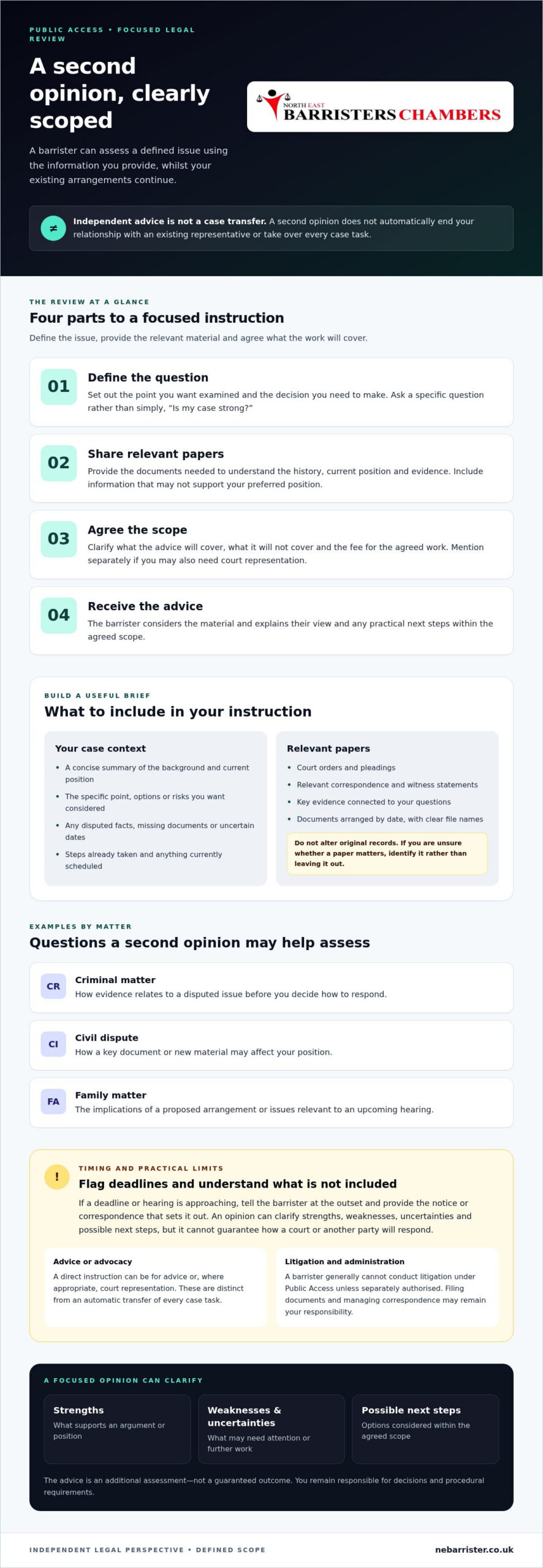
The opinion can clarify strengths, weaknesses, uncertainties and possible next steps. It may also identify missing information or questions that need further work. It cannot guarantee how a court or another party will respond, or promise a particular outcome.
When might a second opinion be useful?
An independent assessment can help you make a more informed choice at practical decision points. For example:
- Criminal matter: you want another view on how evidence relates to a disputed issue before deciding how to respond.
- Civil dispute: the parties interpret a key document differently, or new material may affect your position.
- Family matter: you need to understand the implications of a proposed arrangement or the issues relevant to an upcoming hearing.
A second opinion can also help before accepting or rejecting a proposal, preparing a response, or deciding what position to take at a hearing. It gives you an additional assessment, not an automatic transfer of the case. If proceedings are active, explain what is already scheduled and which steps are under way.
Act promptly if a deadline or hearing is approaching. Tell the barrister the relevant date at the outset and provide the notice or correspondence that sets it out. This helps define what can usefully be considered. If you’re uncertain about existing advice, a clear question and focused review can help you understand your options, but you remain responsible for making decisions and meeting procedural requirements.
How does direct instruction work for a barrister’s second opinion?
A clear instruction helps the barrister focus on the issue that matters to you. For a direct instruction for second opinion, provide the relevant background and papers, explain what you need assessed, and agree the scope of work before the review begins. The process is practical, but the quality of the assessment depends on complete information and a well-defined question.
- Define the question. Set out the point you want examined and the decision you need to make.
- Share relevant papers. Provide the documents needed to understand the history, current position and evidence.
- Agree the scope. Clarify what the advice will cover, what it won’t cover and the fee for the agreed work.
- Receive the advice. The barrister considers the material and explains their view and any practical next steps within the agreed scope.
For broader context on direct instruction, the direct access barrister guide explains the Public Access route. The instruction is for advice or advocacy, not an automatic transfer of every case task. Under Public Access, a barrister generally cannot conduct litigation unless separately authorised. Court administration, such as filing documents or managing correspondence, may therefore remain your responsibility.
What should you ask the barrister to consider?
Replace a broad concern such as “Is my case strong?” with specific questions. You could ask how a particular document affects your position, what options follow from the evidence, or which risks need attention before a response or hearing. Identify any immediate procedural priorities. If you may also need court representation, state that separately from your request for advice.
What papers should you prepare?
Gather documents that relate directly to your questions. Depending on the case, these might include court orders, pleadings, correspondence, witness statements and key evidence. Arrange them by date and use clear file names. Don’t alter original records. Explain separately if a fact is disputed, a document is missing or a date is uncertain.
Accuracy matters. Include information that may not support your preferred position as well as material that does. Tell the barrister about relevant deadlines, hearing dates and steps already taken, so the advice can be considered in context. If you’re unsure whether a paper matters, identify it rather than leaving out something that could affect the assessment.
Keep the instruction focused on the decision you need to make. Separate facts you can support with documents from points that are disputed or uncertain. A clear brief gives the barrister a practical starting point and helps keep the advice tied to your circumstances. North East Barristers Chambers provides direct barrister advice for criminal, civil and family matters.
A second opinion, changing representatives or court advocacy: what is the difference?
These are separate choices. A second opinion asks a barrister to assess a defined legal issue. Changing representatives means ending or altering your current arrangements. Court advocacy involves a barrister representing you at a hearing. Seeking another view does not, by itself, require you to change representatives or ask the barrister to appear in court.
| Option | Purpose | Typical output | What happens afterwards |
|---|---|---|---|
| Second opinion | Test a particular legal issue or decision. | An independent assessment based on the question and material provided. | You consider the advice and decide what steps to take. |
| Changing representatives | Arrange for a different professional to handle work going forward. | A new set of working arrangements and an agreed scope of work. | You manage the transition and clarify responsibilities for the ongoing matter. |
| Court advocacy | Have a barrister present your case or submissions at a hearing. | Representation at court within the agreed instructions. | Any further work or case administration needs to be considered separately. |
The distinctions matter. An opinion is an assessment, not a promise to take over a case, contact other parties or represent you in court. The focus might be narrow, such as examining how one piece of evidence relates to a disputed point. Research into second opinions in legal and institutional settings also considers how an additional view can inform decisions rather than simply replace the first one. The Virginia Law Review article on second opinions offers a broader discussion of the concept.
What does a second opinion give you that a fresh instruction may not?
A fresh instruction can involve a broader review or a new ongoing arrangement. A second opinion lets you isolate the uncertainty first. You can ask whether a particular argument addresses the evidence, or what risks to weigh before accepting a proposal. The barrister may agree with existing advice, differ on a point or identify an issue that needs further attention. The value lies in a reasoned assessment, not guaranteed disagreement.
When might advice lead to a separate request for representation?
After receiving advice, you may decide that you also want advocacy at a hearing. That is a distinct request, with its own scope and arrangements; it doesn’t follow automatically from obtaining an opinion. Whether direct instruction is suitable depends on the case and applicable rules. Procedures can differ across UK jurisdictions, so the relevant court and jurisdiction matter.
If you’re considering an independent view, define the question first. North East Barristers Chambers provides direct barrister advice and court representation in criminal, civil and family matters. You can then decide whether advice alone meets your needs or whether a separate request for advocacy is appropriate.
How to prepare for a useful direct-access legal second opinion
A little preparation can make the review more relevant to the decision you face. Give the barrister a concise account of the background, the current position and what you need to decide. Distinguish established facts from points the other side disputes and from your own concerns or assumptions. A focused question and organised papers help define the review.
Use this checklist to organise your instruction:
- Background: Summarise what happened in chronological order, including key events and previous decisions.
- Current position: Explain what stage the matter has reached and what has already been done.
- Questions: List the legal points you want assessed, in order of importance.
- Decision: Say what choice you need to make and what information would help you make it.
- Dates: Identify any hearing, response deadline or other time-sensitive event. Use the date shown on the relevant notice or document.
- Evidence: Note which facts are supported by documents, which are disputed and which remain uncertain.
How to write a clear brief for the barrister
Write plainly and avoid trying to argue every point in the brief. A short timeline can show how the matter developed, while a separate list of questions keeps the advice centred on what you need to know. For each question, explain the decision it will inform. For example, you might need to decide how to respond to a proposal or which issue to prioritise at an upcoming hearing.
Be precise about dates. If a deadline is approaching, say when it falls and include the document that sets it out. Don’t guess or describe a date as confirmed if you’re uncertain. Flag that uncertainty so it can be taken into account.
How to make the advice practical
Ask the barrister to explain the options available on the information provided and the main considerations attached to each. You can also ask which points need further evidence or attention. Be clear about the limits you want for the review, such as whether it should address one disputed issue or a wider set of questions. The direct access guide to reducing legal costs also explains why defining the scope of work can help keep an instruction focused.
Before the review begins, make sure you understand what the opinion will cover and what it won’t. A barrister can assess the material within the agreed scope, but the advice is based on the information supplied. Share relevant papers accurately and don’t alter original documents. If something is missing or a fact is contested, say so.
To discuss advice on a defined legal issue, instruct a barrister directly.
How to take the next step with a barrister’s second opinion
Once you’ve identified the issue you want reviewed, set out what you need from the barrister. A direct instruction for second opinion is most useful when the question, supporting material and requested work are clear. You don’t need to resolve every uncertainty before making an enquiry. A concise summary can help establish whether you’re seeking advice on a specific point, broader advice or court representation.
Before substantive work begins, make sure you understand what the barrister has agreed to do and the fee for that work. The scope should reflect the question you want answered and the papers needed to address it. If your needs change, raise that before assuming the original instruction covers additional advice or advocacy.
What to expect when you request a second opinion
An initial discussion establishes the legal issue, the background and the type of work you’re requesting. Be ready to explain the current stage of the matter, the decision you face and any important dates. The barrister can clarify the proposed scope, identify relevant papers and set out the fee before starting the substantive review.
Make sure the agreed work matches your expectations. For instance, an opinion on one disputed issue may not include a review of every aspect of a case or advice on later developments. Clarify what the opinion will cover and what falls outside the agreed scope. There’s no guaranteed conclusion or outcome. Advice can help you understand options, but decisions remain yours and outcomes depend on the circumstances of the case.
Choose a clear next step for your case
Think about whether you need advice, representation or both. If you want an independent assessment before deciding what to do, describe the question and request advice on that point. If you need a barrister to speak for you at a hearing, explain that you’re considering advocacy as a separate part of the work. The appropriate arrangements depend on the case and the agreed instruction.
Criminal, civil and family matters each involve different facts, documents and decisions. For a criminal matter, your questions may concern evidence or a proposed response. In a civil dispute, you may want an assessment of a contested issue or a document. In a family matter, you may need advice on a proposed arrangement or an upcoming hearing. Include the relevant papers and dates, and explain what you hope the advice will help you decide.
You can take the next step with a short summary of your case, your key question and any important dates. Discuss a second opinion with a barrister.
Turn uncertainty into a clear next step
You don’t need to have every answer before seeking another view. Start with the decision in front of you and the point that makes it difficult. A direct instruction for second opinion can help you examine that issue with greater clarity, but the advice is a tool for your decision, not a guarantee of what will happen next.
Before you proceed, consider what would make the advice useful. Do you need to understand the risks of a particular option, identify a question to raise, or decide whether further work is needed? Being clear about your aim helps shape a practical discussion with a barrister.
To set out the issue and discuss what advice may help, discuss a second opinion with a barrister. A focused first step can make a complex decision feel more manageable.
Frequently Asked Questions
Can I instruct a barrister directly for a second opinion?
Yes. Individuals and businesses can instruct a barrister directly through Public Access for legal advice. A direct instruction for second opinion can focus on a defined question rather than the whole case. Give the barrister enough information to understand the issue and the work you want done.
Does seeking a second opinion mean I have to change my solicitor?
No. Asking a barrister for an independent view does not itself end or change your existing arrangements. You can seek advice on a particular question and then decide what to do with it. If your matter is ongoing, keep track of who is responsible for each task and any deadlines. Consider how and when to share the new advice with those already involved in your case.
Can a barrister give a second opinion if my case is already in court?
Yes. An active court case doesn’t automatically prevent you from seeking advice, but the hearing stage, case directions and upcoming deadlines affect what can be considered. Include the latest court order, hearing notice and any relevant directions with your instruction. Be clear about dates and work already completed. Advice is separate from taking over court administration or acting for you at a hearing.
What documents should I send for a legal second opinion?
Send documents that help explain the issue and the case’s current position. Depending on the matter, these could include court orders or notices, statements, pleadings, key evidence and relevant correspondence. Include documents that present different sides of a disputed point, not just those supporting your view. A short index or contents list can help the barrister locate material relevant to each question.
Can a second opinion guarantee a different result in my case?
No. A second opinion can’t guarantee that another barrister will disagree with the advice you already have, or that the case will reach a particular outcome. The barrister assesses the legal issues and material provided, which may lead to agreement, a different interpretation or further questions. A court or another decision-maker is not bound to reach a particular conclusion because you’ve obtained independent advice.
How much does a direct-access second opinion cost?
The fee depends on the work agreed, including the issues to be assessed and the papers involved. Before substantive work begins, establish the fee and what it covers. If you want the barrister to consider additional documents or questions later, that may require a change to the agreed scope and fee. Don’t assume a second opinion includes court representation or further work unless it’s agreed.
Is a barrister’s second opinion confidential?
Barristers have professional duties concerning confidential information received from clients. However, confidentiality and legal privilege are not identical, and whether a particular communication is legally privileged can depend on the circumstances. Tell the barrister if you have concerns about sensitive material before sending it, and don’t assume that an opinion can never be disclosed or relied on elsewhere. Clarify the intended use of the advice at the outset.
Can a barrister’s second opinion be used in court?
Not automatically. An opinion prepared to advise you is not necessarily evidence for the court, and its relevance or use depends on the proceedings and applicable rules. It may help you understand your position or consider what steps to take, but that is different from instructing a barrister to represent you or prepare evidence for a hearing. Explain the intended use when defining the requested work.