
What if representing yourself didn’t mean handling every legal question alone? Litigant in person barrister help can give you access to focused legal advice or court representation while you remain in control of your case. Through direct access, you can instruct a barrister without going through a solicitor first.
It’s understandable to feel unsure about procedure, evidence, deadlines and how to put your case across. A barrister may be able to advise on the legal issues, help you prepare or speak for you in court, depending on your case and the work agreed. Their role isn’t the same as a solicitor’s, and instructing a barrister doesn’t automatically transfer responsibility for managing your case.
This guide explains what support may be available, where its limits lie and what you’ll still need to organise yourself, including documents and court deadlines. It also explains how to prepare for a useful discussion with a barrister, so you can identify the help that fits your situation and agree what you will continue to manage.
Key Takeaways
- Litigant in person barrister help can include focused legal advice or court advocacy, while you retain responsibility for the work agreed as yours.
- Compare self-representation, advice-only support and court representation to decide where professional input could be most useful.
- Gather court orders, applications, correspondence and evidence, then create a dated chronology to make your case easier to explain.
- Before speaking to a barrister, note your case type, current court stage and any approaching deadlines.
- Agree the scope of the barrister’s work and how you’ll communicate, so you understand what support to expect and what you need to handle.
Litigant in person barrister help: what does it mean?
A litigant in person is someone involved in a court case who represents themselves rather than having a solicitor or barrister conduct it for them. The term is commonly used in England and Wales; the Litigant in person overview explains the concept and its use. Representing yourself doesn’t mean you have to make every legal decision without advice. You can seek help with a particular issue while remaining responsible for presenting and managing your case.
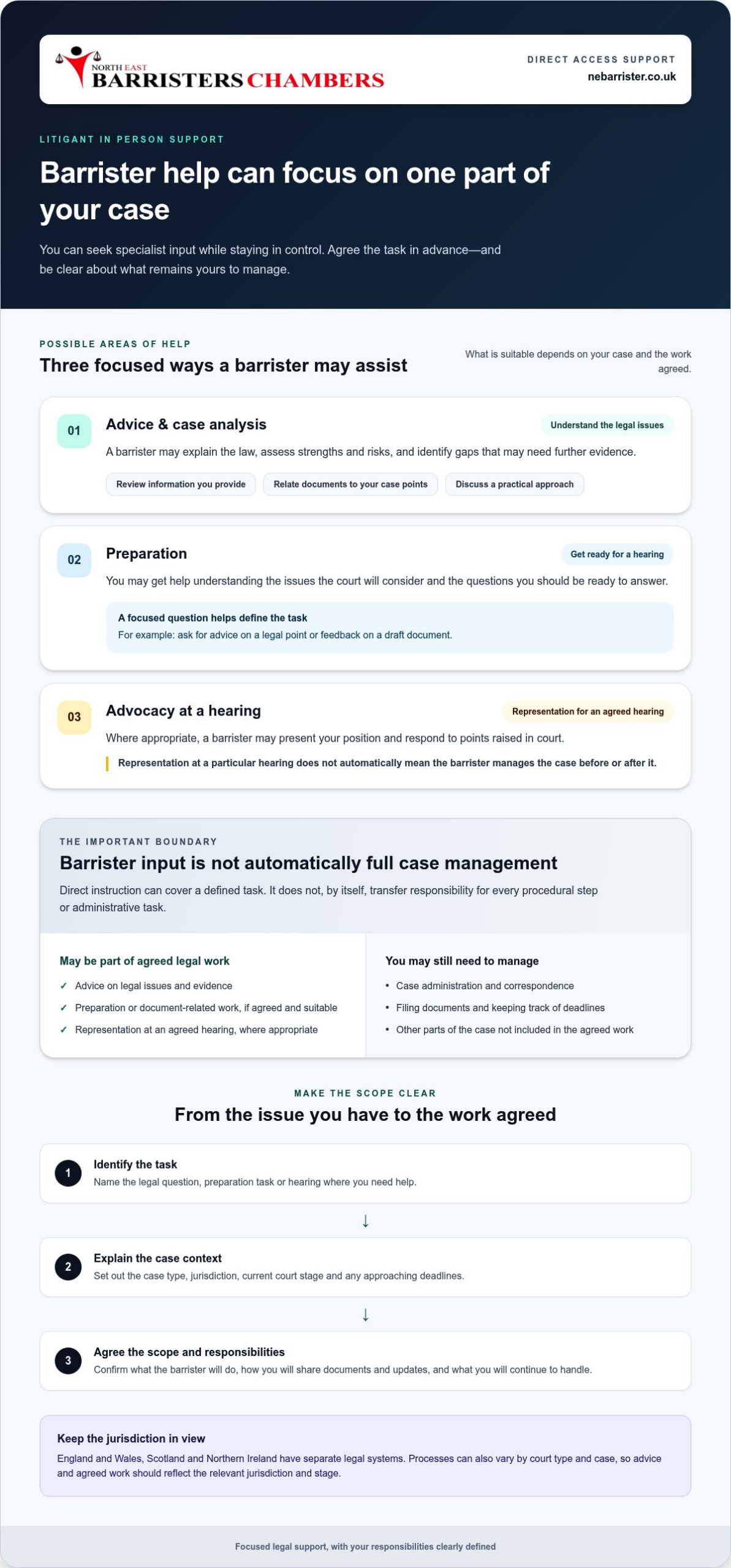
That distinction matters. You might ask a barrister to explain the legal issues, assess the strengths and risks of your position, or represent you at a hearing, while continuing to handle other parts of the case yourself. The work must be agreed and suitable for direct instruction. A barrister’s involvement doesn’t automatically mean they’ll manage your case file or take responsibility for every procedural step.
There isn’t one set of court procedures for the whole UK. England and Wales, Scotland and Northern Ireland have separate legal systems, and processes can also vary between court types and cases. Make sure any advice relates to the jurisdiction and stage of your proceedings. The right form of litigant in person barrister help depends on what your case requires, what you need the barrister to do and how their role is defined.
Can you get barrister help without a solicitor?
Yes. Direct access, also called public access, allows a person to instruct a barrister directly for suitable legal advice or representation, without first instructing a solicitor. This differs from asking a solicitor to manage the wider case, including its administration and ongoing correspondence. Direct instruction can focus on a defined task, but it isn’t appropriate for every matter or task. Agree the proposed work and your responsibilities from the outset.
Why might someone represent themselves?
People act for themselves for different practical or personal reasons. They may want to keep control of decisions, have limited funds for legal support, or feel able to handle some parts of the case. Even so, procedure can be unfamiliar. You may be unsure what evidence matters, how to meet a deadline or how to explain your position clearly at a hearing.
Self-representation does not prevent you from seeking legal advice. You can get help with a specific question without handing over control of the whole case. For example, you might seek advice on the issues to address before a hearing, then continue preparing your own documents. A barrister may also be able to speak for you at a hearing if that work is agreed and suitable. Start by identifying the part of the case where you need help.
What can a barrister do to help a litigant in person?
Support can be tailored to a particular legal task. A barrister may advise you on the law, analyse the issues in your case, help you prepare or represent you at a hearing. Agree the work in advance so you know what the barrister will do and which responsibilities remain yours. The Direct Access Portal – Bar Council explains how direct access can provide a route to barrister advice and representation in England and Wales.
For example, you might need help understanding a court application, assessing the evidence that supports your position or preparing for questions at a hearing. That doesn’t mean the barrister takes over the whole case. A defined piece of litigant in person barrister help can provide specialist input on a legal issue while you continue to handle other parts yourself.
Advice, case analysis and preparation
A barrister can review the information you provide, explain the legal issues and help you identify strengths, risks and gaps that may need further evidence. They may discuss a practical approach to your case or advise on how documents relate to the points you need to make. Document review or drafting can also be considered, depending on the agreed work and the rules that apply to your case.
Useful advice starts with a focused question. If you’re preparing for a hearing, you could ask the barrister to explain the issues the court will consider and the questions you should be ready to answer. Be clear about the outcome you need from the work, such as understanding a legal point or getting feedback on a draft. That helps define the task and your responsibilities.
Advocacy at a hearing
Where appropriate, you may instruct a barrister to represent you at a particular hearing. Advocacy can include presenting your position and responding to points raised in court. This differs from full conduct of proceedings: representation at one hearing doesn’t automatically mean the barrister manages the case before and after it. Whether a barrister can undertake a hearing depends on the case, the work required and the arrangements agreed.
There’s also a practical boundary between legal work and case administration. A barrister’s advice or advocacy doesn’t automatically include managing correspondence, filing every document or keeping track of all your deadlines. Establish who is doing each task and how you’ll share updates, documents and instructions. Court processes differ across the UK, so the work should reflect the relevant jurisdiction and court.
If you’re considering direct access barrister advice, identify the task you need help with and the stage your case has reached. A focused discussion can establish what support is suitable, what you’ll remain responsible for and how the work will be carried out.
Self-representation or barrister support: which approach fits?
You don’t have to choose between managing every part of a case alone and handing it all over to a solicitor. Depending on the matter, you may represent yourself, seek focused advice from a barrister or instruct a barrister to advocate at a particular hearing. Direct access means a solicitor isn’t always needed before you can speak to a barrister, although not every case or task is suitable for direct instruction.
Use this comparison as a starting point. The right option depends on the case’s procedural complexity, how soon you need help and the kind of support you need. Court processes also vary across UK jurisdictions, so consider the rules and requirements relevant to your proceedings.
| Approach | Control | Preparation responsibility | Professional input and likely fit |
|---|---|---|---|
| Self-representation | You make and present your case. | You organise documents, meet deadlines and prepare for hearings. | No barrister input. May suit someone comfortable handling the legal and practical work. |
| Focused barrister advice | You retain conduct of the case. | You remain responsible for case administration and agreed tasks. | Advice on a defined issue may help you understand your position or prepare for a hearing. |
| Instructed advocacy | You retain decisions about your case; the barrister presents your position at the agreed hearing. | You provide accurate instructions and handle tasks outside the agreed work. | May suit a hearing where legal argument, evidence or procedure feels difficult to manage alone. |
When might focused legal advice be useful?
A focused advice session may help if you need to clarify a legal issue, get an informed view of your position or prepare questions for a hearing. You might want to understand how a particular document affects your case, for example. This approach can suit someone who wants to remain responsible for the proceedings but would value professional input on a specific point. The work depends on what is suitable and agreed.
When might representation be worth considering?
Consider advocacy if a hearing involves unfamiliar procedure, contested evidence or important legal arguments. A barrister may be instructed to represent you at that hearing where appropriate, but you’ll still need to provide complete, accurate instructions. If you’re weighing up this route, the guide to direct access barrister services explains how direct instruction can work.
To choose a starting point, identify the next decision or event in your case. If you can manage the process but need clarity on one issue, focused advice may be enough. If you’re unsure how to present your case at a hearing, advocacy may be worth discussing. Either way, be clear about the help you’re seeking, the urgency and what you’ll continue to manage yourself.
How to prepare for useful litigant in person barrister help
A clear brief helps a barrister understand what you need and focus on the questions that matter. You don’t need to master legal terminology or write a long account. Start with the next hearing or deadline, organise the key information and decide what you want advice to address.
- Identify the next event. Note the hearing date, any deadline and what the court is being asked to decide. If a deadline is close, make that clear at the outset. Don’t miss or delay a required court action while seeking advice. If you’re unsure what must be done and when, flag the uncertainty promptly.
- Summarise the case. Write a short account of what has happened, what outcome you’re seeking and what currently concerns you. Keep it factual and identify any important points the other party disputes. This gives the barrister a practical starting point without requiring you to resolve every legal issue first.
- Organise the documents. Group the material by type and put key items in date order. A short index makes it easier to find a court order, application or piece of evidence during a discussion.
- Set out the help you need. List the questions you want answered and the task you’re considering, such as advice on an issue or representation at a hearing. Agree the proposed work, your responsibilities and how you’ll communicate before the work begins.
Documents and case information to organise
Prepare a chronological index rather than sending an unsorted file. Keep court orders and applications together, separate correspondence from evidence, and make a distinct note of disputed facts. Label documents clearly and include dates where possible. Share material relevant to the discussion, and take care to protect confidential or sensitive information when sending case documents.
Questions to settle before the discussion
Be ready to say which decision, hearing or issue you need help with. Ask what work is proposed, what you’ll need to do and what sits outside its scope. Clear boundaries help you understand the practical arrangement; the guide to managing legal costs with direct access also explains why defining the work matters.
Your questions might include whether the barrister will review specified documents, provide advice on a particular point or represent you at an identified hearing. Ask how to provide instructions and what information they’ll need from you. Keep the focus on the decision you face, rather than trying to cover every possible issue at once.
With your deadline, short case summary and indexed documents ready, you can discuss litigant in person barrister help in a focused way and work out what support fits the task.
Getting litigant in person barrister help through direct access
Direct access gives you a way to approach a barrister yourself about legal advice or court representation, without first instructing a solicitor. It can be a practical route when you’re representing yourself and want professional input on a defined issue. Whether the work is suitable depends on your case, the task you need done and the barrister’s professional obligations.
Before making an enquiry, prepare a short outline of:
- the type of case, such as a criminal, civil or family matter
- the court stage and what decision or hearing is coming up
- any approaching deadlines or urgent procedural concerns
- the key documents that help explain the issue
You don’t need to send every document at the first step. A concise summary and relevant papers can help make the discussion focused. If a deadline is close, say so promptly. Don’t put off a required court action while seeking advice.
What happens when you make an enquiry?
Start by explaining the issue and the specific help you’re seeking. You can then share relevant information so the proposed work can be considered. If it’s suitable, discuss what the barrister will do, the fee, how you’ll communicate and which tasks remain yours. A direct access barrister is not a solicitor and won’t automatically manage every part of your case.
The barrister’s professional obligations and the circumstances of your case matter. Direct access isn’t appropriate for every case or task, so make the scope clear before proceeding. This helps you understand what the work covers, what it doesn’t and what information you’ll need to provide.
Choose a clear, proportionate next step
Decide whether you’re looking for advice on a legal issue, input on particular documents or advocacy at a hearing. You can raise a defined piece of work without committing to full-case support. A focused request also helps the barrister understand what you want to achieve and whether the proposed task is suitable.
Before agreeing to the work, make sure you understand the fee and what it covers, what you must do yourself, and how updates or further instructions will be handled. If the proposed task changes, clarify any revised scope and fee before additional work is undertaken. This keeps expectations practical and responsibilities clear.
If you’re ready to discuss your situation, prepare a brief case outline and the key documents, then discuss your case with a direct access barrister. Explain what stage you’re at and explore a suitable next step without assuming you need to hand over the whole case.
Take the next step with a clearer sense of what you need
You don’t have to plan every stage of your case before seeking help. Start with the next decision that feels difficult, then consider what would help you prepare for it. A focused conversation can help you explore whether advice, document input or representation is the right next step, without assuming you need to hand over the whole case.
North East Barristers Chambers provides direct access advice and court representation for individuals and businesses across the UK in criminal, civil and family matters. You can discuss work that fits your case and clarify responsibilities, so you can decide how to proceed with a better understanding of the support available.
If litigant in person barrister help could make your next step clearer, prepare a short outline of the issue and the outcome you’re seeking. You can discuss your case with a direct access barrister and explore a proportionate way forward. You remain in control of your decisions and can take the process one step at a time.
Frequently Asked Questions
Can a barrister represent me in court if I am a litigant in person?
Yes, a barrister may represent you at a hearing if the case and proposed work are suitable. For example, you might seek advocacy for a hearing where you need to present legal arguments or respond to evidence. Representation at one hearing doesn’t necessarily cover later hearings or other stages. Agree which hearing is included, what preparation is required and what information you must provide before the barrister accepts the work.
Can I instruct a barrister directly without hiring a solicitor?
Yes, direct access allows you to approach a barrister yourself about suitable advice or representation. You don’t have to hire a solicitor first simply to speak to a barrister. The arrangement isn’t the same as having a solicitor manage the case. Before proceeding, establish the exact work proposed, how documents and instructions will be handled, and which case-management tasks remain your responsibility.
Can a barrister help me prepare for a hearing without attending it?
Yes, you may be able to instruct a barrister for preparation or advice without asking them to attend the hearing. For instance, you could seek help understanding the issues to address or reviewing questions you plan to ask. The work must be suitable and clearly agreed. You would still need to attend and present your case yourself, unless separate advocacy work is arranged.
What if my hearing date is very close?
Tell the barrister about the hearing date and any related deadlines at the start of your enquiry. Share the key papers and explain what decision the court is being asked to make, so the time available is clear. Don’t assume representation can be arranged at short notice, and don’t leave a required court step undone while seeking advice. If you’re unsure about a deadline, say so promptly.
Does a barrister take over my case when I am a litigant in person?
No, instructing a barrister for a specific task doesn’t automatically transfer responsibility for your whole case. If you ask for advice on a legal issue, for example, you may still need to manage correspondence and court paperwork. Confirm who will handle each agreed task, how you’ll provide instructions and what happens after the work is complete. That avoids assumptions about ongoing support.
Can a barrister help with a family, civil or criminal case?
Yes, direct access barrister help may be available for suitable family, civil and criminal matters. The type of case affects the legal issues, court process and preparation needed. For example, a family hearing about arrangements may require different documents and preparation from a criminal matter. Explain the nature of your case and its current stage so the proposed advice or representation can be considered in context.
What documents should I have ready before asking for barrister help?
Have the latest court order or notice, any application relevant to the issue, and key correspondence or evidence ready. A simple dated timeline can help explain what has happened and when. You don’t need to send every paper immediately. Select documents linked to the question you want answered, label them clearly and note any missing information or facts you and the other party disagree about.