
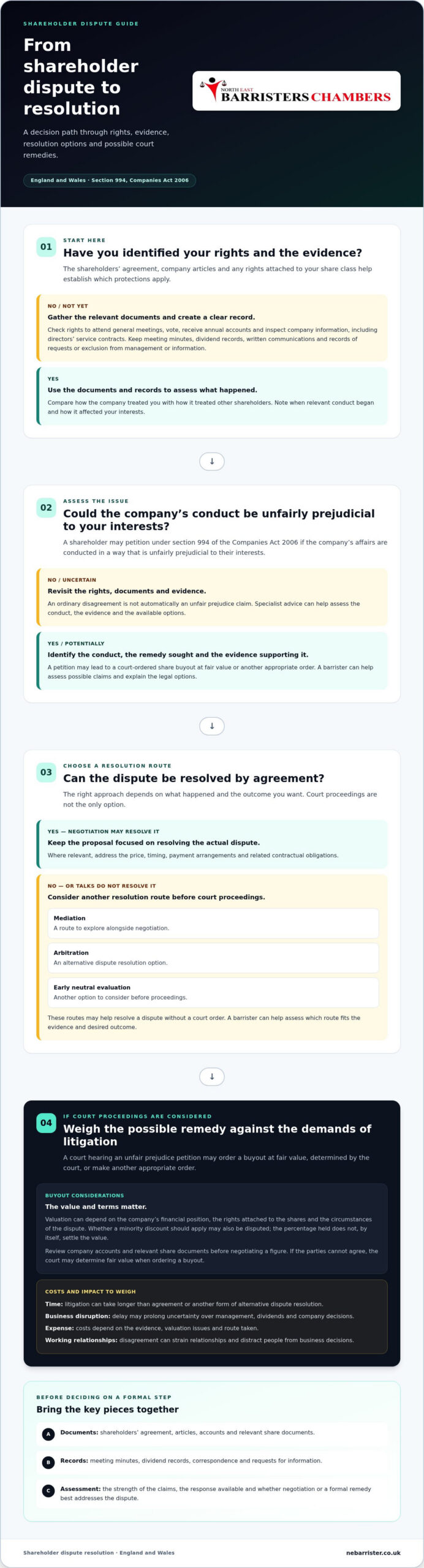
A shareholder dispute may be resolved through an agreement, mediation, arbitration or early neutral evaluation; if it reaches court, an unfair prejudice petition may lead to a share buyout or another order. In England and Wales, a shareholder may petition under section 994 of the Companies Act 2006 if the company’s affairs are conducted in a way that is unfairly prejudicial to their interests, according to UK Parliament. A barrister for shareholder disputes can help assess the issues and explain the legal options.
Disagreements about management, dividends or a shareholder’s role can put pressure on a business and the people involved. The shareholders’ agreement, the company’s articles and the conduct at the centre of the dispute all matter. Court proceedings are not the only option: the right approach depends on what happened and the outcome you want.
This article explains how shareholder disputes may be resolved, how governing documents shape shareholder rights and what can happen when shareholders disagree about running a business. It also explains how specialist barrister advice can help you weigh negotiation, alternative dispute resolution and court proceedings, then decide what to do next.
Key Takeaways
- Compare negotiation, mediation, arbitration and court proceedings to identify a route that fits the dispute and the outcome you want.
- Understand how a minority shareholder may challenge conduct that unfairly affects their interests, including through a petition under section 994 of the Companies Act 2006.
- Read the shareholders’ agreement alongside the company’s articles to see what they say about decision-making, rights and resolving disagreements.
- Look beyond business direction: disputes may also involve management roles, company assets, contracts or dividends.
- Get specialist advice early to assess the evidence, clarify your options and plan a practical next step.
How Does a Shareholder Dispute Get Resolved?
A minority shareholder dispute may be resolved through negotiation, mediation, arbitration or court proceedings. Consider the potential legal expense, disruption to the company and damage to working relationships. Costs depend on factors such as the evidence, valuation issues and the route taken.
Minority shareholder protections
Start by identifying the rights attached to your shares and reviewing the company’s governing documents. A minority shareholder may have rights to attend general meetings, vote, receive annual accounts and inspect company information, including directors’ service contracts. The articles, shareholders’ agreement and any rights attached to a particular class of shares help establish which protections apply.
Keep a clear record of decisions and requests. Meeting minutes, dividend records and written communications can help show how the company treated you compared with other shareholders. If you have been excluded from management or information, record when it began and how it affected your interests. This evidence can help distinguish an ordinary disagreement from conduct that may support an unfair prejudice claim.
Share valuation and minority discounts
A buyout may depend on the value of the shares and whether a minority discount should apply. Valuation can turn on the company’s financial position, the rights attached to the shares and the circumstances of the dispute. Review the company accounts and relevant share documents to understand the issues before negotiating a figure.
A dispute involving three shareholders during 2021-2022 raised whether the petitioner’s shares should be valued with a minority discount. That question illustrates why the percentage held does not, by itself, settle the value. If the parties cannot agree, a court hearing an unfair prejudice petition may determine fair value when ordering a buyout.
Minority shareholder remedies and buyouts
In an unfair prejudice petition, a court may order the petitioner’s shares to be bought out at a fair value determined by the court, or make another appropriate order. A buyout can provide an exit, but the valuation and terms matter. Identify the conduct you complain of, the remedy you seek and the evidence supporting it.
Before starting proceedings, shareholders can explore an agreement, mediation, arbitration or early neutral evaluation. These routes may help resolve a dispute without a court order. A practical proposal should address the price, timing, payment arrangements and any related contractual obligations. Keep it focused on resolving the actual dispute, rather than reopening every past disagreement.
Risks and costs of disputes
Litigation can take longer than resolving a dispute by agreement or through another form of alternative dispute resolution. Delay may prolong uncertainty over management, dividends and company decisions. Legal work, evidence gathering, valuation issues and court steps all affect costs. Weigh those demands against the outcome you seek.
Bringing or defending a claim also takes time and requires careful handling of company information. Disagreement can strain working relationships and distract directors and shareholders from business decisions. Before taking a formal step, organise the relevant agreements, accounts, meeting records and correspondence. Then assess the strength of the claims, the response available and whether negotiation or a formal remedy best addresses the dispute.
Representing companies and individual shareholders
A barrister can help a company, director or shareholder understand a dispute and decide how to respond. The appropriate approach depends on the parties’ roles, rights and evidence.
The barrister’s role and framework
A barrister can analyse the legal issues, advise on possible claims and represent a party in court. They can also help assess whether negotiation or another resolution route fits the evidence and the outcome you want.
In England and Wales, a shareholder may petition the court under section 994 of the Companies Act 2006 if the company’s affairs are conducted in a manner that is unfairly prejudicial to their interests as a shareholder, according to UK Parliament. For companies without a shareholders’ agreement, the articles and Companies Act 2006 provide the default framework for shareholder matters.
For an offshore company, identify where it is incorporated and which law governs its internal affairs. Those details can affect which rights apply and where a dispute may be heard. A barrister can help map the issues and identify when advice on another jurisdiction is needed.
Qualifications and relevant experience
Look for a barrister experienced in company law disputes, shareholder rights and court advocacy. Ask how they would approach issues similar to yours, such as a minority shareholder’s exclusion from management or a disagreement about company assets. Relevant experience means understanding both the legal arguments and the practical effects on the business.
Choose a barrister who can explain the strengths, weaknesses and possible next steps in plain English. Ask who they would represent, what work they would undertake and whether they can advise on negotiation as well as court proceedings. These points help you judge whether their approach fits your position, whether you are an individual shareholder or acting for a company.
Preparing evidence and documents
Before a meeting, organise the shareholders’ agreement, articles of association and documents showing your share rights. Include relevant meeting minutes, accounts, dividend records, board decisions and correspondence between the parties. For an offshore company, note its place of incorporation and include documents identifying the law governing its affairs.
Prepare a short chronology of key events, with dates and people involved. Mark the decisions you challenge and explain how each affected your position. Note the outcome you seek, such as a negotiated resolution or court action. A focused set of documents helps the barrister identify gaps, assess the claims and give more useful advice.
If you want to discuss your position directly with counsel, Direct Access Barrister Services provide a route to specialist legal advice and representation without instructing a solicitor.
Shareholder agreements
A shareholders’ agreement can set rules for decisions, dividends, management rights and dispute resolution. Compare it with the company’s articles to identify which terms matter to the disagreement.
Shareholder agreements and articles
A shareholders’ agreement regulates relationships between shareholders and can help prevent or resolve disputes. Its provisions may cover how decisions are made, how dividends are handled, which shareholders can participate in management and whether a buyout mechanism applies. These terms can give shareholders a planned route through disagreements instead of leaving each issue to informal discussion.
The articles of association form a separate part of the company’s governing framework. A shareholder’s specific rights depend on the agreement, the articles and any rights attached to their class of shares. Read the relevant clauses together. For example, compare the agreement’s decision-making procedure with the articles’ provisions on meetings and voting, then note any apparent differences.
If there is no shareholders’ agreement, the articles and the Companies Act 2006 provide the default framework for shareholder matters. That makes the articles especially important when checking how the company handles decisions, share rights and internal processes. Keep the current documents together, including any amendments, so the version relied on reflects the company’s arrangements.
Breaches of shareholder agreements
A potential breach may arise when a shareholder or company fails to follow an agreed process or right. Examples include ignoring a stated decision procedure or management right, or failing to follow an agreed dispute-resolution or buyout mechanism. First, identify the precise clause and the person or company bound by it. Then compare its wording with the events and records.
Minutes, emails, financial records and notices can help establish what happened and when. Keep a chronology linking each relevant event to the clause in question. Separate the alleged contractual breach from any wider complaint about unfair treatment: they may raise different issues and require different responses. The agreement’s wording and the evidence shape the available arguments.
Before starting litigation, consider the agreement’s own resolution steps. It may require discussion, mediation or another process before court action. Follow any stated procedure and document attempts to resolve the issue. If you are considering an urgent step, such as an interim injunction, assess the alleged breach, supporting evidence and practical effect on the company before deciding how to respond.
For a focused review, list the relevant clauses, the conduct you say breached them and the outcome you seek. This helps clarify whether negotiation, mediation or litigation is the more suitable next step, keeping attention on the contractual issues rather than unrelated disagreements.
Shareholder disagreements about management and business direction
Disputes can concern who controls decisions, how company assets are used or whether directors should change strategy. Separate a business disagreement from specific conduct that may support a legal claim.
Management and business direction disputes
A disagreement about expansion, investment or appointing a director can become more serious when a shareholder is excluded from management. Other examples include diverting business to another entity, misappropriating company assets, paying some shareholders excessive remuneration or withholding dividends whilst the company remains profitable. Record each decision, who made it and how it affected the company or your interests.
Next, identify the resolution you want. You might seek access to information, a change in decision-making, protection against a proposed transaction or an exit from the company. Compare that outcome with the company’s articles and any contractual rights. If the conduct appears unfairly prejudicial, an unfair prejudice petition may be relevant. Focus the petition on evidenced events, not simply a difference of opinion about corporate strategy.
For example, if directors propose transferring company assets, gather the proposal, board records and communications explaining its purpose. If a director faces removal, collect relevant notices and minutes. These steps can help distinguish a genuine management concern from a wider breakdown between shareholders.
Directors’ statutory duties
Allegations concerning directors’ statutory duties require close analysis of what each director did, the decision-making process and the company’s interests. A claim may allege misfeasance, breach of duty or negligence, but those labels do not establish what happened. Set out the specific act or omission, the records supporting it and the consequences for the company.
For instance, examine board minutes, financial records, contracts and messages relating to a disputed transaction. Consider whether the director disclosed relevant information, followed company procedures and acted consistently with their responsibilities. A poor commercial result alone does not explain the decision or prove misconduct. The evidence and context matter.
Shareholders and companies may have different interests in a directors’ duties dispute. A shareholder may be concerned about personal rights or unfair prejudice, whilst the company may need to address a loss or protect its operations. Keep those issues distinct when considering claims and possible responses. Specialist advice can clarify who should act, what evidence supports each allegation and whether negotiation or court proceedings better fit the resolution sought.
Specialist legal advice for shareholder disputes
Early advice can help you choose a proportionate response before a disagreement develops into proceedings. Set out the disputed decisions, the people involved and the outcome you want. For example, a shareholder concerned about a proposed asset transfer needs a different response from one seeking to leave the business. A barrister for shareholder disputes can assess your circumstances and explain the available routes.
A specialist can assess the evidence and explain whether negotiation, mediation or formal proceedings best fit the dispute. That assessment should connect each allegation to supporting material, such as company records, correspondence or transaction documents. It should also identify who owns each claim: an individual shareholder, the company or both. This distinction helps direct any proposed action towards the right party and remedy.
Timing matters when a company is being restructured, assets may be transferred or a minority interest could be diluted. Bring together the relevant proposal, board papers and communications so advice can address the practical risks. A clear chronology helps distinguish completed actions from proposed steps and identify urgent priorities. A barrister for shareholder disputes can use those details to focus advice on the decisions that need attention first.
Advice should test the commercial consequences as well as the legal position. Consider how a claim could affect trading, relationships between shareholders and partners, access to company information or a possible share purchase. For example, a negotiated purchase may resolve an ownership deadlock, whilst a court claim may be needed to seek a formal remedy.
Alternative dispute resolution can provide a structured way to discuss settlement without going to court. Mediation gives the parties a setting to explore proposals, whilst early neutral evaluation can help assess contested issues. Litigation takes longer to conclude than resolving a shareholder dispute by agreement or another out-of-court process. The likely route should reflect the evidence, relationships between the parties and the outcome sought.
Prepare for an initial advice meeting by organising the shareholders’ agreement, articles, accounts and key correspondence. Add a short chronology and note the decision you want advice on. Ask the barrister to explain the available options, the immediate steps involved in each and what further evidence could change the assessment. This keeps the discussion focused on decisions you can make.
Independent advice is especially useful before sending a formal claim, responding to one or agreeing to a share purchase. It can clarify the legal basis, likely points of dispute and practical alternatives, helping you avoid a step that does not serve your commercial objective.
Discuss your shareholder dispute and next steps to get advice focused on your position and the resolution you are seeking.
North East Barristers Chambers: Direct Access Barrister Services
North East Barristers Chambers provides Direct Access Barrister Services for people and businesses seeking legal advice about a shareholder dispute. You can instruct a barrister directly for advice on your position, possible claims and practical next steps, without needing a solicitor to instruct counsel. If proceedings are necessary, Court Representation can support you through the advocacy process.
Shareholder disputes fall within civil law. Direct access may suit you if you want a barrister to assess the issues, explain your options or represent you in court. It is not a substitute for every form of legal support, so the right next step depends on the work required and the stage of your dispute.
To discuss your shareholder dispute and possible next steps, contact North East Barristers Chambers.
Choose your next step with a clear objective
Before taking action, decide what you need the next conversation to achieve. You might want an initial view of your position, advice on a proposed response or representation for a court step. A barrister for shareholder disputes can help you focus on the important questions and understand the practical choices ahead.
North East Barristers Chambers offers Direct Access Barrister Services and Court Representation, with a practice that includes civil and criminal law. For a shareholder dispute, the next step depends on the advice or advocacy you need and how the matter is progressing. A concise account of the issue and your intended outcome can make an initial discussion more focused.
You can take that step without deciding every part of the dispute in advance. Set out your immediate concern, identify the decision you need to make and seek advice on the available options. Clear guidance can help you move forward with purpose, whether you are considering a response or preparing for proceedings.
Contact North East Barristers Chambers to discuss your situation and possible next steps. A measured first conversation can help you approach the dispute with greater clarity.
Frequently Asked Questions
What Legal Rights Do Shareholders Have?
Shareholders’ rights depend on the company’s articles, any shareholders’ agreement and the class of shares they hold. Rights may include attending and voting at general meetings, receiving annual accounts, inspecting directors’ service contracts and company information, bringing claims against directors and appointing proxies. Check the governing documents alongside the share terms. For example, voting rights may differ between share classes, so a share certificate alone may not explain the full position.
When is an offer to buy out a minority shareholder reasonable?
An offer is easier to assess when its valuation method, payment terms and proposed timetable are clear. Compare it with the rights attached to the shares, company accounts and any buyout mechanism in the shareholders’ agreement. Consider whether the proposal addresses the dispute’s effect on the shareholder, rather than simply offering an exit. If valuation is contested, identify the assumptions behind the figure and whether a minority discount is proposed.
Why is it important to seek specialist legal advice?
Specialist advice can help distinguish a personal shareholder complaint from a claim concerning the company itself. That distinction affects who may bring a claim and which remedy to seek. Advice is particularly useful before responding to a proposed restructuring, asset transfer or dilution of a minority interest. Prepare the relevant documents and your desired outcome, then seek an assessment of the evidence, available routes and immediate decisions.
When should a shareholder instruct a barrister directly or through a solicitor?
You can instruct a barrister directly when you want legal advice or advocacy without a solicitor acting as an intermediary. This may suit a defined task, such as advice on a proposed claim or court representation. If a solicitor is already coordinating correspondence, documents and wider case work, they can instruct counsel as part of the legal team. Choose the route that fits the work you need handled.
How do I find a barrister specialising in shareholder disputes in England and Wales?
Look for relevant experience in company disputes, unfair prejudice claims, shareholder rights and court advocacy. Ask how the barrister would approach your specific issue, such as exclusion from management or a disputed share valuation. Check that they can explain the legal arguments, evidence needed and practical options in clear language. A useful initial discussion should help you understand the proposed scope of advice or representation and the next decision to make.
What legal claims can shareholders bring in England and Wales, including unfair prejudice and derivative claims?
In England and Wales, a shareholder may petition under section 994 of the Companies Act 2006 if the company’s affairs are conducted in a manner unfairly prejudicial to their interests as a shareholder, according to UK Parliament. Broadly, a derivative claim seeks to pursue a claim belonging to the company, rather than remedying a shareholder’s personal treatment. Identify who suffered the alleged wrong and what outcome is sought before considering the claim type.
What are the steps and typical timescales in a UK shareholder dispute?
Start by assembling the company documents and a chronology, then identify the disputed conduct and the outcome you seek. The parties can explore negotiation or alternative dispute resolution before court proceedings. Timing depends on factors such as the complexity of the issues, evidence required and whether valuation is disputed. Litigation takes longer to conclude than resolving a dispute by agreement or out-of-court resolution, so choose a route that addresses the issues requiring a decision.
How can a shareholder dispute be resolved through negotiation, mediation, arbitration, or court?
Negotiation lets shareholders discuss proposals directly, whilst mediation uses a neutral facilitator to support settlement discussions. Arbitration provides an alternative dispute resolution process, and early neutral evaluation can help assess contested issues. If the parties cannot resolve the matter, court proceedings may determine the claim and remedy. Compare each route against the urgency, evidence, relationship between shareholders and practical outcome sought, including whether continued involvement or an exit would resolve the dispute.