
You don’t automatically need a solicitor to get legal advice for your business. In the UK, Direct Access lets you instruct a barrister directly. A barrister for small business legal advice can help you understand your options before you decide what to do.
It’s understandable to want clear guidance on both the process and fees. This article explains what small business legal advice can cover, how barrister fees are agreed and what Direct Access means in practice, so you can decide whether it suits your needs.
We’ll cover when advice may be useful, including contracts, employment matters, compliance and disputes. You’ll also learn what can affect the work involved and how direct instruction may fit with court representation. Use this as a practical starting point to decide what support your business needs.
Key Takeaways
- Identify whether your business needs help with a contract, an employment issue, compliance or a dispute, then gather the relevant documents before seeking advice.
- Review business agreements carefully before signing and consider where clear terms or amendments could reduce uncertainty.
- Agree the scope of work and fee with a barrister in advance so you understand what the work covers and can plan your budget.
- Direct Access lets you instruct a barrister without going through a solicitor first; consider whether direct advice or court representation fits your needs.
- Think through your business structure, founders’ responsibilities and any plans to reward key employees before making decisions that could affect the business.
What does small business legal advice typically cover?
Small business legal advice can cover contracts, employment matters, regulatory compliance and disputes. Before signing a business contract, advice can help you understand the obligations, risks and practical consequences of its terms.
A barrister for small business legal advice may help you assess a proposed agreement, clarify a disagreement or decide what to do next. The focus depends on the document, the other party’s responsibilities and the decision your business needs to make.
Commercial contract drafting
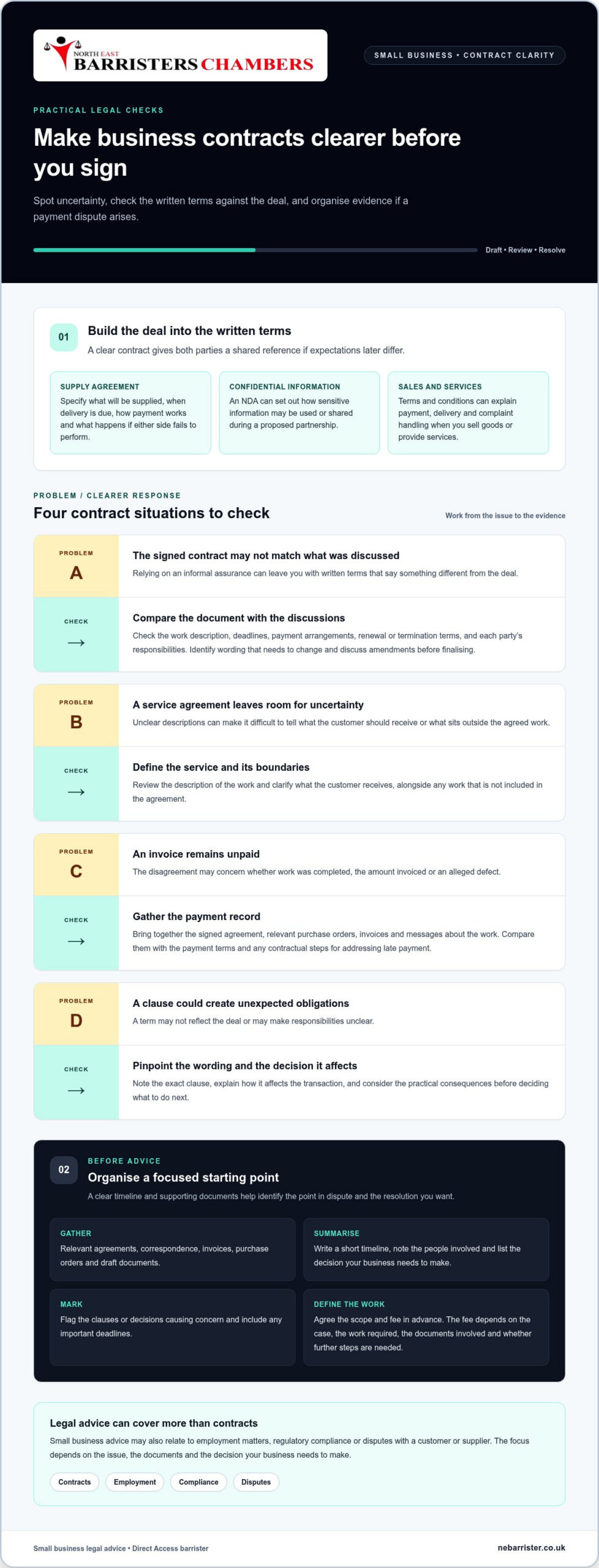
Drafting means preparing business and commercial contracts to reflect the deal you intend to make. For a supply agreement, specify what will be supplied, when delivery is due, how payment works and what happens if either side fails to perform. Clear terms give both parties a shared reference if expectations later differ.
Consider confidentiality, too. A non-disclosure agreement (NDA) can set out how sensitive information may be used or shared during a proposed partnership. Terms and conditions can explain the basis on which you sell goods or provide services, including payment, delivery and complaint handling.
Contract review
Reviewing a contract means examining its terms before you sign. Compare the written document with what you agreed in discussions. Check the description of the work, deadlines, payment arrangements, renewal or termination terms, and each party’s responsibilities. For example, a service contract should state what the customer receives and what falls outside the agreed work.
Look for terms that could create uncertainty or impose unexpected obligations on your business. If a clause does not reflect the deal, identify the wording that needs to change and discuss amendments before finalising the contract. That is safer than relying on an informal assurance that differs from the signed terms.
Contracts and debt recovery
A contract can establish what a customer agreed to pay and when payment was due. If an invoice remains unpaid, gather the signed agreement, relevant purchase orders, invoices and messages about the work. Compare them with the payment terms and any contractual steps for addressing late payment.
Advice can help you assess the dispute, explain your position and consider a proportionate next step. The disagreement might concern whether the work was completed, the amount invoiced or an alleged defect. A clear timeline and supporting documents help identify the point in dispute and the resolution you want.
Contracts are only one part of a business’s legal needs. Advice may also cover an employment issue, a compliance question or a dispute with a customer or supplier. Regular attention to these matters can help you identify risks before they disrupt operations. If you are about to sign an agreement or make a decision with financial or legal consequences, organise the relevant documents and list the questions you need answered. These steps give legal services a focused starting point and help the adviser understand the outcome you want. If you are unsure how to interpret a clause, note the exact wording and explain how it affects the transaction. A barrister can be here to help clarify the legal issues and the practical choices connected with your contracts.
Agreeing fees directly with a barrister in advance
Agree the work and payment arrangements before the barrister starts. This gives you a clearer basis for budgeting and helps both sides understand what the instruction covers. The fee depends on the case and is provided after a quote request. Factors include the work required, the documents involved and whether further steps are needed.
Ask for a clear scope of work. Advice on a partnership agreement, for example, differs from drafting amendments, negotiating with a partner or preparing for a dispute. Establish which tasks are included, what would count as additional work and how expenses paid on your behalf will be handled.
What documents and information should I prepare before consulting a barrister? Gather the relevant agreements, correspondence, invoices and draft documents, then write a short timeline of events. Include your business structure, the people involved, the decision you need to make and any important deadlines.
Agreeing payment in advance can help you plan business spending. Before proceeding, make sure you understand when payment is due, what work it covers and how changes to the instruction may affect the fee. If the matter develops, discuss the new work and its cost before it begins.
Partnership and shareholder agreements
A partnership agreement can record how partners share responsibilities, make decisions and handle a partner leaving. For example, clarify who can commit the business to a contract and how disagreements should be resolved. Reviewing these points before a dispute arises can reveal gaps between the written agreement and the partners’ expectations.
Shareholder agreements set out arrangements between company owners. Consider how decisions are made, what happens if a shareholder wants to sell and how the business should respond to a disagreement. In discussing fees, distinguish advice on existing wording from drafting or negotiating replacement terms.
Other business issues can affect the scope of work. An employment disagreement might require advice on a contract or the events leading to a proposed decision. A commercial property matter may involve a lease, renewal discussions or a dispute about responsibilities. Explain the issue and the result you want so the work can be defined around the actual task.
To prepare for a fee discussion, organise the papers by topic and mark the clauses or decisions causing concern. Then ask for the proposed work, payment timing and any possible additional tasks to be explained plainly. A barrister can then focus the discussion on the documents and practical outcome your business needs.
Direct Access to UK barristers without going through a solicitor
In the UK, Direct Access allows you to instruct a barrister directly without going through a solicitor first. This may suit a small business that needs focused advice, help understanding a dispute or court representation. A barrister may advise on a commercial issue, an employment law concern or a regulatory question. Start by explaining the issue and the outcome you need.
Direct instruction does not mean every task is automatically included. Specify whether you need a written opinion, advice on documents, help preparing a case or representation at a hearing. Share the key papers and explain what has happened so far. This helps define the work and identify whether another type of legal support is relevant.
How do barristers’ fees compare with solicitors’ fees for business advice? There is no single comparison. Fees depend on the work, the documents and how the service is priced. A barrister’s quote should describe the proposed work and payment terms, so you can compare the scope rather than assume one route costs less.
A solicitor may be relevant for a small or medium-sized business when the task requires ongoing support across several areas or work beyond a barrister’s agreed instruction. Define the issue first: a disputed contract, an employment decision and a regulatory concern each call for different expertise. Prepare a concise enquiry with the documents, key dates and decision you need help making. This makes it easier to assess whether the proposed work addresses the problem.
Are there free or low-cost legal advice services for UK small businesses? Some targeted business-support and pro bono schemes provide free or lower-cost guidance, often with limits on eligibility, subject matter or the work offered. Check whether the support covers legal advice rather than general business guidance, and whether it addresses your specific issue. It may help with an initial question but may not include detailed contract work or representation.
Compare options by asking what the fee covers, how payment is arranged and what happens if the matter changes. A quote to review one agreement is not equivalent to ongoing advice on contracts, employment and regulatory matters. Keep the response with your enquiry and note any excluded tasks. If you instruct a barrister directly, agree the scope and payment in advance. This gives you a clearer basis for budgeting and deciding whether Direct Access suits your business’s needs.
Lawyer qualification and experience
For a business legal issue, match the lawyer’s expertise to the work you need. A contract dispute, an employment decision and a commercial property issue involve different documents and questions. A lawyer experienced in the relevant area can focus on the important facts, explain your options and identify practical next steps.
Start by defining the problem in one sentence. For example: “A supplier says we breached the delivery terms, but our records show the goods arrived late.” Then gather the contract, relevant emails and a short timeline. This gives the lawyer a specific issue to assess, rather than a broad request for general business advice.
Qualification and experience answer different questions. Qualification concerns whether someone is authorised to practise in their professional role; experience concerns the type of work they have handled. For a shareholder disagreement, relevant experience might include advising on company-owner disputes and interpreting shareholder agreements. For an employment issue, look for expertise in the specific decision or workplace concern involved.
Useful indicators include clear descriptions of practice areas, examples of similar legal issues and explanations you can follow. A qualified lawyer should be able to explain what the documents mean, which facts could change the analysis and what work they propose to do. Make sure you understand whether you need an initial opinion, document review, negotiation support or representation.
A lawyer’s location alone does not show whether their experience fits your case. Consider where the business operates, where the other party is based and whether a hearing or meeting is involved. For example, a dispute about business premises may turn on the lease and the parties’ dealings, while advice on a supplier contract may focus on its written terms and related correspondence.
Use this short checklist to organise your decision:
- Describe the legal problem and the business outcome you want.
- Identify the relevant area, such as contracts, employment or a shareholder dispute.
- Collect the key documents and note any approaching deadline.
- Clarify the proposed work, its limits and how progress will be explained.
Experience should match the task, not just be broad. A lawyer familiar with commercial agreements may be well placed to review a supplier contract, while a contested hearing calls for advocacy experience. Match the work to the expertise required. This helps you identify the support needed, the documents to prepare and the outcome the advice should help achieve.
Business structures and founders’ issues
The structure a founder chooses affects ownership, decision-making and business responsibilities. A sole trader, partnership and limited company each raise different practical questions. Before choosing or changing a structure, map who owns the business, who makes decisions and what each founder contributes.
Founders should also agree how to handle changes. What happens if one founder leaves, reduces their involvement or disagrees with a proposed expansion? Record how decisions are made, how profits are shared and how disputes will be addressed. Clear written terms give everyone a common reference point.
A partnership agreement can set out founders’ roles, contributions and processes for resolving disagreements. If the business is a company with multiple owners, a shareholder agreement can address decision-making, share transfers and what to do if the relationship breaks down. Check that each written agreement reflects what the founders intend, rather than relying on informal conversations.
Intellectual property needs attention early. A founder may create a name, design, written material, software or other work for the business. List the assets the business relies on, who created them and which agreements cover their use. For example, if a designer developed a brand identity, keep the relevant contract and records with the business’s other ownership documents.
Young and fast-growing businesses may also consider share option schemes to reward valued or important employees. Before discussing an initial scheme, founders should identify its purpose, the employees it is intended to reward and how it may affect existing ownership arrangements. The Small Business, Enterprise and Employment Act is listed by The National Archives as a reference for small business matters.
Use this preparation list before an expert legal discussion:
- Write down each founder’s role, contribution and expectations.
- Collect partnership or shareholder agreements and any proposed amendments.
- Identify business names, creative work and other intellectual property requiring attention.
- Note planned changes, such as recruiting key employees or bringing in another owner.
Before bringing in a co-owner, founders should consider decision rights, ownership and how disagreements will be handled. These questions apply regardless of where the business operates. Bring the relevant documents and a concise account of the founders’ concerns. That helps an adviser identify which issues need attention first and what further drafting or advice may be useful.
North East Barristers Chambers: Direct Access Barrister Services
North East Barristers Chambers provides Direct Access Barrister Services for individuals and businesses seeking legal advice or advocacy. You can instruct a barrister directly, without going through a solicitor first, for a suitable matter.
For a business, this may be relevant when you need a barrister to explain a civil law dispute or represent you in court. The chambers also provides Court Representation and works in criminal law. The right support depends on your issue and the task you need, such as advice or advocacy.
If your business is facing a legal issue and you want to discuss direct instruction, contact North East Barristers Chambers or visit nebarrister.co.uk.
Take the next step with a clear brief
Before seeking advice, decide what you need help with: a business decision, a disagreement or a court matter. Write down the outcome you want and the main question you need answered. This gives your enquiry a clear focus and keeps the next conversation practical.
Choosing a barrister for small business legal advice can be useful when you need focused legal guidance or advocacy. North East Barristers Chambers offers Direct Access Barrister Services and Court Representation, including work in criminal law. The relevant support depends on the issue you need addressed.
Prepare a concise outline of the situation and gather the key documents. You can then discuss whether direct instruction suits the work ahead and what the next step involves. Clear information helps turn a difficult legal question into a more manageable decision.
Contact North East Barristers Chambers to discuss your business’s legal needs. A focused conversation can help you move forward with greater clarity and confidence.
Frequently Asked Questions
Do I need a lawyer for my small business?
You don’t need a lawyer for every routine business decision, but advice can help before you take a step with legal or financial consequences. For example, seek guidance before accepting a complex supplier agreement, responding to a threatened claim or making a difficult employment decision. Prepare the relevant documents and explain the outcome you want. This helps identify the specific question to answer and the next practical step.
Do you offer ongoing legal support for small businesses?
North East Barristers Chambers provides direct access legal advice and court representation for relevant business matters. If you have recurring concerns, such as several disputes or decisions requiring advice, list each issue and its priority. This helps define the work needed for each instruction. Keep a record of advice and documents so future discussions can build on the business’s circumstances.
How can you make an enquiry?
Contact North East Barristers Chambers through its website enquiry route and briefly explain the legal issue. Include the type of business, the other party’s role and the decision or outcome you need help with. For example, say whether a supplier has challenged an invoice or a customer has raised a claim. Avoid sending lengthy background without context. A short timeline and the key document can make your enquiry clearer.
Not sure which barrister you need?
Start with the problem, not a barrister’s job title. State whether you need advice about a dispute, help understanding a legal document or court representation. Then identify the area involved, such as a civil claim or a criminal matter affecting the business. North East Barristers Chambers works in civil and criminal law, alongside family law. A clear description helps focus your enquiry on the relevant legal assistance.
What legal advice can a barrister provide to a small business in the UK?
A barrister can advise on legal questions affecting business decisions, including how to understand a dispute or assess a document’s implications. If a customer challenges work completed under an agreement, for instance, organise the contract, relevant messages and a record of events. Advice can help clarify the issues and possible next steps. The precise work depends on the question and documents involved.
Can a UK barrister advise small businesses directly without a solicitor?
Yes. Direct Access allows a client in the UK to instruct a barrister directly without first going through a solicitor. North East Barristers Chambers provides this service for individuals and businesses. Direct instruction can be useful when you need a barrister’s advice or advocacy. Explain what you need, identify any court dates or key deadlines, and organise the relevant papers before making an enquiry.
How do I find a barrister specialising in small business or commercial law near me?
Look for a barrister whose practice fits the issue, rather than relying only on proximity. Compare their stated expertise with your specific need, such as a civil dispute, contract question or court advocacy. North East Barristers Chambers provides services across the UK, so location need not be the only consideration. Prepare a short description of the matter and the outcome you seek to focus your enquiry.
How much does a barrister charge for small business legal advice in the UK?
The fee depends on the case and is provided after a quote request. The work involved, the volume and complexity of documents, the advice required and whether court representation is needed all affect the proposed fee. Before instructing a barrister, clarify the work covered, payment arrangements and how additional tasks will be handled. This lets you assess the proposed scope against your business’s needs and budget without relying on a general average.