
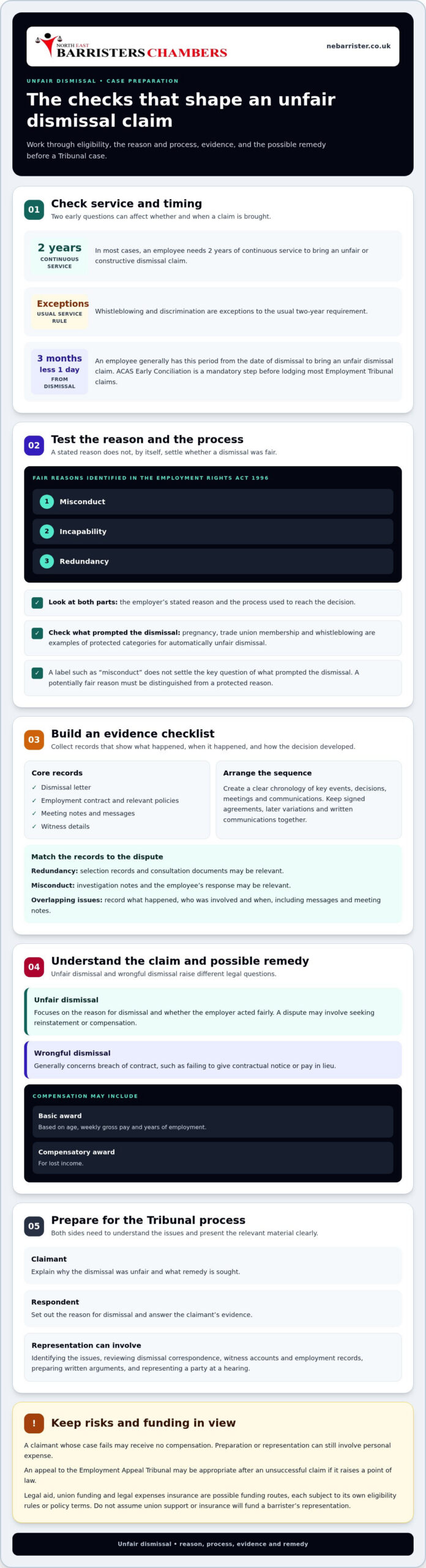
A dismissal can be unfair even when an employer gives a reason for ending the job. According to the UK Government, the Employment Rights Act 1996 identifies misconduct, incapability and redundancy as fair reasons, and most employees need 2 years of continuous service to bring an unfair dismissal claim. A barrister for an unfair dismissal claim can help assess whether the reason and the process may be challenged; whistleblowing and discrimination are exceptions to the usual service requirement.
Timing matters. In the UK, an employee generally has three months less one day from the date of dismissal to bring a claim. The dispute may involve seeking reinstatement or compensation, or responding to an employee’s claim as an employer.
This article explains what may qualify as unfair dismissal, including automatically unfair and constructive dismissal, and outlines the main steps in an Employment Tribunal case. It also explains how representation can support claimants and respondents, so you can understand the issues and prepare for what comes next.
Key Takeaways
- Assess both the employer’s stated reason for dismissal and the process used to reach the decision.
- Understand how qualifying service rules apply, and which circumstances can create exceptions.
- Recognise examples of automatically unfair dismissal, including dismissal linked to whistleblowing or trade union membership.
- Before resigning over an employer’s conduct, consider how the circumstances may affect a constructive dismissal claim.
- Prepare for Tribunal proceedings by identifying the issues, organising relevant evidence and understanding the arguments on each side.
Employment Tribunal representation
Employment Tribunal representation involves presenting the relevant facts, evidence and legal arguments clearly. Claimants and respondents need to understand the issues and prepare for hearings.
Employment Tribunal claims
A barrister can help identify the issues in a claim, prepare written arguments and represent a party at a hearing. This may involve reviewing dismissal correspondence, witness accounts and employment records. In most Employment Tribunal claims, ACAS Early Conciliation is a mandatory step before lodging the claim. An employee generally has three months less one day from dismissal to bring an unfair dismissal claim.
Choosing an employment barrister
When choosing an employment barrister, look for relevant experience in unfair dismissal and discrimination claims, and consider the location of the Tribunal hearing. Compare the proposed role, preparation and representation, and whether the barrister explains employment law clearly. Ask what hearings and preparation involve before deciding how representation should fit your case.
Representation can support either side. A claimant may need to explain why the dismissal was unfair and what remedy they seek. A respondent may need to set out the reason for dismissal and answer the claimant’s evidence. In either case, a clear chronology helps: record key events, decisions, meetings and communications in date order.
Agency and other precarious workers may face different questions about their employment relationship and rights. In Smith v Carillion (JM) Ltd & Anor, the Court of Appeal considered agency workers’ limited rights to unfair dismissal in the context of blacklisting. The case illustrates why the working arrangement and the parties involved can matter. A role’s label does not replace careful examination of the circumstances.
Employment contracts and collective agreements can help explain the terms governing a job. Relevant documents may cover duties, workplace procedures, notice or agreed processes for handling disputes. A barrister can consider how those terms relate to the dismissal and the evidence. Keep signed agreements, later variations and written communications together to make their sequence and context easier to assess.
Employment and discrimination issues can overlap. A dismissal claim may involve arguments about treatment connected with a protected characteristic, as well as the employer’s stated reason. An employment or discrimination barrister can help organise these issues, identify relevant evidence and present the case at hearings. Keep records of what happened, who was involved and when, including messages and meeting notes.
What qualifies as unfair dismissal?
An unfair dismissal claim concerns whether an employer had a fair reason and acted fairly in dismissing an employee. According to the UK Government, the Employment Rights Act 1996 identifies misconduct, incapability and redundancy as fair reasons for dismissal in the UK. The reason alone does not settle every dispute; the evidence and the employer’s decision-making process matter too.
According to the UK Government, in most cases an employee needs 2 years of continuous service with an employer to bring an unfair or constructive dismissal claim. Whistleblowing and discrimination are exceptions to the usual two-year requirement. A dismissal connected with discrimination may also raise a separate issue under the Equality Act 2010.
Unfair dismissal and wrongful dismissal raise different legal questions. Unfair dismissal focuses on the reason for dismissal and whether the employer acted fairly. Wrongful dismissal generally concerns breach of contract, such as failing to give contractual notice or pay in lieu. “Wrongful termination” is often used more broadly, but UK employment disputes usually distinguish these claims by their legal basis.
Evidence helps establish what happened and why. Gather the dismissal letter, employment contract, relevant policies, meeting notes, messages and witness details. For example, a redundancy dispute may turn on selection records and consultation documents; a misconduct dispute may involve investigation notes and the employee’s response. Arrange documents in date order to show how the decision developed.
Compensation can include a basic award based on age, weekly gross pay and years of employment, plus a compensatory award for lost income.
If a claim fails, the claimant may receive no compensation, and preparation or representation can still involve personal expense. An appeal to the Employment Appeal Tribunal may be appropriate after an unsuccessful claim if it raises a point of law. The practical risk is presenting a case without clear evidence linking the dismissal, the employer’s stated reason and the legal argument.
Legal aid, union funding and legal expenses insurance are separate potential funding routes, each subject to its own eligibility rules or policy terms. Union support or insurance cover depends on the relevant scheme or policy; do not assume either will fund a barrister’s representation.
For advice on how the distinction between unfair and wrongful dismissal applies to your evidence, consider speaking with a barrister directly.
Automatically unfair dismissal
An automatically unfair dismissal is one where the reason for dismissal falls within a protected category. Pregnancy, trade union membership and whistleblowing are examples. The employer’s label, such as “misconduct”, does not settle the key question: what prompted the dismissal? A potentially fair reason, such as misconduct, incapability or redundancy, must be distinguished from a protected reason, and the employer’s handling of the decision remains relevant.
Start by identifying the activity or circumstance that may have led to the dismissal. For a whistleblowing concern, keep the disclosure, messages about it and later disciplinary documents together. For trade union membership, note relevant conversations, meeting dates and decisions. In a pregnancy-related case, preserve communications about pregnancy, workplace arrangements and dismissal. These records help an Employment Tribunal consider the sequence of events and the employer’s stated reason.
Discrimination can raise a related but distinct issue. If an employee believes dismissal followed treatment connected with a protected characteristic, the evidence may support a discrimination argument alongside an unfair dismissal claim. Record the specific treatment, who was involved and when it occurred. The Equality Act 2010 may be relevant, while the Tribunal considers the facts and legal issues raised.
A fair reason and an automatically unfair reason are different legal questions. An employer may rely on a disciplinary explanation, but documents can reveal a different motive. Compare the dismissal letter with investigation notes, meeting records and earlier communications. Look for changes in the explanation, gaps in the chronology or a disciplinary step that followed a protected activity.
Smith v Carillion (JM) Ltd & Anor illustrates how blacklisting and agency work can complicate dismissal rights. The Court of Appeal considered agency workers’ limited rights to unfair dismissal in that context. The case does not establish that every agency worker has the same claim. It shows why the working arrangement, parties involved and alleged reason require close attention.
For an employee anywhere in the UK, practical preparation starts with a clear timeline. Set out the protected activity, the employer’s response and the dismissal in date order. Then separate what you know from what you infer. A disciplinary meeting soon after a disclosure may be relevant, but the meeting record and the employer’s explanation also need to be examined.
At an Employment Tribunal hearing, organise evidence around the issue it supports. Label each document, identify witnesses who can explain events and prepare a concise account of why dismissal followed a protected reason. This helps the Tribunal assess the evidence alongside the employer’s explanation, rather than treating the dismissal letter as the whole story.
Constructive dismissal
Market sources describe constructive dismissal as potentially involving an employee resigning because of an employer’s unreasonable behaviour or breach of contract. The circumstances leading to resignation, and the employee’s response, are central to examining the claim.
Constructive dismissal and resignation
Resignation distinguishes constructive dismissal from an employer directly ending employment. Before resigning, seek legal advice and gather relevant records, including emails, meeting notes and contract terms. An employee resigning on this basis may choose whether to work their notice period. Record that decision and communicate it clearly so the resignation and notice arrangements are documented.
Timing and the explanation for leaving matter when building a clear account. For example, note when a manager changed agreed duties, when you raised the issue and how the employer responded. Keep the resignation letter consistent with the concerns already raised. A letter setting out specific events can help explain the link between the employer’s conduct and the decision to leave.
Grounds for constructive dismissal
Possible grounds include unreasonable behaviour or a breach of contract by the employer. Examples might include repeated harassment, a serious change to agreed working terms or failure to address a reported concern. Identify the particular conduct, the contract term or workplace procedure involved, and the dates. General dissatisfaction alone does not explain what prompted the resignation.
Workplace records can show how concerns developed. Save relevant messages, formal complaints, investigation notes and managers’ replies. If a trade union representative attended a meeting, record the date and points discussed. For a whistleblowing concern, preserve the disclosure and any response that followed. These details help distinguish the underlying issue from later explanations for leaving.
Check the employment contract and workplace procedures to clarify the dispute. For example, compare a written grievance process with the steps taken after a complaint. Note who received each report and whether the employer responded. A timeline can show whether the conduct was isolated or repeated, and how it affected the employment relationship.
Representation can help organise the chronology, identify relevant contractual terms and present the reasons for resignation clearly. A barrister can also help prepare questions about the employer’s actions and the employee’s response. Before a hearing, arrange documents by date and label each item by issue, such as harassment, whistleblowing or contract terms. This preparation keeps the account focused on the events behind the resignation.
Legal representation for claimants and respondents
Representation helps each side present its position, evidence and legal arguments in an organised way. A claimant may challenge the employer’s reason or procedure, while a respondent must explain its decision and answer the allegations. The practical focus is the same: identify disputed facts, prepare relevant documents and present a clear account at the hearing.
A claimant can organise evidence around the events leading to dismissal, including correspondence, meeting records and the employer’s written explanation. A respondent can prepare a chronology showing the decision-making process, investigation and any disciplinary steps. For example, if the parties disagree about a meeting, each can identify who attended and which records support their account.
Should you use a barrister, solicitor, union representative or no-win-no-fee lawyer? The right option depends on the work needed, such as legal advice, case preparation, advocacy or workplace support. A union representative may assist within the union’s arrangements, while a barrister can advise on legal issues and represent a party at a hearing. Review the proposed role and any funding terms before choosing.
Some people represent themselves. This means preparing documents, explaining the case and responding to questions without a legal representative. If you choose this route, create a dated chronology, organise evidence by issue and prepare concise points for the hearing. These steps help keep the argument focused on the facts in dispute.
For respondents, representation can help distinguish the employer’s evidence from assumptions or conclusions. A clear account should explain who made the dismissal decision, what information they considered and how they handled the employee’s response. For claimants, preparation may involve testing whether the stated reason matches the documents and witness accounts. In either case, the representative needs instructions grounded in the relevant records.
Ask what the barrister will handle, such as reviewing documents, advising on arguments or appearing at hearings. Clarify how preparation will work and which materials they need. Barristers have different areas of practice, so look for experience relevant to employment disputes and the issues in your case. Choose based on the work required, not simply proximity to the workplace.
An appeal is separate from the original Tribunal hearing. An appeal to the Employment Appeal Tribunal may be appropriate after an unsuccessful claim if it raises a point of law. This differs from asking the Tribunal to reconsider the same facts. Identify the legal issue and the decision being challenged before deciding whether you need appeal representation.
For focused advice or hearing advocacy, discuss employment Tribunal representation and the role a barrister could take in your case.
North East Barristers Chambers: Direct Access Barrister Services
North East Barristers Chambers provides Direct Access Barrister Services for individuals and businesses seeking legal advice or representation. If you’re bringing or responding to an Employment Tribunal claim, direct access lets you instruct a barrister without needing a solicitor. Court Representation can support you in presenting your case and addressing the issues raised at a hearing.
Before seeking representation, organise your dismissal letter, employment contract, key correspondence and a concise timeline. These materials help clarify the dispute and the assistance you need, whether advice, preparation or advocacy. North East Barristers Chambers also provides legal services in criminal and civil law.
To discuss representation for an employment dispute, contact North East Barristers Chambers or visit nebarrister.co.uk.
Take the next step with a clear plan
Before moving forward, decide what you need from representation. You may want an initial view of your legal arguments, help preparing documents or advocacy at a hearing. A barrister for an unfair dismissal claim can help turn your account and records into a focused case plan. Be ready to explain your role, the employer’s decision and the outcome you seek.
North East Barristers Chambers provides Direct Access Barrister Services and Court Representation. Its wider practice also includes criminal law. This gives you a direct route to discuss the legal work involved and whether barrister representation fits your needs. A useful first step is to set out the key events and identify the questions you want answered.
For a practical discussion about your situation, contact North East Barristers Chambers. A clear starting point can help you approach the next stage with greater confidence.
Frequently Asked Questions
How do you claim and what are the time limits?
Start by contacting ACAS for Early Conciliation, a mandatory step before lodging most Employment Tribunal claims. An employee generally has three months less one day from the dismissal date to bring an unfair dismissal claim. Keep the dismissal letter and note key dates while taking this step. Missing the time limit can mean losing the right to bring the claim, so act promptly.
What are the grounds for a constructive dismissal claim?
A constructive dismissal claim may arise when an employee resigns because the employer’s unreasonable behaviour or breach of contract has led them to leave. For example, a worker might point to a serious change to agreed terms or repeated harassment. The claim needs to connect the employer’s conduct with the resignation. Before resigning, seek legal advice and keep records of complaints, responses and relevant workplace events.
What is wrongful dismissal?
Wrongful dismissal is a breach of the employment contract connected with how employment ended. A common example is an employer ending employment without giving the notice required by the contract or paying the correct notice amount. It differs from unfair dismissal, which challenges the reason for dismissal or the fairness of the employer’s process. The contract and termination documents help show which issue may apply.
Why choose a specialist employment dismissal barrister?
A barrister who regularly handles employment disputes can help identify the legal issues, organise evidence and present arguments clearly. For example, they can compare the employer’s dismissal explanation with emails, meeting records and witness accounts. Ask what work they would undertake, such as advice, document preparation or advocacy at a hearing. Understanding the role helps you decide whether the representation meets your needs.
When should I hire a barrister for an unfair dismissal claim in the UK?
Consider instructing a barrister when you need advice on the strength and structure of your argument, preparation for a hearing or representation before the Tribunal. Early advice can help identify relevant documents and avoid overlooking important issues. It can also help an employer responding to a claim organise its explanation and evidence. If a deadline is approaching, prioritise advice about the next procedural step.
Can I instruct a barrister directly for an employment tribunal claim in England and Wales?
Yes. Direct Access Barrister Services allow individuals and businesses to instruct a barrister without needing a solicitor. You can seek advice or advocacy for an Employment Tribunal matter, depending on the work required. Before instructing, prepare a brief timeline, the dismissal correspondence and the questions you need answered. Agreeing the barrister’s role at the outset makes the work and responsibilities clear.
What are the eligibility rules and time limits for bringing an unfair dismissal claim?
According to the UK Government, most employees need 2 years of continuous service with their employer to bring an unfair dismissal claim. Whistleblowing and discrimination are exceptions to the usual qualifying-service requirement. The general time limit is three months, less one day, from dismissal, and ACAS Early Conciliation is required before lodging most claims. Check both eligibility and dates before preparing the claim.
What happens at an Employment Tribunal hearing, and what will my barrister do?
At a hearing, the Tribunal considers the evidence and legal arguments before reaching a decision. Your barrister can help prepare your case, question witnesses where appropriate, address the Tribunal and explain how the evidence supports your position. Bring organised documents and review your account of events beforehand. A respondent’s barrister can present the employer’s explanation and respond to the claimant’s evidence and arguments.