
In England and Wales, a change in the law in 2004 allowed individuals and organisations to instruct barristers directly, without first using a solicitor. A direct access civil litigation barrister can advise you and represent you in court or at a tribunal. Most direct access barristers don’t manage the day-to-day conduct of a case, so it’s important to understand what you’ll need to handle yourself.
Instructing a barrister directly can give you access to specialist legal advice and advocacy. The key is understanding which tasks a barrister can undertake, how you’ll fund the work and whether direct access civil litigation is suitable for your case.
This guide explains what direct access means, what a civil litigation barrister can do and how to find one authorised to accept direct instructions. It also covers fees, private funding and the practical demands of managing your case, helping you decide on a suitable next step.
Key Takeaways
- Understand how brief fees and trial refreshers divide the cost of trial work, and what each typically covers.
- Use the Barristers’ Register to find barristers permitted to accept public access instructions, then focus on experience relevant to your dispute.
- Direct access work is privately funded; legal aid cannot be provided through the scheme, even if you may qualify for it.
- Assess whether you can organise documents and manage case administration, as complex disputes may need ongoing legal management.
- Explore whether advice, drafting or representation at a specific hearing would address the support you need.
What is direct access?
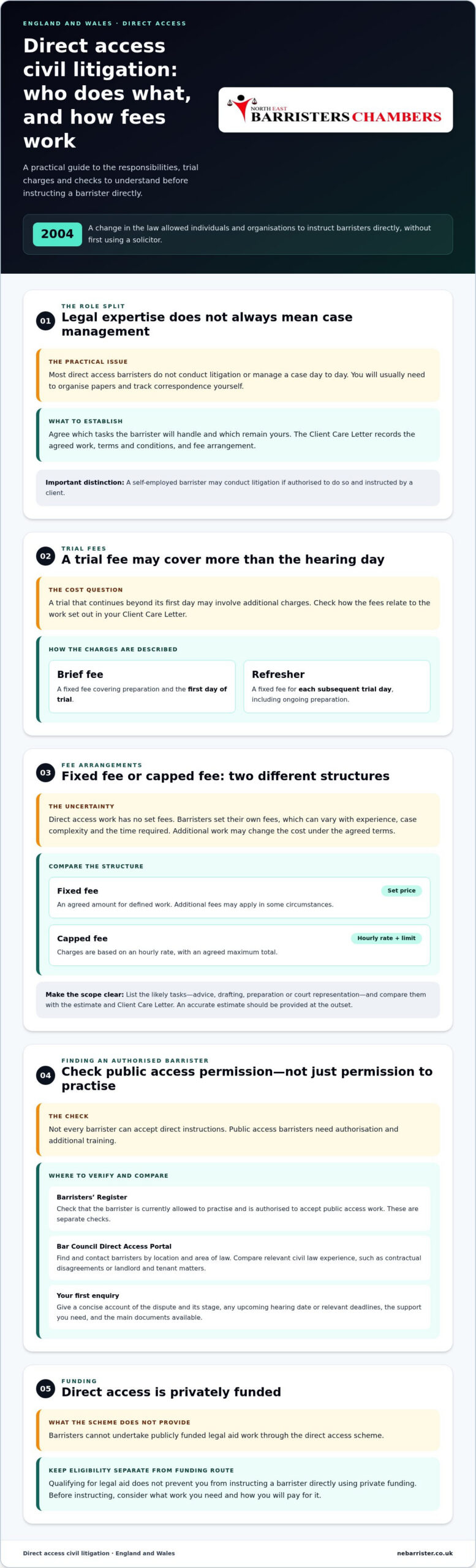
In England and Wales, a change in the law in 2004 allowed members of the public and corporate bodies to instruct barristers directly. You can seek advice from your chosen barrister and ask them to represent you in court or at a tribunal. This route removes the need to instruct a solicitor first, but it doesn’t automatically transfer every case-management task to the barrister.
Most barristers undertaking direct access work don’t conduct litigation, so you’ll usually manage day-to-day tasks such as organising papers and tracking correspondence. A self-employed barrister may conduct litigation if authorised to do so and instructed by a client. Before instructing, establish which tasks the barrister will handle and which remain your responsibility.
The terms of the instruction are recorded in a Client Care Letter. It sets out the agreed work, terms and conditions, and fee arrangement. Direct access work has no set fees: barristers set their own, which can vary according to experience, case complexity and the time required. You should receive an accurate estimate at the outset, so you can understand the proposed work and likely costs before proceeding.
For a trial, a brief fee is a fixed fee covering preparation and the first day of trial. A refresher is a fixed fee for each subsequent trial day and includes ongoing preparation. If a hearing continues beyond its first day, for example, the refresher covers the additional day and continuing preparation. Ask how the brief fee and refreshers relate to the work set out in your Client Care Letter.
Other arrangements structure fees around the work. A fixed fee sets an amount for agreed work, though additional fees may apply in some circumstances. A capped fee charges an hourly rate but sets an agreed maximum total. The difference is that a fixed fee is a set price for defined work, while a cap limits total hourly charges.
Before choosing an arrangement, list the likely tasks: advice, drafting, preparation or court representation. Compare them with the scope of the estimate and Client Care Letter. If your case changes or requires additional work, fees may also change under the agreed terms. A clearly defined scope helps you see what the fee covers and identify work outside it.
A direct access civil litigation barrister can provide focused advice or representation without a solicitor acting as an intermediary. The trade-off is practical responsibility: most direct access barristers don’t manage the litigation itself. Consider whether you can handle that administration, and clarify the barrister’s role, fee basis and trial-day charges before instructing.
How do I find a public access barrister?
In England and Wales, barristers must be authorised to accept public access clients. The Bar Standards Board says they also need additional training, so not every barrister can accept direct instructions.
Finding direct access barristers
The Bar Council Direct Access Portal can help you find and contact barristers by location and area of law. Look for civil law experience relevant to your dispute, such as contractual disagreements or landlord and tenant matters. You don’t need a solicitor to make an initial approach, but you should identify the legal issue and support you need.
You might need advice on a claim, help preparing for a hearing or representation on a particular court date. Make a short list of your main questions and the key events. This gives you a clear starting point for comparing barristers’ stated practice areas and experience.
Contacting a barrister
Once you’ve identified a suitable public access barrister, contact them directly or use the Bar Council portal to make an enquiry. Explain the civil dispute, the stage it has reached and any upcoming hearing date. Give a concise account of what has happened rather than sending a large bundle of documents without context.
Set out the help you’re seeking, such as written advice or court representation. Include relevant deadlines and identify the main documents available. This helps the barrister understand your request and consider whether the work is suitable for direct access. Keep a record of the information you send and any response.
Authorisation and qualifications
The Barristers’ Register lists barristers in England and Wales who are currently allowed to practise. It also indicates whether they can accept public access work. Check both points before instructing: permission to practise does not, by itself, mean a barrister is authorised to accept public access instructions.
The Bar Standards Board regulates barristers in England and Wales and provides guidance for lay clients who want to instruct one directly. Read the guidance alongside the register, then compare the barrister’s civil law experience with the work you need, whether that is advice, drafting or representation at a hearing.
Before making an enquiry, organise a brief case summary, important dates and the documents most relevant to your dispute. A focused first approach makes it easier to explain what you need and helps distinguish a request for one hearing from a need for broader case support. If you’re ready to discuss your case, make an enquiry about your civil matter.
Legal aid eligibility and private funding
Direct access work is privately funded. Barristers cannot undertake publicly funded legal aid work through the access scheme. This is separate from whether you qualify for legal aid: eligibility doesn’t prevent you from instructing a barrister directly using private funding. The distinction is the funding route, not simply whether you meet legal aid eligibility requirements.
Before instructing, decide what work you need and how you’ll pay for it. You might need legal advice on a contract dispute, drafting for a court application or representation at a hearing. List the tasks and note the stage your case has reached. This helps define the instruction and plan for the private cost of the work.
A barrister can advise on the legal issues in your case and draft documents within the agreed scope. You might seek advice on the strengths and risks of a contractual claim, then ask for help preparing a particular document. Be precise about the outcome you need from each task. Advice, drafting and representation are distinct pieces of work, so identify which your funding needs to cover.
Private funding arrangements can take different forms. A fixed fee sets an amount for specified work, although additional fees may apply in some circumstances. A capped fee charges an hourly rate but sets an agreed maximum total. Compare what work is included, how extra tasks are treated and whether the arrangement suits the stages your dispute may involve.
A conditional fee agreement has a specific meaning: you pay the barrister for work only if you receive compensation as a result of proceedings. It differs from ordinary private payment, where fees are payable under the agreed terms. If you’re considering this arrangement, identify whether your case involves a compensation claim and clarify what work the agreement covers.
A business pursuing compensation for a contractual loss, for example, may need advice, document drafting and hearing representation at different stages. List those needs separately before discussing funding. This makes it easier to consider whether a fixed fee, capped fee or conditional fee agreement suits the work. The nature of the claim and the work required are central to choosing a practical payment structure.
Keep funding and legal aid eligibility as separate questions. If you qualify for legal aid, you may still instruct a barrister directly, but that instruction uses private funding. If you need publicly funded legal aid work, the direct access scheme cannot provide it. Understanding this distinction helps you choose a route before committing to advice or drafting.
Assessing whether a case is suitable
The main risks of direct access in civil litigation are the administration you retain and the limits on the barrister’s role. Most barristers don’t conduct litigation. They must refuse an unsuitable case or stop acting if it becomes unsuitable after work begins.
Suitability depends partly on whether you can organise the case yourself. Direct access tends to work best when you can manage documents, correspondence and practical preparation for proceedings. For example, you might gather contracts, arrange them by date and track court directions. If those tasks feel difficult, direct access may not provide the level of support your case needs.
Consider how much ongoing management the dispute involves. A focused request, such as representation at a particular hearing, can suit direct access if you don’t need full case-management support. A case involving many documents, several ongoing steps or complex legal issues may need a solicitor alongside a barrister. The deciding factor is the work required across the case, not just the importance of the hearing.
Cases involving children are usually unsuitable for direct access. Consider this limitation before preparing an instruction. Other civil disputes still require an individual assessment of their demands and the work involved. A chambers clerk can discuss the practical needs of your case and help assess whether direct access is suitable.
Before that discussion, prepare a short case summary and list the key dates. Gather the main documents, such as a contract, relevant letters or court papers, and note any upcoming hearing. Then identify the help you need: advice on a legal issue, drafting or representation at a particular hearing. These steps clarify what the case demands.
Consider what might happen if the case changes. A request for representation at a straightforward hearing can develop into broader proceedings requiring document review or significant ongoing management. If the case becomes unsuitable after work begins, the barrister must stop acting. You need to be able to manage the practical demands and understand the limits of the agreed role.
Assess your position by asking: can you organise the papers, keep up with case administration and handle the work not assigned to the barrister? Is your need focused on advice or a particular hearing, or does it involve extensive management? Clear answers help you decide whether direct access fits your case.
Services direct access barristers can provide
A direct access barrister can advise, draft documents and represent you at hearings. In a civil dispute, that support can focus on a specific legal issue or stage, rather than managing every step of the proceedings.
Without a solicitor, you’re generally responsible for court forms, correspondence, evidence and filing. Most barristers undertaking direct access don’t conduct litigation, so you must manage those administrative tasks yourself. A self-employed barrister may conduct litigation when authorised to do so and instructed by a client. Clarify the barrister’s role and agreed tasks before proceedings move forward.
Legal advice can help you understand the issues in a dispute and your practical options. A business facing a contractual disagreement, for example, might ask a barrister to assess its position before deciding how to respond. A landlord or tenant could seek advice on a specific point. A focused question helps define the advice needed and the relevant documents.
Drafting is a distinct task. A barrister may prepare or advise on documents connected with a civil claim, depending on the agreed instruction. You remain responsible for handling forms and filing unless the barrister is instructed and authorised to conduct litigation. Clarify what will be drafted, what you must submit and who will manage correspondence.
Representation can help when you need advocacy at a particular hearing. You might have organised the case papers and need a barrister to present your position in court or before a tribunal. This is different from full case management. The Bar Standards Board authorises barristers to accept public access work, and the role depends on the instructions and work agreed.
Civil law work can include employment claims, personal injury, landlord and tenant matters, contractual disputes, business law and commercial litigation. Direct access may also cover representation in arbitration, mediation and other alternative dispute resolution processes. For example, a barrister might represent a business in mediation rather than at a court hearing. The right support depends on the process and the task you need done.
Where other expertise is needed, a barrister can suggest suitable advisers or expert witnesses and define the scope of their work. This can help identify the evidence or specialist input a dispute requires while keeping your responsibilities clear. Individuals and commercial organisations can instruct a barrister directly, but the service does not replace ongoing case administration when that is needed.
Before instructing, list each task: advice, drafting, advocacy, or litigation management. Match that list against the barrister’s proposed role, especially responsibility for court documents and deadlines. Discuss civil law representation if you need advice or advocacy for a dispute.
North East Barristers Chambers: Direct Access Barrister Services
North East Barristers Chambers provides Direct Access Barrister Services and Court Representation for civil law matters. If you need legal advice or advocacy for a defined part of a civil dispute, direct access may offer a practical way to instruct a barrister without first using a solicitor. You’ll still need to manage case administration unless litigation conduct forms part of the agreed instruction.
Consider direct access if you can organise your papers and handle correspondence but want a barrister’s input on a legal issue or representation at a hearing. A clear summary of your dispute, its current stage and the help you need makes an initial enquiry more focused.
For help with a civil matter, contact North East Barristers Chambers.
Take the next step with a clear plan
Turn the dispute into a focused instruction. Write down the decision or hearing you need help with, the outcome you’re seeking and the specific work you want the barrister to undertake. Keep key documents together and note important dates. This gives you a practical starting point for discussing whether a direct access civil litigation barrister can assist.
North East Barristers Chambers offers Direct Access Barrister Services and Court Representation, alongside work in civil and criminal law. If you’re unsure how to frame your request, start with the central issue and explain what has happened so far. A clear enquiry helps turn general uncertainty into a defined legal task and an informed decision about representation.
Contact North East Barristers Chambers to discuss your matter and the support you’re seeking. Taking that first step can help you approach the next stage with greater clarity.
Frequently Asked Questions
How Does the Process Work?
Identify the legal help you need, approach a barrister authorised for public access and agree the scope of work before instructing. You might, for example, ask for advice on a contract clause before responding to a claim. The Client Care Letter records the instruction’s terms and conditions. Keep a copy with your case papers and use it to track what the barrister will do and what remains your responsibility.
What Is the Difference Between a Solicitor and a Barrister?
A solicitor often manages a client’s case and its ongoing administration, while a barrister commonly provides specialist legal advice and advocacy. The roles can overlap: an authorised self-employed barrister may conduct litigation when instructed. If you instruct a barrister directly, clarify whether they’ll manage proceedings or focus on advice, drafting or representation. This affects who prepares forms, handles correspondence and monitors case steps.
What is a direct access barrister in England and Wales?
A direct access barrister is authorised to accept instructions from members of the public without first requiring a solicitor. They can provide legal advice and represent clients in court or tribunals. The precise work depends on the instruction and the barrister’s authority. For instance, a business might approach a barrister directly for advice on a dispute, then agree whether further drafting or advocacy is needed.
Can a member of the public instruct a barrister directly for civil litigation?
Yes. A member of the public can instruct a barrister authorised for public access on civil litigation matters. This does not automatically include full case management. You might, for example, instruct a barrister to advise on a hearing while remaining responsible for organising papers and correspondence. Consider the work involved across the case, not only the immediate hearing, before deciding whether direct instructions suit your needs.
Which civil cases can a direct access barrister handle, and what work is excluded?
Civil direct access work can include employment claims, personal injury, landlord and tenant disputes, contract claims, business law and commercial litigation. A barrister may advise, draft documents or represent you in court, arbitration or mediation. Most direct access barristers don’t conduct litigation, so full day-to-day case management may fall outside their role. Publicly funded legal aid work cannot be undertaken through the scheme.
How do I find and check a direct access civil litigation barrister?
Use the Bar Council Direct Access Portal to search by location and area of law, then check the barrister’s status in the Barristers’ Register. The register indicates whether they can accept public access work. For a contract dispute, look for relevant civil law experience and frame your enquiry around the issue, the case stage and the support you need. This helps you assess whether their practice matches your legal task.
What steps are involved in instructing a direct access barrister?
Prepare a concise account of the dispute, key dates and the documents that explain it. State the help you want, such as advice on a claim or representation at a hearing. The barrister considers whether the instruction is suitable and records the agreed terms in a Client Care Letter. Read the scope carefully, then keep deadlines and documents organised throughout the work.
How much do direct access barristers charge for civil litigation, and what fees are typical?
Direct access work has no set fees. Barristers set their own fees based on factors such as experience, case complexity and time required. Arrangements may include a fixed fee for defined work, a capped hourly fee, or a brief fee covering trial preparation and the first trial day, followed by refreshers for later days. Review the estimate and agreed scope before instructing, including how additional work will be charged.