
A magistrates’ court decision is not always the last word. You can appeal a magistrates’ court decision to the Crown Court, and in England and Wales a Notice of Appeal must be submitted within 21 days of the case being completed. The rules differ in Scotland and Northern Ireland.
If you’re considering a challenge, the deadline and your reason for appealing matter. Appealing a conviction is different from asking the court to review a fine or reopen a case. A guilty plea can affect your options, but does not automatically determine whether a challenge is possible.
This article explains how to challenge a decision, what happens during a conviction appeal and what the Crown Court can decide. It also covers the time limit, the risks of appealing and what to consider if you pleaded guilty.
Key Takeaways
- You can challenge a magistrates’ court decision, but the right route depends on whether you dispute a conviction, sentence, fine or the way the case was handled.
- Section 108 of the Magistrates’ Courts Act 1980 provides a statutory right to appeal a Magistrates’ Court decision to the Crown Court, according to The National Archives.
- In England and Wales, a Notice of Appeal must be submitted within 21 days of the case being completed. Acting promptly matters if you are considering a challenge.
- A Crown Court appeal can change the outcome, but it can also lead to a higher sentence or prosecution costs if unsuccessful.
- If you pleaded guilty, the circumstances behind your plea are important to understanding what options may be open to you.
What can the Crown Court do after hearing my appeal against conviction?
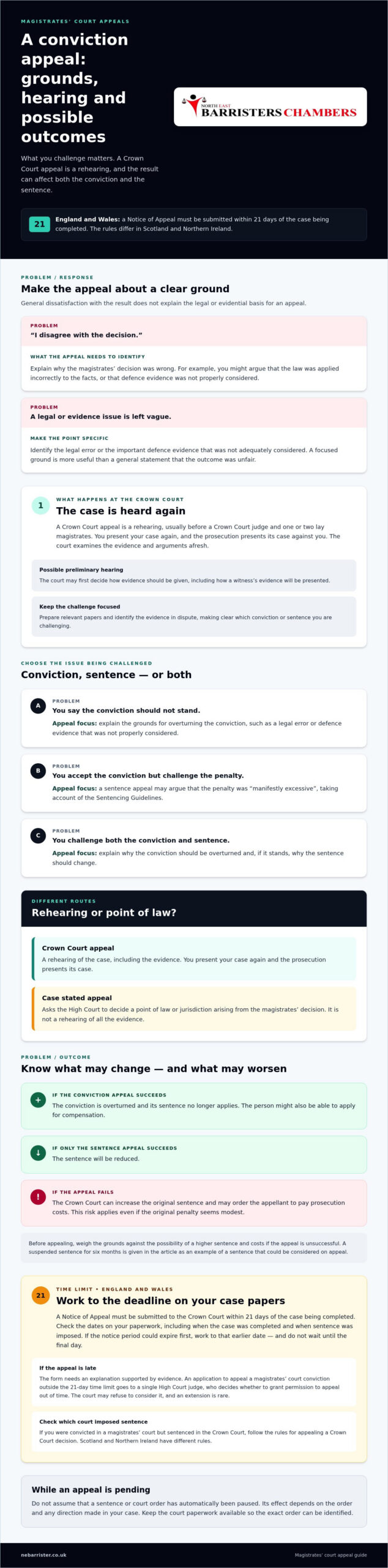
If you were convicted in a magistrates’ court, you can appeal to the Crown Court to challenge the conviction. The appeal is a rehearing, usually before a Crown Court judge and one or two lay magistrates. You have the opportunity to present your case again, while the prosecution presents its case against you.
Your grounds for appealing matter. You might argue that the magistrates applied the law incorrectly to the facts or failed to consider defence evidence properly. For example, you could point to a legal error in how the court treated evidence, or important defence evidence that was not adequately considered. Disagreement with the result alone does not explain the legal or evidential basis for an appeal.
A Crown Court appeal and a case stated appeal follow different routes. The Crown Court rehearse the case, including the evidence. A case stated appeal asks the High Court to decide a point of law or jurisdiction arising from the magistrates’ decision. It is not a rehearing of all the evidence.
You can appeal the conviction, the sentence, or both. A sentence appeal may argue that the penalty was “manifestly excessive”, taking account of the Sentencing Guidelines. If you appeal both, explain why the conviction should be overturned and, if it stands, why the sentence should change.
- If the conviction appeal succeeds: the conviction is overturned and its sentence no longer applies. The person might also be able to apply for compensation.
- If only the sentence appeal succeeds: the sentence will be reduced.
- If the appeal fails: the Crown Court can increase the original sentence and may order the appellant to pay prosecution costs.
The risk of a more severe outcome applies even if the original penalty seems modest. A suspended sentence for six months is one example of a sentence that could be considered on appeal. Before appealing, weigh the grounds against the possibility of a higher sentence and costs if you are unsuccessful.
While an appeal is pending, don’t assume that a sentence or court order has automatically been paused. Its effect depends on the order and any direction made in your case. Get clear advice about compliance and whether to apply to pause enforcement. Keep your court paperwork available so the exact order can be identified.
Time limit for Crown Court appeals
In England and Wales, the deadline depends on the appeal route and the event that starts the clock. A person convicted after a magistrates’ court trial may be able to appeal to the Crown Court, but deadlines apply. A Notice of Appeal against a magistrates’ court decision must also be submitted to the Crown Court within 21 days of the case being completed. These are different ways the time limit is expressed, so don’t wait until the final day to act.
Check the dates on your court paperwork, including when the case was completed and when sentence was imposed. If the notice period could expire first, work to that earlier date. Keep the case reference and decision documents together, and specify which conviction or sentence you are challenging. Missing a deadline can make an appeal harder to pursue.
A late appeal needs an explanation on the form, supported by evidence. The court may refuse to consider it. In England and Wales, an application to appeal a magistrates’ court conviction outside the 21-day time limit goes to a single High Court judge, who decides whether to grant permission to appeal out of time. A strong justification matters, but an extension is rare.
A Crown Court appeal is a rehearing, not simply a review of the magistrates’ written decision. It usually takes place before a Crown Court judge and one or two lay magistrates. You present your case, then the prosecution presents its case against you. The hearing gives the court an opportunity to examine the evidence and arguments again.
The Crown Court decides the appeal at a hearing, though it may first arrange a preliminary hearing to decide how evidence should be given. For example, the court may need to determine how a witness’s evidence will be presented. Preparing relevant papers and identifying disputed evidence helps keep the appeal focused on the conviction or sentence you are challenging.
Scotland and Northern Ireland have different rules for challenging magistrates’ court decisions, so the England and Wales time limits do not apply there. If you were convicted in a magistrates’ court but sentenced in the Crown Court, follow the rules for appealing a Crown Court decision instead. The court that imposed sentence matters as much as the court that heard the trial.
For a case in England and Wales, prompt court representation for an appeal can help you understand the deadline, prepare the grounds and present your position at the Crown Court hearing. Keep the sentence date and case papers available when discussing the next step.
ASK THE EXPERT: How Can I Appeal A Magistrates Court Decision?
Before challenging a magistrates’ court decision, speak to a legal representative or get advice from a legal adviser. They can help you identify whether your concern is about the conviction, sentence, fine or an error in the case. Explain what happened at the hearing and why you believe the decision was wrong. A clear account helps focus an appeal on relevant grounds, rather than general dissatisfaction.
Gather the court’s decision and any paperwork about the offence. Note what evidence the magistrates considered, what the defence said and whether important information was missing. If the case involved mistaken identity, explain how your details became connected with the offence. If the police or court had incorrect information, identify the specific error and any records that support your account.
In England and Wales, applicants need their unique case reference number to apply to challenge a magistrates’ court decision. It appears on a notice letter or another letter from the court or prosecutor. The online application takes about 30 minutes, and you can save your progress and return later. Applying to challenge a decision is free, but an unsuccessful appeal can bring a separate costs risk.
Legal aid may be available for a magistrates’ court appeal. Eligibility depends on your means and the nature of the case. Ask a legal adviser to explain how those factors apply and what representation options are available. If legal aid does not apply, discuss the likely work involved before deciding how to proceed. Court representation can help present your evidence and arguments clearly at the hearing.
Consider the financial risk as well as the legal grounds. The Crown Court can increase the original sentence after an unsuccessful appeal. These are possible consequences, not a fee for making the application. Ask your adviser to weigh them against the strength of your grounds and the outcome you seek.
For a driving offence, have your driving licence number ready. If you want the court to reduce your total fine, prepare evidence of your income, such as payslips or a proof of benefit letter. These documents help explain the practical issue behind your request. Keep copies of everything you submit, including evidence about the police, the offence or your finances.
In Scotland and Northern Ireland, appeal procedures differ from those in England and Wales. The Crown Court route and deadlines described for England and Wales do not apply. The correct process depends on the jurisdiction and the type of decision being challenged, so get advice specific to that court system before taking action.
Appealing after pleading guilty
A guilty plea doesn’t automatically rule out every possibility of challenge. If you pleaded guilty in a magistrates’ court, you may consider appealing if you believe you were wrong to enter the plea. The key question is why you pleaded guilty and what you now say was wrong. Explain the reason clearly rather than relying only on regret about the conviction or its consequences.
First, distinguish a challenge to the conviction from one to the sentence. If you accept responsibility for the offence but believe the penalty was “manifestly excessive”, the issue is the sentence. If you want to challenge the conviction, explain why you believe your guilty plea was wrong. These are different arguments, and the court needs to know which decision you want changed.
Write a short chronology while events are fresh. Include what happened before the hearing, what was said when you entered your plea and what you understood the court to be deciding. For example, distinguish a clear decision to admit the offence from a situation where you say you misunderstood what you were admitting. Keep court papers and any supporting messages or documents together.
Take your account to a legal representative or adviser before lodging an appeal. They can assess why you entered the plea, the court record and the available evidence, then explain the relevant route. Be precise about the outcome you seek: overturning a conviction is not the same as asking the court to reduce a sentence. A clear request helps keep the two issues separate.
Time still matters. In England and Wales, a Notice of Appeal against a magistrates’ court decision must be submitted to the Crown Court within 21 days of the case being completed. If you pleaded guilty and are considering a challenge, get advice promptly and establish which deadline applies to your case. A late appeal needs an explanation and supporting evidence, and the court may refuse to consider it.
Weigh the possible consequences before appealing. The Crown Court can increase the original sentence and may order you to pay prosecution costs after an unsuccessful appeal. That risk does not determine whether your plea was wrong, but it should inform your decision. An adviser can weigh your reasons for challenging the conviction against the practical consequences of proceeding.
A guilty plea is different from not knowing about a hearing or having someone else falsely provide your details. Those circumstances may call for an application to reopen the case, rather than an appeal based on a plea you say was wrongly entered. Explain which situation applies and identify any court or police records that support your account.
Before taking the next step, write down which decision you are challenging, why you believe the plea was wrong and what evidence supports your account. This gives a legal adviser a focused starting point and helps distinguish a conviction challenge from a sentence appeal.
Challenging or appealing a magistrates’ court decision
Yes. In England and Wales, a person unhappy with a magistrates’ court decision can challenge it or ask for it to be reviewed. Section 108 of the Magistrates’ Courts Act 1980 provides a statutory right to appeal a Magistrates’ Court decision to the Crown Court, according to The National Archives. The right to appeal does not mean every concern needs the same route. The decision challenged and the reason for it help determine the appropriate option.
A person convicted in a magistrates’ court, not the prosecution, can appeal the conviction. The appeal is usually heard by the Crown Court as a rehearing. You might challenge a conviction because you believe the court applied the law incorrectly or failed to consider defence evidence properly. A sentence appeal is a separate challenge, based on the argument that the sentence was manifestly excessive. If your concern is the amount of a fine, you may need to ask for it to be reviewed instead.
Some problems may be addressed by asking the magistrates’ court to reopen the case rather than starting an appeal. This can be relevant if you did not know about the case, did not attend the hearing, or the court lacked important information. It may also apply if someone falsely gave your details to the police or court. Section 142 of the Magistrates’ Courts Act 1980 allows a verdict to be changed following a procedural error, so an appeal may not be necessary.
If a request to review a fine or reopen a case because the court lacked information is refused, you can appeal to the Crown Court. For a driving offence, have your driving licence number ready. If you are seeking a lower total fine, prepare evidence of your income, such as payslips or a proof of benefit letter.
In England and Wales, submit a Notice of Appeal to the Crown Court within 21 days of the case being completed. An online application to challenge a magistrates’ court decision takes about 30 minutes, and you need the unique case reference number shown on court or prosecutor correspondence. Applying to challenge a decision is free. Scotland and Northern Ireland have different rules.
A case stated appeal to the High Court is for a point of law or jurisdiction arising from the magistrates’ decision. Unlike a Crown Court rehearing, the High Court considers the legal question rather than rehearing all the evidence. Explain the alleged legal error clearly and get advice on the appropriate route before acting.
If you’re weighing a criminal appeal or a case stated route, discuss court representation to clarify the issue and prepare your arguments.
Use the case stated route when the decision raises a point of law or jurisdiction. Explain the alleged legal error clearly and get advice on whether this is the appropriate route before acting.
North East Barristers Chambers: Direct Access Barrister Services
North East Barristers Chambers provides Direct Access Barrister Services and Court Representation for people considering a magistrates’ court appeal. A barrister can help assess the decision, clarify the grounds you want to rely on and present your case in court. This can be useful when you need advice on a criminal appeal or representation at a Crown Court hearing.
With direct access, you can instruct a barrister without needing a solicitor. The right next step depends on what you are challenging, the evidence available and the appeal route. For a criminal or civil law matter, clear advice can help you understand the process and prepare your case.
To discuss your situation, contact North East Barristers Chambers or visit nebarrister.co.uk.
Take a clear next step with your appeal
If you’re asking whether you can appeal a magistrates’ court decision, turn your concern into a clear account of what you want to challenge and why. A focused discussion can help you understand your practical options, identify what to prepare and decide how to move forward.
North East Barristers Chambers offers Direct Access Barrister Services, Court Representation and expertise in criminal law. Discuss how these services may fit your situation and what support could help you present your case. The right course depends on your circumstances, so get advice before making a decision that could affect your position.
Contact North East Barristers Chambers to discuss your next step. A clear plan can make a difficult process easier to approach.
Frequently Asked Questions
What Happens If I Lose the Appeal?
If your appeal is unsuccessful, the original decision can remain in place, and the Crown Court can increase the original sentence. The court may also order you to pay prosecution costs. Before proceeding, consider your grounds and the potential consequences. If you lose an appeal at the Crown Court, speak to your legal adviser about whether a further appeal is possible and whether additional costs could follow.
Can you appeal a conviction years later?
You can apply to appeal outside the usual time limit, even after a long delay, but your application needs an explanation supported by evidence. In England and Wales, an application to appeal a magistrates’ court conviction outside the 21-day time limit goes to a single High Court judge, who decides whether to grant permission. Set out why you missed the deadline and include documents that support your explanation.
How likely are appeals successful?
The strength of an appeal depends on its grounds and supporting material, not simply on dissatisfaction with the result. A clear legal error or failure to consider important defence evidence gives the court a specific issue to examine. For example, identify evidence the magistrates overlooked and explain why it mattered to the verdict. A legal adviser can assess how the court record supports your argument.
What decisions of a magistrates’ court can be appealed?
If convicted in a magistrates’ court, you can appeal the conviction, the sentence or both. A sentence challenge may argue that the penalty was manifestly excessive. Other situations may call for a different application: for example, if you did not know about a hearing, you may ask the court to reopen the case. A fine review is another distinct route, particularly if your income affects your ability to pay.
How long do you have to appeal a magistrates’ court conviction or sentence?
In England and Wales, a Notice of Appeal must be submitted within 21 days of the case being completed. For a person convicted after a magistrates’ court trial, the stated appeal period is 15 business days from sentence. Check the decision and sentencing paperwork promptly, because the relevant starting point depends on the route. Scotland and Northern Ireland have different appeal rules.
How do you appeal a magistrates’ court decision to the Crown Court?
Yes, you can appeal a magistrates’ court decision to the Crown Court by submitting a Notice of Appeal within the applicable time limit. The online application takes about 30 minutes and requires your unique case reference number, found on court or prosecutor correspondence. You can save your progress and return later. Explain whether you challenge the conviction, sentence, or both, and keep copies of supporting documents.
What are the grounds for appealing a magistrates’ court conviction or sentence?
A conviction appeal may argue that the magistrates applied the law incorrectly to the facts or failed to consider defence evidence adequately. A sentence appeal has a different basis: you must argue that the sentence was “manifestly excessive”, taking account of the Sentencing Guidelines. Focus on the specific error or evidence, rather than simply saying the decision was unfair or too severe.
How much does it cost to appeal a magistrates’ court decision, and is legal aid available?
Legal aid may be available for an appeal, depending on your means and the nature of the case. The application itself is free, while eligibility for help and possible costs depend on different factors.