
A barrister can attend mediation as your legal representative, known as a mediation advocate, and help you present your position. Barrister representation at mediation in the UK does not give the barrister power to decide the dispute: the mediator remains independent and cannot impose a settlement. Mediation discussions are confidential and, until the parties reach a final agreement, are without prejudice and non-binding.
It is reasonable to want clear advice before agreeing to a process that may affect your family, finances or business. The UK Government says you can attend mediation alone or with a legal representative. If the parties reach agreement, they can agree to make it binding.
This guide explains what a barrister can do before and during mediation, how legal experience can help you assess proposals, and how mediation differs from litigation. It also sets out what to consider when deciding whether representation suits your dispute.
Key Takeaways
- Consider what you need from a mediation advocate, such as help presenting your position or assessing proposed terms.
- Understand what confidentiality means in practice and what steps may be needed to formalise an agreement.
- Use a barrister’s legal experience to prepare for negotiation and weigh mediation against court proceedings.
- Learn how direct access can let you instruct a barrister without instructing a solicitor.
Confidential and cost-effective dispute resolution
Mediation gives parties a private setting to explore resolution without asking a court to decide every issue. Its usefulness depends on the dispute, the preparation involved and whether the parties can negotiate constructively.
Mediation and alternative dispute resolution
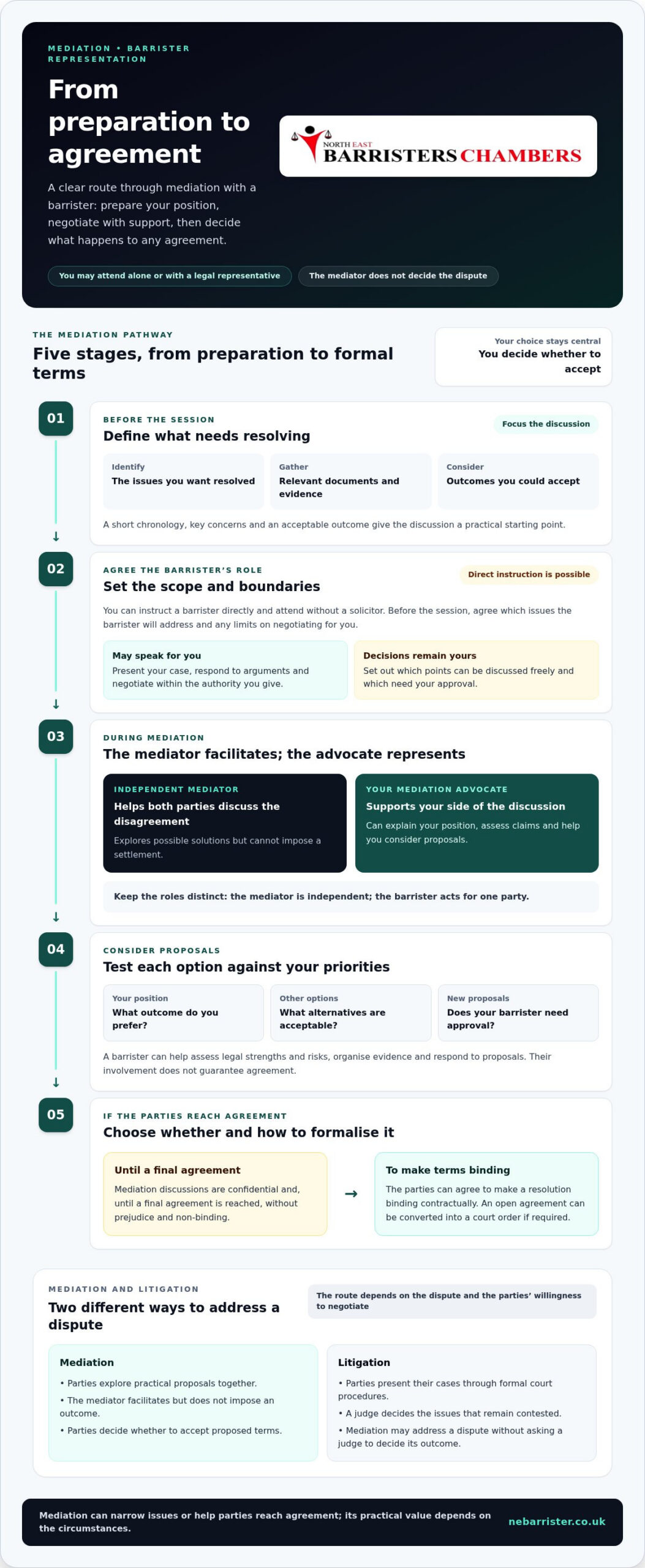
Mediation is a form of alternative dispute resolution. An independent mediator helps the parties discuss their disagreement and explore solutions, but does not impose an outcome. Each party can consider proposals and decide whether to accept them.
The UK Government explains that you can attend mediation alone or bring a legal representative, known as a mediation advocate. Before attending, identify the issues you want resolved, gather relevant documents and consider what outcomes you could accept. These steps help keep discussion focused.
Mediation discussions are confidential and, until a final agreement is reached, are without prejudice and non-binding. Any resolution is not binding unless the parties contractually agree to make it so. An open agreement can be converted into a court order if required.
Disputes suited to mediation
Mediation can help parties explore practical options when communication has stalled. For example, in an environmental regulation dispute, a structured discussion may clarify the points in disagreement and identify possible solutions. The parties should distinguish negotiable issues from any formal obligations that affect their position.
An NHS workplace dispute may involve disagreements about working arrangements or communication between colleagues. Mediation gives participants a setting to explain their concerns and consider workable next steps. Key questions include whether both sides are willing to take part and whether they can discuss the issues constructively.
In either example, identify what needs resolving, who needs to take part and whether negotiation could produce a workable outcome. Mediation is most useful when the parties have room to shape a solution together.
Barrister mediation costs
How much does it cost to instruct a barrister for mediation in the UK? A barrister’s fee depends on the case and is given after a quote request; there is no single figure for every dispute.
The cost depends on the work involved, including preparation, document review, the complexity of the issues and attendance at mediation. To clarify the likely scope, identify the questions you need advice on and organise key papers before discussing the work. Focused preparation can help keep the assignment proportionate.
Compare the likely preparation and mediation work with the steps the dispute may otherwise require. Mediation can narrow issues or help the parties reach agreement, but its practical value depends on the circumstances and their willingness to negotiate.
Barristers’ mediation experience
A barrister’s advocacy experience can help you assess claims, explain your position and consider proposals. Effective preparation starts with a clear account of the dispute.
Attending mediation without a solicitor
You can instruct a barrister directly and attend mediation without a solicitor. The UK Government describes a legal representative at mediation as a mediation advocate. Before the session, agree the barrister’s role, the issues they will address and any limits on negotiating for you.
The key distinction is between the mediator, who facilitates discussion, and the barrister acting as an advocate, who represents one party. Keep those roles clear. Prepare a short chronology, key documents, your main concerns and the outcome you would consider acceptable. A barrister’s clerks can help organise practical arrangements.
Benefits and drawbacks of representation
A barrister can analyse the legal strengths and risks of your position, organise the evidence and help you respond to proposals. Experience across relevant practice areas can be useful where claims involve technical or procedural issues. Robert Seabrook QC was selected to sit on the new NHS Litigation Authority Mediation Service in January 2017.
Representation also has limits. A barrister’s involvement does not guarantee agreement, and you remain responsible for deciding whether to accept proposed terms. Consider whether the issues are complex enough to need advocacy, and whether you can explain your priorities yourself. These choices help keep the barrister’s work focused on the dispute.
Speaking and negotiating on your behalf
A barrister can present your case, respond to arguments and negotiate within the authority you give them. Before mediation, identify which points they can discuss freely and which decisions need your approval. Clear boundaries help avoid uncertainty if the other party makes a new proposal.
Bring relevant correspondence, evidence and any draft agreement. Write down your preferred outcome and acceptable alternatives, then discuss the reasons for each position. This gives your barrister a practical framework for testing proposals while keeping your priorities in view.
If you want support with your position and negotiation, explore barrister representation at mediation.
Mediation as an alternative to litigation
Mediation lets parties address a dispute without asking a judge to decide its outcome. The Civil Justice Council describes it as a non-adjudicative dispute resolution process conducted alongside litigation. A mediator helps parties explore solutions but cannot impose a settlement. Participants therefore have more control over the terms they may accept. Barrister representation at mediation in the UK can help you assess those terms.
Litigation follows a different path. Parties present their cases through formal court procedures, and a judge decides the issues that remain contested. Mediation focuses instead on practical proposals. For example, separating parties might negotiate financial arrangements, while a workplace dispute could focus on steps to improve communication. Mediation may narrow disagreements even if it does not resolve every issue.
In family cases, mediation can help participants develop their own solutions rather than ask a court to impose an outcome. In almost all private law cases concerning children and cases involving financial remedies, courts expect participants to explore what family mediation services can offer. If court proceedings have already started, mediation may affect how the case proceeds. Identify which issues remain open and what information each party needs to make informed proposals.
Financial discussions need a true and full picture of each party’s position. Without that disclosure, proposals about dividing assets on separation or divorce may lack a sound basis. Organise financial information, list disputed points and set out possible outcomes for discussion. This keeps the session focused on decisions that matter, rather than repeating the history of the disagreement. Barrister representation at mediation in the UK can help you prepare to assess proposals against your priorities.
Mediation can be a cost-conscious route when it resolves issues without further litigation steps. The Civil Justice Council supports both mandatory alternative dispute resolution and compulsory mediation, reflecting the role these processes can play alongside court proceedings. Compare your options by considering what needs a decision, what information is available and whether the parties can negotiate a workable agreement.
Can a barrister attend mediation without a solicitor?
Yes. You can instruct a barrister directly and attend mediation without a solicitor. The UK Government says participants may attend alone or bring a legal representative, known as a mediation advocate. Direct access may suit someone seeking focused legal advice or advocacy without also instructing a solicitor.
Family mediation has a particular approach. Lawyers generally do not attend, but participants may ask them to attend and provide independent legal advice during the session. Discuss the role you need beforehand: you might want a barrister to explain a legal point, help assess an offer or speak on your behalf. Keep clear that you remain responsible for decisions.
Before instructing a barrister, define the practical work you need. Set out the dispute, the issues you want resolved and the support you expect during the session. Gather relevant correspondence, financial information or other documents, depending on the subject. An organised bundle helps the barrister understand your position and focus advice on the key points.
Agree how decisions will be made. For example, you might authorise your barrister to discuss proposals but reserve the final decision for yourself. In a family dispute, identify any proposed arrangements affecting finances or children. In a civil dispute, list the claims and responses you need to address. Clear boundaries help keep negotiations aligned with your priorities.
Direct access is not the same as instructing a solicitor. Consider whether you need a barrister’s advice or representation at mediation, or broader legal support beyond that role. The nature of the dispute and the work involved will help determine the appropriate arrangement.
For direct access support, instruct a barrister directly to discuss representation at mediation.
North East Barristers Chambers: Direct Access Barrister Services
North East Barristers Chambers provides Direct Access Barrister Services for people seeking legal advice and representation. If you are considering mediation, a barrister can help you understand the legal issues, prepare your position and assess proposed terms. The right support depends on your dispute and the work you need.
For civil law matters, direct access can provide a route to barrister support without instructing a solicitor. If mediation does not resolve the dispute, court representation may be relevant to the next stage. Understanding these options can help you plan your response and decide what legal assistance fits your circumstances.
To discuss your legal needs, contact North East Barristers Chambers or visit nebarrister.co.uk.
Decide what support you need next
Before your next conversation about the dispute, write down the decision you need help making. You might want to understand a proposed term, prepare your position or consider what happens if discussions do not resolve the matter. This gives you a practical starting point for discussing legal support.
North East Barristers Chambers provides Direct Access Barrister Services and Court Representation, with practice areas including criminal law. If you are considering barrister representation at mediation in the UK, explain the dispute, the stage it has reached and the work you want a barrister to undertake. This makes it easier to discuss whether direct access support meets your needs.
For a clear next step, contact North East Barristers Chambers to discuss your legal requirements. A focused conversation can help you approach the next stage with greater clarity and decide how you want to proceed.
Frequently Asked Questions
How does it work?
A mediation advocate helps you take part in discussions and evaluate proposals, while you decide whether to settle. Before the session, agree the issues to address and the advocate’s role. During mediation, the mediator guides discussion between the parties. If a proposal changes, for example, you can pause to consider its practical and legal effect before responding.
Can a barrister represent a client at mediation in England and Wales?
Yes. You can bring a barrister as your legal representative, known as a mediation advocate. In family mediation, lawyers generally do not attend, but participants may ask them to join and provide independent legal advice during the session. Discuss what you need the barrister to do, such as clarify a legal point or help assess a proposed arrangement.
What does a barrister do before, during and after mediation?
Before mediation, a barrister can review the dispute papers and help identify the issues requiring attention. During the session, they can advise you and, within the agreed role, present or discuss proposals. Afterwards, review any written terms carefully and identify the actions each party has agreed to take. If the terms need formalising, consider the appropriate next step for your circumstances.
How can I find and instruct a direct access barrister for mediation?
Start by defining the dispute, the outcome you want and the support you need at mediation. Look for a barrister whose practice area matches the issue, then explain the background and provide relevant papers when discussing instructions. Direct access lets individuals and businesses instruct barristers without a solicitor. Agree the scope of work, including preparation and attendance, before mediation.
Is a mediation settlement legally binding in England and Wales?
Not automatically. Mediation discussions remain without prejudice and non-binding until the parties reach a final agreement. A resolution becomes binding if the parties contractually agree to make it so. An open agreement can be converted into a court order if required. Before treating terms as final, ensure the written record reflects what the parties agreed and the steps each must take.