
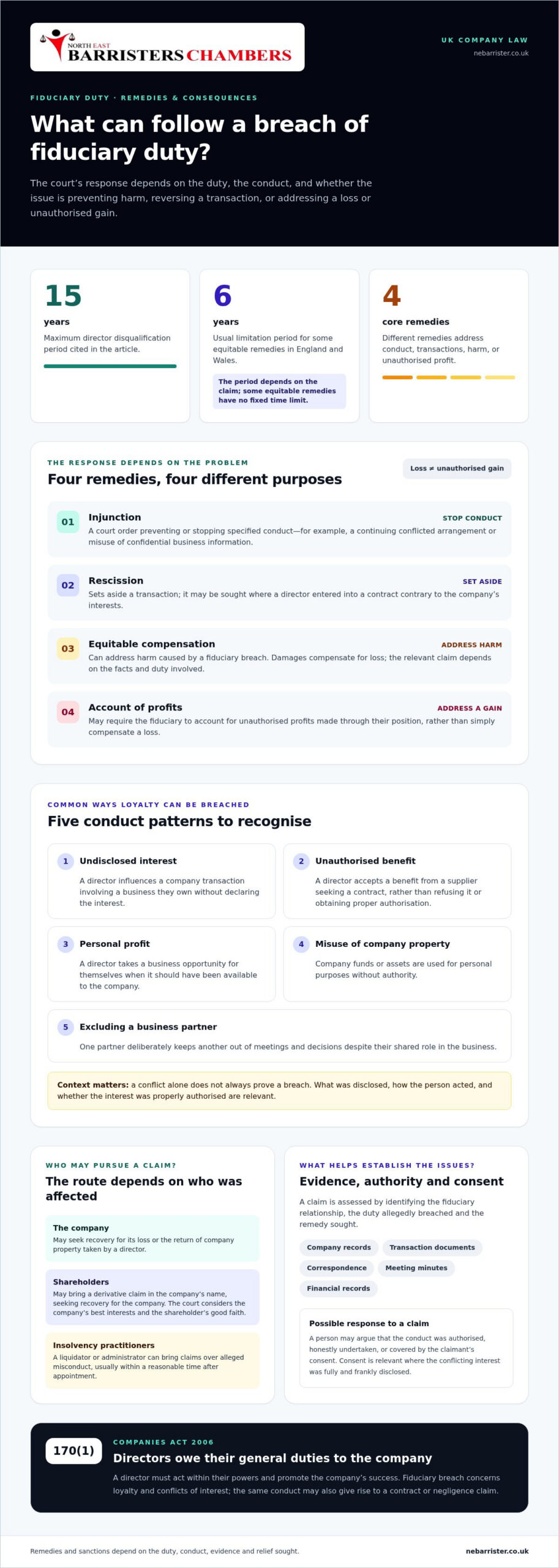
The consequences of a breach of fiduciary duty can include an injunction, rescission of a transaction, equitable compensation or an order to account for unauthorised profits. A breach may arise where someone entrusted to act for another puts personal interests first, conceals a conflict or profits from their position. In serious cases, director disqualification can last up to 15 years, according to UK Parliament.
It’s understandable to want a clear answer about what happens next, especially when a business, relationship or financial interest is at risk. The outcome depends on the duty involved, the conduct, whether a transaction can be reversed, and whether a loss or unauthorised gain can be established. A claimant may also seek urgent court protection to prevent further harm.
This article explains when fiduciary duties are breached, gives common examples and outlines the remedies and sanctions that may follow in the UK. It also distinguishes recovering a loss from requiring someone to surrender a profit, helping you understand the issues before deciding what legal help you need.
Key Takeaways
- Assess whether the relationship involves a duty of loyalty, then consider whether there was an undisclosed conflict, unauthorised profit or failure to act for the company.
- See how a company, shareholders bringing a derivative claim, or insolvency practitioners may pursue a claim depending on who was affected and the circumstances.
- Compare remedies such as an injunction, rescission, equitable compensation and an account of profits to understand what may stop further harm or address a gain or loss.
- Understand the potential personal consequences for directors: disqualification can last up to 15 years, according to UK Parliament.
When does a breach of fiduciary duty occur?
A fiduciary undertakes to act for another where trust and confidence arise. A breach occurs when that person acts against duties of loyalty, conceals a conflict or makes an unauthorised profit. Under the Companies Act 2006, directors owe their general duties to the company under section 170(1). A company director must act within their powers and promote the company’s success.
A fiduciary breach differs from breach of contract or negligence because it concerns loyalty and conflicts of interest. Contract claims focus on broken promises, while negligence concerns a failure to take reasonable care. The same conduct may give rise to more than one type of claim.
A company may seek recovery for its loss or the return of company property taken by a director. Shareholders can bring a derivative claim in the company’s name, seeking recovery for the company rather than themselves, according to UK Parliament. The court must be satisfied that the claim serves the company’s best interests and the shareholder acts in good faith. In insolvency, a liquidator or administrator can bring claims over alleged misconduct, usually within a reasonable time after appointment.
A claim may also target someone who dishonestly assists a breach or knowingly receives misappropriated trust funds. The principal may seek equitable compensation or an account of profits. Such a claim concerns the assistant’s involvement or the recipient’s knowledge, not simply the original fiduciary’s conduct.
In England and Wales, some equitable remedies are subject to the usual six-year limitation period under the Limitation Act 1980, according to UK Parliament. The applicable period depends on the remedy and claim; some equitable remedies have no fixed time limit.
To bring a UK claim, identify the fiduciary relationship, the duty allegedly breached and the remedy sought. Evidence may include company records, transaction documents, correspondence, meeting minutes and financial records that show a conflict, decision or benefit. These materials can help link the alleged conduct to the claimant’s loss or the fiduciary’s gain.
A person defending a UK claim may argue that their conduct was authorised, honestly undertaken or covered by the claimant’s consent. Consent is relevant where the fiduciary fully and frankly disclosed the conflicting interest. Evidence of the authority, disclosure or consent can therefore shape the dispute.
Examples of fiduciary breaches
Fiduciary duties require loyalty in the circumstances of a relationship. For a company director, the Companies Act 2006 includes duties to avoid conflicts, refuse benefits from third parties and declare interests in proposed transactions. A breach may occur when a director puts personal advantage ahead of the company’s interests, even if the decision appears commercially attractive.
Common examples include:
- Undisclosed interest: a director influences a company transaction involving a business they own, without declaring that interest.
- Unauthorised benefit: a director accepts a benefit from a supplier seeking a contract, instead of refusing it or obtaining proper authorisation.
- Personal profit: a director takes a business opportunity for themselves when it should have been available to the company.
- Misuse of company property: a director uses company funds or assets for personal purposes without authority.
- Excluding a business partner: one partner deliberately keeps another out of meetings and decisions, despite their shared role in the business.
The circumstances matter. A conflict alone does not always prove a breach: the issue is how the person acted, what they disclosed and whether the relevant interest was properly authorised. A resolution or full disclosure may be relevant, but it must address the actual conflict rather than merely record approval.
In Hotel Portfolio II UK Limited (in liquidation) & Anor v Andrew Ruhan & Anthony Stevens [2022] EWHC 383 (Comm), the High Court found that Andrew Ruhan contravened the self-dealing rule. The case illustrates why a fiduciary should not place themselves on both sides of a transaction without addressing the conflict.
Employment can also create situations where duties arise, particularly where someone holds responsibilities requiring loyalty. The role and conduct matter; an employment relationship alone does not automatically make every employee a fiduciary. Identifying the position, the transaction and any disclosure helps distinguish poor judgement from disloyal conduct. For a dispute involving business decisions or a director’s actions, direct access barrister services can provide a route to legal advice.
Injunctions, rescission and damages
Courts can use equitable remedies to stop conduct, reverse transactions or address gains and losses. The appropriate remedy depends on the interests affected and the relief sought.
Injunctions and Rescission
An injunction is a court order preventing or stopping specified conduct, while rescission sets aside a transaction. A company might seek an injunction to stop a director continuing a conflicted arrangement or misusing confidential business information. Rescission may be sought where a director signed a contract contrary to the company’s interests. Each remedy aims to address the transaction or prevent further harm.
Damages and Exemplary Awards
Damages compensate for loss, while equitable compensation addresses harm caused by a fiduciary breach. A company may claim for loss resulting from a director’s negligent infringement of duties. If the fiduciary made an unauthorised profit, the claimant may instead seek an account of profits, even if direct loss cannot be proved. Punitive or exemplary damages are identified as possible awards, but the remedy sought must fit the conduct and evidence.
Shareholders may bring legal action seeking damages for loss or an interim injunction to prevent continuing harm. The court may also grant declaratory relief, confirming the parties’ rights, or proprietary remedies based on a constructive trust. For example, profits from the principal’s property or from an opportunity that should have been available to them may support a constructive trust claim.
Legal costs and risks depend on the evidence, complexity of the dispute, remedies sought and work needed to present the claims. A claimant must weigh these demands against the potential benefit of stopping a transaction, recovering company property or addressing a proven loss. Records such as contracts and financial documents can affect how clearly the alleged breach and remedy can be argued.
Rescission may be unsuitable if the transaction cannot practically be unwound; compensation or an account of profits may then address the alleged breach. Equitable remedies can have different timing rules: some are subject to the usual six-year limitation period under the Limitation Act 1980, according to UK Parliament, while others have no fixed time limit. Courts may consider whether delay makes relief unfair.
Consequences and sanctions for breach of duty
A breach can expose a fiduciary to personal liability, financial remedies and restrictions on future business activity. The consequences depend on the conduct, any profits made and the harm caused. Understanding breach of fiduciary duty consequences means considering both the individual’s actions and their impact.
Sanctions for Breach of Duty
Sanctions are legal or professional consequences imposed after misconduct, and they matter because they can affect a director’s role and future work. A director found liable may be dismissed, while serious conduct can damage their reputation and restrict commercial activity. In the UK, director disqualification following a breach of fiduciary duty can last up to 15 years, according to UK Parliament. UK Parliament states that serious breaches may lead to director disqualification under the Company Directors Disqualification Act 1986.
Personal Liability for Breaches
A fiduciary may be personally liable when their conduct breaches a duty owed to the company or another principal. A court may order them to return unauthorised profits, even if the claimant cannot prove direct financial loss. Personal liability may also arise for someone who dishonestly assists a breach or knowingly receives misappropriated trust funds. The consequences for each person depend on their conduct, knowledge and any gain from the conflict.
The company’s remedy depends on the breach established. For example, a director who takes an opportunity for personal gain may have to account for the profits. If their negligent infringement of duties causes company loss, the company may seek damages. An injunction may also prevent a director from continuing conduct that threatens the company’s interests.
Some breaches of directors’ duties are criminal offences and can lead to disqualification and fines, or imprisonment in more serious cases. These outcomes are distinct from civil liability: a civil claim may seek compensation or recovery of profits, while criminal proceedings concern an offence. The parties’ roles, the conduct and the evidence all shape the legal consequences.
If you face allegations or need to respond to a director’s conduct, seek direct access barrister advice on the claims, evidence and potential remedies. Clear advice can help you understand the issues and prepare for court representation where needed.
North East Barristers Chambers: Direct Access Barrister Services
North East Barristers Chambers provides Direct Access Barrister Services for people dealing with a potential fiduciary duty dispute. If you’re considering a claim, responding to allegations or facing court proceedings, a barrister can advise on the legal issues and represent you in court. Civil law expertise is relevant where a dispute concerns company decisions, conflicts of interest or financial loss.
Bring key documents, such as transaction records, company correspondence and relevant decisions. They can help explain what happened and clarify the questions you need answered. Direct access lets you instruct a barrister without needing a solicitor.
Contact North East Barristers Chambers or visit nebarrister.co.uk to discuss your situation.
Decide your next step with confidence
Focus on what you need to protect or resolve. A company may need to preserve its position, while an individual accused of misconduct may need to understand the case against them. Knowing the consequences that can follow a fiduciary breach helps frame the issue. The practical priority is deciding what outcome matters and what legal action may support it.
North East Barristers Chambers offers Direct Access Barrister Services and Court Representation. Its work also includes criminal law, although a fiduciary duty dispute will usually raise civil issues. A barrister can help you assess your position and prepare for proceedings where appropriate. The right advice can make a complex dispute easier to approach and help you take a considered next step.
Contact North East Barristers Chambers to discuss your situation. A clear understanding of your options can help you move forward with greater confidence.
Frequently Asked Questions
What are a director’s fiduciary duties?
A director must use their position for the company’s benefit, not personal advantage. Under the Companies Act 2006, duties include acting within the company’s constitution, promoting its success, exercising independent judgement and declaring interests in proposed transactions. For example, a director with an interest in a supplier should disclose it before the company makes a decision. These obligations apply to the director’s conduct, not simply the outcome.
Can shareholders take action against directors?
Yes. A shareholder may seek permission to bring a derivative claim in the company’s name for an alleged breach by a director. Any recovery goes to the company, not to compensate the shareholder for personal loss. The court considers whether the claim is in the company’s best interests and whether the shareholder is acting in good faith. Disagreement with a business decision alone does not establish a breach.
What does a fiduciary breach claim entail?
A fiduciary breach claim sets out the relationship of trust, the duty involved, the conduct said to breach it and the remedy sought. For example, a claimant may rely on board minutes, emails and transaction records to show that a director concealed an interest. The claim should explain how those events connect to company loss or an unauthorised benefit. A disagreement or poor result alone does not prove disloyal conduct.
What sanctions can be imposed for a breach?
Sanctions can include financial orders, removal from a role or restrictions on acting as a director. A court may require a fiduciary to surrender gains or compensate for harm, while serious director misconduct can lead to disqualification. Some breaches of directors’ duties may also be criminal offences, with fines or imprisonment in more serious cases. The legal route depends on the conduct and the evidence supporting each allegation.
Who are the duties owed by and to whom?
A fiduciary owes duties to the person or organisation they have undertaken to serve in a relationship of trust and confidence. For company directors, section 170(1) of the Companies Act 2006 provides that general duties are owed to the company. Other examples can include a financial adviser acting for a client or a trustee responsible for a beneficiary’s interests. The precise relationship and responsibilities depend on the role and circumstances.
What duties do fiduciaries owe under UK law?
English fiduciary law centres on loyalty: avoiding conflicts, not making unauthorised profits from the role and acting in the principal’s interests. A director’s statutory responsibilities also include independent judgement and reasonable care, skill and diligence. For instance, a director should not secretly take a business opportunity meant for the company. The specific duties depend on the relationship, so a trustee’s obligations may differ from a director’s.