
A company does not automatically have the same right as an individual to speak for itself in court. If you’re asking, “Can I represent my company in court?”, the answer depends on the jurisdiction and type of proceedings. In England and Wales, a civil court may allow a non-lawyer to represent a company, but only on a case-by-case basis. This is not a general right, and Scotland has different courts and rules.
It may seem that an owner or director who knows the business best should be able to speak for it. But a company is legally distinct from an individual, and criminal proceedings raise separate questions. Attending court for a business does not automatically mean you can address the judge or make decisions on the company’s behalf.
This guide explains who may represent a company, how civil and criminal cases differ, and what exceptional circumstances can mean in practice. It also covers the role of a McKenzie friend and the distinction between speaking for yourself and receiving legal advice, so you can understand the limits before deciding how to proceed.
Key Takeaways
- Check which UK jurisdiction and type of proceedings apply, as company representation rules can differ.
- Understand why criminal proceedings may require a different approach from civil cases, including who can speak for the company.
- Learn why financial difficulty alone may not be enough to justify exceptional permission for a non-lawyer to represent a company.
- See what factors matter when seeking permission for a non-lawyer to speak for a company in court.
Exceptional circumstances and legal representation
Exceptional circumstances do not give a company director a general right to speak in court. In England and Wales, civil procedure rules allow a court to consider a non-lawyer company representative case by case. This differs from an individual’s right to conduct their own case. A director must distinguish between permission for a lay representative and the company’s ability to represent itself.
In Ireland, the Rule in Battle generally requires a company to appear through a solicitor or barrister. The rule comes from Battle v Irish Art Promotion Centre Ltd [1968] 1 I.R. 252. The Irish Supreme Court reaffirmed it in Allied Irish Bank plc v Aqua Fresh Fish Ltd [2018] IESC 49. A company’s lack of funds to hire a lawyer was not accepted as exceptional grounds for lay representation. A director’s knowledge of the business does not, by itself, create an exception.
Financial pressure does not automatically give a company representative the right to address the court. In McDonald v McCaughey Developments Limited, the Irish High Court observed that the person controlling a small company may know its business and finances as well as an individual knows their own affairs. That observation did not establish a general right for a director to appear for the company.
An individual representing themselves can still seek legal advice about evidence, procedure or submissions. A McKenzie friend may take notes and offer advice, but cannot speak, interfere with proceedings or sign documents for that person. The judge decides whether a McKenzie friend may attend. This support does not make the friend a company’s advocate. In a civil case, an individual considering self-representation because of legal costs should consider whether they can get legal aid. That is a question about the individual’s eligibility, not an automatic funding route for a company.
Company representatives in criminal proceedings
A criminal case raises a different question from a civil dispute: who has been charged, and who may speak for that defendant? If the company itself faces a charge, a director should not assume that their position automatically allows them to conduct its defence. A separate charge against the director concerns that individual, not the company.
One specific statutory example comes from Ireland, not the United Kingdom. Section 868 of Ireland’s Companies Act 2014 allows a company charged on indictment to appear through a representative. That representative may answer questions and plead on the company’s behalf. The provision concerns an Irish company and Irish proceedings; it is not a general UK rule.
This distinction matters because an Irish statutory route cannot establish a director’s right to represent a company in England, Wales or Scotland. The available facts here do not set out a corresponding UK criminal procedure rule. So avoid relying on the Irish provision when preparing for a UK hearing. Identify the company named in the charge and the court dealing with the case.
For example, if both a business and its director are named as defendants, their positions must be considered separately. The director may need to answer for their own alleged conduct, while the company’s representation concerns its case. Check the charge and court paperwork to establish which defendant each hearing concerns. This distinction also helps clarify who may enter a plea or address the court.
Criminal proceedings can have serious consequences, so representation should be considered early, alongside the charge and hearing details. A barrister can advise on criminal law and provide court representation. For guidance relevant to a company’s criminal case, explore criminal court representation.
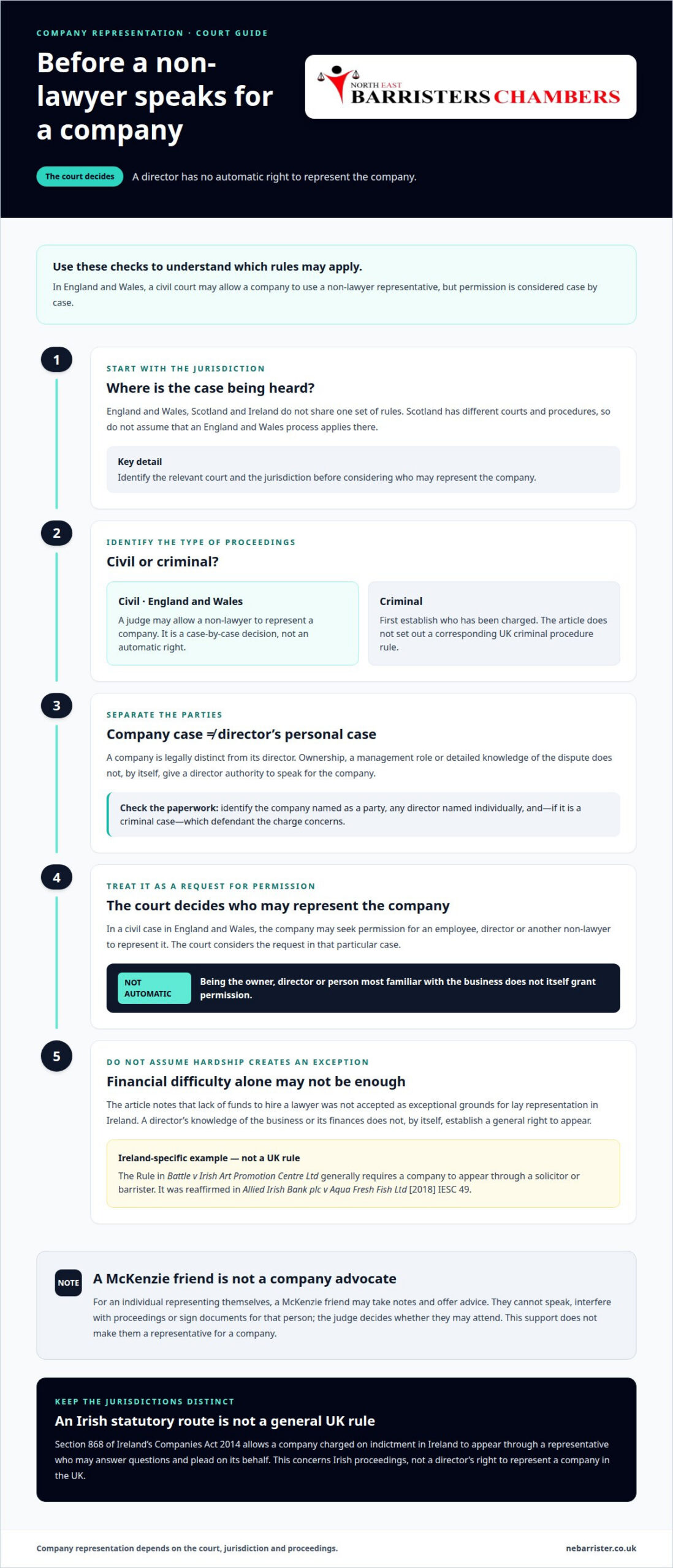
Company representation in court
A company and its director are separate parties in court. A director’s ownership, management role or knowledge of the dispute does not, by itself, give them authority to speak for the company. The company’s representative must be considered separately from anyone appearing in a personal capacity. For example, a director named individually in a claim cannot assume that they also represent the company.
In civil proceedings in England and Wales, court rules give judges discretion to allow a company to be represented by a non-lawyer. This is decided case by case; it does not give every director an automatic right to speak in court. Distinguish between representation by a lawyer and a request for permission for an employee, director or other non-lawyer to represent the company. The court decides whether to allow the request in the particular case.
Jurisdiction matters. Scotland has different courts and rules, so a procedure discussed for England and Wales should not be assumed to apply there. A company with proceedings in Scotland must consider the rules for the relevant court. The hearing’s location is therefore an essential detail, not a formality.
The Irish decision in Allied Irish Bank plc v Aqua Fresh Fish Ltd [2018] IESC 49 illustrates why a senior company role does not automatically confer permission. The Irish Supreme Court affirmed the rule against a company being represented by its managing director or another officer. That decision concerns Ireland; it is not a UK judgment. It should not be used as a substitute for the court’s own rules in a UK case.
Start by identifying the company named as a party, the court hearing the case and the jurisdiction. Then distinguish any individual claim against a director from the company’s case. These details help clarify whether the issue is who may represent the company or whether a particular person may address the court on its behalf.
Applying for a non-lawyer to represent a company in court
In England and Wales, a civil court may allow a company to use a non-lawyer representative. Permission is considered case by case, so a director should make a clear request rather than assume their role gives them the right to speak. The decision applies to representation in that case; it does not create a general right for directors to represent companies.
Before making a request, identify the court, the case and the company named as a party. Explain who the proposed representative is, their connection to the company and what they would be asked to do. For example, a director might explain their knowledge of the events behind a contract dispute and identify the relevant documents. Focus on the request to represent the company, not simply on the director’s title.
Explain why the company seeks permission and how the proposed arrangement would help the court deal with the case. Relevant practical details may include the issues in dispute, the representative’s familiarity with the evidence and the scope of their proposed role. Distinguish the company’s request from any separate case involving the director personally. These points make the request clearer, but do not guarantee permission.
The outcome depends on the circumstances of the particular case. Scotland has different courts and rules, so do not assume an approach for England and Wales applies there. Follow the procedure for the court hearing the case and make the request in the required way. Keep the claim papers and the proposed representative’s details to hand so the request addresses the actual proceedings.
If your company needs advocacy or advice about its position, instruct a barrister for court representation.
North East Barristers Chambers: Direct Access Barrister Services
North East Barristers Chambers provides Direct Access Barrister Services for businesses seeking legal advice or court representation. If your company faces a civil dispute or criminal proceedings, a barrister can help you understand the legal issues and prepare for the hearing. Direct access lets businesses instruct a barrister without a solicitor.
Consider court representation when your company needs an advocate to present its case, or legal advice when you need to understand your position before deciding what to do. The right support depends on the proceedings and your company’s needs. A barrister can explain the issues and represent the company in court.
Contact North East Barristers Chambers to discuss your company’s legal matter.
Choose your next step with clarity
Before deciding, “Can I represent my company in court?”, identify the hearing, the company’s role and the help you need. Understanding these details can help you decide whether to seek advice, advocacy or both. The practical question is not only who may speak, but also how your company’s case will be presented and what preparation it needs.
North East Barristers Chambers offers Direct Access Barrister Services and Court Representation, including in criminal law. Businesses can instruct a barrister directly for advice or advocacy. The right support depends on the company’s proceedings and the task ahead; no single approach suits every case.
If you’re ready to discuss your company’s legal matter, contact North East Barristers Chambers. A focused conversation can help you consider the next step with greater confidence.
Frequently Asked Questions
Can a company director represent a limited company in court in England and Wales?
Not automatically. If you’re asking, “Can I represent my company in court?”, a director’s position alone does not give them the right to speak for a limited company. In civil proceedings, the court may allow a non-lawyer to represent a company on a case-by-case basis. A director involved in the events behind a claim can explain why they are seeking permission, but the court decides whether to grant it.
Can a company employee represent their employer in court in the UK?
An employee does not have an automatic right to represent their employer simply because they work for the company. In civil proceedings, a UK court may allow a non-lawyer to represent a company, depending on the circumstances of the case. The employee should explain their role, the company’s position and the representation sought. Scotland has different courts and rules, so the location matters.
Can a company director represent a company in the County Court small claims track?
A director should not assume that the small claims track automatically gives them permission to speak for a limited company. The question “Can I represent my company in court?” still depends on the court’s decision in that civil case. Identify the proposed representative and the dispute they would address. A director’s familiarity with the events may support the request, but does not itself establish a right to represent the company.
Can a company director represent a company in a tribunal or employment tribunal?
A director should not assume that civil court rules automatically apply in a tribunal or employment tribunal. Tribunals have their own procedures, and the rules on civil court discretion do not establish a general right for a director to represent a company there. For instance, a business responding to an employee’s claim should distinguish the company’s case from any personal claim involving its director and consider the tribunal’s directions on representation.
What happens if a company is not properly represented at a court hearing?
If the court has not accepted someone as the company’s representative, that person may be unable to present the company’s case. The company could then be left without an effective voice at the hearing and face practical difficulties responding to the other side. Check the hearing notice and any court directions beforehand, and make sure the proposed representative has the required authority or permission to act.