
A Consumer Rights Act 2015 court claim isn’t your only route: many consumer disputes can be resolved through negotiation or alternative dispute resolution before court. If goods fail to meet the required standards, you can reject them for a full refund within the first 30 days, according to the UK legislation register. After that, the remedy depends on the stage of the complaint and whether repair or replacement resolves the fault.
It’s understandable to feel unsure about what to do next, especially if the retailer disputes your complaint. This guide explains how the Consumer Rights Act 2015 differs from the Sale of Goods Act, which remedies may apply and how to pursue a claim without going to court.
You’ll also find out what to consider before starting court proceedings, what a clear claim needs to establish and when court representation may help you present your case.
Key Takeaways
- Find out which law may apply to your purchase by considering when you bought the goods and how the two Acts differ.
- Learn how repair, replacement, rejection and price reduction may apply, including when faulty digital content is involved.
- See how negotiation, alternative dispute resolution and the rules on fair contract terms may help resolve a dispute without court.
- Understand the practical steps before a hearing, including what to include in a letter before action and when court representation may help.
Sale of Goods Act vs Consumer Rights Act – what’s the difference?
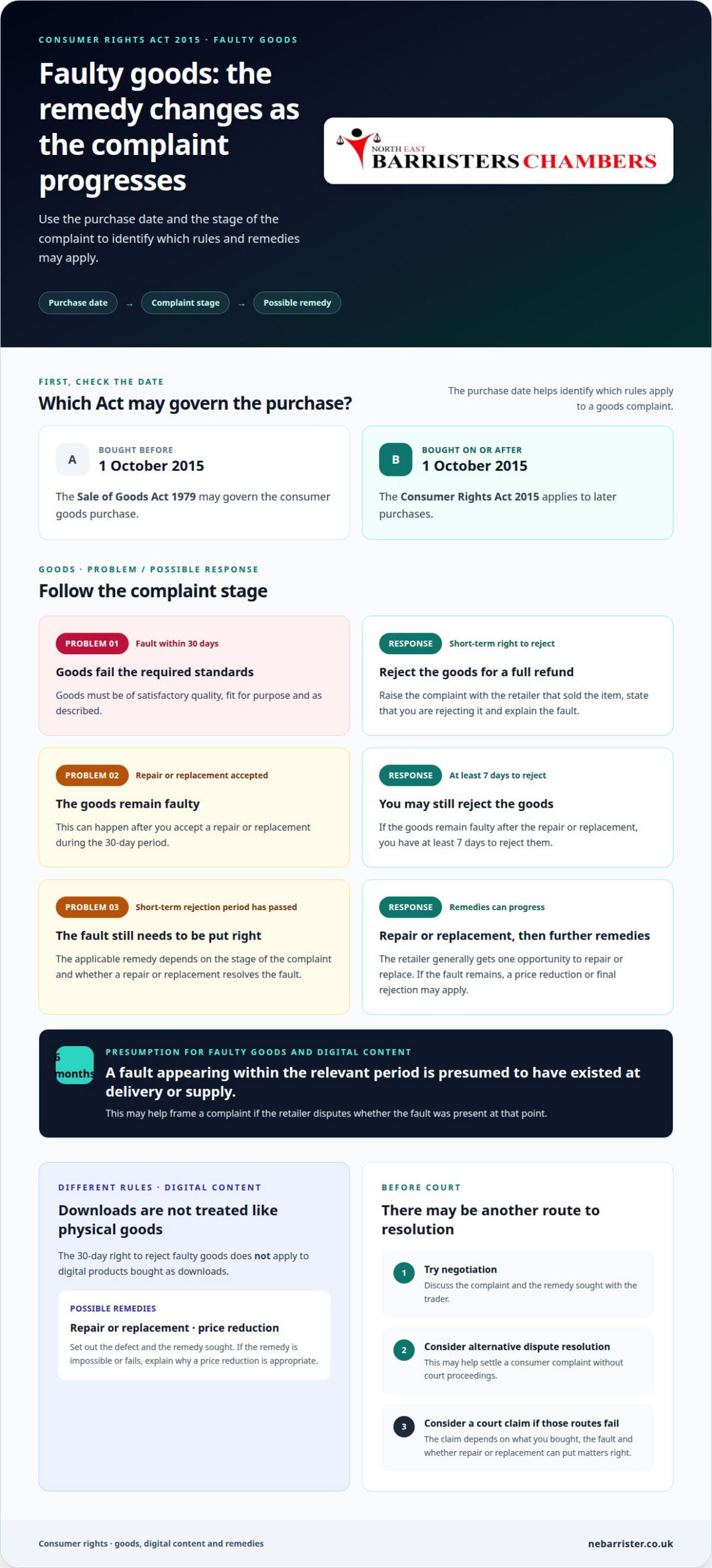
The Consumer Rights Act 2015 sets out consumer protections for goods, services and digital content. The Sale of Goods Act 1979 may still apply to older purchases, so the purchase date helps identify which rules govern a complaint.
30-Day right to reject goods
The short-term right to reject lets a consumer return faulty goods for a refund when they fail required standards. Under the Consumer Rights Act 2015, consumers may reject faulty goods within 30 days for a full refund, according to the UK legislation register. Goods must be of satisfactory quality, fit for purpose and as described. For example, a new appliance that does not work as described may qualify.
Raise the complaint with the retailer that sold the item, because consumer rights are against the retailer, not its manufacturer. State that you are rejecting the goods and explain the fault. If you accept a repair or replacement instead during the 30-day period, and the goods remain faulty, you have at least 7 days to reject them.
Six-month presumption for faulty goods and digital content
The six-month presumption means a fault that appears within the relevant period is presumed to have existed when the goods were delivered or the digital content was supplied. This can help frame a complaint if the retailer disputes whether the fault was present at that point.
The Consumer Rights Act treats digital content separately from goods. Its rules allow remedies including repair or replacement and a price reduction, but the 30-day right to reject faulty goods does not apply to digital products bought as downloads. Keep the fault and the remedy you seek clear when setting out your complaint to the trader.
Sale of Goods Act 1979 relevance
The Sale of Goods Act 1979 may govern consumer goods purchased before 1 October 2015. The Consumer Rights Act 2015 applies to later purchases, so establish the purchase date before relying on either Act. The older Act remains relevant to an earlier transaction, rather than becoming the basis for a later purchase simply because the retailer refers to it.
For purchases governed by the Consumer Rights Act, the remedies can progress from rejection to repair or replacement, then to a price reduction or final rejection if the fault remains. After the short-term rejection period, the retailer generally gets one opportunity to repair or replace the goods. The applicable Act and the stage of the complaint shape the remedy.
What remedies are there if statutory rights under a goods contract are not met?
Consumers may seek remedies for faulty goods or digital content, and for services that fail to meet statutory standards. The claim depends on what you bought, the fault and whether repair or replacement can put matters right.
Defective digital content rights
Defective digital content rights protect consumers when digital content fails statutory standards. Part 1, Chapter 3 of the Consumer Rights Act 2015 covers digital content, including downloads and software. Content must meet the relevant requirements, such as satisfactory quality, fitness for purpose and matching its description.
Section 42 sets out the consumer’s right to enforce terms about digital content. If a downloaded programme does not work as described, explain the defect to the trader and identify the standard it fails to meet. Keep the complaint focused on the content’s fault and the remedy sought.
Digital content refunds
A digital content refund is money returned when the Act’s refund remedy applies. Section 45 sets out the right to a refund for digital content, while section 44 covers a price reduction. These remedies are distinct from the rules for goods, so a faulty download is not treated like a physical item returned to a shop.
Set out what you bought, the defect and how it affects the content’s use. For example, if paid software repeatedly fails to perform its described function, explain why a price reduction or refund would address the problem. The appropriate remedy depends on the breach and the circumstances of supply.
Digital content remedies
Digital content remedies are the statutory steps available to resolve a failure, including repair or replacement and a price reduction. Section 43 of the Consumer Rights Act 2015 covers repair or replacement; section 44 covers a price reduction.
First, describe the fault and ask the trader to put it right through repair or replacement. If that remedy is impossible or fails to resolve the issue, explain why a price reduction is appropriate. If faulty digital content damages a device, you may ultimately need to seek compensation through court proceedings.
Consumer claims under the Act
A consumer claim under the Act seeks a remedy for breached statutory rights in a consumer contract. It may concern goods, digital content or services, depending on what was bought and the trader’s obligations.
For services, section 49 requires reasonable care and skill; sections 55 and 56 provide for repeat performance or a price reduction. Explain the service shortcoming and the remedy requested. If the dispute requires advocacy, court representation can help present the legal claim.
Can I make a claim under the Consumer Rights Act 2015 without going to court?
Yes. Negotiation or alternative dispute resolution may settle a consumer complaint without court proceedings. If those routes fail, you can consider a court claim.
Challenging unfair terms and no-refund signs
An unfair consumer contract term is a condition that fails the Act’s fairness requirement. Part 2 and section 62 of the Consumer Rights Act 2015 cover fairness in consumer contracts. Section 71 requires courts to consider whether a term is unfair.
If a court finds a term unfair, the trader cannot rely on it against the consumer. A no-refund sign does not, by itself, remove your statutory rights to a remedy for faulty goods. Keep the receipt, the sign’s wording and messages with the trader as evidence. These records can help explain why you dispute a term or refusal.
The Act extends to England, Wales, Scotland and Northern Ireland, although separate rules apply in some parts of Scotland. In England and Wales, the limitation period for a breach-of-contract claim concerning goods, services or digital content is six years from the date of breach, according to the UK legislation register. The County Court small claims track is usually for claims of £10,000 or less.
Letters before claim to traders
A letter before claim is written notice of a dispute and the remedy you seek before starting court proceedings. Identify the purchase or contract, describe the breach, say what you want the trader to do, and include relevant evidence such as receipts or messages.
For a straightforward consumer claim, the Practice Direction on Pre-Action Conduct suggests giving the trader 14 days to respond to a letter before action, according to the Ministry of Justice. Keep a copy and record when you sent it. A clear response deadline gives the trader an opportunity to address the complaint before you consider a court claim.
Consumer claims and court representation
A court claim asks a judge to resolve a dispute when a trader has not provided an appropriate remedy. In England and Wales, preparation means organising the purchase details, evidence and remedy sought.
Court fees and legal costs
Court fees cover steps in the court process, while legal costs cover professional assistance. The fee to issue a claim depends on the amount claimed and the procedure used.
On the small claims track in England and Wales, the court’s power to order one side to pay the other’s costs is limited under CPR 27.14, according to the Ministry of Justice. This limits costs recovery, but does not mean every expense is automatically recoverable. Consider the claim value, the evidence needed and whether representation would help you present the dispute clearly.
Starting a claim through the small claims procedure
The small claims procedure is a County Court route for resolving qualifying lower-value disputes. First, send the trader a letter before action setting out the purchase, what went wrong, the remedy you want and the evidence supporting your position.
For a straightforward consumer claim, the Practice Direction on Pre-Action Conduct suggests giving the trader 14 days to respond to a letter before action, according to the Ministry of Justice. If the dispute remains unresolved, issue the claim with clear details of the breach and the remedy sought. In England and Wales, a fixed-sum claim of £25,000 or less can be issued through the GOV.UK Make a money claim service.
Keep records of the retailer’s response, delivery details and any attempted return or refund. These documents show what happened and how you calculated the amount claimed. A focused claim connects each piece of evidence to the remedy you seek.
For a breach-of-contract claim concerning goods, services or digital content in England and Wales, the limitation period is six years from the date of breach, according to the UK legislation register. If you need help presenting your case, instruct a barrister for court representation through Direct Access Barrister Services.
North East Barristers Chambers: Court Representation
North East Barristers Chambers provides court representation for consumers pursuing a civil claim when a dispute remains unresolved. A barrister can help you understand the issues, present your position and respond to the trader’s arguments in court.
With Direct Access Barrister Services, you can instruct a barrister directly for legal advice and advocacy without a solicitor. This may suit you if you have made a clear complaint, considered the evidence and are preparing to pursue court proceedings. The support you need depends on the issues in your claim.
If you would like to discuss court representation for a consumer dispute, contact North East Barristers Chambers.
Take the next step with a clear plan
Before proceeding, decide what outcome would resolve the dispute for you. A refund, repair or other remedy will shape how you present your position and what you ask the court to decide. Keep your explanation focused on the unresolved issue, rather than letting frustration with the retailer distract from your case.
Preparing a Consumer Rights Act 2015 court claim also means being ready to explain why the remedy sought follows from the facts. Clear, organised presentation can help the court understand the dispute and the decision you are asking it to make.
If you want help considering how to present your case, contact North East Barristers Chambers to discuss your options. A practical next step can make a complex dispute feel more manageable.
Frequently Asked Questions
How long do you have to return a faulty product?
You can reject faulty goods within the first 30 days for a full refund. Tell the retailer promptly that you’re rejecting the item, and describe the fault and remedy you want. After that period, you’ll generally need to give the retailer one opportunity to repair or replace it. If that attempt fails, a price reduction or final rejection may be available.
Product quality: what should you expect?
Goods should be of satisfactory quality, fit for purpose and match their description. For example, a kettle advertised as new should work as described and be suitable for making drinks. If it arrives damaged or cannot perform its stated function, explain the mismatch to the retailer. The product description and evidence of the fault help clarify what went wrong.
Satisfactory quality: what counts?
Satisfactory quality is the standard goods must meet under the Consumer Rights Act 2015. Consider the item’s stated purpose and description alongside the problem you’ve found. A fault that prevents a product working as advertised is different from a feature you simply dislike. Describe the defect specifically, such as a cracked casing or a device that repeatedly fails to switch on.
What proof do you need?
Keep evidence showing what you bought, when you bought it and what went wrong. A receipt or order confirmation can identify the purchase, while clear photographs can record visible damage. Save emails, chat messages and notes of calls with the retailer, including any repair or replacement offered. Together, these records create a reliable timeline and show how the complaint developed.
What should I do if a seller refuses to honour my consumer rights?
Reply in writing, explaining the fault, the remedy you seek and why the seller’s response does not resolve the complaint. Attach relevant purchase records and earlier messages. If direct discussions fail, consider alternative dispute resolution before court action. A letter before action sets out your position formally and gives the trader a final opportunity to respond.
What evidence do I need for a Consumer Rights Act 2015 court claim?
For a court claim, organise evidence around the purchase, the fault and the remedy sought. Include the order confirmation or receipt, photographs or other records of the defect, and correspondence showing your complaint and the trader’s response. Add a concise timeline so each document has context. Keep copies of everything you send, including your letter before action and its delivery record.