
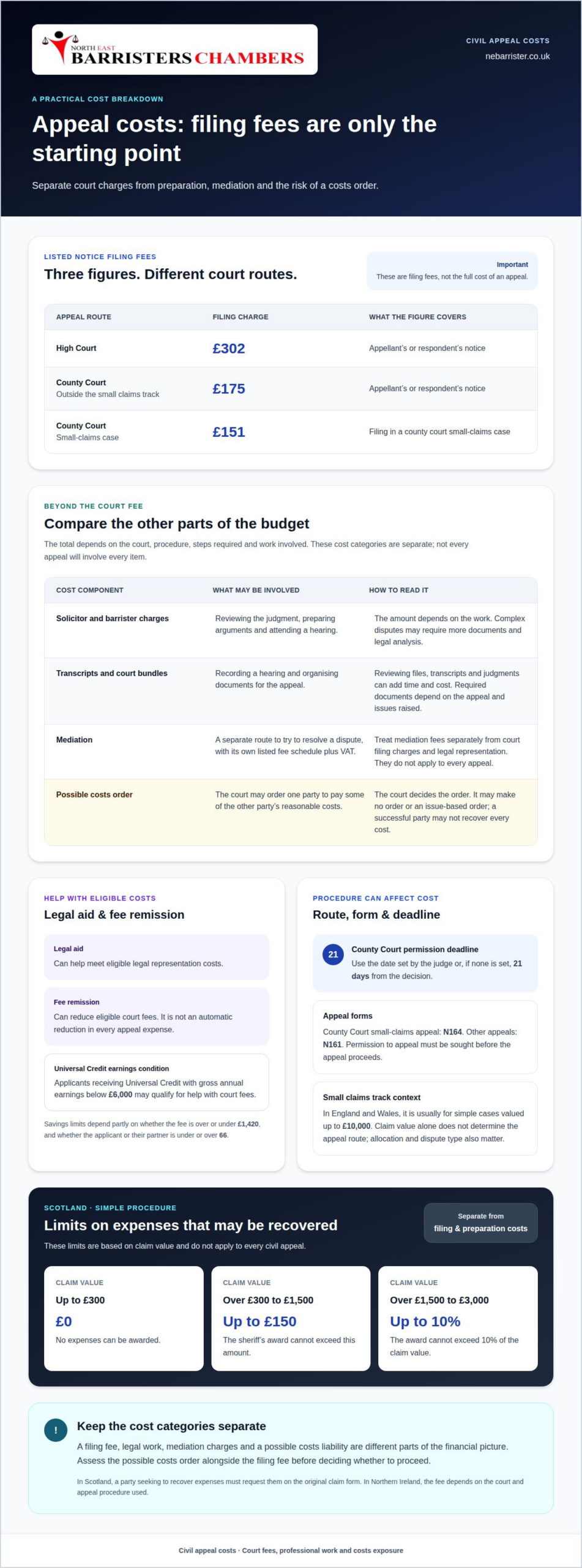
The court fee is only part of the cost of appealing a civil case. For an appellant’s or respondent’s notice, HM Courts & Tribunals Service lists a fee of £302 in the High Court and £175 for a county court claim outside the small claims track; filing in a county court small-claims case costs £151. These are filing fees, not the full cost of an appeal.
It’s understandable to want a clear figure before deciding whether to appeal. The total may include court fees, legal work and the risk of being ordered to pay some of the other party’s costs. The cost of appealing a civil case depends on the court, the steps required and the work involved. This guide explains how to assess those costs and what a successful appeal may mean for costs ordered by the lower court.
Key Takeaways
- For a County Court appeal in England and Wales, identify the permission deadline first: it may be set by the judge or follow the standard time limit.
- A claim’s value and track can affect the appeal route, the form used and the fees that apply.
- Separate Court of Appeal fees from legal costs and any mediation fees when estimating the overall financial commitment.
- An appeal can affect costs ordered in the lower court. Understand that risk before deciding whether to proceed.
Fees for bringing a civil case to the Court of Appeal
Court fees depend on the court and the type of appeal. Professional fees for legal work and any costs order can add to the filing fee.
Solicitor and barrister charges
Solicitor and barrister charges are professional fees for preparing and presenting an appeal. The amount depends on the work involved, including reviewing the judgment, preparing arguments and attending a hearing. A short appeal still requires focused preparation, whilst a complex dispute may involve more documents and legal issues. Legal advice can help clarify the work needed before you decide how to proceed.
Transcripts and court bundles
A transcript records what was said at a hearing, while a court bundle organises documents for the appeal. Reviewing case files, transcripts and judgments can add time and cost. The documents needed depend on the appeal and the issues raised. A clear, relevant bundle helps the court follow the case, and preparing and filing the required material is part of the practical work involved.
Legal aid and fee remission
Legal aid helps meet eligible legal representation costs; fee remission reduces eligible court fees. In England and Wales, applicants receiving Universal Credit with gross annual earnings below £6,000 may qualify for help with court fees. Savings limits depend partly on whether the fee is over or under £1,420, and whether the applicant or their partner is under or over 66. These rules concern court-fee help, not an automatic reduction in every appeal expense.
Costs by court and case complexity
Appeal costs vary with the court, procedure and amount of preparation required. According to the Ministry of Justice, the deadline to ask permission to appeal a County Court decision is the date set by the judge or, if none is set, 21 days from the decision. In Scotland, appealing a decision under simple procedure costs £74. In Northern Ireland, the fee depends on the court and appeal procedure used.
Under CPR 44.2, the unsuccessful party usually pays the successful party’s reasonable costs, although the court decides the order. In Scotland, a party seeking to recover expenses must request them on the original claim form. Assess the possible costs order alongside filing fees before proceeding.
In England and Wales, the small claims track is usually for simple cases valued up to £10,000.
Limits on expenses
Expense limits restrict what a successful party can recover from the other party. In Scotland, the simple procedure rules limit expenses according to the claim value: no expenses can be awarded for claims up to £300. For claims over £300 and no more than £1,500, the sheriff’s award cannot exceed £150. For claims over £1,500 and no more than £3,000, it cannot exceed 10% of the claim value.
Scottish limits for simple procedure claims do not apply to every civil appeal. In England and Wales, fixed recoverable costs primarily apply to lower-value claims. The track and circumstances matter when assessing potential legal costs after a judgment. An appeal may also involve separate filing and preparation costs, in addition to expenses ordered in the original claim.
Small claims track appeals
A small claims track appeal challenges a judgment in a case allocated to that track. The claim’s value alone does not determine its route: the court’s allocation and the type of dispute also matter.
For a county court small-claims appeal, the appellant uses form N164; other appeals use form N161. The appellant must seek permission to appeal before the appeal proceeds. Parties should distinguish the notice fee from their own preparation costs and any costs order. For a claim near the track boundary, legal advice can help assess the judgment, proposed grounds and likely procedure. You can explore appeal advice before deciding how to proceed.
Civil Appeals Office fees
Civil Appeals Office fees are charges listed for appeal-related services and procedures in the Court of Appeal Civil Division. The relevant court fee schedule is titled as covering fees from 8 April 2025, so distinguish its listed charges from legal fees and any costs order.
Mediation has its own schedule, with charges shown plus VAT. These are mediation fees, not a single Court of Appeal filing charge. The schedule gives several figures within each category, so don’t treat them as interchangeable or assume every appeal incurs them.
Mediation is a separate route for trying to resolve a dispute, rather than a court hearing. If the parties agree to use it, its listed fee may form part of their overall appeal budget. A solicitor can explain the role of mediation in a particular appeal and how its costs relate to preparation and representation. The Court of Appeal’s listed mediation charges should therefore be considered separately from the notice fee and counsel’s fees.
Costs orders can create a further financial consequence. Under CPR 52.20(1) and (2), the Court of Appeal has the lower court’s powers on an appeal, including power to make a costs order. CPR 44.2(2) states the general rule that the unsuccessful party pays the successful party’s costs. The court retains discretion, however, and may make no order or an issue-based order. A defendant who succeeds on one issue may not recover every cost incurred.
The Court of Appeal can summarily assess appeal costs, even if both parties oppose that approach. Summary assessment may be inappropriate if an appeal lasts more than half a day or involves leading counsel. Before accepting a fee or budgeting for interest on costs, identify whether it is a court charge, mediation fee or potential costs liability. Separating these items gives a clearer picture of the financial exposure.
How much are court fees to appeal a civil case in England and Wales?
A court fee is the charge for filing an appeal document or application. The cost of appealing a civil case includes these charges, but the amount depends on the court and the procedural step.
HM Courts & Tribunals Service lists a fee of £302 for filing an appellant’s or respondent’s notice in the High Court. For a county court claim outside the small claims track, HM Courts & Tribunals Service lists a filing fee of £175. These are notice fees, not a complete estimate of appeal expenses.
Permission to appeal is a separate step in a County Court appeal. The application fee is £147, £171 or £294, depending on which court is used. For a county court small-claims case, filing an appellant’s or respondent’s notice costs £151. The small-claims notice fee and permission application fee relate to different steps, so identify which application you are making before relying on a figure.
Use this sequence to narrow down the relevant fee:
- Identify whether the original decision came from the County Court or High Court.
- Establish whether the claim was allocated to the small claims track.
- Separate an application for permission from filing an appeal notice.
- Match each step to the court handling it and its corresponding fee.
The Ministry of Justice says Civil Procedure Rules Part 52 governs appeal procedures. The cost of appealing a civil case also depends on preparation and any costs order, which are separate from filing charges. A notice fee is payable for filing, whether the appeal later succeeds or not, so assess the proposed grounds before proceeding. The court route and procedural step determine which listed charge applies, rather than claim value alone.
If you need help assessing an appeal or preparing for court, discuss your civil appeal with a barrister.
North East Barristers Chambers: Civil law
North East Barristers Chambers provides direct barrister advice and court representation for people considering or responding to a civil appeal. Individuals and businesses can instruct a barrister directly for advocacy without needing a solicitor.
An appeal may require careful review of the judgment, proposed grounds and potential costs consequences. A Direct Access Barrister can explain the issues and represent you in court, helping you understand the process before you decide how to proceed. This support may be relevant whether you are challenging a decision or responding to an appeal.
If you’d like to discuss your civil appeal, contact North East Barristers Chambers.
Make your next step a considered one
Before acting, set out what you want the appeal to achieve and which parts of the judgment you intend to challenge. Reviewing the decision, possible grounds and costs risks can help you assess whether an appeal is practical in your circumstances.
The cost of appealing a civil case is only one part of that decision. Timing, the issues in dispute and the possible effect on existing costs also deserve attention. You don’t need to resolve every question alone before seeking legal advice. A clear discussion can help you identify the key points and understand what preparation an appeal may involve.
North East Barristers Chambers can discuss your civil appeal and the representation you may need. Contact North East Barristers Chambers to talk through your next step. A clear plan can make a difficult decision easier to approach.
Frequently Asked Questions
What fees do I have to pay?
The filing fee depends on the court and appeal step. HM Courts & Tribunals Service lists £302 for filing a notice in the High Court and £175 for a county court claim outside the small claims track. A small-claims notice costs £151. An application for permission to appeal a County Court decision has a separate fee, which varies by court. Legal work and any costs order are additional considerations.
What happens next?
First, identify the decision you want to challenge and the deadline applying to your case. For a County Court decision in England and Wales, the Ministry of Justice says the judge may set the permission deadline; otherwise, it is 21 days from the decision. If permission is refused on paper, an appellant has 7 days after receiving the refusal to apply for an oral hearing.
What is an appeal?
An appeal asks a higher court to review a lower court’s decision. It is not simply another chance to present the same case or disagree with the outcome. The appellant needs grounds explaining why the decision should be changed, such as an alleged error in applying the law. The appeal court considers those grounds alongside the judgment and relevant case material.
Who Pays Civil Litigation Costs in the UK?
In England and Wales, the court usually orders the unsuccessful party to pay the successful party’s reasonable costs under CPR 44.2. That is a general rule, not an automatic guarantee of full repayment. The court can make a different order, including one limited to particular issues. Scotland uses the term “expenses”; the applicable approach depends on the court and procedure involved.
Who can appeal a civil judgment and what permission is required?
A party to the case affected by the judgment may seek to appeal it, but must establish grounds for challenging the decision. In England and Wales, an appeal against a County Court decision requires permission before it proceeds. The judge may set the deadline to request permission; if no date is set, the Ministry of Justice states it is 21 days from the decision.
What happens to costs if I lose a civil appeal, and could I pay the other side’s legal fees?
Yes. If your appeal fails, you may have to meet your own legal costs and contribute to the respondent’s recoverable costs. The appeal court decides what costs order is appropriate, so its amount and scope depend on that decision. The court may limit an order to specific issues or make no order. Consider this potential exposure alongside your own appeal expenses before proceeding.