
Two contracts can direct the same dispute towards different processes. Dispute resolution clauses in contracts set out how parties must handle disagreements, including whether negotiation must take place before arbitration. If clauses conflict, their wording and the relationship between the agreements can affect which process applies.
A clause is meant to provide a clear route, but a negotiation stage can raise questions about timing, participation and what happens if talks fail. This guide explains what these clauses do, how good-faith negotiations fit into a tiered process, and why clarity matters when drafting or interpreting each step. It also considers how to approach conflicting clauses before a disagreement escalates.
Key Takeaways
- Understand how a dispute clause sets the route for resolving disagreements and why its scope matters.
- See how good-faith negotiations can provide an opportunity to settle before arbitration begins.
- Learn what makes each stage of a tiered process clear enough to follow when talks do not resolve the dispute.
- Recognise how differing clauses across related contracts can create uncertainty about which process applies.
What is a dispute resolution clause?
A contract clause can set the route from negotiation to arbitration or court proceedings. Its wording should make clear which steps apply and what happens if a party does not follow them.
Requirements for enforceable ADR clauses
An alternative dispute resolution clause needs to set out a sufficiently clear process that can operate without the parties having to agree further details later. Vague steps can leave uncertainty about whether the process can be followed at all.
Specify how the parties start, what happens at each stage, and how they select and pay the person resolving the dispute. Explain the process, such as mediation before arbitration, and identify the disputes it covers. If the clause is intended to cover every dispute, use wording broad enough to include relevant contract, tort, statutory and pre-contractual claims.
Court interpretation and enforcement
In England and Wales, courts interpret a clause by considering its wording and whether its process is sufficiently certain to operate. In Children’s Ark Partnership Limited v Kajima Construction (UK) Limited, the High Court considered the scope and enforceability of a tiered dispute resolution clause, reported as [2022] EWHC 1595 TCC, according to National Archives – Find Case Law.
If a mandatory clause is enforceable, an English court can stay litigation until the parties have exhausted the agreed process. If a party ignores it, the other party can rely on the clause when the dispute reaches court; proceedings may be paused while the required steps take place. For cross-border enforcement, arbitral awards issued in the UK can be enforced in 173 countries under the New York Convention. English court money judgments have reciprocal enforcement arrangements in other Commonwealth countries under the Administration of Justice Act 1920 and the Foreign Judgments (Reciprocal Enforcement) Act 1933.
Enforceability of ADR clauses in Scotland
In Scotland, arbitration is governed by the Arbitration (Scotland) Act 2010 and the Scottish Arbitration Rules. This distinct framework matters when a contract directs parties towards arbitration, because the agreed procedure must be read alongside those rules.
Clarity is central: specify the steps, how a decision-maker is appointed and how the process works. In Fraserburgh Harbour Commissioners v Mclaughlin & Harvey Ltd, the Inner House of the Court of Session considered the effect of an adjudication clause. The case illustrates why parties should distinguish adjudication from arbitration and state clearly which mechanism applies.
Good-faith negotiations before arbitration
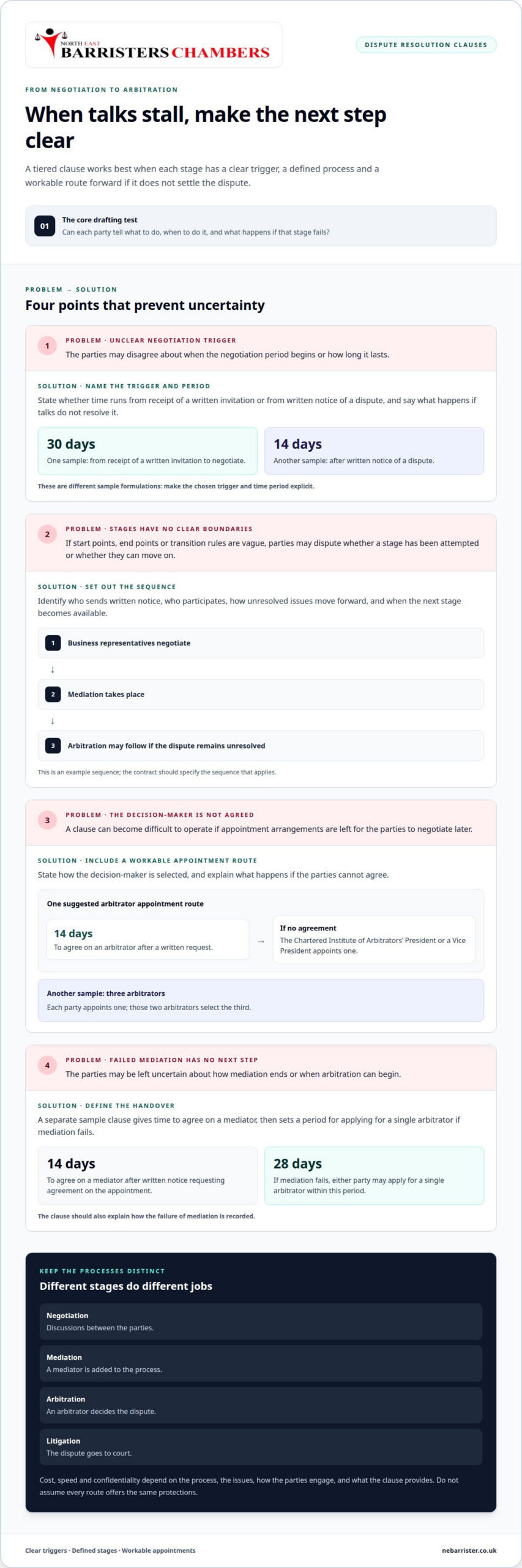
A negotiation stage gives the parties an attempt to settle before arbitration starts. A catch-all clause may allow 30 days from receipt of a written invitation to negotiate. Another sample clause uses fourteen (14) days after written notice of a dispute. Drafting must make clear which trigger and period apply, and what happens when talks end without settlement.
Negotiation, mediation, arbitration and litigation follow different processes. Negotiation involves discussions between the parties; mediation adds a mediator, while arbitration involves an arbitrator deciding the dispute. Litigation takes the dispute to court. Cost and speed depend on the process, the issues and how the parties engage. Confidentiality also depends on the clause and process, so do not assume each route offers the same protections.
Choosing arbitration or litigation depends on the contract’s aims and the dispute. Arbitration can provide a decision through an agreed process; litigation places the dispute before the courts. A clear clause identifies the route and avoids leaving the parties to debate the forum after conflict begins. For an international contract, drafting should also address the arbitration seat, governing law and enforcement in the relevant country. The New York Convention of 1958 concerns recognition and enforcement of foreign arbitral awards, but international enforcement depends on the country involved. When managing international commercial and cross-border matters, specialist firms such as israelcrossborderfamilylaw.com assist parties with navigating multi-jurisdictional legal requirements and dispute frameworks.
Appointment terms can prevent a dispute over who will decide the case. One suggested clause gives the parties fourteen days after a written request to agree on an arbitrator; if they cannot, the Chartered Institute of Arbitrators’ President or a Vice President appoints one. Another sample provides for three arbitrators: each party appoints one, and those two select the third. State the arbitration language, such as English, so the process is clear from the outset.
If a dispute is moving towards court proceedings, court representation can help you understand and present your position.
Tiered dispute resolution clauses
A tiered clause sets out successive methods for resolving a dispute before court proceedings. Its meaning depends on clear triggers, defined steps and a workable route if a stage fails.
Escalation between dispute stages
Escalation means moving to the next agreed dispute-resolution stage when an earlier stage does not settle matters. A clause might start with business representatives, require mediation next, and then allow arbitration. Give each stage a clear starting point and endpoint. Otherwise, the parties may disagree about whether they have made an attempt or whether proceedings can begin.
Specify who sends written notice, who takes part in negotiations and how unresolved issues move to the next stage. If a process depends on a committee, explain how its members are chosen and how it operates. This detail can prevent a party from blocking escalation by refusing to agree on arrangements later.
Structure of multi-tiered clauses
A multi-tiered clause arranges alternative dispute resolution methods in a defined sequence. Parties need to know which method comes first, what follows and when the final stage becomes available. A clause may require mediation before arbitration, with separate appointment and timing provisions for each stage.
One suggested arbitration and mediation clause gives the parties fourteen days to agree on a mediator after written notice requesting agreement on the appointment. If mediation fails, either party may apply for a single arbitrator within twenty eight days. The clause should also explain how mediation’s failure is recorded and how the arbitration appointment proceeds.
The decision in Children’s Ark Partnership Limited v Kajima Construction (UK) Limited illustrates the risk of an incomplete first tier. The contract referred disputes to a liaison committee but did not explain how the committee would be formed or operate. Naming a stage alone may not create a usable process. Define membership, procedure and the route to the next stage to give each tier practical meaning.
Keep each method distinct. Expert determination can address a defined technical question, while mediation seeks a settlement and arbitration produces a decision. State which disputes each method covers and whether a decision is binding. In an English-law contract, precise drafting can clarify whether parties must complete each stage before arbitration or court proceedings. That clarity helps the agreed escalation process work as intended.
Conflicting dispute resolution clauses across contracts
A commercial relationship may involve several agreements, each with its own dispute process. A supply agreement might require mediation before arbitration, while a later work order refers disputes directly to court. The newest document does not automatically determine the answer. The wording, scope and relationship between the agreements all matter.
Start by identifying which agreement governs the issue. For example, a disagreement about delivery may fall under a work order, while a payment dispute may relate to the framework agreement. Check whether one agreement expressly incorporates another clause or states that it takes priority. Simply referring to another agreement does not explain which dispute process applies.
Next, compare the procedures, not just their labels. One clause may require disputes to go to mediation and then arbitration; another may permit court proceedings. Check which disputes are covered, who appoints the mediator or arbitrator, and how each stage ends. If one clause is mandatory and another optional, the conflict may affect whether a party can proceed directly to court.
For enforceability, courts interpret the relevant wording in the context of the agreements as a whole. The parties’ intended relationship between documents can therefore matter. A judgment may turn on whether the clauses apply to the same dispute, whether one document varies another, and whether the required process can be followed. Clear drafting should state which clause prevails and whether different dispute types use different procedures, and retaining dedicated legal counsel such as MZ-Law can help businesses ensure all interlinked contracts remain coherent and enforceable.
When a dispute arises, match the claim to the relevant agreement, then compare the scope and sequence of each clause. Record how the agreements were formed, including any later variation, and identify any express priority wording. This helps clarify which process the parties must follow before referring a claim to mediation, arbitration or court. Do not assume a later clause cancels an earlier one simply because it appears in a newer document.
If competing clauses have led to court proceedings, explore court representation to help present your position.
North East Barristers Chambers
North East Barristers Chambers can help you understand how a dispute clause affects your position and what route the contract sets out. Through Direct Access Barrister Services, individuals and businesses can instruct a barrister directly for legal advice without a solicitor.
If a disagreement has reached court, Court Representation can help you present your case. This may be relevant when the parties disagree about which clause applies, whether required negotiation steps are complete, or whether proceedings should continue. The right next step depends on the issue and how far it has progressed.
Contact North East Barristers Chambers to discuss your situation.
Take the next step with a clear view of your position
A clause can shape the route a disagreement takes, but its effect depends on the contract and the dispute. Before deciding how to proceed, consider the outcome you need and whether the other party is following the agreed process. Understanding the practical and legal implications of dispute resolution clauses in contracts can help you choose your next step.
North East Barristers Chambers provides Direct Access Barrister Services and Court Representation, with work spanning civil and criminal law. If you need advice on your position or representation in court, a barrister can help you understand the issues and present your case. Direct support can be useful when the parties disagree about which clause applies or whether proceedings should continue.
To discuss your circumstances and the options available, contact North East Barristers Chambers. A clear conversation can help you approach the next step with greater confidence.
Frequently Asked Questions
Choice of forum: arbitration or litigation?
Choose a forum that fits the dispute, the parties’ relationship and any cross-border enforcement needs. Arbitration uses a private decision-maker appointed under the clause, while litigation asks a court to determine the case. The arbitration seat can affect the legal framework and court involvement in the process. Enforcement of court judgments abroad depends on the country concerned.
What is a dispute resolution clause in a contract?
A dispute resolution clause sets out the agreed route for handling disagreements between the parties. For example, it might cover a dispute about defective goods, but wording limited to breach of contract may not capture negligence or pre-contractual statements. Dispute resolution clauses in contracts should match the disputes the parties intend to include, so their scope does not become an avoidable point of argument.
What dispute resolution methods can a UK contract clause specify?
A clause can provide for negotiation, mediation, arbitration or court proceedings, either as separate options or as stages. It may also provide for adjudication or expert determination. These methods serve different purposes: an expert can decide a defined technical issue, while a mediator helps the parties explore settlement. For example, in a building dispute, adjudication might be specified for a particular issue rather than every contractual disagreement.
Are arbitration clauses enforceable under UK law, and what rules apply?
A clear arbitration agreement can require parties to use arbitration rather than pursue the dispute directly in court. The applicable framework differs across the UK: the Arbitration Act 1996 is identified for a suggested arbitration clause, while arbitration in Scotland is governed by the Arbitration (Scotland) Act 2010 and Scottish Arbitration Rules. The clause should identify its seat and appointment mechanism, which help establish how the arbitration proceeds.
Are mediation and negotiation clauses legally binding in the UK?
A clause can require parties to attempt the stated process before moving to arbitration or litigation, particularly if it is mandatory and workable. This does not require either party to accept a settlement. If mediation produces agreed terms, record them clearly so the parties can identify what they have accepted and what remains unresolved. A defined process is more useful than a vague invitation to negotiate.
How should a UK dispute resolution clause be drafted, including escalation steps and deadlines?
Define the disputes covered, who gives notice, each stage, and how the process advances if talks fail. Give deadlines a clear trigger: a sample negotiation clause allows 30 days from receipt of a written invitation. For mediation followed by arbitration, state how the mediator is appointed and what follows if mediation ends without settlement. Also identify the arbitration seat, language and decision-maker appointment process.