
The challenge is balancing firm case management with fair, clear communication. Dealing with a difficult litigant in person may involve repeated correspondence, explaining procedural steps and preparing for a hearing that takes longer than expected. In England and Wales, a lawyer must put their duty to the court ahead of their duty to a client if the two conflict, but is not required to run the other party’s case.
It’s understandable to feel frustrated when communication becomes demanding or progress slows. The practical response is to stay professional, keep the case on track and avoid treating someone unfairly because they’re unrepresented. Being a litigant in person doesn’t automatically make someone difficult. Challenges often arise because the parties have different levels of familiarity with legal procedures and expectations.
This article explains how to communicate clearly and respectfully, keep a reliable record of conversations, and prepare for pressures such as excessive correspondence, hearing delays and extra procedural work. It also explains how direct access barrister services and court representation can support you with your own case.
Key Takeaways
- Keep correspondence calm, clear and focused on the next procedural step, even when messages become demanding.
- Make a dated note of conversations and keep key documents organised so there is a reliable record of what was discussed.
- Plan for extra preparation and possible delays at hearings, including practical tasks that may otherwise be handled by a represented party.
- Know the limits of your role: fairness does not mean running the other party’s case or accepting abusive behaviour.
1. Clear, courteous communication
Clear communication helps keep a dispute focused, even when correspondence becomes difficult. Acknowledge a message when useful, explain when you expect to respond, and describe procedural steps in plain language. You don’t have to reply immediately. If a litigant in person sends several emails, for example, address the points that need action and identify any information still required.
Lawyers must balance duties to their client and the court. Lawyers should act in their client’s interests while also maintaining their independence and serving the interests of justice. If those duties conflict, the duty to the court takes priority. The SRA Handbook, chapter 11, says solicitors must not take unfair advantage of an opposing party’s lack of knowledge.
The National Archives (legislation.gov.uk) records that rule 3 and rules 5 to 19 come into force on 29th April 2024. In England and Wales, the court must consider whether a party is a litigant in person when using its case-management powers. Give reasonable notice of applications and arguments, and avoid surprising an unrepresented party where possible. The 2015 guidelines prepared by the Law Society, Bar Council and CILEx offer a framework for lawyers.
A litigant in person is an individual, company or organisation that represents itself in court rather than being represented by a solicitor or barrister. They may seek costs, and a represented party may seek costs caused by unreasonable conduct. When deciding whether to award costs against a litigant in person and how much to award, the tribunal should consider their means.
To seek a civil restraint order, apply to the court and explain the pattern of conduct and why you are seeking an order. For a hearing, prepare a concise chronology, the key documents, the issues for decision and clear responses to likely applications or requests for more time.
2. Keeping records of conversations
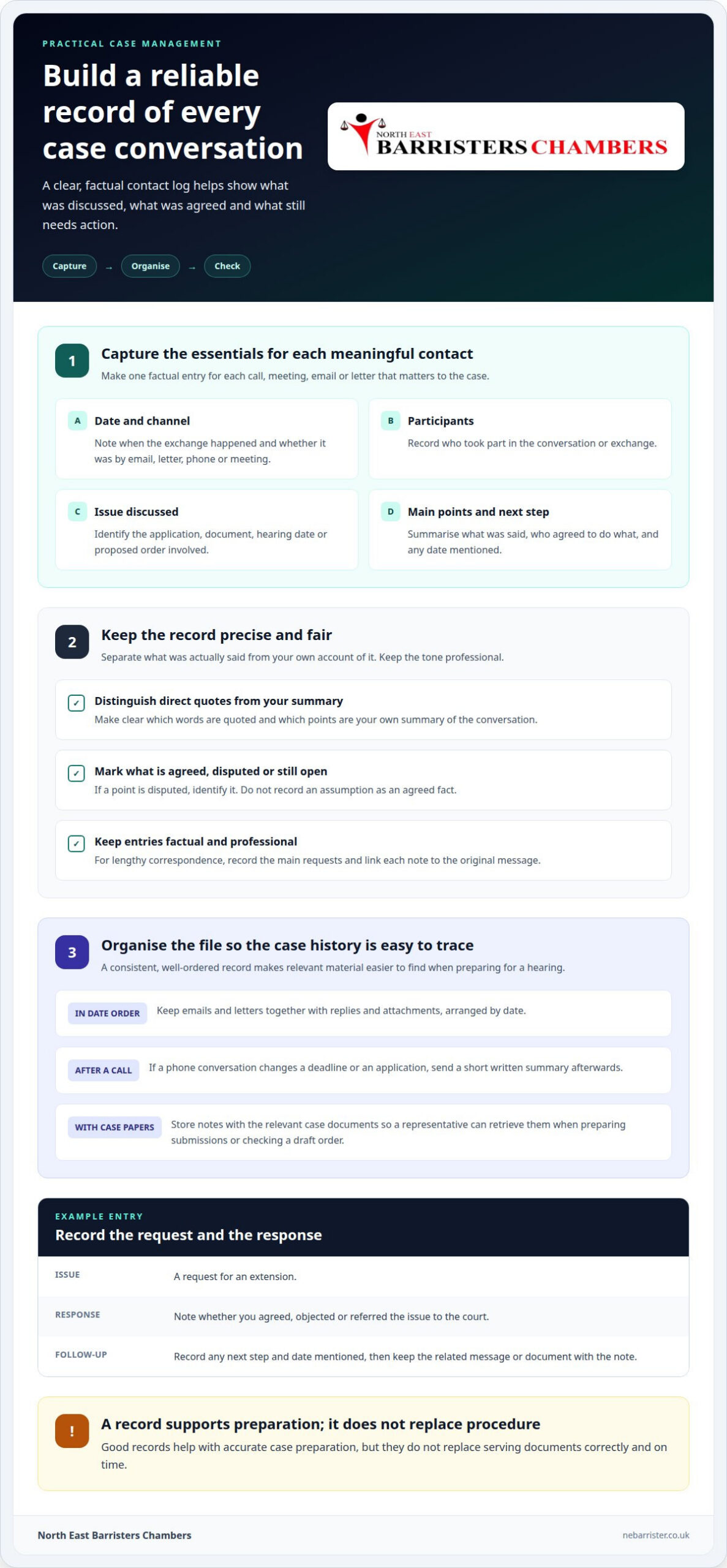
A clear record helps establish what was said, what was agreed and what still needs action. For each call or meeting, note the date, participants, communication method and main points. Separate direct quotes from your own summary. For example, record a request for an extension, then note whether you agreed, objected or referred the issue to the court. This makes later discussions about conduct more precise.
Keep emails and letters in date order, together with replies and attachments. A solicitor or barrister can then trace how an issue developed rather than relying on memory before a hearing. If a phone conversation changes a deadline or an application, send a short written summary afterwards. Identify any point the other party disputes, and don’t record an assumption as an agreed fact. A consistent file also helps the legal team find relevant material quickly.
Use a simple log, with one entry for each meaningful contact. Include:
- Date and channel: when the exchange happened and whether it was by email, letter, phone or meeting.
- Issue discussed: the application, document, hearing date or proposed order involved.
- Next step: who agreed to do what, and any date mentioned.
Keep the log factual and professional. For lengthy correspondence, record the main requests and link each note to the original message. This preserves context and helps distinguish repeated queries from new issues. The Law Society’s guidelines can inform a lawyer’s approach, but your file should reflect the actual exchanges in your case. Store notes with the relevant case documents so a representative can retrieve them when preparing submissions or checking a draft order.
Good records support accurate case preparation; they don’t replace serving documents correctly and on time. If you need help understanding your position or preparing for court, direct access barrister services can provide a route to legal advice without instructing a solicitor.
3. Plain, respectful and proportionate communication
Keep each message focused on a clear issue, such as a document, deadline or proposed next step. Use short paragraphs and explain procedural terms in plain English. Instead of repeating a disputed claim in emotive language, identify the point in dispute and say what response or action is needed. This helps the parties understand what matters in the proceedings and reduces avoidable argument.
Manage unreasonable or repeated emails with a calm, practical response. Group related questions, answer relevant points together and state which issues need action. Lawyers don’t have to respond immediately to every message. They can acknowledge correspondence and indicate when they expect to reply, setting a workable expectation without ignoring its substance.
Professional communication doesn’t mean accepting every demand or giving the other party an advantage. Avoid sarcasm, personal criticism and unnecessary arguments. If a message makes several claims, separate them: identify what is agreed, what is disputed and what evidence or clarification is relevant. A measured reply keeps attention on the issues rather than the sender’s tone. It also helps lawyers maintain their independence and support the administration of justice.
The duty to act in the interests of justice shapes how lawyers communicate, alongside their obligations to clients and the court. The Law Society’s notes for litigants in person can explain what an unrepresented party may expect from a lawyer. In disputes involving children, paragraph 4.9.1 of the Family Law Protocol says applications and supporting documents should use factual rather than emotive language. For example, describe a missed handover by stating when it happened and what followed, rather than labelling someone’s character. Practices specialising in family proceedings, such as The Sands Law Group, APLC, similarly emphasise keeping records objective and measured to prevent unnecessary conflict.
Set a proportionate boundary if correspondence becomes excessive: identify the channel for future messages, ask that unrelated points be kept separate, and respond to urgent procedural matters. If the conduct becomes abusive, remain civil, preserve the relevant communication and raise the issue through the proper court process. Clear limits can protect the working relationship without escalating the dispute.
4. Challenges of dealing with litigants in person
A hearing may need more preparation when one party is unrepresented. Allow time to explain the issues, anticipate procedural questions and consider whether the hearing may take longer. Requests for adjournments or extensions can affect the timetable, so prepare a clear response and identify the practical effect on the case.
There may be extra procedural work for the represented party, such as preparing hearing bundles, providing copies and drawing up orders. In an Employment Tribunal, represented parties are generally expected to take responsibility for these tasks. For employers facing dispute proceedings, working with HR professionals such as Altum HR can help manage documentation and provide expert employment support. Plan this work alongside hearing preparation rather than leaving it until the final stages.
Repeated correspondence and queries can take time and increase costs for a represented party. Triage messages by urgency and relevance, then deal with procedural action separately from repeated arguments. A litigant in person is not entitled to have someone else run their case, but clear explanations of process can reduce confusion. Explain what a step involves without preparing their evidence or making their case for them.
If a litigant in person makes threats or behaves abusively, you don’t have to tolerate it. Keep your response professional, preserve the communication and raise the conduct through the appropriate court process. If the behaviour occurs during a hearing, address it calmly through the judge rather than escalating the exchange yourself.
Support in Scotland or Northern Ireland must reflect the relevant jurisdiction. The procedural points in this article concern England and Wales, so don’t assume the same rules or court processes apply elsewhere in the UK. A barrister familiar with the relevant jurisdiction can explain the process and represent a party where appropriate.
Preparation helps manage these pressures. Before a hearing, organise the documents, identify the decisions sought and plan how to respond to an application or request for more time. If you need representation or advice about your position, get support with your court case.
North East Barristers Chambers
North East Barristers Chambers provides direct access legal advice and representation for individuals and businesses in criminal, civil and family law matters. You can instruct a barrister directly, without a solicitor. For a dispute involving a litigant in person, a barrister can help you understand your position, prepare for the next step and represent you at a hearing where appropriate.
The right support depends on the nature of the proceedings and the help you need. North East Barristers Chambers provides advice and representation in civil and criminal law, helping you assess documents, clarify arguments and prepare for court. If you would like to discuss your case and the support that may assist, contact North East Barristers Chambers.
Take a clear next step
Before the dispute moves further, decide what you need help with now. You may want an independent view of your position, support preparing your arguments or representation at a hearing. Being clear about your needs can help you use your time with a barrister effectively.
Dealing with a difficult litigant in person can put pressure on your judgement as well as your case. A focused discussion can help you separate the practical issue from your frustration, consider your options and approach the next stage with greater clarity. You don’t need to wait until a hearing is imminent to seek legal support.
If you’re ready to discuss your situation, contact North East Barristers Chambers. Share the stage your case has reached and the specific decision or challenge you’re facing. A straightforward conversation is a practical place to begin, and you can move forward with a clearer sense of your next step.
Frequently Asked Questions
So, what’s the problem?
The difficulty is usually practical, not simply that someone is unrepresented. They may be unfamiliar with court procedure, while the represented party must manage their own case and communicate fairly. For example, a disagreement about what a court order requires can cause delay if each party understands the next step differently. Clear roles and attention to the issues help prevent that misunderstanding from taking over the dispute.
How should you communicate with a difficult litigant in person?
Keep each exchange civil and direct, and make clear what action you need and why. If a message raises several unrelated points, group your response by topic rather than replying emotionally to each sentence. For example, distinguish a request for a document from a disagreement about the merits of a claim. This makes it easier for both parties to identify what needs resolving next.
What steps can the court take to control a litigant in person’s conduct?
The court can use its case-management powers to keep proceedings focused and take account of whether a party is unrepresented. It may give directions about how the case should progress. In a case involving repeated applications, a civil restraint order may restrict further applications without the court’s permission. These measures address conduct and case management, not the person’s unrepresented status alone.