
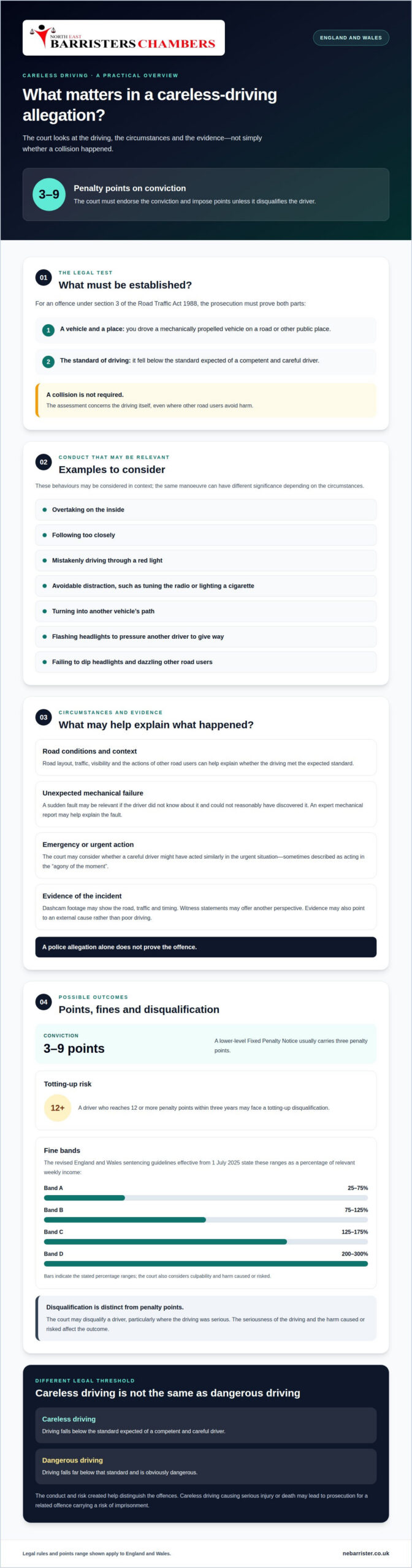
Careless driving can put 3 to 9 points on your licence. In England and Wales, the court must endorse a conviction and impose those points unless it disqualifies you. A driving-without-due-care-and-attention defence depends on the facts and evidence, not simply on whether a collision happened.
When you’re facing an allegation, you need a clear answer. Driving without due care and attention means driving below the standard expected of a competent and careful driver. Whether ordinary actions fall below that standard depends on the circumstances.
This article explains the legal test, examples of conduct that may amount to careless driving, and what a defence may involve. It also outlines the evidence and circumstances that can matter when assessing an allegation.
Key Takeaways
- Learn how the court assesses careless driving and what factors can affect the penalty.
- Understand why an accident is not required for an allegation and which everyday driving behaviours may be relevant.
- See how the legal test distinguishes careless driving from more serious driving offences.
- Explore how circumstances such as an emergency or unexpected mechanical failure may be relevant to a defence.
How many points is careless driving?
In England and Wales, a careless driving conviction carries 3 to 9 points unless the court disqualifies you. A lower-level careless driving Fixed Penalty Notice usually carries three penalty points. The exact outcome depends on the seriousness of the driving and the harm caused or risked. A driver who already has points may also face a totting-up disqualification after reaching 12 or more penalty points within three years.
Examples of careless driving can include overtaking on the inside, following too closely or mistakenly driving through a red light. Avoidable distractions, such as tuning the radio or lighting a cigarette, may also be relevant. Other examples include turning into another vehicle’s path, flashing headlights to pressure another driver to give way, or dazzling road users by failing to dip headlights.
The offence is defined under section 3 of the Road Traffic Act 1988. The prosecution must prove that you drove a mechanically propelled vehicle on a road or public place, and that your driving fell below the standard expected of a competent and careful driver. An accident is not required. A driver may face an allegation even if no collision occurred.
Careless driving and dangerous driving have different legal thresholds. Careless driving falls below the standard expected of a competent and careful driver. Dangerous driving falls far below that standard and must be obviously dangerous. The conduct and risk created help distinguish the offences. Careless driving that causes serious injury or death may lead to prosecution for a related offence carrying a risk of imprisonment.
The 3-to-9-point range described here applies to England and Wales. Scotland and Northern Ireland have separate legal systems, so this points range and the England and Wales rules should not be assumed to apply there.
The effect on insurance depends on the insurer and policy, but a careless driving conviction may be relevant to an insurer’s assessment. The court may also disqualify a driver, particularly where the driving was serious, rather than impose penalty points.
There is no single deadline that applies to every careless driving prosecution. Whether proceedings were brought in time depends on the applicable time limit and when the case began.
What is driving without due care and attention?
For a careless driving charge in England and Wales, the prosecution must prove that you drove a mechanically propelled vehicle on a road or other public place. Whether the location falls within that legal scope may matter. The court assesses the driving against the standard of a competent and careful driver, taking the circumstances into account.
A driving without due care and attention defence may focus on what happened and why. If a sudden mechanical failure caused the incident, it may be relevant if you didn’t know about it and couldn’t reasonably have discovered it. An emergency requiring swift action may also matter. The question is whether a careful driver might have acted similarly in that urgent situation, sometimes described as acting in the agony of the moment.
The prosecution’s evidence must support its account of the driving. Dashcam footage may show the road, traffic and timing, while witness statements may provide another perspective. An expert mechanical report could help explain a vehicle fault. Evidence may also support an account that an external factor, rather than poor driving, caused the incident. A police allegation alone does not prove the offence.
Fines are assessed by reference to relevant weekly income and the seriousness of the offence. Under the revised England and Wales sentencing guidelines effective from 1 July 2025, the stated fine ranges include Band A at 25-75% of relevant weekly income, Band B at 75-125%, Band C at 125-175%, and Band D at 200-300%. The court also considers culpability and harm caused or risked, including injury. A fine and penalty points are distinct from disqualification, which may be considered for serious driving.
Legal definition and statutory basis
In England and Wales, section 3 of the Road Traffic Act 1988 makes driving without due care and attention an offence. It also covers driving without reasonable consideration for other road users. The law does not set a separate definition of a “prudent motorist”. Instead, the expected standard is assessed through the statutory test in section 3ZA(2).
Section 3ZA(2) asks whether the driving fell below the standard expected of a competent and careful driver. The assessment concerns the driving itself, not simply whether a collision, injury or damage occurred. For example, a driver who fails to respond appropriately to a hazard may face scrutiny even if other road users avoid harm.
To prove the offence, the prosecution must establish that the accused drove a mechanically propelled vehicle on a road or other public place and that the driving fell below the statutory standard. The road layout, traffic, visibility and actions of other road users may help explain what happened and whether the driving met the expected standard.
Dangerous driving has a higher threshold. Under section 2 of the same Act, the driving must fall far below the required standard and be obviously dangerous. That distinction matters because the charge affects the potential penalty and the court’s assessment of the conduct. A poor manoeuvre may be careless without meeting the separate test for dangerous driving.
Legal advice can help identify the exact allegation, examine the prosecution evidence and apply sections 3 and 3ZA(2) to the circumstances. Court representation may be relevant if the case proceeds to a hearing. A representative can address whether the evidence proves the required standard was breached, and explain the legal issues before the court considers penalty, penalty points or disqualification.
Examples of driving without due care and attention
The same manoeuvre can have different significance depending on traffic and road conditions. Overtaking on the inside may be careless if it leaves another vehicle little room. The assessment concerns how the vehicle was driven and the risk created, not simply the name of the manoeuvre. The driver’s account and available evidence can put the incident in context.
Following too closely may leave little time to react if traffic slows suddenly. Turning into another vehicle’s path may also fall below the expected standard, particularly if the other vehicle was visible. A mistaken entry at a red light is another possible example, although the circumstances of the mistake remain relevant.
Distraction can affect a driver’s response to changing traffic. Tuning the radio or lighting a cigarette may divert attention from the road. Flashing headlights to make another driver give way can be inconsiderate, while unnecessary use of an overtaking lane may affect other road users. Undipped headlights that dazzle oncoming drivers provide another example. These actions can be assessed under the Road Traffic Act 1988, but an example alone does not establish guilt.
The key question is whether the driving fell below the standard of a competent and careful driver in the circumstances. A sudden hazard, nearby traffic and what the driver could see may help explain a manoeuvre. Careless driving can carry penalty points or disqualification. Dangerous driving has a higher legal threshold, while insurance consequences are separate from whether the offence is proved.
If you face a criminal allegation and need help understanding how the evidence relates to the driving standard, seek advice about your case.
North East Barristers Chambers
North East Barristers Chambers provides direct access legal advice and court representation for criminal law matters, including driving allegations. You can instruct a Direct Access Barrister directly, without needing a solicitor.
For an allegation under the Road Traffic Act 1988, criminal law advice can help clarify the charge, the prosecution evidence and how the circumstances may relate to the legal test. If the matter proceeds to court, Court Representation can support you through the hearing and present your case.
Consider seeking advice if you’ve received a charge, are unsure how to respond, or need representation in court. Contact North East Barristers Chambers to discuss your situation.
Take the next step with clarity
An allegation can be difficult to assess when the evidence shows only part of what happened. Compare the account of the journey with the available evidence and the legal test. This can help identify the issues that matter before you respond to the allegation or appear in court.
A driving without due care and attention defence depends on the facts of the incident. Assessing the prosecution’s account against the evidence can clarify what response may be appropriate. A familiar example of careless driving does not determine the outcome, as each case turns on its circumstances.
If you want to discuss your situation and the legal options available, contact North East Barristers Chambers. Taking advice can help you approach the next stage with a clearer understanding and a practical plan.
Frequently Asked Questions
Can I be charged without being in an accident?
Yes. A collision, injury or damage is not required for a careless driving allegation. A driver could, for example, be accused after a witness reports a risky manoeuvre, even if all vehicles continue safely. The issue is whether the driving met the legal standard, not whether anyone was hurt. The prosecution must still prove the offence with evidence.
What if I believe I was driving in a prudent manner?
Your belief about your driving is relevant, but it does not decide the case by itself. The question is whether you drove to the standard expected of a competent and careful driver in the circumstances. An urgent manoeuvre, for example, may need to be considered alongside the hazard and the time available to react. Evidence about what happened can help explain your actions.
What is driving without due care and attention under UK law?
In England and Wales, section 3 of the Road Traffic Act 1988 covers driving without due care and attention or without reasonable consideration for other road users. The assessment uses the standard expected of a competent and careful driver. The offence requires driving a mechanically propelled vehicle on a road or other public place. Scotland and Northern Ireland have separate legal systems.
What are common defences to a careless driving charge in England and Wales?
A defence may argue that the driving did not fall below the required standard, or that an unexpected event explains it. A sudden mechanical failure may be relevant if you neither knew about it nor could reasonably have discovered it. An emergency may also matter if swift action was needed. The evidence and circumstances determine how these arguments apply.
Can poor road conditions, an emergency, or another driver’s actions provide a defence?
Poor visibility or another vehicle’s sudden movement may be relevant, but neither automatically provides a defence. The court considers whether the response was reasonable and met the required standard. Depending on the evidence, an emergency may support an argument that a careful driver would have acted similarly under pressure.
What evidence can help defend a careless driving allegation?
Dashcam footage, witness statements and expert mechanical reports may help clarify a disputed incident. Footage could show the sequence of traffic movements; a witness may describe events from another position; and a mechanical report may address whether a sudden fault affected control of the vehicle. The value of each item depends on what it shows and how it relates to the allegation.