
Disclosure doesn’t mean handing over every document you hold. In England and Wales, the disclosure process in civil litigation arises when, and to the extent that, the court orders it; where Part 31 applies, it covers documents within your control, including those that support or undermine a party’s case. Part 31 doesn’t apply to claims allocated to the small claims track.
It’s understandable to be unsure what must be revealed, especially when documents are confidential, electronic or potentially damaging to your case. This guide explains the duty of disclosure, what counts as a document within your control and how Part 31 sets the rules for disclosure and inspection. You’ll also see how the court’s directions shape what each party must do.
Key Takeaways
- Understand which documents count as being within your control, including records held electronically or no longer available.
- Learn why relevant documents that weaken your case may still need to be disclosed, and how privilege can affect what is revealed.
- See how the court’s directions shape the disclosure process and why the duty can continue as a case progresses.
- Find out how missed or inaccurate disclosure can affect your ability to rely on documents and expose you to court sanctions.
Documents within a party’s control
Control determines which documents must be considered for disclosure, including relevant records held electronically. The search must be reasonable, and inspection follows specific rules.
Documents and reasonable searches
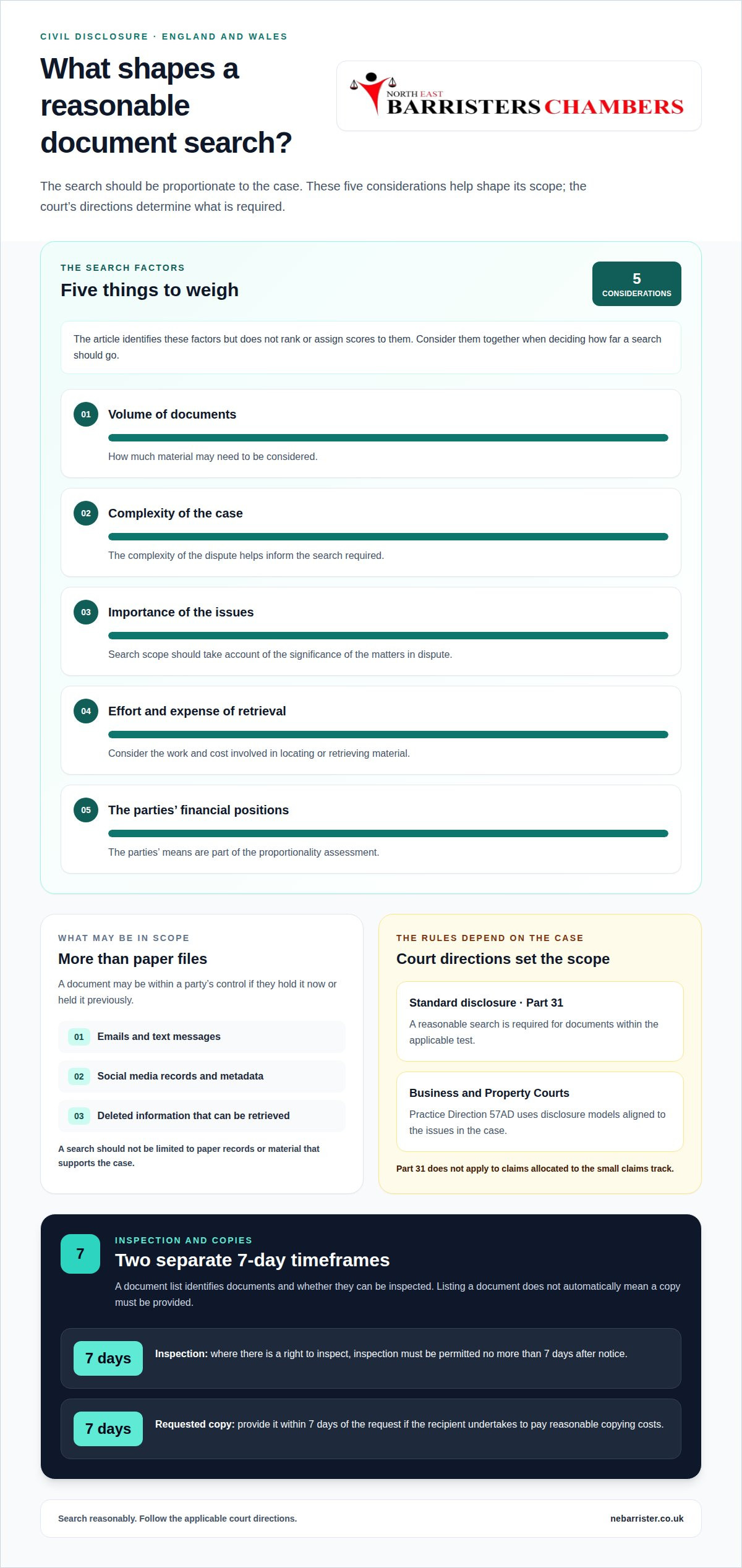
A document is within a party’s control if they hold it or previously held it. Relevant material may include emails, text messages, social media records and metadata, as well as deleted information that can be retrieved. A search should not be limited to paper files or documents that support a party’s case.
For standard disclosure, the Civil Procedure Rule Committee requires a reasonable search for documents falling within rule 31.6(b) or (c). The search should account for the document volume, case complexity, importance of the issues, retrieval effort and expense, and the parties’ financial positions.
In the Business and Property Courts, Practice Direction 57AD uses disclosure models aligned to the issues in the case. This differs from standard disclosure under Part 31, so the court’s directions determine the search required.
Document lists and inspection
Standard disclosure involves listing documents that meet the applicable test and making them available for inspection as required. The list identifies each document and whether it can be inspected; it does not mean every document must automatically be copied.
Where a party has a right to inspect, the Civil Procedure Rule Committee says inspection must be permitted no more than 7 days after notice. If the recipient requests a copy and undertakes to pay reasonable copying costs, the Civil Procedure Rule Committee says it must be provided within 7 days of the request.
Electronic searches may use forensic computer experts and document review software to find and sort relevant material, with organisations and legal teams often engaging specialised support providers such as Trustpoint.One to assist with complex eDiscovery and review. The work involved depends on the volume and complexity of the documents and the effort and expense needed to retrieve them. These factors also help determine a proportionate search, rather than requiring every device or file to be examined in the same way.
Disclosure in Civil Litigation: What Documents must you reveal?
Part 31 disclosure is not limited to documents that support your position. Relevant adverse documents may also need to be disclosed, unless privilege protects them.
Consequences of failing to disclose
Failing to disclose a relevant document can affect how a party presents its case. Under CPR 31.21, a party generally cannot rely on a document it failed to disclose or make available for inspection unless the court gives permission. For example, a business that later finds a key email may need the court’s permission before using it as evidence.
Concealing a damaging record is different from making an honest mistake, but both can disrupt the case. The court may address non-compliance through financial penalties or adverse costs orders. A false disclosure statement made without an honest belief in its truth can also lead to contempt proceedings under CPR 31.23.
Consequences of non-compliance
Non-compliance means failing to meet a disclosure requirement, such as omitting relevant documents or not complying with an inspection obligation. It matters because disclosure duties continue during proceedings, so a party must act when further relevant material comes to light.
Preserve relevant documents once litigation is anticipated, including emails, text messages and social media records. Deleting or withholding material can leave gaps in the evidence and raise questions about the search. Privilege may protect some documents, including material created for the dominant purpose of conducting existing or contemplated litigation. Confidentiality alone does not automatically prevent disclosure.
For covered claims, parties must discuss and seek to agree a disclosure proposal no less than seven days before the first case management conference, according to the Civil Procedure Rule Committee. A clear proposal can define which documents and searches are in dispute. If a relevant document comes to light later, promptly notifying the other parties can help address the omission before it affects the evidence or costs.
What Is the duty of disclosure?
In England and Wales, disclosure means stating that relevant documents exist or have existed and making them available as required. This duty helps the parties and the court assess the evidence behind a dispute.
Meaning and purpose of disclosure
Disclosure gives each side a clearer picture of the evidence, including material that may support or weaken a claim. In a contract dispute, for example, an email recording a change to agreed terms could help explain what happened.
The aim is a fair resolution based on relevant information, rather than only the documents one party chooses to rely on. In the Business and Property Division, CPR Practice Direction 57AD, paragraph 2.1, describes disclosure as important to achieving the fair resolution of civil proceedings.
A 2014 Court of Appeal decision recognised the public interest in providing relevant evidence to the court. It also acknowledged the impact disclosure can have on litigants’ privacy and confidentiality. The court’s approach must balance those concerns against the need to resolve the dispute fairly.
Scope of the disclosure duty
The duty of disclosure applies to individuals and organisations, including public authorities such as the National Crime Agency. It can arise before formal proceedings begin, when someone knows or reasonably ought to know they may become involved in litigation.
The relevant point is not simply the date a claim is filed. A business that learns a customer intends to bring a claim, for instance, may already need to consider preserving relevant records. The duty’s scope depends on the applicable court rules and directions.
Disclosure is not an unrestricted demand to reveal every private or confidential record. The rules determine what information must be provided and when. In practice, court directions link the documents sought to the issues in dispute, helping the parties understand what evidence the case requires.
Civil Procedure Rules Part 31
In England and Wales, Part 31 sets rules for disclosure and inspection in civil claims, except claims allocated to the small claims track. The disclosure process in civil litigation follows this framework, while the court’s order sets practical requirements for each case.
Under CPR 31.4, a document includes anything that records information, such as a paper contract, email or electronic file. Under standard disclosure, CPR 31.6 covers documents a party relies on and documents that adversely affect its own case, another party’s case, or support another party’s case.
The court can tailor the process. At a case management conference, it makes a disclosure order specifying what each party must do and the timescale. CPR 31.12 also allows specific disclosure or inspection. For example, the court may require a search for defined records or inspection of identified material.
For intermediate and multi-track claims covered by the rule, each party must file and serve a disclosure report no less than 14 days before the first case management conference, according to the Civil Procedure Rule Committee. The report helps the court understand the proposed approach before setting directions.
The duty continues until proceedings conclude under CPR 31.11. If relevant documents come to a party’s attention later, that party must notify the others immediately. A party generally cannot rely on an undisclosed document without the court’s permission under CPR 31.21. Privileged documents may be withheld from inspection when privilege applies.
Part 31 gives the disclosure process in civil litigation its structure; the court’s directions determine what is required in practice. For help applying the rules to a civil dispute, discuss civil law representation.
North East Barristers Chambers: Civil law
North East Barristers Chambers provides civil law advice and court representation when disclosure questions affect your case. A barrister can help you understand the court’s directions, assess how disclosure obligations apply to the documents in dispute and prepare for the next stage of proceedings.
Direct Access Barrister Services let individuals and businesses instruct a barrister directly for legal advice and advocacy, without a solicitor. This can be useful when you need focused guidance on a disclosure issue or representation in court. The right support depends on the work your case requires, whether advice, advocacy or both.
To discuss your civil case, contact North East Barristers Chambers.
Plan your next step with confidence
Consider how the evidence may shape the decisions ahead. The disclosure process in civil litigation is not simply administrative: the relationship between documents and disputed issues can affect how you assess your position, prepare for discussions and present your case. Legal advice can help you connect these choices to the wider aims of your civil claim.
A focused discussion can put your immediate procedural concerns in context. Consider which decision is approaching, what evidence matters and where you need advice or advocacy. This gives the conversation a practical starting point and keeps the next steps centred on your case, rather than treating every document as a separate problem. Clear advice can also help identify the questions to address before deciding how to proceed.
For guidance on your civil matter, contact North East Barristers Chambers. You can take the next step with a clearer sense of what you need to resolve.
Frequently Asked Questions
What about confidential or privileged documents?
Confidentiality alone does not automatically prevent a document being disclosed, but legal professional privilege may protect some material from inspection. For example, a confidential commercial contract may still be disclosable if relevant, while a lawyer’s confidential advice may be privileged. If someone inadvertently permits inspection of a privileged document, CPR 31.20 says it may only be used with the court’s permission.
What is eDisclosure?
eDisclosure is the identification, review and disclosure of electronically stored information in a civil case. It can include emails, text messages, social media posts, deleted information and metadata, such as details showing when a file was changed. A dispute about a project timeline, for example, may require searching email accounts and shared drives, not just collecting printed correspondence.
When does the duty arise?
The duty can arise before a claim is formally issued, once a person knows or reasonably ought to know they may become involved in litigation. A business receiving a detailed complaint alleging a defective product, for instance, may need to consider preserving relevant records. The precise disclosure obligations depend on the court’s directions and the rules applying to the case.
What are the current CPR Part 31 disclosure rules and exceptions?
Part 31 applies to civil claims except those allocated to the small claims track. Disclosure takes place when, and to the extent that, the court orders it. Standard disclosure under CPR 31.6 covers documents relied on and specified documents affecting or supporting a party’s case. Privilege can protect documents from inspection, while CPR 31.21 restricts reliance on documents not disclosed unless the court permits it.
How does the disclosure process work step by step in civil proceedings?
The sequence depends on the court’s directions, but usually begins by identifying the disputed issues and the disclosure required. The parties then search for relevant material, prepare the required disclosure information and make documents available for inspection where required. If a later search finds a relevant message, the party must notify the others promptly rather than wait for the next hearing.
What disclosure models are available under the Civil Procedure Rules?
The court can order standard disclosure under Part 31 or require specific disclosure or inspection. It can also direct disclosure or inspection in stages. In the Business and Property Courts, Practice Direction 57AD uses models aligned to the issues in the case. The court’s directions establish which approach applies, so the required searches and documents can differ between cases.