
Adultery or blame rarely changes a divorce financial settlement in England and Wales. The court generally considers conduct only in exceptional circumstances, and the reason for the divorce does not determine how finances are divided. In the divorce financial settlement UK process, financial needs and available assets matter far more than who was at fault.
It is understandable to worry that a partner’s behaviour, hidden assets or the grounds for divorce could affect your settlement. This article explains when conduct may matter, how full and frank financial disclosure works, and what a court considers when deciding whether to make a Financial Order.
You will also learn how divorce grounds relate to financial claims, what a consent order does when you reach an agreement, and when you may need to apply to court. This should help you understand the process and the issues that can shape its outcome.
Key Takeaways
- Understand when a Financial Order can formalise an agreement or resolve issues the couple cannot settle themselves.
- See why ordinary marital conduct and divorce grounds rarely determine how finances are divided.
- Learn how complete financial disclosure helps the court assess assets, income and liabilities.
- Find out how barrister advice can clarify the relevant factors and support decisions about court proceedings.
When can a barrister advise you on applying to court for a Financial Order?
A barrister can explain your options if financial arrangements remain unresolved or an agreement needs formal approval. The right route depends on whether you and your former partner can agree.
Types of financial order
A financial order sets out how assets, income or pensions are dealt with after a marriage ends. It matters because different orders address different needs. Under section 24 of the Matrimonial Causes Act, a UK court can make a property transfer order, including transferring the matrimonial home into one spouse’s name, according to UK Parliament. A court can also order a lump sum, regular payments or pension sharing. These options can create separate financial arrangements suited to the assets involved.
Making an agreement binding with a consent order
A consent order asks the court to approve an agreement you have already reached, making its terms legally binding. An informal agreement may not offer the same enforceable closure. A barrister can advise whether the proposed terms reflect your agreement and explain how the order addresses property, savings, maintenance or a pension. In England and Wales, you can submit the draft once divorce proceedings reach the Conditional Order stage. The judge considers whether the proposed settlement is fair.
Applying for a financial order when agreement is not possible
A contested application asks the court to decide financial arrangements when you cannot reach agreement. This may be necessary if discussions have stalled over the home, income or pension provision. A barrister can advise on the issues the court will need to resolve and represent you in court. In England, you can apply after filing to end a marriage or civil partnership. It is usually best to apply before the Final Order, as timing can affect financial matters.
Mediation and financial orders
Mediation gives separating couples a structured opportunity to discuss financial arrangements before court proceedings. In England and Wales, applicants generally must attend a Mediation Assessment Information Meeting before starting proceedings for a Financial Order, subject to exceptions. Mediation may help narrow disagreements or reach agreement on some issues. A barrister can explain how proposed terms fit the available court options. If agreement remains impossible, you can apply for the court to determine unresolved matters.
Does conduct affect the financial settlement?
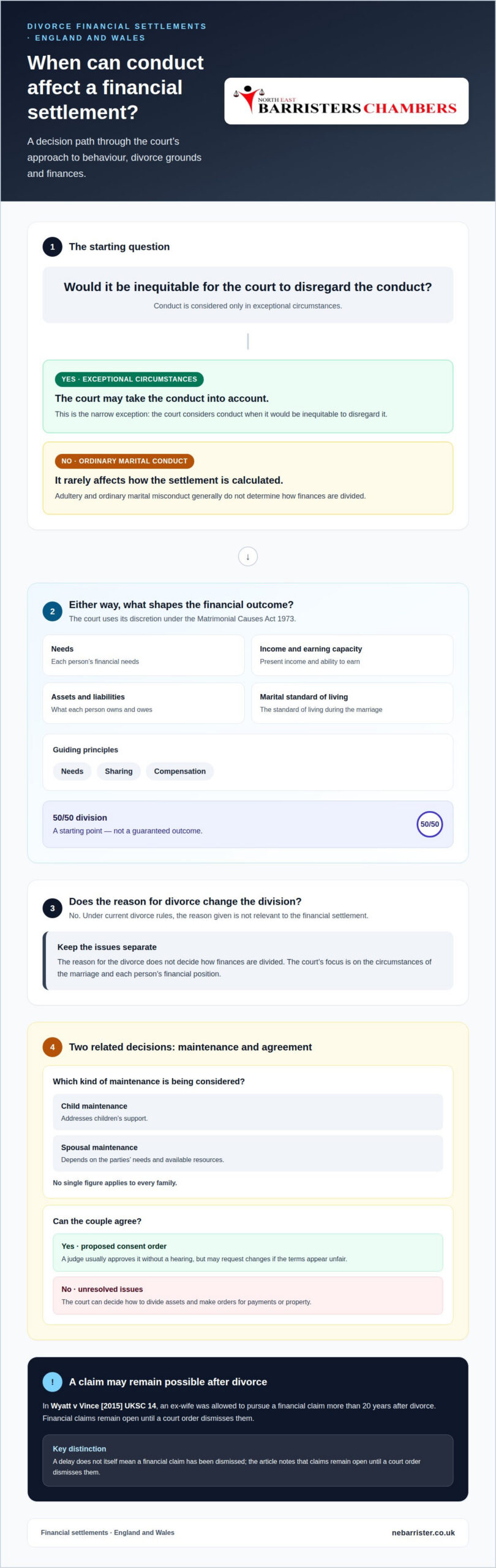
Usually, no. In England and Wales, adultery and ordinary marital misconduct rarely affect how a settlement is calculated. The court considers conduct only in exceptional circumstances, when it would be inequitable to disregard it. Under current divorce rules, the reason given for the divorce is not relevant.
There’s no fixed formula. The court uses its discretion under the Matrimonial Causes Act 1973, weighing the circumstances of the marriage and each person’s financial position. It considers needs, income, assets, liabilities and earning capacity, alongside the standard of living during the marriage. The principles of needs, sharing and compensation guide that assessment. A 50/50 division is a starting point, not a guaranteed outcome. Legal advice can help explain how these factors apply to a particular agreement or disputed asset.
Maintenance depends on its purpose and the parties’ financial circumstances. Child maintenance addresses children’s support, while spousal maintenance depends on the parties’ needs and available resources. No single figure applies to every family.
Agreement can help couples avoid court hearings. If a judge is asked to approve a consent order, they usually do so without a hearing, but can request changes if the terms appear unfair. If a couple cannot agree, the court can decide how to divide assets and make orders for payments or property. A delayed claim may still matter: in Wyatt v Vince [2015] UKSC 14, an ex-wife was allowed to pursue a financial claim more than 20 years after divorce. Financial claims remain open until a court order dismisses them.
For a financial remedy application in England and Wales, the first court hearing usually takes place 12-16 weeks later. A consent order’s timing depends on when the terms are agreed and submitted for approval. If you need help presenting your position in court, court representation can provide professional advocacy.
Financial disclosure using D81 or Form E: how a barrister can help
Financial disclosure sets out each person’s financial position so proposed arrangements can be assessed. In England and Wales, both parties must provide full and frank disclosure, and this duty continues.
Choosing between D81 and Form E with professional advice
D81 provides information about a proposed agreement for the court’s consideration, while Form E gives detailed financial disclosure. The right document matters because it must fit the stage and complexity of the case. A consent-order application requires a statement of information form. A barrister can help explain the D81 and clarify whether the proposed figures reflect the agreement. Form E may be required where finances are complex, assets are substantial or a spouse’s financial position is unknown. Advice can help organise the information clearly, including income and pension details.
Disclosure through mediation
Disclosure in mediation means sharing financial information so discussions have a reliable basis. This matters when proposals affect housing, income or children. The duty of full and frank disclosure continues during settlement discussions and court proceedings. A barrister can advise on information relevant to the issues and help identify gaps that could affect an agreement. Clear disclosure helps both parties assess whether proposed terms reflect their financial circumstances.
Asset disclosure and valuation
Asset disclosure records what each person owns or owes, while valuation estimates its financial worth. Both are important because an agreement or Financial Order depends on an accurate picture of available resources. Property, pensions, savings and investments may all need consideration. A barrister can help assess whether the information presents a coherent account of the assets and liabilities.
If a spouse hides assets or refuses to disclose information, the other person may lack a reliable basis for agreeing a settlement. Disclosure must be full, frank and ongoing, so missing information needs to be addressed before the financial arrangements can be properly assessed. A barrister can advise on the disclosure issue and its effect on proposed terms or court proceedings.
Divorce grounds and financial settlements
In England and Wales, the reason for divorce does not determine how financial assets are divided. The Divorce, Dissolution and Separation Act 2020 removed the requirement to prove fault or blame, separating the divorce decision from financial arrangements.
The court’s financial powers come from the Matrimonial Causes Act 1973. In White v White [2001] 1 AC 596, the House of Lords established an equality yardstick for settlements. That does not guarantee an equal division. In Miller v Miller and McFarlane v McFarlane [2006] UKHL 24, the House of Lords set out needs, sharing and compensation as principles for financial remedy cases. Together, these decisions help courts assess the circumstances rather than apply a fixed formula.
Children’s welfare also matters. When making a financial order, the court considers the welfare of any child of the family under 18 years old, according to UK Parliament. That consideration can affect how arrangements address housing and financial needs. It does not mean that the divorce grounds decide who keeps a particular asset.
For civil partners, financial orders are governed by Part 5 of the Civil Partnership Act 2004, schedule 5. Marriage and civil partnership have distinct legal frameworks, so the relevant rules depend on the relationship. A solicitor may help advise on the wider case, while a barrister can explain the legal issues in a financial dispute. A formal agreement can be made binding through court approval; an informal understanding does not provide the same certainty.
Yes. Financial arrangements after separation follow different rules in Scotland and Northern Ireland, so do not assume the rules explained here for England and Wales apply there. The applicable law depends on where the case is dealt with.
If the grounds for divorce are being confused with the financial issues, get advice on your family law dispute before deciding how to proceed.
North East Barristers Chambers
North East Barristers Chambers can help you understand the financial issues involved in divorce and your options for resolving them. Its Direct Access Barrister Services let individuals instruct a barrister directly for legal advice and advocacy, without needing a solicitor.
Consider seeking advice if you need to assess a proposed agreement, understand how financial disclosure affects your position, or decide whether to apply for a Financial Order. A barrister can explain the relevant legal principles and represent you in court if proceedings are needed. This can clarify the issues and help you make informed decisions about your next steps.
If you would like advice about your circumstances, contact North East Barristers Chambers.
Take a clear next step
Before agreeing financial terms or responding to a proposed order, identify the decision you need help with. You may need advice on how a proposal affects your position or support preparing for a court hearing. A focused discussion can clarify the legal issues and the information relevant to your next decision.
The divorce financial settlement process in the UK can involve complex choices about assets, disclosure and formal arrangements. Direct Access Barrister Services let you speak with a barrister directly, while Court Representation can support you if your matter proceeds to a hearing.
For clear advice on your circumstances, contact North East Barristers Chambers. Taking an informed next step can make a difficult process easier to approach.
Frequently Asked Questions
Divorce settlements: what are you entitled to?
There is no automatic entitlement to half of every asset. The outcome depends on the circumstances, including each person’s needs and available resources. An inheritance or gift may be treated differently from shared property, but can still be considered if needed to meet those needs. For example, the court may consider whether inherited money was used to buy the family home.
How does the court decide who gets what?
The court assesses the overall financial picture rather than dividing each asset in isolation. It may consider income, housing needs, pensions and debts alongside available property and savings. For example, one person might retain more of the home’s equity while the other receives a different asset. The court considers the circumstances as a whole, including any children’s needs. Where rehousing requires securing finance, consulting a specialist such as a mortgage broker for doctors UK can help medical professionals understand their borrowing capacity.
How much will a divorce cost?
Court fees depend on the application. These are court fees, not the cost of legal advice or representation. Professional fees depend on the work involved, such as giving advice, preparing a case or attending a hearing.
Is mutual agreement possible?
Yes. You and your former partner can agree financial arrangements without asking a judge to decide every issue. For example, you might agree what happens to the home while still needing to resolve pension arrangements. You can submit agreed terms for court approval. If only some points remain disputed, you can ask the court to decide those unresolved matters.
Step 2 – How can I find out what is a fair settlement?
Ask for the proposed terms to be assessed against both parties’ financial positions and needs. A useful review considers what each person would have after the arrangement, including housing, income, debts and pension provision. For instance, a larger share of property may not be fair if it leaves someone without enough income to meet ongoing living costs. Alongside legal guidance, specialist advisers such as herfinancialplanning.co.uk can help individuals analyse the long-term impact of settlement proposals on pensions, investments and future living costs.
What is the process for reaching a financial settlement in a UK divorce?
The UK divorce financial settlement process usually begins with both parties setting out their finances and exploring whether they can agree on arrangements. Mediation can help address disputed points. If they reach agreement, the terms can be submitted for a consent order. If important issues remain unresolved, a court application allows a judge to decide them. Divorce proceedings and a Financial Order involve related but separate steps.