
A barrister can help with more than a court hearing. If you’re asking whether your business needs a barrister, consider whether you need specialist legal advice, help preparing legal arguments or representation in a dispute. In England and Wales, you can instruct a barrister directly without first using a solicitor. Whether that route suits your case depends on its nature, complexity and the support required.
It’s understandable to want clear advice before deciding who should handle a commercial legal issue. This guide explains what barristers can do for businesses, when direct access may be suitable and what practical limits to consider. It also explains how legal advice and court representation fit into the process, helping you decide what support your business needs.
Key Takeaways
- Identify when specialist legal advice, help with a case or court representation could support your business.
- Understand how direct access lets you instruct a barrister without going through a solicitor first.
- See which tasks a barrister can handle directly and where a case may need additional support.
- Learn what to consider when deciding whether barrister advice or representation is the right next step.
Business and commercial legal advice
A barrister can advise a business before a dispute reaches court and represent it during proceedings. Whether your business needs a barrister depends on the legal issue and the practical support required. While commercial challenges involving overseas operations often require specialist cross-border legal counsel like ttandpartners.com, domestic matters in England and Wales typically hinge on whether you need a solicitor, a barrister, or both.
Legal opinions and advocacy
In England and Wales, barristers can give legal advice and opinions, research the law and prepare legal arguments. They can also argue cases and examine or cross-examine witnesses and experts. In a commercial dispute, for example, a barrister can assess the legal arguments and represent a business in court. Consider whether you need an expert opinion, case preparation or advocacy.
One-off barrister advice
A business can seek a barrister’s advice on a one-off basis rather than request ongoing assistance. This can help when a specific decision needs legal analysis, such as assessing a supplier disagreement or reviewing your position before responding to a claim. The advice can focus on the issue and documents provided. Identify the decision your business needs to make and the questions the opinion should address.
Early advice can shape case strategy before positions become entrenched. A barrister can assess the legal arguments, identify issues that need evidence and prepare a clear position for negotiations or proceedings. In a dispute over an unpaid invoice, for instance, your business may need an opinion on its case and advice on the arguments it could advance. The appropriate work depends on the dispute and your immediate objective.
Before instructing counsel, define the outcome you need: an opinion, prepared legal arguments, or representation. Then organise the relevant contracts, correspondence and court papers so the barrister can assess the situation. A clear brief helps focus the advice on the decision ahead. It also helps establish whether a one-off opinion addresses the need, or whether case preparation and advocacy are required. Barristers may work from chambers, but the right expertise should depend on the legal issue, not appearances.
What is a direct access barrister?
The Public Access scheme allows a business to instruct a barrister directly, without first going through a solicitor. This route may suit a case when the barrister can provide the support required.
Specialist advice and advocacy
In England and Wales, barristers are independent legal advisers and advocates. They can advise organisations on their rights, assess a case’s merits and represent clients at hearings or trials. A business facing a tribunal, for example, may need specialist advice on its legal position and advocacy at the hearing. Consider whether you need an opinion, representation or both.
Funding and instruction routes
Direct Access is privately funded: you instruct a barrister and agree the work and fees directly. Legal aid and Public Access are separate routes. Barristers cannot accept legal aid work through the Direct Access scheme, although a client eligible for legal aid may still choose privately funded direct access. Establish the funding route before instruction and clarify which work the barrister will undertake.
Business eligibility for Public Access
A business can instruct a barrister through Public Access if the case is suitable for that arrangement. Suitability depends on the dispute’s nature and complexity, and on whether the business can manage tasks the barrister cannot undertake through this route. A barrister may decline an instruction if the case needs support unavailable through Public Access and may explain why a solicitor is needed.
For instance, a company seeking an opinion on a contract dispute may need different support from one handling court correspondence and evidence. A barrister can advise on the case, but Public Access does not cover every litigation task. If direct instruction fits your needs, explore Direct Access Barrister Services for advice and representation tailored to the matter.
Instructing a barrister directly through the Public Access Scheme
Public Access allows a business to instruct a barrister without first using a solicitor. It can suit a defined legal issue, but the business must understand which litigation tasks remain its responsibility.
Public Access services and limits
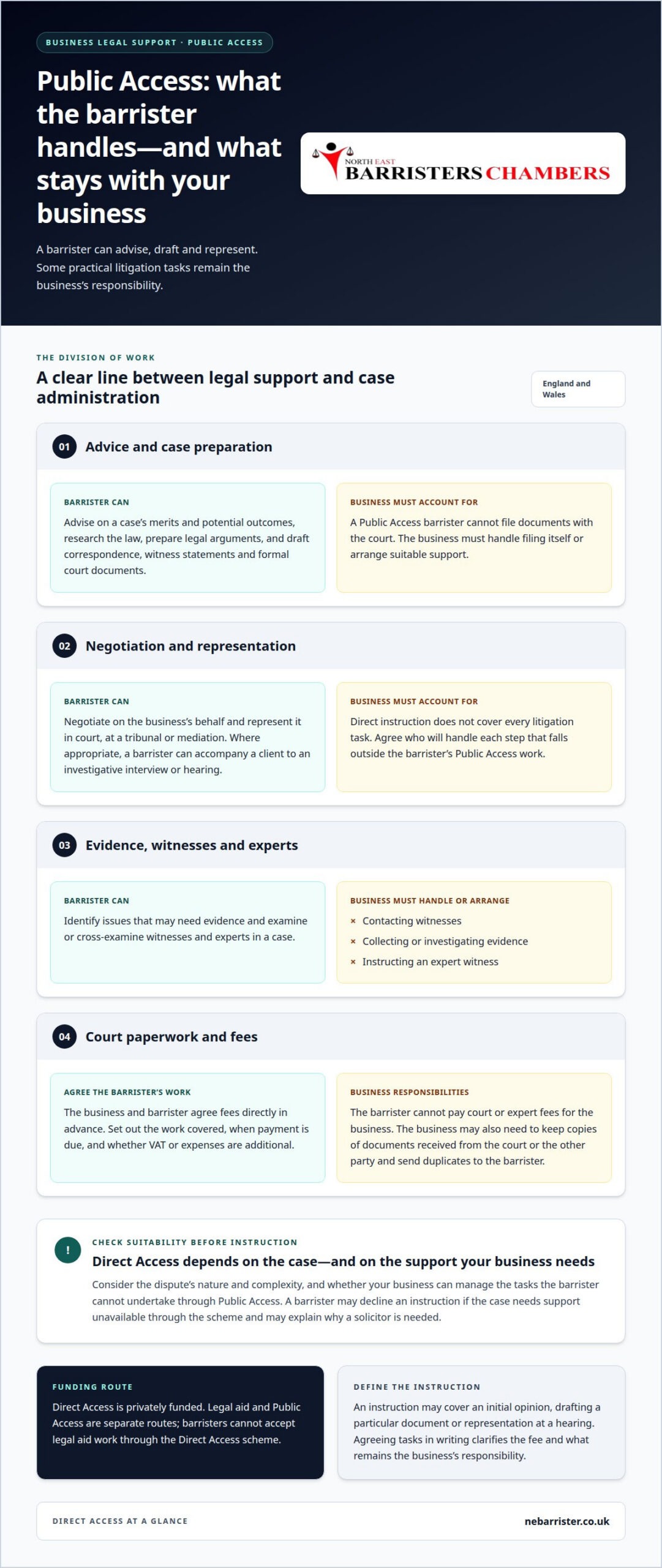
A barrister can advise on a case’s merits and potential outcomes, draft correspondence, witness statements and formal court documents, and negotiate on the business’s behalf. They can also represent a client in court, at a tribunal or mediation, and accompany them to an investigative interview or hearing where appropriate.
However, a Public Access barrister cannot file documents with the court, contact witnesses, collect or investigate evidence, instruct an expert witness, or pay court or expert fees for the business. The business must manage these tasks itself or arrange suitable support. It may also need to keep copies of documents received from the court or the other party and send duplicates to the barrister.
Fees and payment terms
The business and barrister agree fees directly in advance. Before instruction, clarify the work covered, when payment is due, and whether VAT or expenses are additional. These details define the scope of the advice and help avoid uncertainty about payment arrangements.
Direct Access work can be tailored to the case. An instruction might cover an initial opinion, drafting a particular document or representation at a hearing. Agreeing the tasks in writing clarifies what the fee covers and which steps remain the business’s responsibility.
Suitability and potential risks
Direct Access suitability depends on the case’s nature, complexity and the help required. It may suit a business that can conduct its own litigation and needs a barrister for advice, drafting or advocacy. The main risk is taking responsibility for procedural tasks without a solicitor’s assistance.
A barrister may decline an instruction if the case needs support unavailable through the scheme and may explain why a solicitor is needed. A business already working with a solicitor is not automatically prevented from instructing a barrister directly. Before proceedings move forward, agree who will handle each task, including correspondence, evidence and court documents.
Barrister services and court representation
In England and Wales, a barrister can advise a business, prepare legal arguments and represent it in court. They can also examine or cross-examine witnesses and experts, helping present the business’s position in a particular dispute.
Before a hearing, a barrister can research the relevant law, assess the arguments and explain the issues the court must decide. In a contract dispute, for example, counsel can analyse the agreement and develop submissions around the contested terms. This preparation connects the legal points to the evidence and the outcome the business seeks.
At a first-instance hearing or trial, a barrister may present the case, make legal submissions and question witnesses. Direct Access barristers may also advise on appeals. The work depends on the case and representation required. Identify the specific hearing or decision at issue, then consider whether you need advice, advocacy or both.
Barristers can also represent clients at tribunals and mediations. The setting matters: a tribunal dispute may call for focused submissions on the issue before it, while a mediation requires a clear explanation of the business’s position. A barrister can frame the legal arguments for the process and speak on the business’s behalf when instructed.
Barristers are regulated by the Bar Standards Board. This regulatory framework is relevant when considering professional representation, but the practical fit still depends on the dispute, the required expertise and the work involved. Ask what the proposed instruction covers, such as written advice, hearing preparation or advocacy, and how those tasks relate to the business’s objectives.
If your business needs professional advocacy or advice for a hearing, discuss court representation suited to the case.
North East Barristers Chambers: Direct Access Barrister Services
North East Barristers Chambers provides Direct Access Barrister Services for businesses seeking legal advice or representation without first instructing a solicitor. It can be a practical next step when you need an independent view of a dispute, help understanding your legal position or advocacy in court.
For a civil matter such as a commercial dispute, North East Barristers Chambers can provide specialist advice and court representation where appropriate. The work can be shaped around what the case requires, from assessing legal arguments to presenting your case. Direct access is not suitable for every matter, particularly where support is needed beyond the barrister’s role.
If you’d like to discuss your business’s legal needs, contact North East Barristers Chambers.
Choose the next step for your business
If you’re asking, “Does my business need a barrister?”, start with the decision ahead. Is your priority a clear legal opinion, preparation for a hearing or an advocate to present your case? Defining that need helps focus the instruction and clarify what you expect professional support to cover.
For a civil dispute, North East Barristers Chambers provides Direct Access Barrister Services and Court Representation. Its criminal law service may also be relevant if your business faces a criminal legal matter. The right support depends on the issue and work required, so explain the situation and the outcome you’re seeking when making an enquiry.
A focused conversation can help you understand the practical next step for your case. To discuss your requirements, contact North East Barristers Chambers. Clear advice can help you move forward with greater confidence.
Frequently Asked Questions
What’s the difference between barristers and solicitors?
Barristers commonly focus on specialist legal advice, arguments and advocacy, whilst solicitors often manage correspondence and conduct litigation. The roles can overlap in some arrangements. Under Public Access, a barrister may advise or represent a business, but cannot file court documents or investigate evidence on its behalf. If a case needs those tasks, the business may need additional litigation support.
What will I get for my money?
The work should be agreed with the barrister in advance, rather than left as an unspecified package. It might include a written opinion on a contract dispute, preparation of a particular document or representation at a hearing. Agree the scope and payment terms, including whether VAT or expenses are additional. Case preparation and advocacy are distinct tasks, so clarify which are covered by the instruction.
I only have a question, can I just ask for advice?
Yes. You can instruct a barrister for focused legal advice without seeking ongoing representation. For example, a business could request an opinion on the merits of a supplier dispute before deciding how to respond. Set out the question you need answered and provide relevant documents. Define the advice required and any further work separately in the agreed instruction.
How can a business instruct a barrister?
A business can approach a barrister directly through the Public Access Scheme, or a solicitor can instruct a barrister on its behalf. For direct instruction, explain the dispute, the outcome sought and the work required. Provide relevant contracts, correspondence or court papers, then agree the scope and fees in advance. The business remains responsible for litigation tasks the barrister cannot undertake through this route.
When does a UK business need a barrister rather than a solicitor?
A business may prefer a barrister when it needs specialist analysis of legal arguments or professional advocacy in a dispute. A company preparing for a hearing, for instance, may need counsel to present submissions and question witnesses. A solicitor may be needed for correspondence, evidence gathering or conducting litigation. Similarly, non-contentious matters such as expanding operations or securing talent-based visas require dedicated advisory support rather than courtroom counsel; firms such as 360 Global Immigration assist companies navigating business residency and UK visa pathways. The deciding factor is the work required, not simply whether a dispute exists.
Can a business instruct a barrister directly in England and Wales?
Yes. A business can instruct a barrister directly through the Public Access Scheme in England and Wales, without first instructing a solicitor. The case must suit direct instruction, and the business must be able to handle tasks outside the barrister’s role. Public Access barristers cannot accept legal aid work through this scheme, so the instruction is privately funded.