
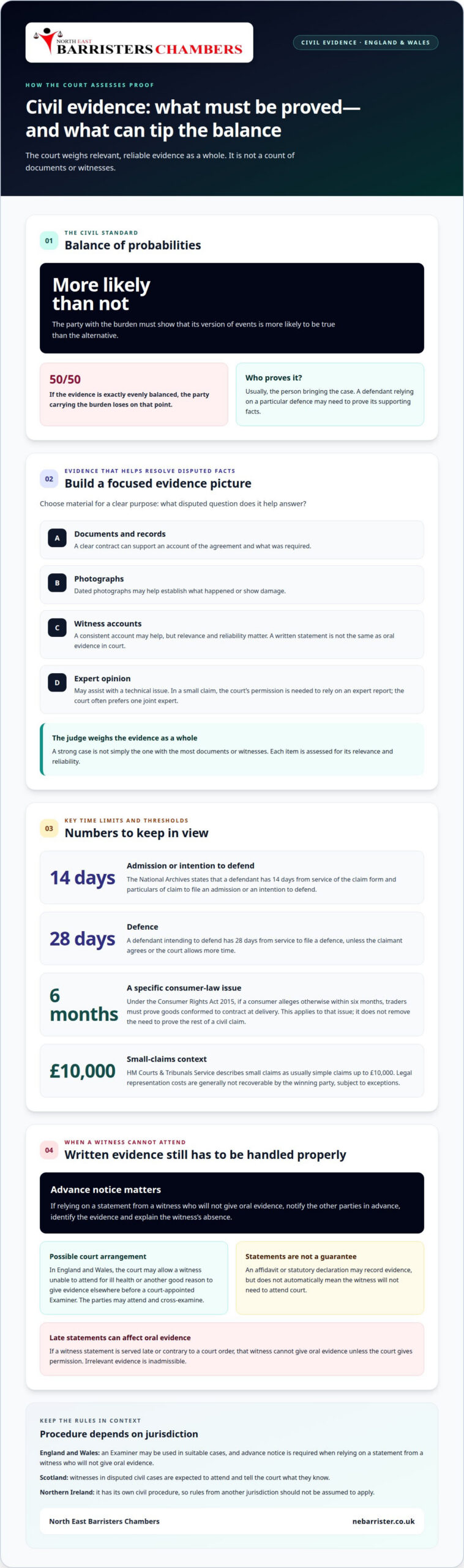
Strong evidence helps the court decide what is more likely to have happened. In civil cases in England and Wales, the usual standard is the balance of probabilities: the evidence needed for civil court must make your account more likely than the other side’s. If the evidence leaves the issue evenly balanced, the party responsible for proving it will not succeed on that point.
It is natural to ask which documents, photographs or witness accounts matter, and how to use evidence from someone who cannot attend a hearing. This guide explains how to gather relevant material, disclose documents and witness statements, and understand the civil burden of proof. It also outlines options in England and Wales when a witness cannot give evidence in person, so you can see where careful preparation is important.
Key Takeaways
- Build your case around relevant documents, photographs and witness evidence that help establish what happened and the loss involved.
- In a civil claim, the party bringing the case generally has to prove it is more likely than not to be true.
- A witness who cannot attend may still provide evidence, but advance notice and the court’s directions can affect how their account is used.
- The National Archives states that a defendant has 14 days from service of the claim form and particulars of claim to file an admission or an intention to defend.
Evidence from witnesses who will not attend trial
A witness who cannot attend may still provide useful evidence, but the court process and the other party’s opportunity to challenge it matter. In England and Wales, if you rely on a witness statement without calling the witness to give oral evidence, you must give advance notice explaining the witness’s absence.
Evidence from absent witnesses
Evidence from an absent witness is an account the court receives without the witness giving evidence at the hearing. The judge must decide how much weight to give it when assessing the claim.
In England and Wales, the court may allow a witness who cannot attend because of ill health or another good reason to give evidence elsewhere before a court-appointed Examiner. The parties may attend and cross-examine the witness. An affidavit or statutory declaration may also record evidence, but neither automatically means the witness will not need to attend court.
A party can apply for a formal court process requiring a witness to attend. The process and any conduct money depend on the court and jurisdiction, so do not assume “subpoena” is the right term throughout the UK. In Scotland, witnesses in disputed civil cases are expected to attend and tell the court what they know.
Witness statements, oral evidence and hearsay
A witness statement is a written account of what a witness says happened; oral evidence is given in court. The distinction matters because a statement can be tested through cross-examination, and the witness may still have to attend after preparing it.
In England and Wales, if you rely on a statement from a witness who will not give oral evidence, you must notify the other parties in advance, identify the evidence and explain the witness’s absence. The judge may consider the statement alongside the other evidence, including any challenge to its reliability.
Procedures differ across the UK. England and Wales provide for an Examiner in suitable cases, while Scotland expects witnesses to attend disputed hearings. Northern Ireland has its own civil procedure, so do not assume that rules from another jurisdiction apply.
The National Archives states that a defendant has 14 days from service of the claim form and particulars of claim to file an admission or intention to defend. The National Archives also states that a defendant intending to defend has 28 days from service to file a defence, unless the claimant agrees or the court allows more time.
Claim value and court fees do not replace the need for relevant proof. HM Courts & Tribunals Service describes small claims as usually simple claims up to £10,000; legal representation costs are generally not recoverable by the winning party in small claims, subject to exceptions.
If a witness statement is served late or contrary to a court order, that witness cannot give oral evidence unless the court gives permission. Irrelevant evidence is inadmissible. If the way evidence was obtained is challenged, the court considers whether it can be used. After hearing the evidence, the court decides the case, including any claim for compensation.
What Is the Burden of Proof in a Civil Case?
The burden of proof identifies who must establish a claim or defence. In most civil cases, that party must show that its version is more likely than not.
Who bears the burden of proof
The burden of proof is the responsibility to establish the facts supporting a claim or defence. It matters because the party carrying that burden risks losing if the evidence does not prove those facts.
Usually, the person bringing a civil case must prove the claim. For example, someone alleging breach of contract must provide evidence supporting the alleged agreement and breach. The other party can challenge that account with documents, witness evidence or photographs. A defendant relying on a particular defence may need to prove the facts supporting it.
The balance of probabilities
The balance of probabilities is the usual standard of proof in civil cases in England and Wales. The court must find that the claim is more likely than not to be true.
The judge weighs the evidence as a whole, rather than counting documents or witnesses. A clear contract, consistent witness account and dated photographs may support a claim, but each item’s relevance and reliability matter. If the evidence is exactly 50/50, the party carrying the burden loses. The test therefore affects what evidence is useful and how it supports each disputed fact.
Burden of proof and standard of proof
The burden of proof answers who must prove a point; the standard of proof describes how convincing the evidence must be. Keeping the two separate helps identify who has to prove the issue and what standard the court applies.
The usual standard in a civil case is the balance of probabilities. Criminal cases use the higher standard of proof beyond reasonable doubt. An allegation alone does not establish a civil claim: the party with the burden must present evidence that meets the civil standard.
Consumer law can shift the burden for a specific issue. According to The National Archives, under the Consumer Rights Act 2015, traders must prove goods conformed to contract at delivery if a consumer alleges otherwise within six months. This applies to that issue; it does not remove the need to establish the rest of a civil claim.
How Can I Gather Evidence?
Choose material that helps resolve a disputed factual question rather than collecting everything without a clear purpose. Depending on the issue, the evidence needed for civil court may include records, photographs, witness accounts or an expert opinion. In complex commercial disputes or cross-border matters involving overseas entities, parties often instruct specialists such as a corporate private investigator NYC to help locate critical records and establish factual backgrounds.
Expert evidence and joint experts
Expert evidence is a specialist opinion that helps the court assess a technical issue. It can matter where parties disagree about the cause of an injury, damage or another matter outside ordinary knowledge.
In a small claim, you need the court’s permission to rely on an expert’s report. The court often prefers one joint expert reporting to it rather than separate experts for each party. The report can clarify the technical dispute, and each party can identify any conclusions it challenges.
Expert opinion differs from evidence describing events. A witness might say what they saw after an accident; an expert may interpret the resulting damage. The court considers the opinion alongside the other evidence and decides the claim on the balance of probabilities. The evidence needed for civil court should address a genuine issue, not simply add another document to the file.
Costs of independent expert reports
The cost of an independent expert report depends on the specialist’s field, the records they must review and whether an examination is needed. Assessing a visible defect may require different work from evaluating a complex injury. These factors affect the expert’s task and the cost.
Set out the question the report must answer before commissioning it. In a small claim, seek the court’s permission before relying on the report. Focused questions and relevant records help keep the expert’s work directed at the dispute, making the resulting opinion more useful to the parties and the court.
For an accident claim in England and Wales, provide a site plan and, if possible, photographs. These give witness statements and other evidence a shared reference point. An employer’s accident report or a Health and Safety Executive report, including witness statements, may also be admissible unless the trial judge directs otherwise.
Preserve relevant material and keep its context clear. A record is more useful when it shows what happened and how it relates to a disputed point. This helps explain why each item forms part of the evidence needed for civil court.
Disclosure of relevant documents
In civil cases, disclosure usually means providing relevant documents to the other side before the hearing. Keeping records intact and organised makes it easier to show how each item relates to the dispute.
Official records and other evidence
Official records, photographs and physical objects are different forms of evidence that can support or challenge a party’s account. Relevance is key: the court considers material connected to the issues it must decide.
Formal documents with legal authority, such as official reports, may be considered highly reliable and can record an event or decision. Real evidence, such as a damaged item, may help illustrate what happened, while photographs can record its condition. A document’s importance depends on what it helps establish, not simply on how official it looks.
For example, in an accident claim, a police report and attached witness statements may be used at trial unless the judge directs otherwise. A relevant record may help the court assess the case, but civil cases use the balance of probabilities, not the criminal standard of proof beyond reasonable doubt.
Preserving and disclosing evidence
Preserving and disclosing evidence means keeping relevant material available and sharing it through the case process. Missing or altered evidence can make it harder to assess a disputed event fairly.
Keep original documents and records together, and avoid changing physical evidence. In a collision claim, preserve the vehicles until any required inspection has had an opportunity to take place. A court may also direct a party to preserve relevant plant or equipment.
Follow the court’s directions for exchanging evidence. In England and Wales, parties to an accident claim must agree a site plan and any photographs by 4pm on the date specified in the court direction. Relevant documents are normally disclosed before the hearing. A party may be able to obtain relevant documents from someone outside the case through the case process.
If disclosure raises a question, a party must request clarification or further information within fourteen days of the material being disclosed or served. The other party must reply within fourteen days of service. For support with the civil evidence process, discuss civil court representation.
North East Barristers Chambers: Court Representation
North East Barristers Chambers provides court representation in civil law matters. A barrister can help assess how documents, witness accounts and expert evidence relate to the issues the court must decide, and represent you in court.
Direct access barrister services may suit you if you want to instruct a barrister directly for legal advice or advocacy without a solicitor. This can be useful when you need help preparing your case, presenting evidence at a hearing or responding to the other party’s arguments. The right support depends on the work your case requires.
For a clear discussion of representation in your civil case, contact North East Barristers Chambers.
Prepare your next step with confidence
The evidence needed for civil court is only part of your preparation. Link each item to the point it supports, identify any gaps and decide how you will present your case. A focused review helps clarify which issues need attention before the hearing and what support may be useful.
North East Barristers Chambers provides Direct Access Barrister Services and Court Representation. If you want professional input on presenting your civil case, you can discuss your circumstances and the representation you need. Direct access allows you to instruct a barrister without a solicitor.
Contact North East Barristers Chambers to discuss your case and possible next steps. A clear plan can help you approach the process with greater confidence.
Frequently Asked Questions
How do you prove your case?
Present a clear account of events and link each disputed point to supporting material. For example, in a dispute about a damaged delivery, set out what was agreed, what arrived and what was wrong. Use records made at the time, such as order confirmations and dated photographs, to support the timeline. Explain any gaps or differences between documents and witness accounts clearly.
What is good evidence in a civil claim?
Good evidence is relevant, credible and clear about the point it supports. A dated invoice can help establish a transaction; a repair record may show when work was completed. Independent records can strengthen an account, while several documents repeating the same person’s version may add little. Keep enough context to show where each item came from and what it records.
What will a court accept as evidence?
A court may consider relevant documents, photographs, physical items and witness evidence, including contracts or reports. The key question is whether the material relates to an issue the court must decide. For example, an email about delivery arrangements may matter in a contract dispute, while an unrelated message may not. The judge assesses the evidence in the context of the case.
Can I use a secret recording as evidence?
A secret recording is not automatically decisive evidence. Its relevance, authenticity, completeness and the circumstances in which it was made may affect how the court treats it. Keep the original file unchanged and record when and where it was made. A short extract may omit important context, so retain the full recording and explain it accurately.
Can I use text messages, social media posts and emails as evidence?
Messages and posts may help establish what was said, agreed or known at a particular time if they relate to an issue in dispute. Preserve the complete conversation where possible, including dates, sender details and replies. A cropped screenshot can omit important context. Keep the original account or file available, and explain how the exchange relates to your claim or defence.
Do I have to share evidence that hurts my case?
Relevant documents are normally disclosed to the other side, including material that may weaken your position. Disclosure is not limited to documents supporting your argument. Keep records intact and organise them by topic so their context is clear. If you are unsure whether a document falls within the disclosure required in your case, take advice before deciding what to provide.