
The applicant usually prepares, files and serves the family court bundle, although responsibility can change if the applicant is representing themselves and the respondent has a legal representative. The bundle is the organised set of case documents the judge needs for the hearing, so family court bundle preparation starts with the court’s directions and the issues to be decided.
It is understandable to be unsure what belongs in a family court bundle, who should prepare it and how to present it. The required documents and format depend on the hearing and the court’s directions, and rules differ across the UK.
This guide explains what a family court bundle is, who prepares it and which documents to include or leave out. It also covers key formatting requirements, so you can understand the process and where careful preparation matters.
Key Takeaways
- Learn what a family court bundle contains and why it should focus on documents needed for the hearing.
- Understand who is usually responsible for preparing the bundle, including what can change when a party is representing themselves.
- See how the hearing type and court directions affect which documents to include and what to leave out.
- Find out what makes an electronic bundle easier to navigate, read and use in court.
Documents to include or exclude
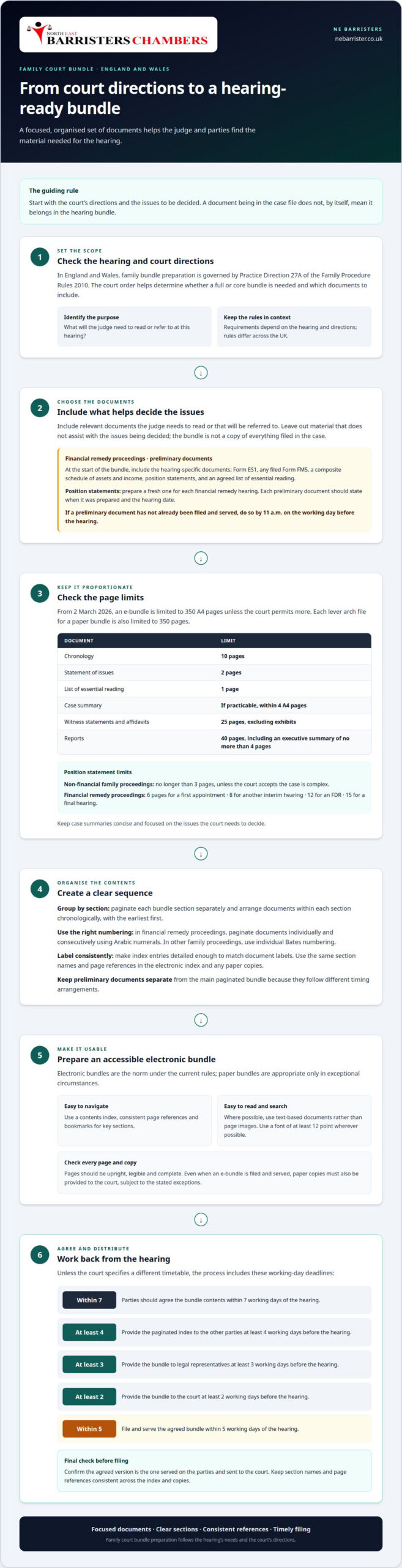
In England and Wales, family court bundle preparation is governed by Practice Direction 27A of the Family Procedure Rules 2010, according to the Ministry of Justice. Include documents relevant to the hearing that the judge needs to read or that will be referred to.
The court order helps determine whether a full or core bundle is needed and which documents to include. Leave out material that does not assist with the issues being decided. A document’s presence in the case file does not, by itself, make it necessary for the hearing.
Mandatory hearing documents
Preliminary documents are short, hearing-specific material placed at the start of the bundle. In financial remedy proceedings, these include Form ES1, any filed Form FM5, a composite schedule of assets and income, position statements and an agreed list of essential reading.
Prepare a fresh position statement for each financial remedy hearing, rather than reusing an earlier statement with an update. Each preliminary document should state when it was prepared and the hearing date. Any preliminary document not already filed and served must be filed and served by 11 a.m. on the working day before the hearing.
E-bundle and document page limits
From 2 March 2026, an e-bundle may contain no more than 350 A4 pages unless the court permits more. The limit encourages a focused bundle, rather than a case archive. Each lever arch file used for a paper bundle is also limited to 350 pages.
Other limits shape what goes in: chronologies are capped at 10 pages, statements of issues at 2 pages, and lists of essential reading at 1 page. Keep case summaries concise and focused on the issues the court needs to decide. Witness statements and affidavits are limited to 25 pages, excluding exhibits. Reports are limited to 40 pages, including an executive summary of no more than 4 pages.
Position statements in non-financial family proceedings should be no longer than 3 pages unless the court accepts the case is complex. In financial remedy proceedings, the limits are 6 pages for a first appointment, 8 for another interim hearing, 12 for an FDR and 15 for a final hearing.
How should a bundle be formatted?
In England and Wales, the current rules are in Practice Direction 27A, with its latest version published on 24 March 2026 after amendments by FPR Practice Direction Update No 1 of 2026. Parties should agree the contents within 7 working days of the hearing; the agreed bundle must be filed and served within 5 working days of the hearing.
Provide the paginated index to the other parties at least four working days before the hearing, the bundle to legal representatives at least three working days before, and the bundle to the court at least two working days before, unless the court specifies a different timetable.
Electronic bundle accessibility
An accessible e-bundle is an electronic document that is clearly organised and easy to navigate and view. Use a legible layout, a contents index and consistent page references so the judge, parties and any witness can find the relevant material during the hearing.
Where possible, use text-based documents rather than images of pages, and add bookmarks for key sections. Documents should use a font of at least 12 point wherever possible. These practical choices help readers search reports and statements, and follow references without relying on colour alone.
Paper and electronic bundle formats
Electronic bundles are the norm under the current rules. Paper bundles are appropriate only in exceptional circumstances. Even when an e-bundle is filed and served, paper copies must also be provided to the court, subject to the stated exceptions.
Use a consistent format and make sure every page is upright, legible and complete. In financial remedy proceedings, paginate documents individually and consecutively using Arabic numerals. In other family proceedings, use individual Bates numbering. Paginate each bundle section separately and arrange its documents chronologically, with the earliest first.
Bundle labelling
Clear labels help parties find the right bundle and section quickly. Give index entries enough detail to match the document labels, so a reference to a witness statement or report points to the intended item.
Use the same section names and page references in the electronic index and any paper copies. Keep preliminary documents separate from the main paginated bundle, as they follow different timing arrangements. Before filing, confirm that the agreed version is the one served on the parties and sent to the court.
What is a court bundle?
A court bundle is an organised collection of case documents prepared for a hearing. It gives the judge and parties a shared set of material to follow.
Court bundle definition and contents
The bundle brings together relevant court papers, evidence and other documents needed to decide the issues at the hearing. It may include applications, court orders, statements, reports and a case summary. The contents depend on the hearing’s purpose and the court’s directions.
A bundle should help the judge locate evidence and understand the applicant’s and respondent’s positions. It is not simply a copy of everything filed in the case. For example, a report that will not be read or referred to may not belong in the bundle for that hearing.
Bundle contents and section order
Group documents into sections and paginate each section separately. Within each section, arrange documents chronologically, with the earliest first. This creates a clear sequence of events, such as an application, a later statement and a subsequent court order.
A case summary should, if practicable, fit within four A4 pages. Authorities belong in a separate bundle, normally capped at 10 authorities from 2 March 2026. A litigant in person should use the court’s directions to understand whether a full or core bundle is required.
Disagreement about the contents does not give either party a reason to add every document they prefer. The applicant and respondent should identify which disputed items are relevant to the hearing and raise the issue through the appropriate court process. The court’s directions may resolve what to include.
Once agreed, serve the bundle on the parties and provide it to the court. If a party objects to a document, state the objection clearly rather than silently removing material from the agreed version. This helps the judge distinguish what is agreed from what remains in dispute.
Who prepares the family court bundle
In England and Wales, the applicant is usually responsible for preparing the bundle. Practice Direction 27A sets out who takes responsibility when a party represents themselves.
Responsibility for preparing the bundle
The applicant is generally responsible for preparing, filing and serving the bundle in family proceedings. If the applicant is a litigant in person and the respondent has legal representation, responsibility passes to the respondent. If every party is a litigant in person, none is required to provide a bundle unless the court directs otherwise.
Establish responsibility early: the person preparing the bundle needs time to collect evidence, agree its contents and meet filing dates. If responsibility changes, the parties should agree who will coordinate the work and serve the final bundle.
The cost of professional bundle preparation depends on the case. A quote will reflect factors such as the volume of documents, the complexity of the hearing and the work needed to organise and paginate the material.
Local court bundle requirements
Practice Direction 27A provides the general rules for family bundles in England and Wales, while a court order may set case-specific directions. Follow the order for the hearing, including any instruction about a full or core bundle, filing arrangements or additional documents.
There is no single local format to assume for every hearing. Read the directions made in your proceedings and apply any court-specific instruction alongside Practice Direction 27A.
Common problems include missing documents required by a court order, irrelevant material, incorrect pagination, and late filing or service. Non-compliance may lead the court to remove the case from the list or place it further back. An adverse costs or wasted costs order may also follow.
To reduce these risks, the responsible party should compare the draft bundle against the order, confirm that the agreed version is served, and meet the relevant working-day deadlines. If you need advocacy as well as clarity about your role in the hearing, discuss court representation.
North East Barristers Chambers: Court Representation
North East Barristers Chambers provides court representation in family law matters, including hearings where clear advocacy and a sound grasp of the papers are important. With Direct Access Barrister Services, individuals can instruct a barrister directly for professional advocacy, without needing a solicitor.
Consider representation if you want a barrister to present your case, address the court’s directions or help you understand how the evidence and submissions relate to the hearing. Representation is distinct from preparing the bundle itself, so it is most useful when your main need is legal advice or advocacy rather than document collation alone.
For a family hearing, the bundle gives the court a structured record to work from. A barrister can use that material to focus submissions on the issues the judge must decide.
Contact North East Barristers Chambers to discuss court representation for your family matter.
Choose your next step with confidence
Use the time before the hearing to decide what support would help most. Careful preparation of family court bundles helps the court focus on the issues, but you may also need advice on presenting your position or responding to questions during the hearing.
Decide whether your main need is to organise case documents, understand the legal issues or have an advocate speak for you. Identifying that priority can help you choose your next step and make any discussion about representation more focused.
North East Barristers Chambers provides Direct Access Barrister Services and Court Representation. If you would like to discuss representation for your family matter, contact North East Barristers Chambers. A clear next step can make the process feel more manageable.
Frequently Asked Questions
Who is responsible for preparing the bundle?
The applicant usually takes responsibility, but the parties’ representation status can change this. If the applicant is a litigant in person and the respondent has legal representation, the respondent must prepare the bundle. If all parties represent themselves, none is required to provide one unless the court directs otherwise. Agree early who will coordinate the documents, so responsibility is clear.
How do I lodge the bundle?
File the bundle using the method and at the destination specified by the court for your hearing. Electronic bundles are the norm in England and Wales, but paper copies may also be required, subject to stated exceptions. Unless the court sets a different time, the paginated bundle should reach the court no less than two working days before the hearing. Serve the other parties as directed.
What are the contents of the bundle?
Include material the judge needs to read or that will be referred to during the hearing. Depending on the case, this can include applications, orders, evidence, statements and reports. In a financial remedy case, preliminary documents can include Form ES1, a composite schedule of assets and income, position statements and an agreed list of essential reading. Follow the court order for case-specific inclusions.
What should not be included in the bundle?
Leave out documents unrelated to the hearing or that no one needs to read or refer to. For example, an old report that does not bear on the current issue may add bulk without helping the judge. Avoid duplicates and material included only because it appears in the case file. If relevance is disputed, raise the disagreement rather than silently removing the contested document.
When must it be prepared?
Plan the work around the hearing deadlines, not the hearing day. Parties must seek to agree bundle contents within 7 working days of the hearing, and the agreed bundle must be filed and served within 5 working days of it. Any preliminary document not already filed and served is due by 11 a.m. on the working day before the hearing.
Who is responsible for preparing and filing a family court bundle?
Usually, the applicant prepares, files and serves the bundle, unless the court directs otherwise or the applicant’s litigant-in-person status shifts responsibility to a represented respondent. Preparation involves coordinating the agreed documents and meeting filing and service deadlines. If every party is a litigant in person, no one is obliged to provide a bundle unless the judge orders one.