
Can you get legal advice without solicitor support and still have someone represent you in court? If solicitor fees feel out of reach, or you’re unsure who can help with your case, you may be wondering whether you must manage everything alone.
In England and Wales, you can instruct a barrister directly through the Public Access Scheme for suitable work. A barrister may advise you, draft documents and represent you, but usually won’t handle litigation steps such as filing or serving papers. Direct instruction can be useful, but it doesn’t remove every responsibility or suit every case. This guide explains the main routes to legal help, when direct access may be appropriate, and what to clarify about your case, deadlines and the work you need. It also sets out the practical tasks you may need to manage if you represent yourself or instruct a barrister for a defined piece of work.
Key Takeaways
- Legal advice without solicitor support may be possible through direct access to a barrister, depending on the case and the work needed.
- Separate the help you need: advice, court advocacy and managing case paperwork are different tasks.
- Consider complexity, evidence, deadlines and your capacity to handle procedure when deciding whether to act without a solicitor.
- Before seeking advice, identify your immediate legal task and organise key documents and a concise chronology.
- North East Barristers Chambers provides direct legal advice and court representation in criminal, civil and family matters.
Can you get legal advice without a solicitor in the UK?
Yes, legal advice without solicitor support may be possible, including by instructing a barrister directly. Whether it is suitable depends on your case and the work you need. In England and Wales, individuals can use the Public Access Scheme to instruct a barrister directly for appropriate work. Legal systems and arrangements differ across the UK, so the route depends on where your case is being dealt with.
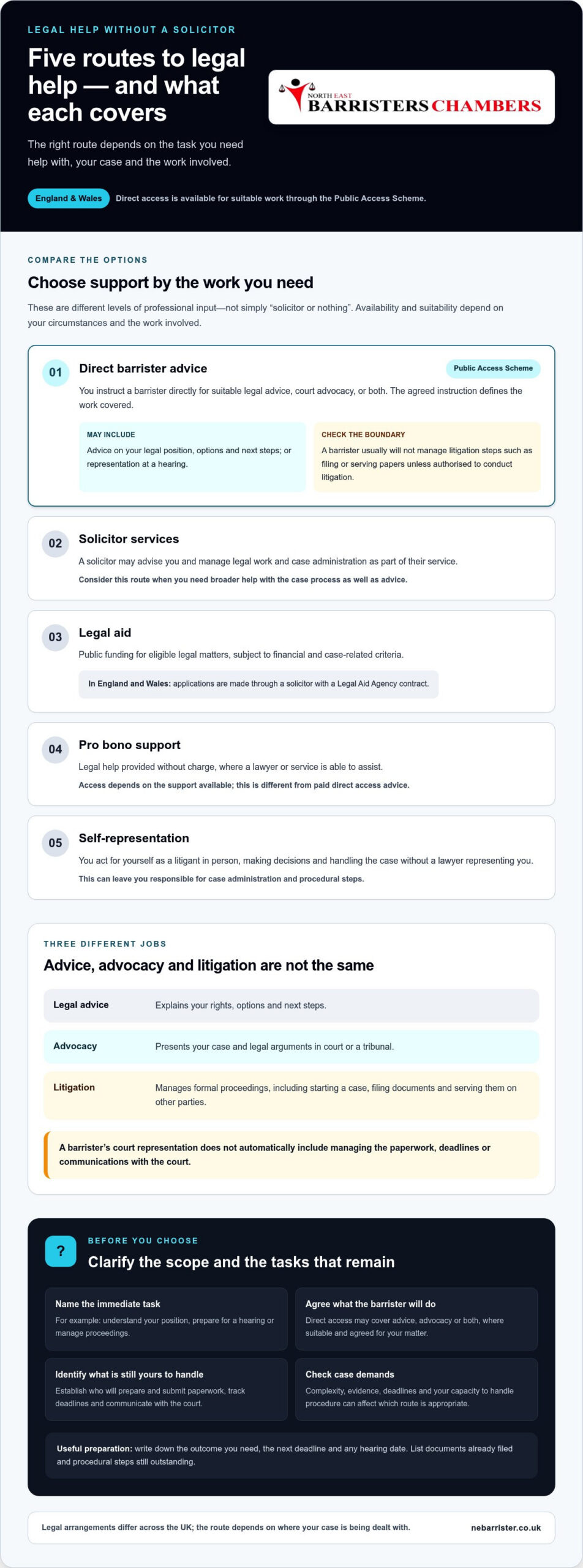
It helps to distinguish three kinds of legal work. Legal advice explains your rights, options and next steps. Advocacy means presenting your case and legal arguments in court or a tribunal. Litigation means managing formal court proceedings, including procedural steps such as filing or serving documents. These tasks can overlap, but they are not the same. This Role of a Barrister in the UK overview outlines a barrister’s role in the legal system.
What does ‘legal advice without a solicitor’ mean?
You may be able to instruct a barrister directly for advice on a specific issue, without first appointing a solicitor. For example, a barrister might assess a contract dispute and explain its strengths, risks and possible next steps. That does not automatically mean the barrister will manage every part of the proceedings. Establish what work is covered and who is responsible for any remaining tasks.
Start by identifying the particular help you need, rather than assuming one instruction covers the whole case. Direct access may include advice or advocacy where appropriate, but not every legal task is suitable for this route.
What legal help routes are available?
Your options are not limited to hiring a solicitor or doing everything alone. Each route provides a different kind of support, and eligibility or availability depends on your circumstances and the work involved.
- Direct barrister advice: You instruct a barrister directly for suitable legal advice or advocacy. The work covered is agreed for the instruction.
- Solicitor services: A solicitor may advise you and manage legal work and case administration as part of their service.
- Legal aid: This is public funding for eligible legal matters. It has financial and case-related criteria. In England and Wales, applications are made through a solicitor with a Legal Aid Agency contract.
- Pro bono support: This is legal help provided without charge, where a lawyer or service is able to assist. It is different from paid direct access advice, and access depends on the support available.
- Self-representation: You act for yourself, sometimes called being a litigant in person. You make decisions and handle the case without a lawyer representing you.
These routes involve different levels of professional input. Begin by naming the task you need help with, such as understanding your position, preparing for a hearing or managing proceedings. This helps you judge whether direct barrister advice may fit, or whether your case calls for broader support.
How direct barrister advice works without a solicitor
Direct access means you instruct a barrister yourself, without first appointing a solicitor. In England and Wales, this route is known as the Public Access Scheme. It can provide professional advice or court representation for appropriate work, but does not automatically cover every part of your case. The barrister must consider whether direct instruction is suitable for the work and in your best interests.
The scope matters. Before work begins, establish what help you need, what the barrister will do and which practical tasks remain yours. The Bar Council’s Direct Access Scheme explains the route and how direct access works. The barrister’s authorisation and the requirements of your case are relevant to the work that can be undertaken.
What can a directly instructed barrister help with?
A barrister may advise you on your legal position, explain your options and help you understand the issues in dispute. Court representation is a separate task: the barrister presents your case and legal arguments at a hearing or trial. Depending on the case and applicable rules, direct instruction may cover advice, advocacy or both. The work must be agreed for your particular matter.
North East Barristers Chambers provides direct legal advice and court representation in criminal, civil and family matters. For example, someone involved in a family dispute might seek advice on a specific legal issue, while a person facing a civil hearing may need an advocate. These examples do not mean every case or task is suitable for direct access. The circumstances and procedural demands still matter.
What is the difference between advocacy and litigation?
Advocacy is speaking for you in a court or tribunal, presenting your position and responding to legal arguments. Litigation is managing the formal case process, including procedural steps such as starting proceedings, filing documents and serving them on other parties. These responsibilities affect who prepares and submits paperwork, tracks deadlines and communicates with the court.
Barristers are generally not authorised to conduct litigation unless they hold the relevant authorisation. Instructing a barrister to appear at a hearing does not necessarily mean they will manage the case administration around it. You may remain responsible for steps outside the agreed work. If those tasks feel difficult, or the case has demanding procedures, factor that into your decision.
To prepare, write down the outcome you need from the instruction, the next deadline and any hearing date. List the documents already filed and any procedural steps still outstanding. This helps distinguish a focused request for legal advice without solicitor involvement from a need for broader case management. For more detail on the process, see this direct access barrister services guide.
North East Barristers Chambers works with individuals and businesses on criminal, civil and family matters. Explore direct barrister advice and court representation for the legal task you have identified.
When might you still need a solicitor or another form of support?
Direct access is not the right fit for every case or task. You might need an expert opinion on a particular legal issue and feel able to handle straightforward administration. Alternatively, you may need ongoing help organising evidence, preparing documents and tracking several procedural steps. These are different needs. The right support depends on the case, your time and your capacity to manage the work.
Do not assume that you can manage proceedings alone simply because a barrister can advise or represent you for a specific task. Consider who will keep the case moving, meet deadlines, deal with paperwork and respond if circumstances change. In many civil disputes and injury claims, individuals often benefit from end-to-end representation rather than handling filings themselves—an approach seen in full-service practices like mraccident.com that manage every step of an accident claim. Before deciding how to proceed, clarify the scope of the work and the responsibilities that will remain with you.
Which case features can make direct instruction more complex?
Some features call for closer assessment, although none automatically rules out direct instruction. Consider whether your matter involves:
- Several parties: More people or organisations can mean more positions and correspondence to organise.
- Extensive documents or evidence: You may need to sort, review and share a large volume of material, and identify what is relevant.
- Urgent deadlines: A short time to respond or an approaching hearing can leave less time to gather information and manage procedural steps.
- Detailed court procedures: Some cases require repeated filings, formal applications or careful coordination between stages.
Use these as prompts for an honest assessment, not as a checklist that decides the answer for you. A matter with many documents may still involve a focused question, while a seemingly narrow dispute can have procedural demands you had not expected. Think about what you can manage reliably, where you need professional help and whether you need advice on the law, ongoing administration, advocacy or a combination.
Could legal aid, insurance or free advice be relevant?
Private direct access is one route among several. Legal aid is public funding for eligible cases, but eligibility depends on the type of matter and your circumstances. The rules also vary across the UK. For information about England and Wales, Understanding Legal Aid in the UK explains the scheme and how to check whether it may apply to your situation.
Legal expenses insurance may cover some legal costs under a policy, but the terms determine what is covered and how support can be accessed. Read the policy wording and any requirements before relying on it. Pro bono support means legal help provided without charge. It may be available through particular schemes, but eligibility and capacity to help vary. These options are separate from paid direct barrister advice and will not necessarily cover every task.
If affordability is the main concern, consider whether legal aid, insurance or pro bono support could apply before choosing a route. If the challenge is managing a complex case, focus on the level of ongoing help and administration you need. Legal advice without solicitor involvement does not necessarily mean handling every step by yourself.
How to decide which legal advice route fits your situation
Choose support by working backwards from the task in front of you. A focused question about your legal position may call for different help from a case involving ongoing administration, several court applications or representation at a hearing. Use this sequence to define what you need before choosing a route.
- Name the task. Decide whether you need advice on your rights and options, help preparing for a hearing, advocacy or support managing proceedings.
- Check urgency. Write down hearing dates, response deadlines and other time-sensitive events. Make any approaching deadline clear at the outset.
- Identify the procedural work. Note whether documents need to be filed or served, whether proceedings have started and who is handling each step.
- Set a realistic budget. Consider what you can afford and whether legal aid, insurance or pro bono help may be relevant to your circumstances.
A defined need, such as understanding the strengths and risks of a dispute, may suit a focused barrister’s opinion. If you also need someone to coordinate documents, manage ongoing steps and keep the case on track, account for that wider support. Direct access can be a cost-effective alternative in some situations, but it is not automatically cheaper. The work included and the responsibilities left with you matter as much as the professional’s title.
What should you clarify before seeking advice?
Prepare a short, factual summary. Set out the legal issue, what has happened so far, important dates, whether proceedings are under way and the outcome you are seeking. Include the next deadline or hearing date, if known. Keep the chronology concise and distinguish confirmed events from anything you are unsure about.
Gather relevant documents, such as letters, agreements, court papers or messages. You do not need to write a legal argument. Instead, list the questions you want answered and identify any missing information. Clear preparation can make an initial discussion more focused and help the professional understand the issue and the support you need.
How should cost and funding affect your decision?
Compare the scope of support, not just a headline fee or professional title. Clarify which work is included, what remains your responsibility and whether you may need additional help later. Check whether legal expenses insurance or other funding could apply before deciding. For more on what can affect fees and budgeting, see this direct access legal costs guide.
If you are weighing up legal advice without solicitor support, consider the task, urgency, procedural demands and budget together. The UK direct access guide provides further context on the route. To explore direct advice or court representation for a criminal, civil or family matter, discuss direct barrister support with North East Barristers Chambers.
Getting legal advice directly from North East Barristers Chambers
You can instruct barristers at North East Barristers Chambers directly for legal advice and court representation, without first appointing a solicitor. The chambers works with individuals and businesses across the UK in criminal, civil and family matters. Direct instruction lets you seek focused professional help, while the work must still suit your case and the assistance you need.
Advice and representation are different forms of help. You may want a barrister to explain your legal position and options, or to present your case at a court hearing. Start by identifying which task you need help with. This makes it easier to discuss the issue and the scope of support that may be appropriate.
What kinds of matters does the chambers handle?
The chambers’ work covers three broad areas:
- Criminal law: Direct legal advice and court representation in criminal matters.
- Civil law: Advice and representation relating to civil disputes and proceedings.
- Family law: Direct professional support in family matters, including court representation where appropriate.
The work depends on the circumstances and requirements of your case. You might seek advice about an issue in a dispute, or representation at a hearing. These are distinct needs, so explain which applies rather than assuming one instruction covers every aspect of a matter. The chambers provides direct legal advice and advocacy without you first appointing a solicitor.
What is a practical next step?
Prepare a short outline of what has happened and what you need help with. Include key dates, any court hearing or response deadlines, and whether proceedings have started. Gather documents that relate directly to the issue, such as relevant correspondence, agreements or court papers. You do not need to prepare a detailed legal argument. A clear summary and organised documents are a practical starting point.
It can also help to write down the questions you want answered. Are you looking for an assessment of your options, advice on a particular stage or representation at a hearing? If your matter involves several issues, note which are most pressing. This gives the initial discussion a clear focus and helps identify the legal support you are seeking.
If you are considering legal advice without solicitor support, explain your situation directly to North East Barristers Chambers. Set out the legal issue, the assistance you need and any important dates. The chambers provides direct legal advice and court representation in criminal, civil and family matters for individuals and businesses. Contact the chambers to discuss the support you need.
Take the next step with clarity
Choosing legal advice without solicitor support does not mean you have to make every decision alone. Turn uncertainty into a clear brief: what has happened, what needs attention and what kind of help would move things forward. You do not need to know the legal answer before seeking advice. A concise account of the issue and your key questions is enough to begin a focused conversation.
Explain what you can manage yourself and where you need support. This helps clarify whether you are looking for advice on a defined issue or representation, and what practical responsibilities may remain with you. A clear request can make the process more manageable, even if the right route is not immediately obvious.
Discuss your legal advice or representation needs with North East Barristers Chambers. Set out the issue and the support you are looking for to take a practical next step.
Frequently Asked Questions
Can I get legal advice without a solicitor in the UK?
Yes, legal advice without solicitor support is possible, but the route depends on where your case is being handled. In England and Wales, you may be able to instruct a barrister directly for suitable work. For example, you could seek advice on a legal issue before deciding how to respond to a claim. Rules and arrangements differ across the UK, so the relevant jurisdiction matters.
Can I hire a barrister directly without a solicitor?
Yes. In England and Wales, individuals can instruct a barrister directly through the Public Access Scheme, provided the case and requested work are suitable. You do not have to appoint a solicitor first. Direct instruction can cover a defined piece of work, such as advice about a dispute or representation at a hearing. The barrister must consider whether direct access is appropriate for your circumstances.
Is direct access to a barrister suitable for every type of case?
No. Suitability depends on the legal issue, the procedural work involved and your ability to handle tasks that are not included in the barrister’s instruction. For instance, a case involving several parties, detailed evidence and multiple deadlines may need broader administrative support. Those factors do not automatically rule out direct access, but they make it important to assess your responsibilities before choosing this route.
What can a barrister do if I do not have a solicitor?
A directly instructed barrister may advise you on your legal position, explain possible options, prepare certain legal documents and provide advocacy in court or a tribunal where permitted and appropriate. The agreed work is specific to your instruction. A barrister generally will not manage all proceedings unless authorised to conduct litigation. You may therefore need to handle tasks such as court correspondence or filing documents yourself.
Can a barrister represent me in court without a solicitor?
Yes, a barrister may represent you in court without a solicitor where direct instruction is permitted and the case is suitable. Representation means presenting your case and legal arguments at a hearing. It does not necessarily include managing proceedings before or after that hearing. Clarify who is responsible for documents, court deadlines and communications, so you understand what you will need to manage personally.
Can I get legal aid if I do not use a solicitor?
Legal aid may be available if your case and circumstances meet the relevant eligibility rules, but the application route depends on the UK jurisdiction. In England and Wales, you generally apply through a solicitor who holds a Legal Aid Agency contract. Legal aid is separate from paid direct access services, and eligibility is not automatic. The type of case, your finances and the evidence required can all affect the assessment.
Is it cheaper to instruct a barrister directly?
Not necessarily. Direct instruction can be cost-effective when you need specific advice or representation rather than wider case management, but it is not guaranteed to cost less overall. Compare what each option includes, any additional work you may need and the time you will spend managing tasks yourself. A limited instruction may suit a focused need, while complex ongoing proceedings could require broader support.