
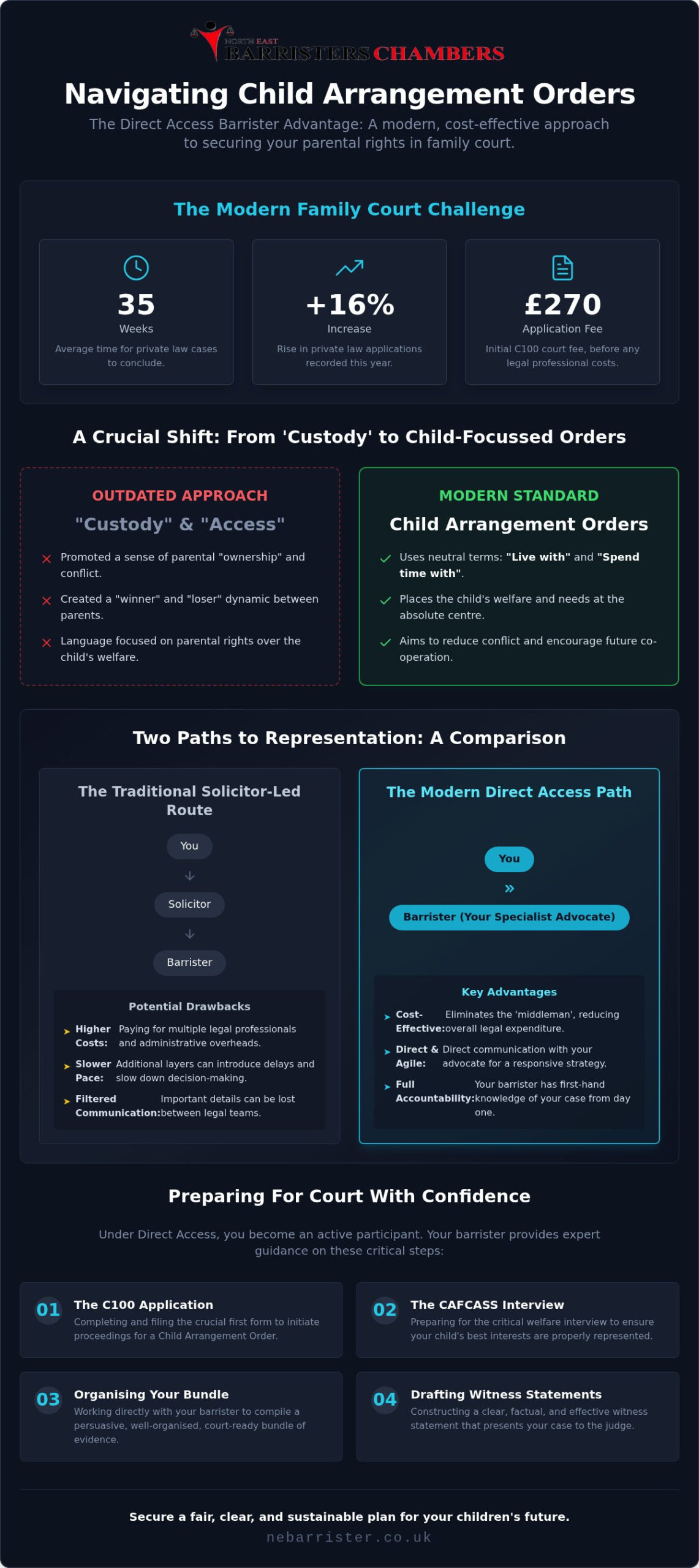
What if you could bypass the mounting hourly rates of a solicitor and go straight to the expert who will actually stand up for you in court? Facing a family court hearing is one of the most stressful experiences any parent can endure, particularly when private law cases now take an average of 35 weeks to conclude. You’re likely feeling the weight of the £270 application fee and the anxiety of potentially losing contact with your children. Instructing a child custody barrister directly is no longer a privilege reserved for the wealthy; it’s a practical way to secure elite advocacy whilst protecting your finances.
I understand that the legal system can feel intimidating, especially with the 16% rise in private law cases recorded this year. This guide explains how you can instruct me directly to manage your Child Arrangement Orders, effectively removing the need for a solicitor. I’ll show you how to navigate the 2026 legal landscape, including the nationwide rollout of Child Focussed Courts and the latest legislative changes regarding parental involvement. By the end of this article, you’ll have a clear plan to secure professional representation and ensure your parental rights are treated with the respect they deserve.
Key Takeaways
- Learn why the court now uses Child Arrangement Orders instead of “custody” and what this change means for your parental rights.
- Discover how a child custody barrister can provide expert courtroom representation whilst significantly reducing your overall legal expenditure.
- Uncover the practicalities of the C100 application and how to manage the critical CAFCASS welfare interview with confidence.
- Find out how to organise a court-ready bundle and draft a witness statement that effectively presents your case to the judge.
- Explore how a direct and professional approach can help you secure a fair, clear, and sustainable plan for your children’s future.
What is a Child Custody Barrister and Why Do You Need One?
I find that most parents start their search for a child custody barrister because they want an expert to fight for their right to see their children. It’s an incredibly stressful time, and the terminology often adds to the confusion. In the UK, the legal system has replaced the old concepts of “custody” and “access” with the Child Arrangement Order. This change was designed to move the focus away from parental “ownership” and place the child’s needs at the centre of the process.
Custody vs Child Arrangement Orders
The modern court focuses on “live with” and “spend time with” orders. This language is intentional. It aims to lower the temperature of disputes by removing the idea that one parent “wins” custody whilst the other simply gets “access”. I use these specific legal definitions to help you build a practical framework for your child’s life. Whether we’re discussing where they sleep on a Tuesday or how school holidays are split, the goal is always clarity and the reduction of future conflict between parents.
The Advantage of Specialist Advocacy
As a child custody barrister, my role is fundamentally different from that of a solicitor. I am a specialist advocate. I spend my professional life in the courtroom, which gives me a deep understanding of judicial behaviour and how the “welfare principle” is applied in real-world scenarios. I don’t just process paperwork; I build the courtroom strategy that determines how your case is perceived by the judge. This strategic focus is vital for preventing simple disagreements from escalating into intractable disputes.
Instructing me directly means you have a direct line to the person who will be speaking for you in court. This is particularly important in 2026, as we see significant shifts like the proposed repeal of the presumption of parental involvement in the Courts and Tribunals Bill. The court is moving toward a more neutral starting point, making the quality of your advocacy more important than ever. I provide the expert focus needed to ensure your parental rights are presented effectively, helping you avoid the high costs of using a solicitor as an intermediary. By cutting out the middleman, you get professional representation that is both agile and cost-effective.
The Benefits of Direct Access for Family Law
Choosing to work with a child custody barrister through the Direct Access scheme is a strategic decision that fundamentally changes the dynamic of your case. Traditionally, the legal system required you to hire a solicitor who would then instruct a barrister for court appearances. This created a two-tier system that was often slow, repetitive, and unnecessarily expensive. By instructing me directly, you remove that middle layer. This allows for a more agile and responsive approach to family law disputes, which often move quickly and require immediate tactical adjustments based on new developments.
Reducing Legal Costs Without Compromising Quality
The most immediate benefit of this model is the reduction in legal costs in the UK. When you use a solicitor, you often end up paying for two legal professionals to attend a single hearing. This “double-teaming” of fees can drain your resources long before you reach a final hearing. Direct Access ensures you pay only for the expert advocacy you actually need. You retain control over the administrative tasks, such as filing forms and sending emails, whilst I focus on the high-level legal strategy and specialist courtroom representation. It’s a pragmatic way to access elite legal advice without the corporate overheads of a traditional law firm.
Direct Instruction and Personal Accountability
Instructing a child custody barrister directly builds a relationship of trust that isn’t filtered through a third party. I get to know the nuances of your case from the ground up, rather than reading a summary prepared by a junior solicitor. This first-person connection means I can provide a realistic assessment of your situation from day one. There’s no risk of vital information being lost in translation between different offices. You become an active participant in your case management, helping to organise evidence and witness statements under my direct guidance.
This level of control over your evidence is a significant tactical advantage. In family court, the quality of your bundle can make or break your case. When we work together directly, we ensure that every document and statement is aligned with the final courtroom strategy. I help you cut through the emotional noise and focus on the facts that the judge actually cares about. This streamlined process doesn’t just save money; it creates a more persuasive and cohesive case. If you’re ready to take this more direct path, you can view my direct access services to see how we can work together to secure your children’s future.
Navigating Child Arrangement Orders (CAO) and Family Court
Starting a court case is a significant step that requires careful preparation. The process officially begins with the C100 application form and a court fee of £270. This document isn’t just a formality; it’s your first opportunity to explain to the court why an order is necessary for your children. I often see parents struggle with the technicalities of this stage, but getting the initial application right is vital for setting the correct tone for the entire proceedings.
Applying for a Child Arrangement Order
Before you can apply to the court, you’re usually required to attend a Mediation Information and Assessment Meeting (MIAM). This is a legal check to see if your dispute can be resolved without a judge. If mediation isn’t appropriate or doesn’t work, I can assist you in drafting a clear and persuasive application. Professional drafting ensures your concerns are heard without the emotional clutter that can sometimes cloud a parent’s statement. For a deeper look at how this fits into the wider legal system, you can read my guide on family court representation UK.
Dealing with CAFCASS and Welfare Assessments
Once your application is filed, CAFCASS (Children and Family Court Advisory and Support Service) becomes involved. With private law cases currently taking an average of 35 weeks to conclude, the First Hearing Dispute Resolution Appointment (FHDRA) is a critical milestone. This is the first time a judge and a CAFCASS officer will look at your family’s specific needs. Under the 2026 rollout of ‘Child Focussed Courts’, you should expect a Child Impact Report early in the process. This report gathers information from schools, health records, and the children themselves to give the judge a clear picture of the situation.
I help you prepare for these welfare interviews so you can present your views calmly and effectively. As your child custody barrister, I provide the specialist advocacy needed to either support or challenge the recommendations made by CAFCASS. My role is to ensure the court stays focused on the “Welfare Checklist,” which includes factors like the child’s emotional needs and any risk of harm.
In some cases, a standard arrangement isn’t enough. You might need a Specific Issue Order to decide on a child’s schooling or a Prohibited Steps Order to prevent one parent from taking the child abroad. These are powerful legal tools that require precise evidence. By instructing a child custody barrister directly, you ensure that these applications are handled with the strategic focus required to protect your parental rights and your child’s best interests.
Preparing for Court: A Practical Guide for Parents
Preparing for a family court appearance requires a significant shift in mindset. You’re moving from a period of personal conflict into a structured environment where evidence is everything. My job as your child custody barrister is to ensure that your preparation is methodical and that your voice is heard clearly by the judge. We’ll begin by organising your evidence into a court-ready bundle. This isn’t just a collection of papers; it’s a paginated, indexed narrative of your child’s life that allows the judge to locate key information quickly. A well-organised bundle shows the court that you are a focused and reliable parent.
Your behaviour in the courtroom is just as important as the documents you provide. The family court is a professional space. You must remain calm and respectful, even whilst the other party says something you disagree with. I act as the direct buffer between you and the legal system. I handle the formal introductions and ensure you follow the correct protocol amongst the legal professionals and the judiciary. This professional distance allows you to focus on your children whilst I manage the technicalities of the hearing.
Creating Your Witness Statement
When it comes to your witness statement, I always advise that “less is more”. A judge doesn’t want to read fifty pages of emotional history or personal grievances. They want to see the specific facts that impact the child’s daily welfare. I will review and refine your statement to ensure it focuses on concrete incidents, dates, and outcomes. Honesty and transparency are your greatest assets in these proceedings. If you try to hide facts or embellish the truth, it will inevitably damage your credibility during cross-examination. My role is to help you present the truth in a way that is legally persuasive.
What to Expect on the Day of the Hearing
The reality of a court day often surprises parents. Many hearings are now conducted remotely via video link, but the gravity of the situation remains the same. If we are attending in person, much of the work actually happens in the corridors before we even see the judge. I will negotiate with the other party’s legal team to see if we can reach an agreement on specific points. This can often narrow the issues the judge needs to decide, saving time and reducing stress for everyone involved.
It’s also vital to understand the stage of your case. A “Directions Hearing” is about the logistics of the case, such as setting dates and ordering reports from CAFCASS. A “Final Hearing” is where the judge makes the ultimate decision on the Child Arrangement Order. No matter the stage, having an expert advocate by your side provides the clarity you need to stay focused on the end goal. If you’re feeling overwhelmed by the preparation process, you can instruct a barrister directly to start building your case today.
Instructing North East Barristers Chambers for Child Custody
I believe that family law should be accessible, transparent, and focused on results. North East Barristers Chambers was established to provide parents with a direct route to expert advocacy without the administrative layers of a traditional law firm. When you instruct me as your child custody barrister, you aren’t just hiring a legal representative; you’re gaining a professional partner who understands the high emotional stakes of your case. My practice has a national reach, and I regularly represent clients in family courts across the UK, ensuring that high-quality courtroom strategy is available wherever your case is heard.
My approach is built on approachable pragmatism. I cut through the dense legal jargon to provide you with a clear, actionable plan. This direct connection ensures that your instructions are never diluted or misunderstood. By working together, we can navigate the complexities of the 2026 legal landscape with confidence, focusing on a sustainable future for your children and a fair resolution of your parental rights.
A Modern Approach to Family Law
The traditional legal model often introduces unnecessary friction into family disputes. By removing the solicitor as an intermediary, I can offer a more agile service that responds quickly to the changing dynamics of your case. This direct model provides immediate relief to parents who feel overwhelmed by the system. Many of my clients find that their child arrangement matters are closely linked to their broader separation. If you are also managing the breakdown of your marriage and want to understand how to proceed without incurring excessive legal fees, my guide on using a direct access barrister for divorce explains how to secure expert representation whilst keeping costs under control. If you are also managing a divorce settlement, you may find my insights as a financial remedy barrister useful for understanding how the court balances different family needs.
How to Get Started with Direct Access
Starting your journey with Direct Access is a straightforward process designed to put you in control. It begins with an initial enquiry where I assess the specific details of your case to ensure it is suitable for direct instruction. I prioritise honesty from the first conversation; if your matter requires a different type of support, I will tell you. Once we agree to move forward, you will benefit from a transparent fee structure. This allows you to manage your legal expenditure without the fear of hidden costs or unexpected invoices.
Securing your child’s future requires expert, authoritative advocacy that doesn’t lose sight of the human element. If you’re ready to move past the confusion and high costs of traditional routes, you can instruct a barrister directly today. I will act as your professional guide through the family court, providing the courtroom expertise you need to achieve a fair and lasting arrangement for your children.
Secure Your Family’s Future with Expert Advocacy
Navigating the family court doesn’t have to be a journey you take alone or one that drains your financial resources. By understanding the shift toward Child Arrangement Orders and preparing your evidence with precision, you put yourself in the best position to protect your children’s welfare. Working with a child custody barrister directly ensures that your courtroom strategy is built on professional expertise rather than emotional reaction. I’ve spent my career helping parents move from a place of anxiety to one of clarity and relief.
I provide transparent, fixed-fee advocacy for parents across the UK. Whether we’re refining a witness statement or negotiating in the court corridors, my goal is to simplify the process and deliver the results your family needs. As a Direct Access qualified expert, I offer national representation that combines high-level legal authority with a pragmatic, service-oriented mindset. You can instruct a child custody barrister directly through North East Barristers Chambers to begin organising your case today. I’m here to act as your professional guide, helping you secure a fair arrangement that allows you to focus on your children’s future.
Frequently Asked Questions
Can I hire a child custody barrister without a solicitor?
Yes, you can hire a child custody barrister directly through the Direct Access scheme. This allows you to manage the administrative side of your case whilst I focus on the legal strategy and courtroom advocacy. It’s a pragmatic choice that removes the need for a solicitor, often resulting in significant savings on your overall legal expenditure. You’ll have a direct line of communication with the person who actually represents you.
What is the difference between custody and a child arrangement order?
UK law no longer uses the term “custody” in a legal capacity. It has been replaced by Child Arrangement Orders, which define where a child “lives” and how they “spend time” with each parent. This shift in language was designed to reduce parental conflict by focusing on the child’s welfare rather than parental rights. I help you navigate these specific definitions to create a sustainable plan for your children.
How much does a child custody barrister cost in the UK?
Costs for a child custody barrister vary depending on the complexity of your case and the number of hearings required. Instructing a barrister directly is usually more cost-effective because you aren’t paying for two legal professionals at the same time. You will also need to factor in the £270 court application fee, which was part of a wider update to family court fees in July 2026.
Will I have to go to court for a child arrangement dispute?
Not necessarily, as many disputes are resolved through mediation or early negotiation. Most parents must attend a Mediation Information and Assessment Meeting (MIAM) before applying to court. The legal system encourages settlement through alternative dispute resolution to avoid the stress of a hearing. However, if mediation fails or is inappropriate, a judge will make a decision at a formal hearing to ensure the child’s best interests are met.
Can a barrister help me with a C100 application?
Yes, I can assist you with the drafting and filing of your C100 application. Ensuring this document is clear, factual, and focused on the child’s welfare is essential for a successful start to your case. A barrister provides the strategic insight needed to present your concerns effectively to the judge from the very first hearing, helping you avoid the common mistakes that can lead to delays.
What happens if the other parent does not follow a court order?
If a parent breaches a Child Arrangement Order, you can apply to the court for an enforcement order using form C79. The court takes these breaches very seriously. A judge has the power to order unpaid work, fines, or even change the child’s living arrangements if they believe the current order is no longer working. I can provide the robust advocacy needed to ensure the court order is respected.
How long does it take to get a child arrangement order?
As of early 2026, the average time for a private law children case to conclude is 35 weeks. Some cases resolve much quicker at the First Hearing Dispute Resolution Appointment (FHDRA), whilst contested matters requiring multiple reports will take longer. The nationwide rollout of Child Focussed Courts aims to streamline this timeline by introducing a Child Impact Report early in the process to help judges make faster decisions.
Can a child choose which parent they want to live with?
A child does not have an absolute right to choose, but their wishes and feelings are a key part of the “Welfare Checklist.” The court considers these views more heavily as the child grows older and gains more understanding, typically from age 12 onwards. Ultimately, the judge makes the final decision based on what is safest and best for the child’s overall development, rather than just the child’s preference.
