
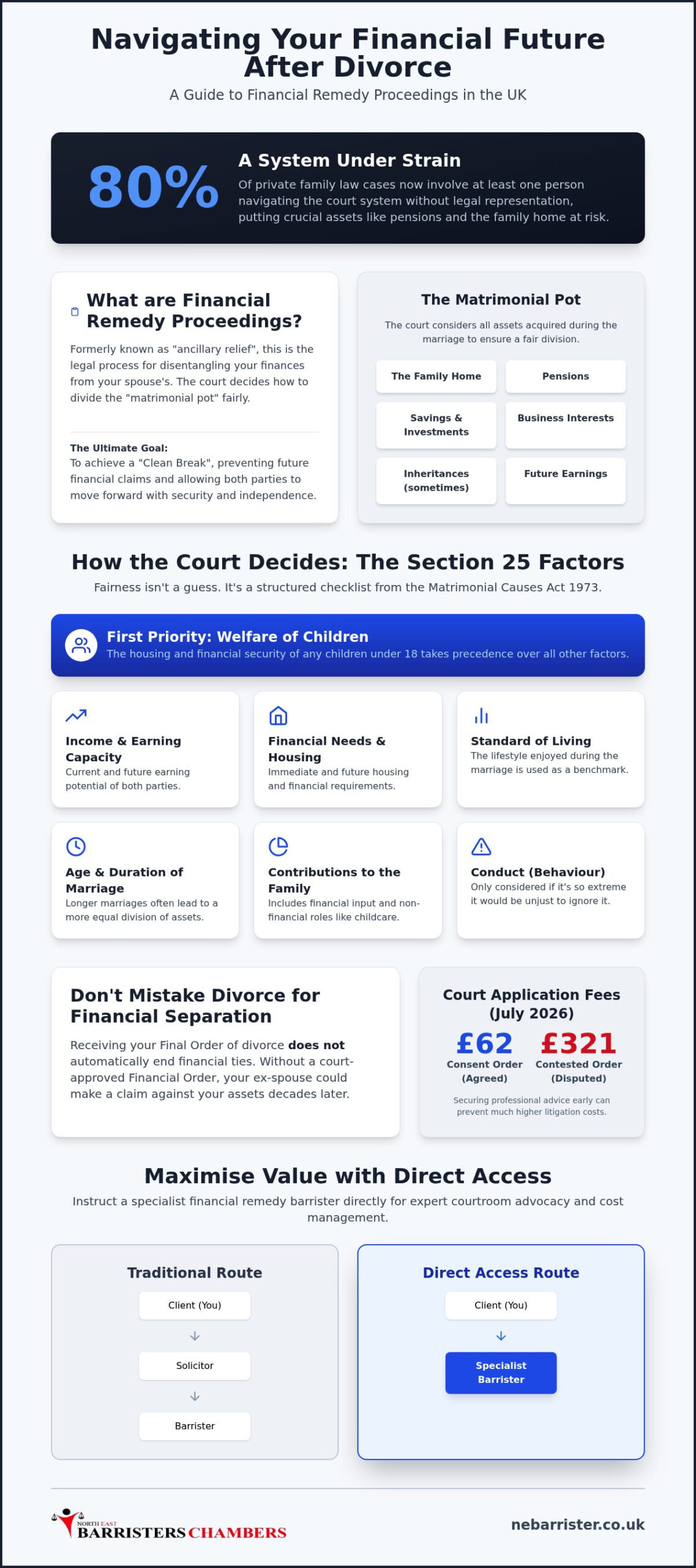
Did you know that 80% of private family law proceedings now involve at least one person navigating the court system without legal representation? While many attempt to go it alone, the stakes of a divorce settlement are far too high to leave to chance. As a financial remedy barrister, I see first-hand how easily the family home or a lifetime of pension contributions can be put at risk during the complex division of matrimonial assets.
I understand the anxiety that comes with the “Form E” financial disclosure process and the genuine dread of appearing in court without an expert by your side. It is a stressful journey, but you don’t have to manage it in isolation. This guide will show you how to secure your financial future by instructing a specialist barrister directly. I’ll explain exactly how the court divides assets in 2026, the practicalities of the direct access scheme, and how you can achieve a fair outcome with total confidence in the legal process.
Key Takeaways
- Demystify the legal process of “disentangling” matrimonial finances and pensions, previously known as ancillary relief.
- Learn how the court uses the Section 25 factors as a structured checklist to ensure a fair outcome for both parties.
- Understand the critical role of the Form E and how it serves as the foundation for your entire financial strategy.
- Discover how a financial remedy barrister can provide expert courtroom advocacy whilst helping you manage costs through the Direct Access scheme.
- Gain a step-by-step roadmap for instructing North East Barristers Chambers directly, from managing fees to securing representation for your final hearing.
What are Financial Remedy Proceedings in UK Divorce Law?
Financial remedy proceedings are the legal mechanism for “disentangling” your financial life from your spouse’s. If you happen to be reading older legal guides, you might see this process referred to as “ancillary relief”. In simple terms, it’s the court’s way of deciding how to split everything you own. This includes the family home, joint savings, business interests, and maintenance payments. As a financial remedy barrister, I focus on helping clients reach a “clean break” whenever possible. This ensures that once the divorce is finalised, neither party can come back years later to claim a share of future earnings or inheritances.
The core goal of these proceedings is to achieve a fair distribution that allows both parties to move forward independently. This involves looking at the total value of the matrimonial pot and determining how it can be divided to meet everyone’s needs. Pensions are a major part of this conversation. They are often the most valuable asset after the family home, yet they are frequently overlooked. A specialist advocate ensures these complex funds are valued correctly and divided fairly, rather than being ignored during negotiations.
The Legal Basis for Asset Division
The framework for these decisions is found in the Matrimonial Causes Act 1973. While the court usually starts with the idea of a 50/50 split, it rarely ends there. Judges distinguish between “matrimonial assets”, which is wealth built during the marriage, and “non-matrimonial assets”, such as property or money brought into the marriage or inherited. A 2026 Supreme Court ruling in Standish v Standish recently clarified that the equal sharing principle applies strictly to matrimonial property. This makes it vital to identify which assets should be protected from the start of your case.
When Should You Apply for a Financial Order?
You should ideally start this process alongside your divorce application. Many people mistakenly believe that receiving a Final Order automatically ends financial ties. It doesn’t. Without a court-approved “Consent Order”, your ex-spouse could potentially make a claim against you decades later. Even if your split is amicable, skipping this step is a significant risk. As of July 2026, the court fee for a contested Financial Remedy Order application is £321, whilst a standard consent order application costs £62. Investing in a financial remedy barrister early on helps you avoid the far higher costs of litigation that arise when financial loose ends are left untied.
How the Court Decides: The Section 25 Factors and Fairness
When you enter a courtroom, “fairness” is not a subjective idea or a vague feeling. It is a rigorous legal evaluation. Judges do not simply guess at a division of assets; they follow a strict statutory framework to reach a conclusion. As a financial remedy barrister, my role is to present your case through the lens of these specific rules to ensure the outcome is genuinely equitable and legally sound.
The first priority for any judge is the welfare of any children under the age of eighteen. Their housing needs and financial security take precedence over the desires of the adults. This often dictates who stays in the family home or how much of the capital is preserved for their upbringing. Beyond the needs of the children, the court looks at the individual circumstances of both spouses to balance the scales.
People often ask if their spouse’s behaviour will affect the final settlement. In reality, conduct is rarely a factor in the division of money. The court only considers it if the behaviour is “gasp-inducing” or extreme enough that ignoring it would be a clear injustice. For the vast majority of cases, the focus remains purely on financial needs, resources, and contributions.
The Core Section 25 Criteria
The court works through a specific checklist of factors to determine a fair split. These include your current income and your future earning capacity; for example, whether one party can realistically return to work after a career break. Judges also look at your immediate housing needs and the standard of living you enjoyed during the marriage. This provides a benchmark for what is considered reasonable after the split. Finally, the duration of the marriage is critical. This includes any period of cohabitation that led directly into the wedding ceremony.
Special Considerations: Pensions and Businesses
Pensions are frequently the most undervalued asset in a divorce settlement. They are complex financial instruments and require careful analysis to ensure you aren’t walking away from a significant future income. Similarly, business assets are not just about the cash in the bank. The court looks at both the capital value and the income the business generates to support the parties. Understanding the court procedure for financial remedy helps you prepare the necessary expert evidence to value these assets correctly. If you need clarity on how your specific assets might be divided, you can request a consultation for direct advice to better understand your position.
The Financial Remedy Procedure: A Step-by-Step Roadmap
The path from a divorce application to a settled financial order is a structured journey. It begins with the application for a financial order (Form A) and moves through several distinct court stages. Throughout this process, both parties are under a strict legal duty of “full and frank disclosure”. This means you must be completely honest about every asset you own, from overseas bank accounts to cryptocurrency. Hiding assets is a serious mistake; if discovered, the court can reopen the case years later and impose heavy financial penalties. The entire framework is built upon the Matrimonial Causes Act 1973, which ensures the process remains consistent and legal.
At the heart of the case is the “Form E”. This is a comprehensive financial statement where you list your income, assets, and future needs. It’s the most important document you’ll complete. As a financial remedy barrister, I use the information in your Form E to construct your legal arguments and identify any gaps in your spouse’s disclosure. For a deeper look at how hearings are conducted, you can read my Family Court Representation UK guide.
Stage 1: First Appointment (FDA) and Disclosure
The First Directions Appointment, or FDA, is essentially a housekeeping hearing. The judge doesn’t make final decisions here. Instead, we focus on what evidence is missing. We might request valuations for the family home or expert reports on a business. My role is to draft a “questionnaire” that forces the other party to explain any inconsistencies in their financial disclosure, narrowing the issues before costs escalate.
Stage 2: The Financial Dispute Resolution (FDR) Hearing
The FDR is often the most critical day in the calendar. It’s a “without prejudice” hearing, which means the judge who hears the negotiations cannot be the same judge who decides the final trial. This creates a safe space to talk openly. The judge will listen to both sides and give an “indication” of what they think a fair outcome would look like. A specialist financial remedy barrister uses this indication as leverage to negotiate a favourable settlement, often avoiding the need for a stressful and expensive final trial.
Stage 3: The Final Hearing
If an agreement isn’t reached at the FDR, your case proceeds to a Final Hearing. This is a formal trial where both parties give evidence and are cross-examined. The quality of advocacy here is vital, as the judge will be assessing the credibility of the evidence presented. The Final Hearing is the culmination of the legal process where a judge imposes a financial order.
Barrister vs Solicitor: Maximising Value through Direct Access
In the traditional legal model, you’d typically hire a solicitor to manage your case file, who would then “instruct” a barrister to represent you in court. This structure often leads to a double layer of fees that can quickly exhaust your budget. By choosing the Public Access scheme, you can reduce UK legal costs significantly. You’re effectively removing the middleman. As a financial remedy barrister, I focus on the high-level strategy and the specialist advocacy required to secure your settlement, whilst you handle the day-to-day administration of your case.
Barristers are litigation specialists. We spend our lives in the courtroom, which gives us a unique perspective on how judges are likely to react to specific arguments. Whilst solicitors are excellent at managing ongoing correspondence and document gathering, my role is to look at the “end game.” I help you understand which battles are worth fighting and which are likely to result in wasted costs. It’s a pragmatic, results-driven approach that prioritises your financial recovery over endless legal posturing.
I’ll be straightforward: this approach isn’t for everyone. If you’re someone who feels completely overwhelmed by paperwork or doesn’t have the time to manage court emails, a solicitor provides an invaluable service. However, if you’re organised and want your budget to go directly toward expert advice and courtroom representation, instructing me directly is a powerful alternative. You can get in touch today to see if your case is a good fit for this model.
The Advantages of Direct Instruction
The most immediate benefit is direct communication. When you instruct me, you’re talking to the person who will actually stand up and argue your case in front of a judge. There’s no risk of information being lost in translation between different legal professionals. This direct link creates a more agile case strategy. Additionally, fee structures in the direct access model are often more transparent. Instead of an open-ended hourly rate that covers every phone call and email, we often work on a fixed-fee basis for specific pieces of work or court hearings.
Who is Direct Access Suitable For?
Direct access is ideal for individuals who are comfortable managing their own administrative tasks. This includes filing the Form E we discussed earlier and keeping track of court dates. It’s particularly effective for cases where the primary need is for a specialist legal opinion or robust representation at a First Appointment or FDR hearing. If you are considering this route for your divorce proceedings, our divorce barrister direct access buying guide explains exactly what to look for when selecting the right specialist for your case. For more information on the specific requirements and how the process works in practice, you can refer to my Direct Access Barrister North East guide.
Instructing Your Financial Remedy Barrister Directly
Engaging a financial remedy barrister through North East Barristers Chambers is a straightforward and transparent process. It begins with a simple enquiry through our website or a phone call to my chambers. Unlike the traditional solicitor-led model, you’ll have a direct line to the expertise you need. My chambers clerks are your first point of contact. They are highly experienced professionals who manage my diary and fee structures. They’ll discuss the practicalities of your case, including my availability for specific court dates and the fixed-fee options we offer for direct access work.
Whilst our name suggests a regional focus, we provide national coverage for family court hearings. I regularly travel to courts across England and Wales to represent clients in complex financial disputes. We believe that geographic location shouldn’t limit your access to specialist advocacy. Our approach is built on reliability and clarity; we aim to be a reassuring presence during what is often a turbulent time. North East Barristers Chambers does not use intimidating legalese or hidden charges. Instead, we provide a functional, business-like service that focuses on resolving your financial disentanglement efficiently.
Preparing for Your First Consultation
To make our initial meeting as productive as possible, I recommend having your financial data organised in advance. This preparation allows us to spend more time on strategy and less on administrative sorting. You should gather the following documents:
- Recent bank statements for all accounts held in your name.
- Up-to-date pension valuations (the Cash Equivalent Value or CEV).
- Recent mortgage statements and an estimate of your property’s current market value.
- A concise, one-page summary of your marriage history, including dates of cohabitation and the ages of any children.
Defining your objectives is equally important. Think about what a “fair” outcome looks like to you in practical terms. Are you prioritising staying in the family home, or is a clean break with a lump sum payment your main goal? Having these answers ready helps me provide more tailored advice from the very first session.
Securing Expert Advocacy Today
There is a significant sense of relief that comes from knowing you have a professional advocate to speak for you in court. I provide a straightforward solution to complex legal problems, ensuring your voice is heard and your interests are protected according to the law. By instructing a financial remedy barrister directly, you gain the peace of mind that comes from specialist representation whilst maintaining control over your case. Enquire about Direct Access representation today to secure your financial future.
Taking Control of Your Financial Future
The journey through a financial remedy application can feel daunting, but as we’ve explored, it is a process governed by clear rules and structured stages. From the initial disclosure in your Form E to the strategic negotiations at an FDR hearing, each step is an opportunity to move closer to a clean break. By choosing to work with a financial remedy barrister directly, you ensure that your resources are focused on the expert advocacy that truly influences a judge’s decision, providing you with the best possible chance of a fair settlement.
North East Barristers Chambers provides the specialist advice and national court representation required to handle even the most complex matrimonial finances. We pride ourselves on a transparent, helpful approach that removes the intimidation factor from the legal system. If you are ready to secure your assets and begin your next chapter with confidence, Instruct a specialist Financial Remedy Barrister directly today. Your future financial stability is a goal we can achieve together.
Frequently Asked Questions
Do I need a solicitor and a barrister for a financial remedy case?
No, you don’t necessarily need both professionals to manage your case. Through the Direct Access scheme, you can instruct a barrister directly to provide expert advice and courtroom representation. This model allows you to handle the administrative tasks yourself whilst benefiting from specialist legal advocacy. It’s a pragmatic way to manage your budget without compromising on the quality of your representation during complex hearings.
What is the “sharing principle” in UK divorce settlements?
The sharing principle suggests that all assets built up during the course of a marriage should generally be divided equally. This applies to the “matrimonial pot,” which includes the family home, joint savings, and pensions accrued whilst you were together. However, the court can depart from a 50/50 split if one party has significantly greater financial needs or if there are non-matrimonial assets involved.
Can I protect my business assets during a divorce?
Protecting a business is possible, but it depends on whether the court views the company as a matrimonial asset. Judges generally try to avoid liquidating or damaging a viable business that provides an income. Instead, they may “offset” the value of the business against other matrimonial property, such as giving the other spouse a larger share of the family home or a pension fund.
How long does a financial remedy court process usually take?
A contested financial remedy case typically takes between 12 and 24 months to reach a final conclusion. As of early 2025, the average time from a divorce application to a final order was 74 weeks. These timelines can fluctuate based on the complexity of your financial disclosure and the current backlog within the family court system. Early negotiation often helps to shorten this period significantly.
What happens if my ex-partner hides assets during disclosure?
Hiding assets is a serious breach of the legal duty of full and frank disclosure and carries heavy penalties. If the court discovers a party has been dishonest, it can award a higher share of the known assets to the other spouse or order the dishonest party to pay all legal costs. In extreme cases, the court can even reopen a settled case years later.
Is a financial remedy order the same as a divorce settlement?
A financial remedy order is the formal, legally binding document issued by the court that makes your settlement enforceable. Whilst a “settlement” is the agreement you reach with your ex-spouse, the “order” is what actually ends your financial ties. Without this court-approved order, both parties remain at risk of future financial claims against their income or assets, even many years after the divorce.
Can I change from a solicitor to a direct access barrister mid-case?
Yes, you can switch to a financial remedy barrister at any point during your proceedings. Many people start their journey with a solicitor but decide to move to direct access to manage their legal costs more effectively or to secure specialist advocacy for the FDR or final hearing. You simply need to request your case file from your previous representative to begin the transition.
How are pensions split in a UK divorce?
Pensions are usually divided using a Pension Sharing Order, which transfers a specific percentage of one person’s pension into a new fund for the other spouse. This provides a clean break and ensures both parties have an independent retirement income. As your financial remedy barrister, I’ll help you review the Cash Equivalent Value (CEV) of all funds to ensure the split is equitable and fair.
