
You don’t need a middleman to secure a high-calibre defence when contesting criminal charges UK. Facing a prosecution is naturally overwhelming. The traditional route of hiring both a solicitor and a barrister often feels like an unnecessary financial burden. It adds more stress to an already difficult situation. I understand the anxiety that comes with court appearances and the confusion over how the legal system actually works. Most people worry about the strength of the prosecution’s case whilst simultaneously fearing they will be priced out of a fair trial.
This guide shows you how to take control by instructing a specialist barrister directly through the Direct Access scheme. By using this method, you can manage your defence strategically whilst significantly reducing your legal fees. You’ll gain a clear understanding of the defence process and access specialist advocacy in court without the traditional overheads. I’ll provide a straightforward roadmap of the legal steps involved. I’ll explain how to navigate the system effectively and show you how to ensure your case is presented with professional authority from the very first hearing.
Key Takeaways
- Learn how to navigate the court system by contesting criminal charges UK with a focus on specialist advocacy and procedural clarity.
- Understand the financial advantages of Direct Access, which allows you to instruct a barrister directly and avoid the additional costs of a solicitor.
- Discover how to challenge the prosecution’s case through effective cross-examination and by questioning the admissibility of their evidence.
- Prepare effectively for trial by mastering the Defence Statement and gathering critical evidence to support your version of events.
- Find out how to engage a specialist barrister directly for court representation, ensuring you have expert guidance from the initial consultation to the final verdict.
Understanding the Process of Contesting Criminal Charges in the UK
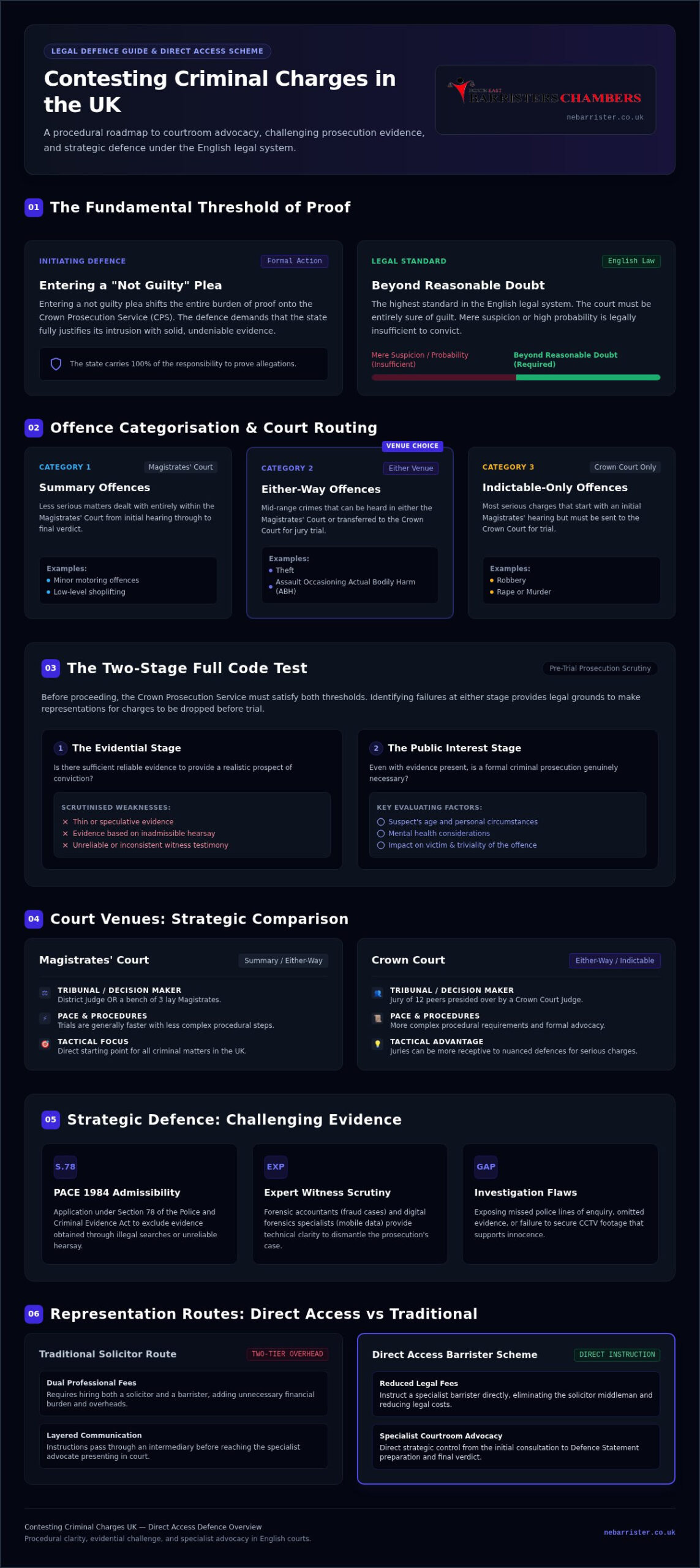
Contesting criminal charges UK begins with a fundamental decision: entering a not guilty plea. This simple act shifts the responsibility entirely onto the Crown Prosecution Service (CPS). They must prove your guilt beyond reasonable doubt. I often tell my clients that this is the highest standard in the English legal system. It means the court must be sure of your guilt; mere suspicion or even a high probability isn’t enough to convict you. When you contest a charge, you’re demanding that the state justifies its intrusion into your life with solid, undeniable evidence.
Your journey starts at the Magistrates’ Court regardless of the severity of the offence. This initial hearing is critical. It’s where you’ll formally enter your plea and where the court decides where your trial will take place. Offences are categorised into three types:
- Summary offences: Less serious matters like minor motoring offences or low-level shoplifting, usually dealt with entirely in the Magistrates’ Court.
- Either-way offences: Mid-range crimes like theft or Assault Occasioning Actual Bodily Harm (ABH) that can be heard in either the Magistrates’ or Crown Court.
- Indictable-only offences: Serious charges like robbery, rape, or murder that must be sent to the Crown Court for trial.
The Two-Stage Test: Challenging the Prosecution’s Logic
Before a case reaches trial, the CPS must apply the Full Code Test. I look for weaknesses in how they’ve applied these two stages to find grounds for a dismissal. The first is the Evidential Stage. Is there enough reliable evidence to provide a realistic prospect of conviction? If the evidence is thin, based on hearsay, or comes from unreliable witnesses, the case shouldn’t proceed. I’ll scrutinise the initial disclosure to see if the prosecution’s house is built on sand.
The second is the Public Interest Stage. Even if the evidence is strong, is a prosecution actually necessary? Factors like the suspect’s age, mental health, the impact on the victim, or the triviality of the offence come into play. Through the Public Access Scheme, I can review the prosecution’s file and identify if they’ve failed to meet these thresholds. This often allows me to make representations to the CPS to have the charges dropped before you even step foot in a trial court.
Magistrates’ Court vs Crown Court: Where Your Case Will Be Heard
The venue of your trial dictates our tactical approach. In the Magistrates’ Court, your case is decided by a District Judge or a bench of three lay Magistrates. These trials are often quicker and involve less complex procedures. However, for either-way offences, you might have a choice. Electing for a Crown Court trial means your fate is decided by a jury of twelve peers. Whilst the process is more complex, it is often a preferred route when contesting criminal charges UK for more serious allegations. Juries can sometimes be more receptive to nuanced defences than a professional judge. I’ll help you weigh up the benefits of each venue, considering the specific evidence and the local court environment.
Strategic Defence: Challenging Evidence and Prosecution Arguments
Success in the UK criminal court system often hinges on a barrister’s ability to dismantle the prosecution’s narrative. When contesting criminal charges UK, I don’t just wait for the trial to happen; I actively look for ways to exclude evidence that shouldn’t be there. This involves challenging the admissibility of certain materials. For example, if the police conducted an illegal search or if the prosecution tries to rely on unreliable hearsay, I can apply to have that evidence excluded under Section 78 of the Police and Criminal Evidence Act 1984. This tactical approach can often weaken the Crown’s case before a witness even takes the stand.
Expert witnesses also play a vital role in modern defence. Whether it’s a forensic accountant in a fraud case or a digital forensics expert in a matter involving mobile phone data, their testimony can provide the technical clarity a jury needs. I work closely with these specialists to identify gaps in the police investigation. If the officers missed a crucial line of enquiry or failed to secure CCTV that could prove your innocence, we make that failure a central part of your defence. If you’re concerned about the strength of the evidence against you, speaking with a barrister directly can help you understand which tactical manoeuvres are available in your specific case.
Disclosure and the Search for Unused Material
Disclosure is perhaps the most powerful tool in a defence barrister’s arsenal. The prosecution has a legal duty to provide any “unused material” that might undermine their case or assist yours. This isn’t just a courtesy; it’s a requirement under the Criminal Procedure and Investigations Act 1996. I’ve seen many cases dropped because the police failed to disclose evidence that supported the defendant’s version of events. I spend significant time scrutinising the “Schedule of Unused Material” to force the CPS to reveal hidden documents, emails, or witness statements that they might have overlooked whilst building their case.
Attacking the Credibility of the Prosecution Case
The art of cross-examination is where a barrister’s expertise truly shines. By highlighting inconsistencies in witness statements over time, I can test the credibility of those testifying against you. People’s memories fade, or their stories change under pressure; my job is to ensure the court sees those cracks. We use digital forensics and mobile phone data to provide an alternative narrative that contradicts the prosecution’s timeline. Finally, the closing speech allows me to pull all these threads together. I use this moment to present a clear, persuasive argument to the jury or Magistrates, explaining exactly why the burden of proof has not been met.
Direct Access Barristers vs. The Traditional Solicitor Route
I often see clients who feel trapped by the traditional legal model. Historically, the only way to get a barrister was to hire a solicitor first, who would then “instruct” the advocate. This creates two layers of fees and often leads to a “Chinese whispers” effect with your information. When contesting criminal charges UK, you don’t always need this complex and expensive structure. Direct Access allows you to instruct me directly. I’m the person who will actually stand up in court and speak for you. By removing the middleman, you get a direct line to your advocate and a much clearer view of your case strategy from the start.
This approach isn’t just about efficiency; it’s about clarity. You’ll know exactly who is handling your case and how I plan to defend you. Whilst solicitors are skilled at administrative litigation, many of my clients prefer to manage the basic paperwork themselves to save on costs. This model is particularly effective for those who are organised and want to stay closely involved in their own defence. It’s a modern way of working that prioritises your results over traditional legal hierarchies.
Cutting Costs Without Sacrificing Quality
The most immediate benefit of Direct Access is the reduction in legal spend. Solicitors often charge high hourly rates for every phone call, email, and letter sent. By instructing a barrister directly, you bypass these administrative costs entirely. I typically work on fixed-fee arrangements for specific stages of work. This means you know exactly what the representation will cost before we begin. There are no surprise bills at the end of the trial.
We also avoid the unnecessary duplication of work. In the old model, you pay a solicitor to read a document and then pay a barrister to read that same document. Direct Access streamlines the process. I review your evidence once and build the strategy immediately. This efficiency is vital when preparing for Crown Court trials and procedure, where the stakes are high and every detail counts towards your final outcome.
The Barrister’s Role in Case Management
In a Direct Access matter, I take on a more active role in your strategy from day one. I don’t wait for a brief to arrive on my desk a week before trial. Instead, I help you decide which evidence to gather and how to frame your defence statement to your best advantage. You should be aware of the limitations; unless a barrister has specific litigation rights, you’ll need to handle some administrative tasks yourself. This might include posting documents to the court or sending emails to the CPS.
Most cases involving contesting criminal charges UK are eligible for the Public Access scheme. I’ll assess your case during our initial consultation to ensure it’s a suitable fit. If your case is exceptionally complex or requires round-the-clock administrative support, I’ll be honest with you about whether a solicitor is necessary. My goal is to provide a pragmatic, cost-effective solution that puts your interests first and gives you the best possible chance in the courtroom.
Preparing Your Defence: Steps to Take Before the Trial
A successful outcome when contesting criminal charges UK doesn’t happen by accident. It’s the result of meticulous preparation that starts long before you step into the courtroom. I always encourage my clients to take an active role in this phase. You are the person who knows the facts of your life best. Your first task is to review the Initial Details of the Prosecution Case (IDPC). This is the summary of evidence the Crown intends to use against you. By looking at this early, we can identify immediate inconsistencies or missing pieces of the puzzle. Whilst I handle the legal technicalities, your role is to provide the raw materials for your defence.
Mental preparation is just as vital as gathering paperwork. The courtroom can be an intimidating environment. Understanding the layout, the roles of the various officials, and what to expect during cross-examination helps to reduce anxiety. I’ll guide you through this process so you feel confident when it’s your turn to speak. If you’re ready to start building your case, you can instruct a barrister directly to begin the strategic review of your evidence.
Drafting an Effective Defence Statement
In Crown Court cases, serving a Defence Statement is a mandatory requirement. It’s your opportunity to set out your stall and explain exactly which parts of the prosecution’s case you dispute. We use this document to highlight specific points of law or factual errors. Accuracy is vital here. If your trial testimony deviates from what’s written in your Defence Statement, the prosecution will highlight this to the jury. I’ll work with you to ensure the statement is robust, clear, and consistent from the outset.
Organising Your Evidence for Your Advocate
Efficiency saves time and money. I ask my clients to create a clear, chronological bundle of their own evidence. This should include a minute-by-minute timeline of events, receipts or bank statements that prove your actions, and contact details for potential witnesses. We also need to identify character witnesses who can testify to your reputation and integrity. This preparation is essential for the Pre-Trial Preparation Hearing (PTPH). When contesting criminal charges UK, having our evidence organised early means we can take a proactive stance during this hearing, ensuring the trial is listed on terms that favour your defence.
Instructing a Barrister Directly for Criminal Court Representation
The process of contesting criminal charges UK often feels like an immense burden until you have a specialist advocate by your side. Our initial consultation is designed to replace that anxiety with a clear, actionable strategy. I’ll review the evidence you’ve gathered and the prosecution’s initial disclosure to provide a frank assessment of the merits of your defence. This isn’t just a legal formality; it’s a vital step in deciding whether a trial is the right path for you or if a different tactical approach is required.
Once we’ve assessed the case, we agree on the scope of work. You might only need advice on how to plea, or you may require full representation through a multi-day trial. This flexibility is a hallmark of the Direct Access model. To ensure I have every tool to defend you, I rely on you to provide clear and honest instructions. The more detail you provide about the circumstances of the alleged offence, the better I can identify the legal loopholes or witness inconsistencies that could win your case. Seeing an expert advocate take the lead often provides the first moment of genuine relief for many of my clients.
Finding the Right Specialist for Your Charge
Matching your barrister’s expertise to the specific nature of your charge is essential for a successful defence. Criminal law is a broad field. A barrister who specialises in complex financial fraud may not be the same person you want defending a serious driving matter. I focus on specific areas of criminal law to ensure my knowledge of the relevant statutes and case law is as sharp as possible. This depth of expertise allows me to anticipate prosecution tactics before they’re even deployed in the courtroom.
Independent advocacy remains the gold standard in the UK legal system. Whilst I work as an agile, independent practitioner, being part of a chambers structure provides the professional support needed to manage your case effectively. This environment fosters high standards and ensures that every barrister is held to a rigorous code of conduct. You aren’t just hiring a person; you’re engaging a professional who is part of a long-standing tradition of excellence in the English courts.
Taking Action: The First Steps to Contesting Your Case
The first step toward taking control of your situation is to submit your case details for a Direct Access quote. I’ve designed the process to be as straightforward as possible. Once I have the basic information regarding your charges and the court date, I can provide a transparent fee proposal. You can learn more about this process in my guide on Criminal law court representation, which explains how the 2026 regulations affect your case.
During our first conference, we’ll move from the logistics of your instruction to the heart of your defence. We’ll discuss witness lists, disclosure requests, and the specific points of law we intend to challenge. My goal is to ensure you leave that meeting with a complete understanding of the road ahead. By removing the confusion of the traditional solicitor-led model, we can focus entirely on the only thing that matters: securing the best possible result for you in court.
Take Control of Your Legal Defence
Navigating the complexities of the legal system doesn’t have to be a solitary or prohibitively expensive journey. By understanding the strategic importance of disclosure and the procedural nuances of the court system, you’ve already taken the first step toward a robust defence. Contesting criminal charges UK is a significant challenge; however, the Direct Access model provides a transparent and efficient way to put an expert advocate in your corner without the overheads of a traditional solicitor.
I am Direct Access qualified to provide specialist criminal advocacy, offering transparent fee structures for both individuals and businesses. My practice provides expert representation in both the Magistrates’ and Crown Courts, ensuring you have the highest standard of independent advocacy at every stage. Don’t let the weight of a prosecution overwhelm you. You can instruct a specialist criminal barrister directly to defend your case and begin building a strategic, professional defence today. You have the right to a fair trial, and I am here to help you secure it.
Frequently Asked Questions
Can I really contest a criminal charge without a solicitor in the UK?
Yes, you can contest a criminal charge without a solicitor by using the Direct Access scheme. This allows you to instruct a barrister directly for advice and court representation. Whilst you will need to handle some administrative tasks yourself, such as filing certain papers, I provide the specialist advocacy needed in the courtroom. It is a legal and increasingly common way to manage your defence whilst reducing overall costs.
How much does it cost to hire a barrister directly for a criminal case?
Fees for Direct Access services depend on the complexity of your case and the length of the trial. I typically provide a transparent, fixed-fee quote after reviewing your initial case details. This ensures you have total clarity on your legal spend from the outset. Because you aren’t paying for a solicitor’s hourly rate on top of an advocate’s fee, the total cost is often significantly lower than the traditional route.
Will I get a better result in court with a barrister than a solicitor?
Barristers are specialist advocates who spend the majority of their professional lives in the courtroom. Whilst many solicitors are highly capable, a barrister’s training is specifically focused on the art of persuasion and cross-examination. When contesting criminal charges UK, having a specialist who understands the nuances of the trial process can provide a significant advantage. I focus on high-level advocacy to ensure your version of events is presented with professional authority.
What happens if I plead not guilty at the Magistrates’ Court?
When you plead not guilty at the Magistrates’ Court, the case is adjourned for a trial. The court will set dates for the prosecution to disclose their evidence and for your defence to be served. If the offence is “either-way”, the Magistrates will decide if they have the power to hear the case or if it should be sent to the Crown Court. I can advise you on which venue is most tactically advantageous for your situation.
Can a Direct Access barrister help me with a Crown Court trial?
Yes, I can represent you in the Crown Court for the full duration of your trial. Direct Access barristers are fully qualified to handle even the most serious criminal matters in front of a judge and jury. I will help you prepare your Defence Statement and manage the strategic elements of your case. My role is to ensure that the prosecution’s evidence is tested rigorously and that your defence is presented clearly to the jury.
Do I have to pay for a barrister upfront?
Fees for Direct Access work are generally paid in advance of each stage of the case. For example, you might pay for an initial conference first, and then pay the brief fee for the trial itself later. This stage-by-stage approach helps you manage your finances and ensures that you only pay for the work that is actually required. I provide clear invoices so you always know exactly what you are paying for.
What is the “burden of proof” in a UK criminal trial?
The burden of proof rests entirely with the prosecution. When contesting criminal charges UK, the Crown must prove your guilt “beyond reasonable doubt”. This means the jury or Magistrates must be sure that you committed the offence. If there is any reasonable doubt in their minds, they are legally required to find you not guilty. My job is to highlight those doubts by challenging the credibility and consistency of the prosecution’s evidence.
Can I change from a solicitor to a Direct Access barrister midway through my case?
You can change your legal representation at any point, provided it does not cause an unreasonable delay to the court proceedings. Many clients start with a solicitor and then decide to move to a Direct Access barrister to save on costs or to work more closely with their advocate. If you decide to make this change, I can help you manage the transition to ensure I have all the necessary evidence to continue your defence.