
What if the biggest barrier to a robust legal defence isn’t the evidence against you, but the outdated way you’re expected to hire your legal team? Most people assume they must start with a solicitor, but that often leads to duplicated work and spiralling costs that many find impossible to manage. I understand that facing a Crown Court appearance is a source of immense anxiety, especially when you’re caught in the justice gap where you earn too much for Legal Aid but not enough to fund a traditional multi-tier firm. Learning how to prepare for a criminal trial UK doesn’t have to be a confusing or bank-breaking process.
I’ve written this guide to show you how to strategically contest charges by instructing a specialist barrister directly. You’ll discover how to bypass unnecessary overheads and gain direct access to the advocate who will actually stand up for you in court. I’ll walk you through the practicalities of the defence process, including how the 2026 updates to the Criminal Procedure Rules and the Sentencing Act 2026 impact your strategy. By the end of this article, you’ll have a clear, step-by-step roadmap to securing expert advocacy and achieving the best possible outcome for your case.
Key Takeaways
- Learn exactly how to prepare for a criminal trial UK by organising your evidence early and understanding your disclosure obligations.
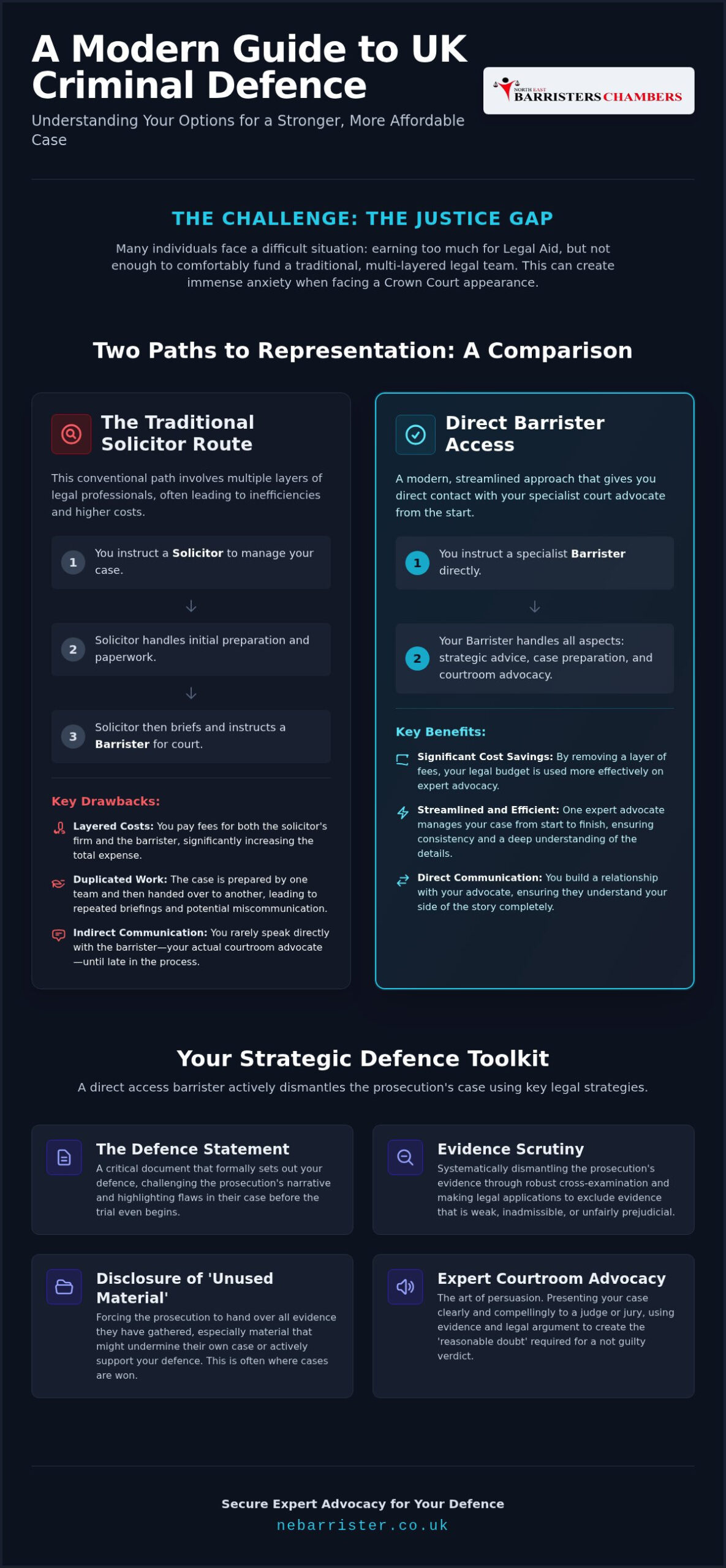
- Discover how instructing a barrister directly removes the need for a solicitor, significantly reducing legal fees and eliminating duplicated work.
- Understand the strategic importance of the Defence Statement in challenging the prosecution’s narrative before the trial begins.
- Gain insight into how specialist courtroom advocacy, including cross-examination and evidence exclusion, is used to contest charges.
- Find out how to assess the strengths of your case and agree on a clear scope of work through a direct consultation with an expert advocate.
Understanding the Process of Contesting Criminal Charges in the UK
Contesting a criminal charge is a formal legal action that begins with a “not guilty” plea at your first hearing. This isn’t just a denial; it’s a strategic decision to put the prosecution to proof. In English criminal law, you don’t have to prove your innocence. Instead, the burden of proof rests entirely on the Crown. They must prove your guilt beyond reasonable doubt, which is a high standard. I focus on finding the cracks in their case to ensure that standard isn’t met. Understanding this fundamental principle is the first step in learning how to prepare for a criminal trial UK.
Every criminal case starts in the Magistrates’ Court. Whether your case involves a summary offence like a minor motoring matter, or an indictable-only offence like a serious assault, that initial hearing is a critical milestone. It’s where the court decides where your trial will take place. For “either-way” offences, there’s a choice between the Magistrates’ Court and the Crown Court. I help you weigh the risks and benefits of each venue, as the tactical approach to your defence will change depending on who is judging the facts.
The Two-Stage Test: Challenging the Prosecution’s Logic
The Crown Prosecution Service (CPS) must follow a strict two-stage test before they can bring a case to trial. I scrutinise their decision-making to see if they’ve applied these tests correctly:
- The Evidential Stage: Prosecutors must ask if there is a “realistic prospect of conviction” based on the evidence. I look for witness statements that don’t hold up or forensic data that’s been poorly handled.
- The Public Interest Stage: Even if evidence exists, is it in the public interest to prosecute? I identify factors that might suggest a trial isn’t the right course, such as the age of the defendant or the minor nature of the incident.
If I can show that the CPS has failed either stage, it’s possible to argue that the case should be discontinued before it ever reaches a courtroom.
Magistrates’ Court vs Crown Court Strategy
The venue of your trial dictates my advocacy style. In the Magistrates’ Court, your case is heard by a District Judge or a panel of lay magistrates. They’re seasoned at hearing legal arguments and tend to be very efficient. However, for serious indictable offences, your case will move to the Crown Court for a trial by jury. This is a different environment entirely. Jurors are members of the public, and they respond to clear, persuasive narratives rather than just technical legal points. Part of knowing how to prepare for a criminal trial UK is understanding how to present your story to twelve strangers in a way that creates that vital reasonable doubt.
Strategic Defence: Challenging Evidence and Prosecution Arguments
Contesting a charge requires more than a simple denial. It involves a systematic dismantling of the prosecution’s narrative. I don’t just wait for the trial to begin; I actively look for gaps where the police failed to follow reasonable lines of enquiry. This proactive approach is a core part of how to prepare for a criminal trial UK. If a witness has changed their story or the CCTV doesn’t match the written statement, I highlight those flaws to the court to create that vital reasonable doubt.
Evidence isn’t always admissible just because the police collected it. I frequently make legal applications to exclude hearsay evidence or prevent “bad character” applications from being used to unfairly prejudice a jury. Expert witnesses also play a vital role in modern trials. In technical cases involving forensics, cell site analysis, or digital data, having an independent expert can provide the alternative explanation a jury needs to hear. If you’re concerned about the strength of the evidence against you, speaking with an advocate about your specific case can provide much-needed clarity.
Disclosure and the Search for Unused Material
Disclosure is the prosecution’s legal duty to hand over “unused material.” This is evidence they’ve gathered that doesn’t support their case but might actually help yours. It’s a high-stakes area of how to prepare for a criminal trial UK. I’ve seen many cases collapse because the police didn’t disclose vital phone records or witness accounts that contradicted the complainant. I force the issue by requesting specific logs, officer notebooks, or digital metadata that the CPS may have overlooked or deemed irrelevant. Common pitfalls include lost body-worn footage or unexamined social media threads that can change the entire context of an allegation.
Attacking the Credibility of the Prosecution Case
Witness statements are rarely perfect. I analyse inconsistencies over time to test whether a witness is reliable. Did they say one thing during the initial 999 call and something entirely different in their formal statement? I use digital forensics and CCTV to show that the prosecution’s timeline is physically impossible. My role is to ensure the jury sees these discrepancies clearly. The closing speech is where I pull these threads together, showing the jury or the Magistrates why the evidence is too thin to support a conviction. This methodical destruction of the Crown’s case is the most effective way to secure an acquittal.
Direct Access Barristers vs. The Traditional Solicitor Route
Traditional legal routes often feel like a game of Chinese whispers. You tell your solicitor your story; they write it down and tell a barrister; the barrister then tells the court. This duplication isn’t just slow; it’s expensive. Direct Access changes this by allowing you to instruct an advocate without a middleman. I believe that working closely with the person who will actually speak for you in court is the most effective way to build a robust defence. This direct line of communication ensures nothing is lost in translation and is a vital component of how to prepare for a criminal trial UK.
While the traditional route is still necessary for highly complex cases requiring massive administrative teams, many criminal matters are perfectly suited for Direct Access. It’s about agility and focus. I provide the specialist advocacy you need while you take a more active role in the logistics of your case. This approach prioritises results over paperwork, ensuring your resources are spent where they matter most: on the quality of your representation in the courtroom.
Cutting Costs Without Sacrificing Defence Quality
One of the most immediate benefits of direct instruction is the financial relief. You aren’t paying for two sets of legal professionals to review the same evidence. By removing the solicitor’s hourly rate from the equation, you can often secure high-level representation for a fraction of the traditional cost. I prefer to work on fixed-fee arrangements wherever possible. This gives you total transparency from the start, so there are no nasty surprises as the trial date approaches. If you’re looking for ways to Reduce UK Legal Costs, this model is often the most pragmatic solution available.
The Barrister’s Role in Case Management
In a Direct Access model, I take on the strategic lead much earlier. Instead of receiving a brief days before a hearing, I work with you from the outset to define the best path forward. However, it’s important to understand the boundaries. As a barrister, I focus on the law and the courtroom. You’ll need to handle some administrative tasks yourself, such as gathering your own receipts or organising witness contact details. This partnership is a key part of how to prepare for a criminal trial UK successfully. Most criminal charges are eligible for the Public Access Scheme, but I’ll always assess your case during our initial consultation to ensure this route is appropriate for your specific needs.
Preparing Your Defence: Steps to Take Before the Trial
Preparation is the most effective antidote to courtroom anxiety. While the prosecution builds their case, I help you build yours. The first step involves reviewing the Initial Details of the Prosecution Case (IDPC). This document outlines the evidence against you and the specific charges you face. It’s where I find the initial inconsistencies that we’ll later exploit in court. Understanding exactly what the Crown knows is fundamental to how to prepare for a criminal trial UK.
I ask my clients to be as proactive as possible in gathering their own evidence. Don’t wait for the police to find the receipts or the CCTV that proves your location; find them yourself. Creating a clear timeline of events is incredibly powerful. When you provide me with a chronological account supported by documents, I can spend more time on advocacy and less on basic administration. This collaboration is what makes the Direct Access model so effective. If you’re ready to start building your case, reach out for a direct consultation.
Drafting an Effective Defence Statement
In the Crown Court, a Defence Statement is a mandatory requirement. It’s a formal document where we set out your stall early in the process. We identify exactly which parts of the prosecution’s case you dispute and why. This isn’t the time for vague denials. We need to be specific about points of law or fact that are in issue. Accuracy is vital here. If your trial testimony deviates from this statement, the prosecution can use that inconsistency to damage your credibility in front of the jury.
Organising Your Evidence for Your Advocate
I need your evidence to be organised and accessible. A chronological bundle of documents, such as emails, texts, and bank statements, allows me to navigate your history quickly during the pressure of a trial. We should also identify potential character witnesses. These are individuals who can testify to your reputation and behaviour, providing the court with a broader context of who you are. This preparation culminates in the Plea and Trial Preparation Hearing (PTPH), where the court sets the trial date and ensures both sides are ready to proceed.
Mental preparation is just as important as the paperwork. The courtroom is a formal, high-pressure environment. I’ll guide you through what to expect during cross-examination so you aren’t blindsided by the prosecution’s tactics. Knowing the rhythm of the trial helps you stay calm and focused on your testimony. This comprehensive approach ensures you aren’t just a passenger in your own defence, but an active participant in how to prepare for a criminal trial UK.
Instructing a Barrister Directly for Criminal Court Representation
Instructing me directly is the final, most decisive step in taking control of your case. It marks the moment where the burden of managing your defence shifts from your shoulders to mine. The process begins with an initial consultation where I assess the merits of your defence. I don’t believe in giving false hope; I provide a pragmatic, honest evaluation of the prosecution’s evidence. This assessment is a vital part of how to prepare for a criminal trial UK because it allows us to identify the strongest legal arguments from day one.
Once we’ve reviewed the case, we’ll agree on a specific scope of work. This transparency is a hallmark of the Direct Access model. You might only need advice on whether to plead guilty or not guilty, or you may require full representation through a complex multi-day trial. Whatever the requirement, we define the boundaries of the service early so you know exactly what to expect. Providing me with clear, honest instructions is the best tool you have. I need to know the full story, including any details you’re worried about, so I can build a defence that stands up to intense scrutiny in court.
Finding the Right Specialist for Your Charge
Success in the courtroom often comes down to matching a barrister’s specific expertise to the nature of the charge. Whether your case involves financial crime, serious violence, or motoring offences, you need an advocate who understands the nuances of that specific area of law. I provide specialist Criminal Law Court Representation that prioritises independent advocacy. In the UK legal system, this independence is the gold standard. It ensures that your advocate is focused entirely on the law and the evidence, providing a level of dedicated courtroom skill that is difficult to replicate in larger, more traditional firm structures.
Taking Action: The First Steps to Contesting Your Case
Starting the process is straightforward and avoids the administrative hurdles of traditional routes. You can submit your case details directly to receive a clear, fixed-fee quote. This removes the anxiety of “billable hours” and allows you to plan your finances with certainty. After you’ve reviewed the quote, our first formal conference will be the foundation of your defence strategy. We’ll go through the IDPC and any evidence you’ve gathered to refine our approach. Exploring Direct Access Barrister Services is the most efficient way to secure the advocacy you need. When an expert takes the lead, the confusion of the legal system is replaced by a clear, methodical plan. This is the ultimate goal of how to prepare for a criminal trial UK: moving from a position of uncertainty to one of prepared, professional confidence.
Secure Your Defence and Take Control
Securing a robust defence starts long before you step into the courtroom. By choosing the Direct Access route, you’ve already taken the most significant step toward a cost-effective and focused trial strategy. You’ve learned that bypassing the traditional solicitor model removes unnecessary layers of fees and puts you in direct contact with your advocate. I’ve shown you that how to prepare for a criminal trial UK involves meticulous evidence gathering, a strategic Defence Statement, and a clear understanding of the prosecution’s burden of proof.
I provide specialist representation in both the Magistrates’ and Crown Courts, ensuring your case is handled with professional authority from the initial hearing to the final verdict. I am Direct Access qualified for expert criminal advocacy and operate with transparent fee structures that provide clarity for individuals and businesses alike. You don’t have to navigate this complex system alone or face the anxiety of escalating legal costs. If you’re ready to contest your charges with a modern, agile approach, you can instruct a specialist criminal barrister directly to defend your case. Taking action now is the best way to protect your future.
Frequently Asked Questions
Can I really contest a criminal charge without a solicitor in the UK?
Yes, you can. Under the Direct Access scheme, you can instruct a barrister directly to handle your defence without needing a solicitor to act as a middleman. This is often a more efficient way to manage your case, as you work directly with the advocate who will represent you in court. I guide you through the necessary steps and help you understand how to prepare for a criminal trial UK effectively.
How much does it cost to hire a barrister directly for a criminal case?
Costs vary depending on the complexity of the charge and the length of the trial. I typically work on a fixed-fee basis, which provides total transparency and helps you avoid the unpredictable hourly rates often associated with traditional legal firms. Because you aren’t paying for both a solicitor and a barrister to review the same evidence, the overall financial burden is often significantly lower than the traditional route.
Will I get a better result in court with a barrister than a solicitor?
Barristers are specialist advocates who spend the majority of their professional lives in the courtroom. While many solicitors are excellent, barristers possess a high level of expertise in cross-examination and trial tactics. Choosing a specialist advocate means you have someone whose primary focus is persuading a jury or a bench of Magistrates. This dedicated courtroom skill is often the gold standard for anyone contesting a serious criminal charge.
What happens if I plead not guilty at the Magistrates’ Court?
When you enter a “not guilty” plea, the court will begin managing your case toward a trial. For summary offences, the trial will usually stay in the Magistrates’ Court. For “either-way” offences, the court decides if the case is serious enough for the Crown Court. I help you navigate this transition and ensure you understand how to prepare for a criminal trial UK by meeting all court deadlines and disclosure requirements.
Can a Direct Access barrister help me with a Crown Court trial?
Yes, I can represent you through the entire Crown Court process, from the initial Plea and Trial Preparation Hearing (PTPH) to the final trial. Direct Access barristers are fully qualified to provide advocacy in the Crown Court. I handle the strategic legal arguments and cross-examination, while you assist with administrative tasks like gathering witness contact details and organising your personal evidence bundle to support the defence case.
Do I have to pay for a barrister upfront?
Yes, most Direct Access barristers require payment before work begins on a specific stage of the case. This is a standard part of the Public Access Scheme. I provide clear quotes for each phase, such as an initial conference or the trial itself, so you can manage your budget without surprises. This “pay-as-you-go” approach ensures that you only pay for the specific legal services you need at each stage of the proceedings.
What is the “burden of proof” in a UK criminal trial?
The burden of proof rests entirely with the prosecution. They must prove that you committed the offence “beyond reasonable doubt.” This is the highest standard of proof in the legal system. My role is to challenge their evidence and highlight inconsistencies to show that this standard hasn’t been met. You don’t have to prove your innocence; the Crown must prove your guilt, which is a vital distinction in any criminal case.
Can I change from a solicitor to a Direct Access barrister midway through my case?
You can certainly switch to a Direct Access model if you feel it better suits your needs or budget. You’ll need to settle any outstanding fees with your current solicitor first. Once that’s done, I can take over your representation and begin reviewing the evidence already gathered. This transition often provides a sense of relief as you move toward a more direct and transparent working relationship with the specialist who will actually defend you.
