
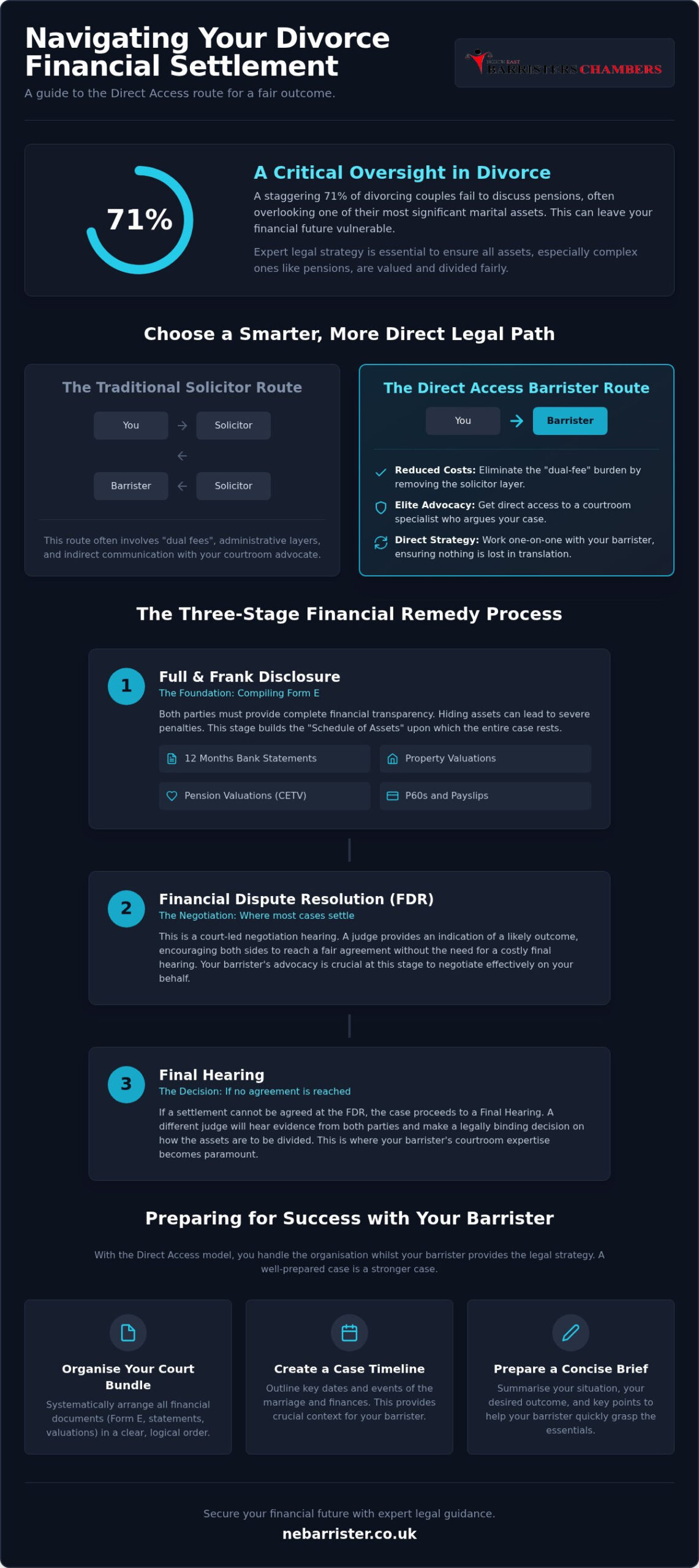
Did you know that 71% of divorcing couples fail to discuss their pensions, often leaving one of their largest marital assets completely off the table? It’s a staggering figure that highlights just how easy it is to feel overwhelmed by the complexities of property division and future security. I understand that you’re likely feeling the weight of rising legal fees and the anxiety of navigating a family court system that feels designed for professionals, not individuals.
I want to show you that securing a fair distribution of assets doesn’t have to drain your remaining capital. By instructing a specialist barrister for divorce financial settlement through the Direct Access scheme, you can access elite courtroom advocacy and clear legal strategy whilst significantly reducing your overall expenditure. You deserve a transparent approach to costs and a professional who acts as a straightforward guide through the Financial Remedy process.
In this guide, I’ll explain how the 2026 court system operates, how to handle complex assets like defined benefit pensions, and the practical steps you can take to ensure your financial interests are protected without the requirement of a solicitor.
Key Takeaways
- Understand how a specialist barrister provides the strategic advocacy needed to protect your future assets during a financial remedy.
- Learn the critical importance of “Full and Frank Disclosure” and how to navigate the three-stage court process with confidence.
- Discover how instructing a barrister for divorce financial settlement through the Direct Access scheme can significantly lower your legal costs by removing the need for a solicitor.
- Get practical tips on organising your court bundle and timeline to ensure your case is presented clearly and effectively.
- Find out what’s expected in your first legal conference and how to prepare a concise brief that helps your barrister secure a fair outcome.
Understanding the Role of a Barrister in Divorce Financial Settlements
When you’re facing the end of a marriage, the financial implications can feel like an impossible puzzle. You want to ensure your future is secure, but you’re probably worried about the cost of getting there. I’ve seen how the traditional legal route can feel detached and prohibitively expensive. That’s why I focus on providing a more direct, transparent way to access legal expertise.
A barrister for divorce financial settlement is a specialist who spends their time in the courtroom. We understand exactly how judges make decisions regarding asset division. While a solicitor might manage the day-to-day administration of a file, I provide the strategic advice and advocacy needed when negotiations get tough or when you’re standing in front of a judge. Getting me involved early helps you avoid the common pitfalls that often lead to prolonged and costly disputes.
Financial Settlement vs. Financial Remedy: What is the Difference?
It’s helpful to clarify the terminology you’ll encounter. Most people use the word “settlement” to describe the final agreement. However, the legal process itself is technically known as a Financial Remedy. Financial Remedy is the legal mechanism for resolving money matters after divorce.
This entire process is built on the foundations of the Matrimonial Causes Act 1973. This legislation dictates how the court looks at everything from the family home and joint savings to complex business interests and spousal maintenance. I’ll help you navigate these rules to ensure the division of matrimonial assets is fair and legally sound. Pensions are a particular area where expert valuation is vital; they’re often the largest asset after the family home but are frequently overlooked in initial discussions.
Why Direct Access is Changing Family Law in 2026
The way people access legal help has evolved. In 2026, the Direct Access model is no longer a niche option; it’s a mainstream strategy for managing legal costs. By instructing a barrister directly, you’re taking control of your case. You handle the administrative tasks, like gathering bank statements or filing basic forms, whilst I provide the high-level legal strategy and courtroom representation.
This shift has been supported by the Bar Council, which regulates practitioners to ensure you receive the same level of expertise as you would through a firm of solicitors. Modern technology allows us to collaborate efficiently through video meetings and digital document sharing. It’s a straightforward, business-like approach that removes the “dual-fee” burden of paying for two sets of lawyers. You get direct access to the person who will actually be arguing your case in court, ensuring nothing is lost in translation. This direct connection fosters a sense of personal accountability that you won’t always find in larger, faceless corporate entities.
The Financial Remedy Process: From Disclosure to Final Hearing
The court process for a financial remedy follows a specific, three-stage structure. It’s designed to move from information gathering to negotiation and finally to a decision if no agreement is reached. As a barrister for divorce financial settlement, I guide you through each phase to ensure you aren’t caught off guard by the complexities of the system. My focus is on providing clarity whilst you navigate what can often feel like a daunting legal landscape.
Mastering Form E: The Foundation of Your Case
Everything begins with “Full and Frank Disclosure”. This is handled through Form E, a comprehensive document where both parties must list all assets, liabilities, and income. You’ll need to gather bank statements for the last 12 months, property valuations, P60s, and up-to-date pension valuations. This isn’t just a paperwork exercise; it’s the evidence upon which your entire future is built.
Hiding assets or providing misleading information is a serious mistake. In 2026, the courts are increasingly strict about non-disclosure; penalties can include costs orders or even the reopening of settlements years later. I use this data to create a “Schedule of Assets”, which acts as our map for the case. I’ll look for discrepancies in bank transfers or undervalued assets that might otherwise go unnoticed. If you’re ready to begin this process, you can reach out for an initial consultation to discuss your specific needs.
The FDR Hearing: Where Most Settlements are Reached
The process moves from the First Appointment (FDA), where the judge sets directions, to the Financial Dispute Resolution (FDR) hearing. The FDR is a unique “without prejudice” meeting. This means nothing said in the room can be used as evidence if the case eventually goes to a final trial. It creates a safe space for genuine negotiation.
The judge’s role here isn’t to make a final order, but to give an indication of how they would likely rule. This provides a much-needed reality check for both sides. The expertise of a barrister for divorce financial settlement ensures you are negotiating from a position of strength during these high-pressure moments. I’ll use the judge’s indication to push for a fair settlement on your behalf. If we reach an agreement, I can draft a “Consent Order” there and then. This document makes the agreement legally binding and prevents future claims. If the FDR fails, the case proceeds to a Final Hearing where a judge makes the final decision, but my goal is always to find a resolution earlier to save you time and stress.
Direct Access vs. Traditional Solicitors: A Cost and Strategy Comparison
In the traditional legal model, you pay for a “dual-fee” structure. You hire a solicitor to manage your file, and they in turn hire a barrister to represent you in court. This often leads to paying two sets of legal fees for the same case. By instructing a barrister for divorce financial settlement directly, you remove the middleman. You take on the administrative tasks, such as organising your bank statements and posting letters, which allows you to focus your budget on elite legal strategy and advocacy.
There’s a significant strategic benefit to this approach. In a solicitor-led case, the barrister often only sees the paperwork a few weeks before the hearing. Under the Direct Access model, I am involved from the beginning. This means the person who will eventually argue your case before a judge is the same person who helps you build your strategy on day one. It ensures your case is “courtroom-ready” from the start, preventing the need to change direction at the last minute when the barrister spots an issue the solicitor missed.
Transparency in Barrister Fees for Financial Cases
I believe in straightforward pricing. Unlike some traditional firms that use open-ended hourly rates, many Direct Access barristers work on a fixed-fee basis for specific stages of work. This gives you much-needed certainty. You can budget for individual “conferences” (legal meetings) and “brief fees”, which cover the preparation and attendance for your court hearings. For a deeper look at how this works, you can read my guide on Direct Access Barrister Cost: Transparency and Value.
This transparency removes the anxiety of receiving a surprise bill at the end of the month. You only pay for the specific expertise you need, whether that’s a one-off advice session or full representation during a Financial Dispute Resolution hearing. It’s a pragmatic way to manage a complex situation without the fear of escalating costs.
When is Direct Access the Right Choice?
Direct Access is an ideal solution if you are organised and comfortable handling your own paperwork. If you can manage your timeline and gather your disclosure documents, you can reduce legal costs UK significantly. This model offers “unbundled” legal services, meaning you have the flexibility to pick and choose when you need professional help. You might handle the initial stages yourself but instruct me for the high-pressure negotiations of a court hearing.
However, it isn’t always the best fit for everyone. If your case involves a highly litigious or abusive counterpart, or if you feel completely overwhelmed by the administration, a solicitor might be necessary to act as a buffer. I’ll always be honest with you about whether Direct Access is suitable for your specific circumstances. My goal is to provide a straightforward solution that fits your needs, not to force a model that doesn’t work for your situation.
How to Prepare for Your Financial Settlement with a Barrister
Direct Access puts you in the driving seat of your case. You aren’t just the client; you’re the litigation manager. This means you’re responsible for organising the “Bundle”. This is the indexed set of documents the judge will read during your hearings. It must be tidy, logical, and complete. I’ll help you understand exactly what needs to go in, but you’ll handle the physical assembly. You also need a clear timeline of the marriage. Note down when you married, when you bought your home, and any major financial contributions like inheritances or gifts. Having this ready before our first conference saves time and keeps your costs down.
Before we meet, I want you to distinguish between your “needs” and your “wants”. The court’s primary focus is on meeting the needs of both parties and any children involved. Think realistically about your future housing requirements and monthly income needs. When we finally step into the family court, your behaviour is just as important as your evidence. Judges look for reasonableness and a willingness to compromise. Stay calm and polite; my role as your barrister for divorce financial settlement is to handle the advocacy whilst you provide the factual foundation.
Drafting Your Witness Statement
Your witness statement is your primary opportunity to explain your position to the judge. It must focus on the “Section 25 factors” established by the Matrimonial Causes Act 1973. These include your age, earning capacity, and the standard of living you enjoyed during the marriage. I’ve seen many statements lose their impact because they become a list of emotional grievances. Keep your draft factual and objective. My role is to “settle” this document, which means I’ll edit your draft to ensure it carries the maximum legal weight whilst remaining focused on the issues the judge actually cares about.
Valuing Matrimonial Assets: Property and Pensions
You cannot reach a fair settlement if you haven’t accurately valued your assets. For the family home, we often instruct a “Joint Single Expert”. This is a neutral surveyor both sides agree to use. Pensions are far more complex than property. The Cash Equivalent Value (CEV) provided by the pension company often fails to reflect the true worth of the fund, especially in public sector or defined benefit schemes. We may need an actuary to provide a detailed pension sharing report to ensure a fair split. If business assets are involved, prepare a list of questions for me regarding liquidity and tax. If you’re ready to begin the valuation process, you can book a conference with me to review your financial disclosure.
Instructing Your Divorce Barrister: The Path to a Fair Resolution
Once you’ve decided to take the Direct Access route, the first practical step is providing me with a “brief”. This isn’t a complex legal document; it’s simply a concise summary of your current situation. I need to see the basic facts of the marriage, a list of the assets you’ve identified, and a clear explanation of the issues you’re struggling to resolve. A well-prepared brief allows me to hit the ground running, ensuring our time together is focused on strategy rather than basic data entry. It’s the foundation upon which I build your case as your barrister for divorce financial settlement.
Our first formal meeting is called a “conference”. In 2026, these are often conducted via secure video link for your convenience, though face-to-face meetings remain an option. During this conference, I’ll provide a pragmatic assessment of your position. I’ll tell you what’s achievable, what isn’t, and how a judge is likely to view your specific arguments. There’s a profound sense of relief in having a specialist who understands the latest financial remedy barrister protocols by your side. You’ll leave that meeting with a clear plan of action and a much better understanding of the legal landscape ahead.
The Direct Instruction Process
The journey begins with your initial enquiry. My first task is to perform a “conflict check” to ensure I haven’t previously acted for your spouse or their family. Once cleared, we’ll agree on the specific scope of work. You might only want me to provide a one-off advice session, or you might require full representation at a specific hearing. This flexibility is the hallmark of the Direct Access model.
After we agree on the scope and the fixed fee, I’ll send you a “Client Care Letter”. This is our contract. It outlines exactly what I will do for you, what it will cost, and how we will work together. It’s a transparent, business-like agreement that ensures there are no hidden surprises. This document provides the professional framework that allows you to instruct a barrister for divorce financial settlement with total peace of mind.
Moving Forward with Confidence
Reclaiming control of your financial future doesn’t mean you have to do it alone. By choosing Direct Access, you’re opting for a modern, agile way to manage your divorce. You get the benefit of elite courtroom experience without the traditional overheads. My practice is built on a service-oriented mindset, offering national coverage for those who need expert advocacy across all family court levels. Whether you require help with a complex property division or need a specialist in criminal law court representation for related matters, I am here to act as your straightforward solution-provider.
You don’t have to let high legal fees or court-room anxiety dictate your future. Take the first step towards a fair and secure resolution today. Contact North East Barristers Chambers for a consultation and let’s discuss how we can secure the settlement you deserve.
Securing Your Financial Future with Confidence
Navigating a divorce financial settlement doesn’t have to be a journey you take in the dark. We’ve explored how the Direct Access model empowers you to take control of your case, reducing unnecessary costs whilst ensuring you have elite representation when it matters most. By preparing your financial disclosure thoroughly and understanding the three-stage court process, you position yourself for a fair and sustainable outcome. Instructing a specialist barrister for divorce financial settlement ensures that complex assets, from the family home to undervalued pensions, are handled with the professional scrutiny they deserve.
My practice offers expert advocacy in family, civil, and criminal law, providing national UK coverage across all court levels. This cost-effective model is designed for individuals who want straightforward, expert advice without the burden of dual-legal fees. If you’re ready to move forward with clarity and professional support, you can instruct a specialist Direct Access barrister for your financial settlement today. Reclaiming your financial independence is a major milestone. I’m here to ensure you achieve it with confidence and a clear path ahead.
Frequently Asked Questions
Can I really hire a barrister for a divorce financial settlement without a solicitor?
Yes, you can instruct a barrister for divorce financial settlement directly through the Public Access scheme. This allows you to bypass the traditional requirement of hiring a solicitor first. I provide expert legal advice and courtroom representation while you manage the administrative aspects of your case. It’s a modern, cost-effective way to secure high-quality advocacy, ensuring you have a specialist’s voice in court without paying for two sets of legal professionals.
How much does a Direct Access barrister cost for a financial remedy case?
Direct Access fees are typically structured around fixed rates for specific tasks or hearings, providing you with much-needed cost certainty. You pay for the work you actually need, such as a strategy conference or representation at a Financial Dispute Resolution hearing. This transparent approach avoids the open-ended hourly billing often associated with traditional firms. I provide clear fee quotes upfront, allowing you to manage your budget effectively whilst accessing elite legal strategy.
What is Form E and why is it so important in divorce finances?
Form E is the comprehensive financial statement used by the court to ensure full and frank disclosure of all assets and liabilities. It acts as the evidence-based foundation for your entire case. Without an accurate Form E, it’s impossible to determine what constitutes a fair settlement. I use this document to identify the total matrimonial pot, including property, savings, and complex pension interests, which is vital for building a persuasive legal argument.
Will I have to go to court for my financial settlement?
Many cases reach a settlement during the Financial Dispute Resolution (FDR) hearing, which is a negotiation-led process. If both parties agree on a division of assets, a judge can sign a Consent Order without the need for a full trial. However, if an agreement cannot be reached, you will need to attend a Final Hearing. I focus on achieving early resolutions to save you the stress and expense of a contested trial whenever possible.
Can a barrister help with pension sharing orders?
Yes, I specialise in the legal strategy required to secure fair pension sharing orders. Pensions are often the most undervalued asset in a marriage, and the Cash Equivalent Value provided by providers rarely tells the whole story. I help you understand when to instruct an actuary for a detailed report and how to argue for a split that truly reflects your future needs, ensuring your long-term financial security is protected through expert legal analysis.
What happens if my ex-spouse refuses to disclose their assets?
If a party fails to provide full disclosure, the court has the power to draw “adverse inferences,” essentially assuming the hidden assets exist and ruling accordingly. Judges can also issue costs orders as a penalty for non-compliance. I am experienced in identifying red flags in financial evidence and can apply for court orders that compel the other party to provide the necessary documentation, ensuring no assets remain hidden from the final settlement calculation.
How long does a typical financial remedy case take in 2026?
In 2026, a standard financial remedy case typically takes between nine and twelve months from the initial application to a final decision. This timeline includes the First Appointment, the FDR hearing, and the Final Hearing if required. The duration can be shortened significantly if both parties are organised and willing to negotiate. My goal is always to streamline the process by focusing on the core legal issues and avoiding any unnecessary procedural delays.
Is a barrister better than a solicitor for a final hearing?
Barristers are specialist advocates who spend the majority of their professional lives in the courtroom. While solicitors handle the day-to-day management of files, I focus on the art of persuasion and cross-examination. For a Final Hearing, where the outcome depends on how evidence is presented to a judge, having a specialist barrister for divorce financial settlement provides a distinct advantage. I bring a level of courtroom expertise that is specifically tailored to high-stakes litigation.