
Did you know that despite living together for decades, “common law marriage” remains a complete legal myth in England and Wales? With over 3.5 million cohabiting couples now making up the fastest-growing family type in the country, many people only discover they lack basic legal protections when a relationship breaks down. It’s a distressing realisation, especially when you’re faced with the fear of losing your home or the investment you’ve worked so hard to build. You might feel that high solicitor fees make taking legal action feel out of reach.
I provide a modern, transparent alternative to these traditional hurdles. By instructing a barrister for cohabitation disputes directly, you can access expert courtroom advocacy and strategic advice whilst significantly reducing your total legal expenditure. This guide explains how to navigate the Trusts of Land and Appointment of Trustees Act 1996 (TOLATA) in the current 2026 legal landscape. I will outline how to handle recent court fee increases and the mandatory emphasis on mediation, giving you a clear path to securing your fair share of assets.
Key Takeaways
- Understand why “common law marriage” is a legal myth and how the law treats cohabiting couples as property owners rather than spouses.
- Learn how the Trusts of Land and Appointment of Trustees Act 1996 (TOLATA) serves as the primary framework for determining your share of shared assets.
- Discover how instructing a barrister for cohabitation disputes via Direct Access allows you to bypass solicitor fees and work directly with a courtroom expert.
- Identify the crucial evidence needed to prove “common intention,” including mortgage records, emails, and witness statements.
- Stay informed on the 2026 court fee updates and the new rules that penalise parties who refuse to engage in out-of-court mediation.
Understanding Cohabitation Disputes and the Common Law Myth
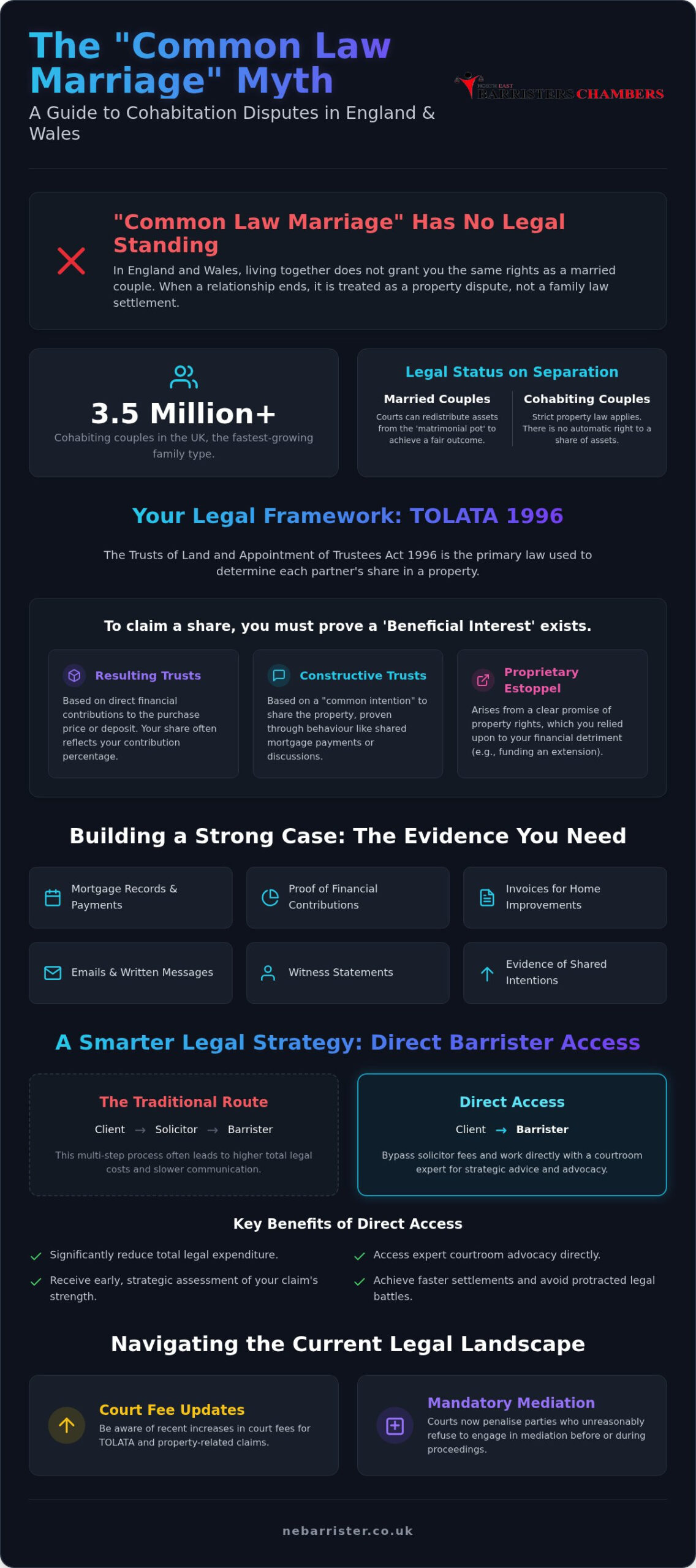
Many people believe that living together for a few years grants them the same rights as a married couple. This is a dangerous misconception. In England and Wales, the concept of “common law marriage” has no legal standing. When a cohabiting relationship ends, the law treats the dispute as a matter of property ownership rather than a family law settlement. For a more detailed look at the legal status of these relationships, Understanding Cohabitation Disputes and the Common Law Myth provides essential context on how the UK treats unmarried partners.
I define cohabitation disputes as legal disagreements over property and assets amongst unmarried partners. Unlike divorce proceedings, where the court can redistribute assets to achieve a “fair” outcome, cohabitation cases fall under strict property law. This means the court doesn’t have the power to award you a share of a house just because you lived there for a long time or raised children in it. The non-owning partner is often left in a vulnerable position, facing the potential loss of their home if they cannot prove a legal or beneficial interest.
Why Unmarried Couples Face Different Legal Challenges
The primary challenge is the lack of automatic rights. In a marriage, both parties have a claim to the matrimonial pot. In a cohabiting relationship, you rely on trust law and specific property legislation. The court’s behaviour is functional and evidence-led; it looks for “common intention” or financial contributions that suggest a trust was created. If you haven’t organised your affairs with a cohabitation agreement, you’re at the mercy of complex rules that were never designed for modern domestic life. I’ve seen many individuals shocked to learn that their partner can legally ask them to leave a property with no financial compensation at all.
The Importance of Early Expert Advice
Waiting for court proceedings to begin is a costly mistake that I encourage you to avoid. Instructing a barrister for cohabitation disputes at the start of your separation can save you thousands of pounds in unnecessary litigation. I can assess the strength of your claim early on, identifying whether you have a viable case under TOLATA or if your evidence falls short. By pinpointing the core issues before legal fees escalate, I help you make informed decisions about your future. This proactive approach often leads to faster settlements and prevents the stress of a protracted legal battle that neither party can truly afford.
TOLATA 1996: The Legal Framework for Unmarried Couples
The Trusts of Land and Appointment of Trustees Act 1996, commonly known as TOLATA 1996: The Legal Framework, is the primary legislation the court uses to resolve property disputes between unmarried partners by determining their respective shares in a home. In these proceedings, the court distinguishes between legal ownership and beneficial interest. Whilst the legal title refers to whose name is on the land registry, the beneficial interest represents the actual financial value each person is entitled to. If your name isn’t on the deed, you must prove that a trust exists to secure any portion of the property’s value.
Constructive vs Resulting Trusts
The court looks at how you and your partner behaved during the relationship to decide if a trust was formed. This usually falls into two categories:
- Resulting Trusts: These are often based on direct financial contributions to the purchase price or deposit. If you provided 20% of the funds, the law might presume you own 20% of the property.
- Constructive Trusts: These are more complex and rely on a “common intention” that both parties would share the property. I look for evidence of shared mortgage payments, significant home improvements, or specific conversations where you agreed on ownership shares.
The court interprets the behaviour of both partners to see if it’s “unconscionable” for the legal owner to deny the other person a share. It’s not about what’s fair; it’s about what was intended at the time the property was bought or during the relationship.
Proprietary Estoppel in Cohabitation Claims
Proprietary estoppel occurs when one partner makes a clear promise about property rights, and the other partner relies on that promise to their own detriment. For example, you might have spent your inheritance on a new extension because your partner promised you’d always have a home there. Proving these oral agreements in court is notoriously difficult. As a barrister for cohabitation disputes, my role is to piece together the evidence of these promises and the resulting financial loss to build a compelling case.
Recent trends in 2025 and 2026 show that courts are increasingly rigorous regarding the quality of witness evidence in these claims. Judges are also more willing to penalise parties with legal costs if they refuse to engage in mediation before reaching a hearing. If you’re unsure where you stand, seeking a professional case assessment can clarify your legal position before you commit to litigation. This early clarity is vital for protecting your investment and managing your expectations.
Why Instruct a Barrister for Cohabitation Disputes Directly?
Historically, the only way to access the expertise of the bar was through a solicitor. The Direct Access scheme has fundamentally changed this, allowing you to bypass the traditional “middleman” for many civil and family matters. When you’re dealing with a property disagreement, hiring a barrister for cohabitation disputes directly gives you a straight line to the professional who will actually represent you in front of a judge. This direct relationship is vital, especially since UK Parliament has highlighted how the Common Law Myth continues to leave thousands of people financially exposed during separations.
Cost-Effectiveness and Efficiency
One of the most immediate benefits of this modern model is the ability to reduce UK legal costs significantly. When you instruct me directly, you aren’t paying for two sets of legal professionals to review the same documents or attend the same conferences. I provide a transparent fee structure, often using fixed fees for specific stages of work, such as an initial case assessment or a court hearing. This differs from the open-ended hourly rates often associated with solicitor firms, where costs can escalate without a clear end in sight. By streamlining the process, I ensure that your budget is spent on expert advocacy rather than administrative duplication.
Direct Access to Courtroom Expertise
As a barrister, I specialise in advocacy and the strategic application of the law. By cutting out the intermediary, I handle your case from the very beginning, ensuring that every strategic decision is made with the final hearing in mind. I draft your pleadings and witness statements personally; this ensures that your evidence is presented in a way that resonates with the court. This creates a far more cohesive strategy than the traditional route, where a solicitor might prepare the paperwork and only hand it to a barrister days before the trial. Whether you need family law barrister direct access for asset division or a specialist in property trusts, the advantage is clear. You get a pragmatic, courtroom-ready professional who knows every detail of your evidence. This direct connection ensures that nothing is lost in translation between different legal offices, providing you with a robust defence of your property rights as a barrister for cohabitation disputes.
Evidence and Preparation: Building Your Cohabitation Claim
A successful TOLATA claim relies on a clear, evidenced narrative that proves your interest in a property. When you consult a barrister for cohabitation disputes, the quality of your preparation directly impacts the strength of the strategic advice you receive. You need to move beyond vague recollections of verbal promises. Instead, focus on gathering a chronological paper trail that documents your financial and emotional investment in the home. This preparation is the bedrock of your case.
Proving Financial Contributions
The court distinguishes sharply between general household expenses and direct property investment. Paying for the weekly shop or utility bills is rarely enough to establish a beneficial interest. I look for evidence of mortgage overpayments, contributions to the initial deposit, or funding for major structural renovations. Tracing the source of these funds is essential. Bank statements showing a direct transfer to a mortgage provider or a contractor provide the most robust evidence. Even small, consistent payments can be vital if they demonstrate a long-term commitment to the property’s upkeep that aligns with a shared intention to own the home together.
Non-Financial Contributions and Promises
Proving your share becomes more complex when your contribution wasn’t purely monetary. The court considers “sweat equity,” which refers to significant unpaid labour that increases a property’s value. If you spent months personally renovating a derelict kitchen or building an extension, this work can support a claim for a constructive trust. However, you must prove this work was done based on a promise of ownership. This is where “common intention” evidence becomes critical. I recommend searching through:
- Emails and text messages discussing house ownership or future security.
- Holiday cards or letters where a partner refers to the property as “ours.”
- Detailed witness statements from friends or family who overheard specific promises.
Organising these documents into a logical timeline allows a barrister for cohabitation disputes to identify the core legal issues quickly. It prevents the other party from dismissing your contributions as mere domestic assistance. If you have gathered your records and are ready to take the next step, you can book a direct access consultation to have your evidence professionally reviewed. This early assessment ensures you don’t waste time or money on a claim that lacks the necessary evidentiary foundation.
Navigating the Legal Process with North East Barristers Chambers
North East Barristers Chambers operates as a modern, agile alternative to traditional, multi-layered legal firms. I bring extensive experience across civil litigation and criminal law court representation, ensuring that every client receives high-level advocacy tailored to their specific needs. When you instruct a barrister for cohabitation disputes through our chambers, you’re choosing a streamlined path that prioritises clear communication over bureaucratic delays. I guide you through the complexities of the Direct Access scheme, making the transition from legal confusion to courtroom readiness as smooth as possible.
The process of working together is designed to be straightforward. It begins with your initial inquiry, followed by a preliminary review of your core documents. I ensure the case is suitable for direct instruction before we move forward. Once we agree on the scope of work, I provide a transparent fee quote and an engagement letter. This removes the uncertainty often found in traditional legal billing and ensures you know exactly what your investment covers from the outset.
Initial Consultation and Case Assessment
I begin every instruction with a thorough review of your evidence. I don’t believe in giving false hope; I provide an honest, pragmatic appraisal of your chances of success under TOLATA. We’ll look at your bank statements, mortgage records, and “common intention” evidence together to build a realistic roadmap for resolution. This assessment helps you understand the strengths and weaknesses of your position before any significant costs are incurred. It’s about giving you the clarity needed to make business-like decisions about your personal assets and your future.
Court Representation and Beyond
My commitment to your case extends from the first preliminary hearing to the final trial. I provide expert advocacy in the courtroom, ensuring your voice is heard and your property rights are defended by a specialist barrister for cohabitation disputes. However, litigation isn’t always the only answer. In line with the 2026 court rules, I actively assist with mediation and alternative dispute resolution (ADR). Refusing to engage in these processes can lead to severe cost penalties under current regulations, so I ensure you’re fully prepared for out-of-court negotiations. Whether we reach a settlement or proceed to a full hearing, you’ll have a seasoned professional by your side who understands both the legal theory and the practical reality of the courtroom. Contact us to discuss your cohabitation dispute today to begin protecting your property interests.
Securing Your Property Interests for the Future
Protecting your financial future starts with understanding that the law treats your shared home as a property asset rather than a matrimonial one. We’ve explored how the TOLATA 1996 framework operates and why the myth of common law marriage can be so damaging to your long-term security. By focusing on clear financial records and evidence of common intention, you can build a robust case to protect your investment and your home.
Choosing to work with a barrister for cohabitation disputes through the Direct Access scheme offers a pragmatic, cost-effective route to expert advocacy. You gain direct access to specialist family and civil barristers who provide expert court representation UK-wide. My commitment is to provide clear and transparent fee structures; this ensures you maintain control over your legal expenditure whilst receiving the highest standard of courtroom strategy.
Don’t leave your home or your savings to chance. You deserve a straightforward solution that prioritises your rights and your budget. Instruct a specialist barrister for your cohabitation dispute today and take the first step towards a fair resolution. You can move forward with confidence knowing your case is in expert hands.
Frequently Asked Questions
Can I get a share of the house if my name isn’t on the deeds?
You can claim a share of a property even if your name isn’t on the deeds by proving a beneficial interest. This usually requires showing you made financial contributions to the deposit or mortgage, or that there was a “common intention” to share ownership. Courts look for evidence of significant home improvements or verbal agreements relied upon to your detriment. A barrister for cohabitation disputes can help you identify the specific evidence needed to establish these property rights.
How much does a barrister for cohabitation disputes cost?
Fees for a barrister for cohabitation disputes vary depending on the complexity of your case and the volume of evidence involved. North East Barristers Chambers operates with a transparent fee structure; this typically includes fixed fees for specific stages such as initial conferences or court hearings. This model offers significant savings compared to traditional routes because you aren’t paying for a solicitor’s hourly rates on top of the barrister’s expertise. I provide clear quotes before any work begins.
Do I really need a solicitor for a cohabitation claim?
You don’t need a solicitor to bring or defend a cohabitation claim in the UK. Under the Direct Access scheme, you can instruct me directly to handle your advocacy, drafting, and strategic advice. This approach removes the middleman and reduces your overall legal expenditure. Whilst solicitors handle administrative tasks, a barrister focuses on the legal arguments and courtroom representation that ultimately decide the outcome of your property dispute in 2026.
What is a TOLATA claim and how long does it take?
A TOLATA claim is a legal application under the Trusts of Land and Appointment of Trustees Act 1996 to resolve disputes over property ownership. The process typically takes between six and eighteen months to reach a final trial, depending on court availability and the willingness of parties to negotiate. Many cases settle much earlier through mediation. I aim to provide a clear roadmap from the initial assessment to help you manage these timelines effectively.
Can my ex-partner kick me out of the house if we weren’t married?
Your ex-partner cannot simply kick you out without a court order if you have a legal or beneficial interest in the property. Even if you aren’t the legal owner, you may have “occupation rights” whilst a dispute is being resolved. If there is a risk of being excluded from your home, you should seek immediate legal advice. I can assist in applying for injunctions or declarations to protect your right to remain in the property during litigation.
What happens to our joint assets if we separate but aren’t married?
Joint assets held by unmarried couples are governed by property law rather than the fairness principles used in divorce. If a bank account or property is in joint names, the starting point is usually a 50/50 split. However, if one person contributed significantly more, they might argue for a larger share through a resulting or constructive trust. I help clients untangle these assets by reviewing financial records to ensure a fair and lawful distribution.
How do I prove we had a ‘common intention’ to share the property?
Proving a common intention requires a combination of documentary evidence and witness testimony. I look for emails, text messages, or letters where ownership was discussed; even holiday cards referring to “our home” can be relevant. Financial evidence such as paying for renovations or shared mortgage payments also supports this claim. A barrister uses these fragments to build a persuasive narrative for the court, showing that both parties intended to share the property’s value.
Can a barrister represent me in a cohabitation dispute mediation?
I can certainly represent you during mediation or any form of alternative dispute resolution. In 2026, the courts place a heavy emphasis on settling disputes outside the courtroom; failing to engage in mediation can result in serious legal cost penalties. Having a barrister present ensures that any settlement reached is legally sound and protects your interests. I provide the same high-level advocacy in a mediation room as I do in a formal court hearing.
