
What if living together for years still doesn’t give you the legal rights of a married couple? It’s a common assumption, but the phrase “common law marriage” doesn’t create marriage rights in the UK. If you’re searching for common law marriage rights UK 2026, the key point is that your position depends on the issue and where you live, not simply how long you’ve been together.
It’s understandable to expect a shared home, children or years of financial commitment to count for more. These facts may matter in specific legal claims, but they don’t automatically give an unmarried partner the same rights as a spouse. This guide explains what the law means for your home, finances and inheritance, and practical steps you can take to reduce uncertainty.
The rules differ between England and Wales, Scotland, and Northern Ireland. We’ll explain those differences, distinguish current law from proposed reforms, and cover steps such as making a will or recording property shares. The 2026 government consultation in England and Wales has closed, but its proposals aren’t law as of October 2026.
Key Takeaways
- Living together doesn’t create marriage rights. Identify which legal rules apply before making assumptions about your position.
- Common law marriage rights UK 2026 depend on where you live: England and Wales, Scotland, and Northern Ireland have different rules for cohabiting couples.
- If you’re concerned about a shared home, check the title deeds and how the property is owned. A dispute about beneficial interest needs to be assessed on its own facts.
- Reduce uncertainty by reviewing property arrangements, considering a cohabitation agreement, making a will, and updating pension beneficiary nominations.
- Before seeking tailored advice, gather your jurisdiction, relationship timeline, property documents, and main concern. A family-law barrister can assess the issues and advise on next steps.
Common law marriage rights in the UK: what the term really means
Living together does not, by itself, make a couple legally married. “Common law marriage” is a popular expression, not a general legal route to marriage rights in the UK. Cohabitation means living together as a couple without marrying or entering a civil partnership. It describes a relationship, but doesn’t give partners one shared set of legal rights. The consequences depend on the jurisdiction and the issue involved.
Marriage and civil partnership are formal legal statuses. Cohabitation is not another version of either, and it doesn’t automatically carry the same financial or inheritance consequences. The overview of Cohabitation in the United Kingdom provides background on the term, but a person’s legal position depends on the relevant law and their circumstances.
Does living together for years create common law marriage?
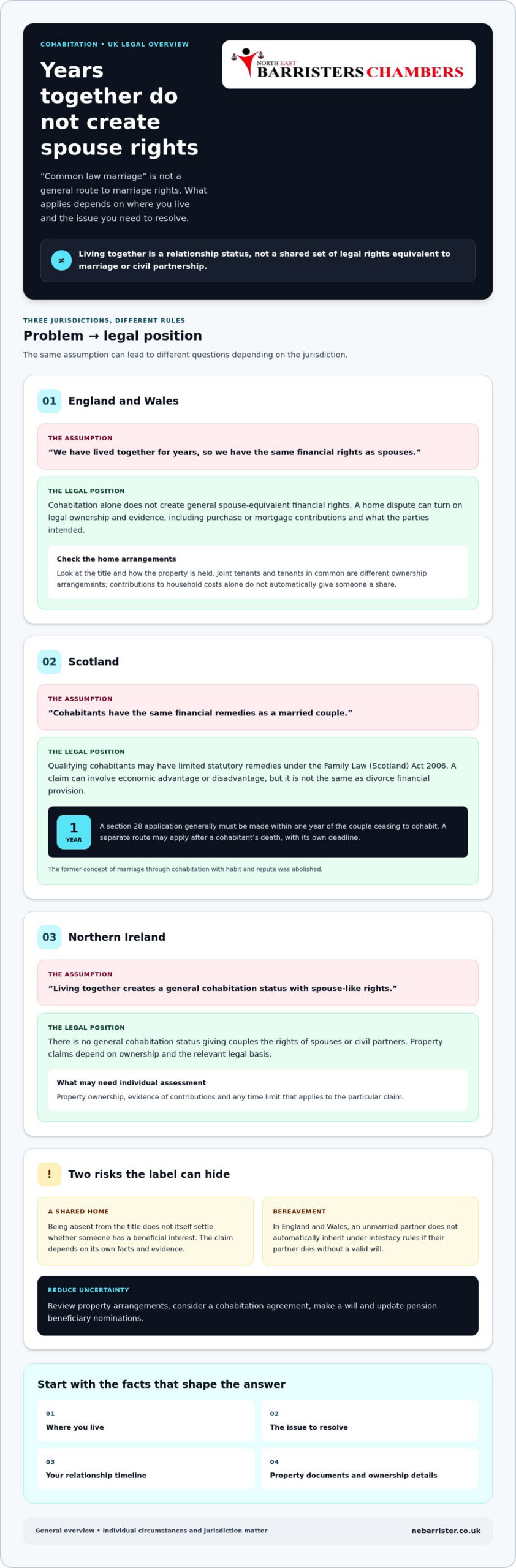
No. In England and Wales, the length of a relationship alone doesn’t make partners spouses or give them the same rights as a married couple. Sharing a surname, paying household bills together or raising children under one roof doesn’t change that status. Scotland and Northern Ireland have their own rules for cohabitants, so it’s misleading to assume one UK-wide rule. In Scotland, the former concept of marriage through cohabitation with habit and repute was abolished, although cohabitants have some limited rights under separate legislation.
Why the label can give couples a false sense of security
The risk is assuming that years together settle questions about a home, finances or what happens if one partner dies. They don’t. Outcomes can depend on legal ownership, evidence of what the partners intended, and the specific claim being made. In England and Wales, for example, a partner who isn’t named as an owner may have to establish a beneficial interest. Contributions to household costs alone don’t automatically give them a share.
Consider two couples who both contribute towards a home. One may own it jointly as joint tenants, whilst another may hold it as tenants in common, with shares recorded separately. Their contributions may look similar, but their legal arrangements differ. If there’s a dispute, the title and other evidence need to be examined.
The same mistaken label can affect bereavement planning. In England and Wales, an unmarried partner doesn’t automatically inherit under intestacy rules if their partner dies without a valid will. Scotland and Northern Ireland have distinct legal frameworks, so advice should be based on the correct jurisdiction. Understanding what “common law marriage” does not provide is a useful first step towards making informed plans.
Common law marriage rights across England and Wales, Scotland, and Northern Ireland
The phrase “common law marriage” doesn’t give cohabiting couples the same status across the UK. The common law marriage rights UK 2026 question needs a jurisdiction-specific answer, especially if you’re separating or dealing with a partner’s death.
| Jurisdiction | General position | Issues needing individual advice |
|---|---|---|
| England and Wales | No general spouse-equivalent financial rights arise from cohabitation alone. | Property ownership, possible beneficial interests, children and inheritance. |
| Scotland | Cohabitants may have limited statutory remedies under the Family Law (Scotland) Act 2006. | Eligibility, financial advantage or disadvantage, and strict application deadlines. |
| Northern Ireland | No general cohabitation status gives couples the rights of spouses or civil partners. | Property ownership, evidence of contributions and any claim-specific time limits. |
These are broad distinctions, not a decision on any individual case. Citizens Advice explains some of the legal differences for cohabiting couples, but the rules and available claims depend on where you live and what you need to resolve.
What cohabitation law generally means in England and Wales
Living together doesn’t itself create a right to a partner’s income or property. A dispute about a home usually turns on legal ownership and evidence, such as contributions to its purchase or mortgage and what the parties intended. The Trusts of Land and Appointment of Trustees Act 1996 can be relevant to disputes about interests in land, but it doesn’t create automatic rights simply because a couple cohabited.
That distinction matters: a person may have a claim about ownership without acquiring the financial remedies available on divorce. The title and supporting evidence need to be considered together.
How cohabitant claims differ in Scotland and Northern Ireland
In Scotland, the 2006 Act can allow a qualifying former cohabitant to seek financial provision when the relationship ends, including in relation to economic advantage or disadvantage. This is a limited remedy, not the same as divorce financial provision. An application under section 28 generally must be made within one year of the couple ceasing to cohabit. A separate route may apply after a cohabitant’s death, with its own deadline.
Northern Ireland has no equivalent general statutory scheme that gives cohabitants spouse-like financial rights on separation. Property claims still depend on ownership and the relevant legal basis. A family-law barrister can assess which rules apply and advise on next steps. Direct-access family law advice can help where the facts or documents are disputed.
The common-law-marriage myth: what happens to property, children, and inheritance?
Cohabitation alone doesn’t give you an automatic share of your partner’s property. If a relationship ends, the legal position usually depends on whose name is on the title, how joint ownership is recorded and, in some cases, evidence of contributions or a shared intention about ownership. Relationship length alone can’t answer the common law marriage rights UK 2026 question.
Who owns the home if an unmarried couple separates?
Start with the title deeds or Land Registry title. If only one partner owns the home, the other doesn’t automatically gain a share by living there or paying household bills. A claim to a beneficial interest may be possible in some circumstances, but the outcome depends on the evidence and applicable law.
For jointly owned property, check how the title is held. Joint tenants generally own the property together without separately defined shares; tenants in common hold specified shares, which may be unequal. Contributions and discussions about ownership can matter in a dispute, but neither guarantees a particular result. These issues differ from the financial remedies available on divorce. For that contrast, see this guide to financial remedy and divorce settlements.
What about children, inheritance, and pensions?
A child’s needs may give rise to legal routes that are separate from a parent’s personal claim to a former partner’s assets. In England and Wales, for example, a parent may be able to apply for child-related financial provision in certain circumstances. That doesn’t mean the parent gains a share of the other parent’s property for themselves. The rules and available options vary across the UK.
Cohabitation does not automatically give a surviving partner the inheritance rights of a spouse. In England and Wales, an unmarried partner generally doesn’t inherit under intestacy rules if there’s no valid will. A qualifying cohabitant may have a separate claim under the Inheritance (Provision for Family and Dependants) Act 1975, but that isn’t an automatic inheritance and depends on meeting the legal test. Scotland and Northern Ireland have distinct succession rules.
Pension benefits also need separate attention. Whether a partner can receive benefits may depend on the pension scheme’s rules, any beneficiary nomination and the law that applies. A nomination can help communicate your wishes, but it doesn’t necessarily override scheme terms.
Reform proposals don’t change the position until they become law. The UK Parliament briefing on the Cohabitation Rights Bill provides background on proposed protections. As of October 2026, the England and Wales consultation proposals described in this article have not become law, so couples should plan around the current rules.
How unmarried couples can reduce uncertainty before separation or bereavement
No single document protects every interest. A practical plan starts with understanding what you own, recording what you intend, and making arrangements for what should happen if one of you dies. The right steps depend on your circumstances and the law in the relevant UK jurisdiction.
Which documents can help clarify a couple’s intentions?
- Check the property records. Confirm whose names are on the title and, if you own a home jointly, whether you hold it as joint tenants or tenants in common. Make sure any recorded shares reflect your understanding.
- Keep clear financial records. Save evidence of substantial contributions to a deposit, mortgage or major improvements, along with records of shared finances. These documents may help explain the arrangements, but they don’t guarantee a particular legal outcome.
- Consider a cohabitation agreement. This can record how you intend to manage finances, property and other practical matters during the relationship or if it ends. Its effect depends on its wording, circumstances and applicable law, so don’t treat it as an automatic guarantee.
- Make or review your wills. A will can set out who you want to benefit from your estate. It’s an important part of planning, but may not prevent every claim against an estate and must be considered under the relevant jurisdiction’s law.
- Review pension nominations. Check whether your pension scheme allows you to nominate a partner and keep your details up to date. The scheme’s rules and applicable law affect how benefits are paid.
These steps help turn assumptions into clear records. They don’t replace tailored advice where ownership is disputed, an agreement may affect children, or the couple’s finances and property arrangements are complex.
When should you seek advice about cohabitation rights?
Consider getting advice if you’re separating, planning to sell a jointly owned home, facing bereavement, or disagreeing about who owns what. Don’t rely on a general description of common law marriage rights UK 2026 to determine your options. The jurisdiction, key dates, property documents, contributions and family circumstances can all matter. Some claims also have deadlines, which vary by claim and location.
Before speaking to a family-law barrister, gather the title documents, any written agreements, relevant financial records and a short timeline of the relationship and events. A barrister can assess the legal issues and advise on appropriate next steps. Get direct-access family law advice to understand your position.
Advice on common law marriage rights in 2026
Before acting, pin down four things: which UK jurisdiction applies, how long you’ve lived together, what the property documents say, and the issue you need to resolve. The rules for common law marriage rights UK 2026 differ across England and Wales, Scotland, and Northern Ireland. A clear summary of your circumstances can help make advice focused and practical.
What information should you organise before seeking advice?
Gather the documents and facts that show how you and your partner arranged your life and finances. You don’t need to resolve the legal question before seeking advice. Start by collecting:
- Property documents: title information, mortgage records and any declaration or agreement setting out ownership shares.
- Written agreements: cohabitation agreements or other documents recording what you agreed about money, property or separation.
- Financial records: relevant bank statements, payment records and correspondence about deposits, mortgage payments or major work on the home.
- A short timeline: when cohabitation began, important property decisions, any separation date, and relevant events following a bereavement.
- Your immediate concern: for example, who can remain in the home, how ownership should be resolved, or how a child’s needs should be addressed.
Keep the summary factual. Note what you know, what is disputed and which documents are missing. These details can help identify the applicable law and whether deadlines or urgent decisions need attention.
How a barrister can help clarify your options
A family-law barrister can assess the legal issues in light of your facts and jurisdiction, explain possible next steps, and advise on the strengths and limits of a potential claim. Where court proceedings are appropriate, a barrister may also provide representation. Not every disagreement needs to go to court; advice can help you understand the options before deciding how to proceed.
If you’re new to instructing a barrister directly, the direct access barrister services guide explains the public access route and what direct instruction involves.
If your property, financial or child-related position needs individual assessment, discuss your family-law position with a barrister. A clear account of your circumstances gives the discussion a useful starting point without assuming what the outcome should be.
Take the next step with a clear understanding of your position
Living together doesn’t create the same legal status as marriage, and the rules for unmarried couples differ across England and Wales, Scotland, and Northern Ireland. For common law marriage rights UK 2026, start by identifying the law that applies and checking what your property documents, agreements and other arrangements say.
Planning ahead can reduce uncertainty. Reviewing ownership records, making a will and keeping financial arrangements clear may help protect your position, but no single document resolves every issue. If you’re facing separation, a property disagreement or bereavement, the relevant facts and jurisdiction matter.
A family-law barrister can provide direct-access legal advice and, where appropriate, court representation. Get direct-access advice from North East Barristers Chambers about your family-law position and understand the options open to you.
Frequently Asked Questions
Is common law marriage recognised in the UK?
No current UK law gives couples a general “common law marriage” status simply because they live together. England and Wales don’t treat cohabiting couples as married, whilst Scotland and Northern Ireland have distinct rules that may provide limited rights in particular circumstances. Those rights aren’t the same as marriage. For common law marriage rights UK 2026, identify which jurisdiction applies and what specific issue you need to resolve.
How long do you have to live together to be common law married in the UK?
There’s no period of cohabitation that automatically makes you legally married anywhere in the UK. Living together for years, sharing bills or having children doesn’t create marriage status. Scotland has specific statutory rules that can apply to qualifying cohabitants, but they don’t make the couple married and may involve deadlines for claims. The legal test depends on the jurisdiction and issue, not simply the length of the relationship.
Do unmarried couples have rights to each other’s property in England and Wales?
Not automatically. Property rights usually depend on whose name is on the title and, if jointly owned, how the ownership is recorded. A partner who isn’t named as an owner may be able to argue for a beneficial interest in some circumstances, but contributions and evidence of shared intentions matter. Paying household bills or living in the property alone doesn’t guarantee a share. The facts and documents need individual assessment.
What rights does a cohabiting partner have in Scotland?
Under the Family Law (Scotland) Act 2006, a qualifying former cohabitant may seek financial provision after separation, including where one partner has gained an economic advantage or the other has suffered a disadvantage. This is not the same as divorce financial remedies. An application under section 28 generally must be made within one year after cohabitation ends. Separate provisions may apply if a cohabitant dies intestate, with their own conditions and deadline.
Can an unmarried partner inherit if their partner dies without a will?
An unmarried partner doesn’t automatically inherit as a spouse under intestacy rules. The specific succession rules depend on whether the death occurred in England and Wales, Scotland or Northern Ireland. A surviving partner may have a separate claim in some circumstances, but eligibility and time limits vary, and a claim isn’t the same as automatic inheritance. A valid will is an important way to record your wishes, though other legal claims may still be relevant.
Can a cohabiting partner claim maintenance after separation?
Usually, an unmarried partner can’t claim ongoing partner maintenance simply because the relationship has ended. That differs from the financial claims that may be available to spouses on divorce. In Scotland, a qualifying former cohabitant may apply for limited financial provision under the 2006 Act, but it isn’t equivalent to spousal maintenance. Child maintenance is separate and concerns a parent’s responsibility towards a child, not personal support for a former partner.
What is the difference between a cohabitation agreement and marriage?
A cohabitation agreement is a written record of arrangements unmarried partners make about matters such as finances, property and what should happen if they separate. Its effect depends on its wording, circumstances and applicable law. It doesn’t turn the couple into spouses or provide every right associated with marriage. Marriage is a formal legal status with a broader set of legal consequences. Individual advice can help clarify how an agreement may apply to your situation.
Do common law marriage rights differ in Northern Ireland?
Yes. Northern Ireland has its own legal system, and living together doesn’t give a couple the same general status or rights as marriage or civil partnership. Property questions may depend on legal ownership, contributions and the basis of any claim. Inheritance and other issues are also governed by Northern Ireland’s own rules. Don’t assume that an answer based on England and Wales or Scotland applies; seek advice based on the relevant jurisdiction and facts.