
Could you instruct the barrister who represents you in court without first hiring a solicitor? In many cases, yes. A public access barrister can work directly with you, putting your advocate at the centre of your case from the outset. This can mean clearer communication and a more focused use of your legal budget, without adding a solicitor’s fees where they aren’t needed.
If legal costs feel hard to predict, or you’re frustrated by having little contact with the person who will argue your case, direct access may be worth exploring. The legal system can be confusing: solicitors and barristers have different roles, and a barrister can’t undertake every task involved in a case. They must tell you if your matter would be better handled another way.
This guide explains how direct instruction works in 2026, when it may be suitable and what to check before proceeding. It also clarifies the distinction between solicitors and barristers, outlines the limits of public access and looks at court representation in criminal, family and civil law. You’ll come away with a clearer picture of whether this route could provide experienced advocacy while helping you manage your legal spend.
Key Takeaways
- A public access barrister can be instructed directly, giving you a direct line to the advocate who may represent you in court.
- Direct instruction may help reduce overall legal spend. Clarify the fees and work included before proceeding.
- Consider whether your criminal, civil or family case is suitable for public access, and whether it may need additional support.
- Prepare for an initial discussion by organising your case papers and setting out the key facts clearly.
- North East Barristers Chambers provides direct access and court representation across the UK in criminal, civil and family law.
What is a Public Access Barrister and How Does the Scheme Work?
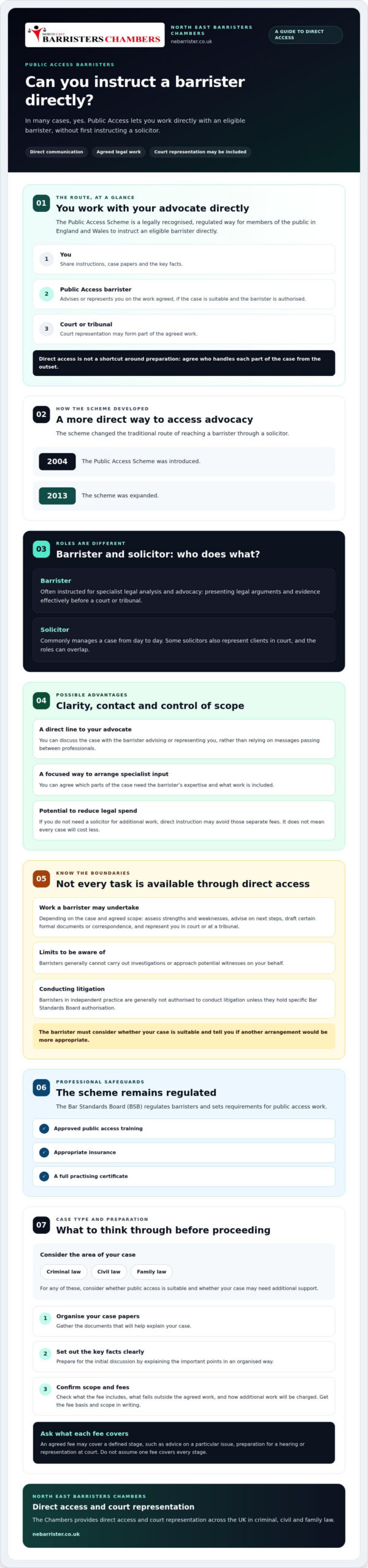
The Public Access scheme, also known as Direct Access, allows members of the public in England and Wales to instruct an eligible barrister without first instructing a solicitor. The arrangement is legally recognised and regulated. A public access barrister can work directly with you on agreed parts of your case, including court representation, if the barrister is suitably authorised and your case is appropriate for this route.
The scheme marked a shift from the traditional expectation that clients would reach a barrister through a solicitor. Introduced in 2004 and expanded in 2013, it gives the public a more direct way to access barristers’ expertise. The Public Access Scheme offers an overview of how this route developed. Its practical appeal is straightforward: you can discuss your case with the specialist handling your advocacy, rather than relying on messages passing between professionals.
Direct instruction doesn’t remove professional safeguards. The Bar Standards Board (BSB) regulates barristers and sets requirements for public access work, including approved training, appropriate insurance and a full practising certificate. Barristers must consider whether a case is suitable for direct access and tell a client if another arrangement would be more appropriate. In general, barristers in independent practice aren’t authorised to conduct litigation unless they hold specific BSB authorisation. The scheme gives you a direct route to legal expertise, but it doesn’t make every task available through a barrister.
The Role of the Public Access Barrister
Depending on the case and the agreed work, a public access barrister may assess the strengths and weaknesses of your position, advise on next steps, draft certain formal documents or correspondence, and represent you in court or at a tribunal. Their role depends on the case and the limits of public access work. For example, barristers generally can’t carry out investigations or approach potential witnesses on your behalf. Agreeing the scope at the outset helps you understand what the barrister will handle and what remains your responsibility.
Barrister vs Solicitor: Understanding the Difference
Solicitors commonly manage a case from day to day, while barristers are often instructed for specialist legal analysis and advocacy. The roles can overlap, and some solicitors also represent clients in court. A barrister’s training has a distinct focus on advocacy: presenting legal arguments and evidence effectively before a court or tribunal.
Without a solicitor acting as an intermediary, you can communicate directly with the barrister advising or representing you. This can make it easier to give instructions, ask questions and understand who is responsible for each part of the case. It isn’t a shortcut around case preparation. It’s a different way to arrange suitable legal work, with the advocate involved directly from the start.
The Benefits of Direct Instruction: Cost, Clarity, and Control
Direct instruction can simplify your relationship with your advocate. You discuss your case with the barrister who may advise you or represent you in court, rather than relying on messages passing through another professional. For individuals and small businesses, it can be a focused way to arrange specialist advocacy and decide which parts of the case need expert input.
It may also reduce overall legal spend if you don’t need a solicitor to carry out additional work. That doesn’t mean every case will cost less, or that a barrister can take on every task. Any potential saving comes from choosing and paying for the work you need, rather than automatically adding separate professional fees. Ask what is included, what falls outside the agreed work and how additional work will be charged.
How Direct Access Helps You Reduce Legal Costs
If you’re comfortable managing routine administration, you may be able to avoid paying a solicitor to organise papers or pass on instructions. A barrister can focus on the legal analysis, preparation and advocacy agreed with you. Some barristers may offer a fixed fee for a defined stage of work, while other work may be charged differently. Confirm the scope and fee basis in writing before proceeding. Our guide to reducing legal costs in the UK explains further points to consider.
A clear scope can make budgeting easier. For example, ask whether an agreed fee covers advice on a particular issue, preparation for a hearing or representation at court. Don’t assume one fee covers every stage. Check what happens if the case changes or further work becomes necessary.
Maintaining Control of Your Legal Strategy
Direct communication lets you explain your priorities in your own words and hear the barrister’s assessment without it being filtered through an intermediary. This can help you understand the choices ahead and respond promptly when decisions are needed. The barrister remains responsible for their professional advice, and direct access doesn’t guarantee a particular outcome.
Some clients manage much of the paperwork themselves and instruct a barrister for specific advice or court representation. In that arrangement, you may be described as a litigant in person, with professional support for the agreed work. Others may want the barrister involved more extensively, if that is suitable for the case. Before deciding, consider realistically how much time, organisation and confidence you can bring to the process.
North East Barristers Chambers provides direct access and court representation in criminal, civil and family law across the UK. If you’re weighing up the level of advocacy you need, explore its direct access barrister services and consider what support your case requires.
Is Your Case Suitable for Public Access? Criminal, Civil, and Family Law
Suitability depends on more than the type of case. Consider whether you can organise documents, meet court deadlines and manage communications yourself, and whether the work you need is within the barrister’s public access remit. A public access barrister can advise whether direct instruction is appropriate for your circumstances. If your case needs tasks a barrister can’t undertake, or managing it alone would be too demanding, you may need to consider other support.
Complexity isn’t measured only by the court hearing. Several parties, extensive evidence, disputed facts or ongoing case administration can make a matter harder to handle without a solicitor. A barrister must tell you if they consider a solicitor necessary for your protection. This is an important safeguard, not a sign that direct access has failed.
The court level is relevant, but it doesn’t decide suitability by itself. Direct instruction may be possible for advocacy in either the Magistrates’ Court or Crown Court, depending on the case, the barrister’s authorisation and the work required. Criminal cases in the Crown Court may involve more involved preparation and evidence, so discuss the support you need before choosing this route.
Family Law and Private Disputes
In family matters, a barrister may represent you in child arrangement proceedings or financial remedy hearings. An independent advocate can help keep the legal issues in focus when emotions are high, while explaining your position clearly to the court. If you’re considering direct instruction in a financial dispute, read about working with a financial remedy barrister.
Criminal Defence and Court Advocacy
Direct instruction may include advice on a plea, the evidence and possible mitigation, as well as representation at a hearing. The appropriate arrangement depends on the charge, procedural demands and preparation required. See the guide to criminal law court representation for more on advocacy in the Magistrates’ Court or Crown Court.
Civil Litigation and Business Disputes
Contract disputes, professional negligence claims, debt recovery and employment issues can call for focused legal analysis and advocacy. A barrister may be able to advise or represent you on agreed parts of a civil matter, but don’t assume they can manage every procedural step. For a professional negligence matter, explore this guide to a civil negligence claim. Be ready to explain the dispute, the evidence and the outcome you’re seeking.
How to Organise Your Case for Direct Instruction
Good preparation helps your barrister understand the issue quickly and focus on the legal questions that matter. Before contacting a public access barrister, gather relevant papers, note any court dates or deadlines, and decide what you want help with. You don’t need to know the legal answer, but you should present the facts as clearly as you can.
Preparing Your Documentation
Start with a timeline. List important events in date order, using brief, factual notes. Where possible, link each event to the document that supports it. If a date is uncertain, say so rather than guessing.
Organise documents into clearly labelled groups, such as court papers, contracts, emails and witness statements. Use descriptive file names and keep documents in date order. Avoid sending several versions of the same item without explaining which is current. A simple index can help you and the barrister find key material without searching through a large, unstructured bundle.
Include information that may not support your position as well as evidence that does. A balanced summary allows the barrister to assess strengths, weaknesses and possible questions. Clear organisation can reduce time spent sorting and identifying material, leaving more attention for the legal work. It doesn’t replace the barrister’s review or guarantee a particular outcome.
The Initial Enquiry and Instructions
A concise letter of instruction gives the barrister a useful starting point. It needn’t be complicated. Set out:
- Who is involved and what the dispute or charge concerns.
- The key events in date order, with references to relevant documents.
- Any court dates, deadlines or steps already taken.
- The outcome you’re seeking and the specific help you want.
Keep fact separate from opinion. If something is disputed, identify each version and the evidence you have. Don’t omit difficult facts: your barrister needs an accurate picture to advise you properly.
At an initial meeting or conference, expect to discuss the background, the papers and your objectives. Prepare questions about the legal issues, risks, next steps and what remains your responsibility. The barrister can then explain whether the proposed work is suitable for direct access and what further information is needed.
Before work begins, agree its scope and fee basis. Confirm what the fee covers, what it excludes and how additional work would be handled. This helps prevent uncertainty as the case progresses. If you’re ready to discuss your case preparation and court representation, contact North East Barristers Chambers.
Expert Advocacy with North East Barristers Chambers
Instructing a barrister directly should feel clear and practical. North East Barristers Chambers provides direct access services and court representation across the UK in criminal, civil and family law. Its work centres on specialist advocacy tailored to the case, with direct communication and a clear understanding of the work being undertaken.
You can discuss the issues with the advocate who may represent you, rather than relying on an intermediary to pass on questions and instructions. Where direct access is suitable, a public access barrister can provide representation without requiring you to instruct a solicitor. The right approach depends on your case, and the work must be agreed clearly from the outset.
Our National Reach and Expertise
You can enquire about representation for a criminal, civil or family matter from anywhere in the UK. The relevant experience matters: a criminal hearing, a family dispute and a civil claim each call for different preparation and advocacy. North East Barristers Chambers focuses on matching its expertise to the case, so you can discuss the legal issues and court work you need.
An independent practitioner can offer a direct point of contact and a focused approach. This can help keep communication practical as your case develops. It doesn’t mean every matter is suitable for direct access, or that an advocate can guarantee a particular result. The barrister should assess the work required and explain if another arrangement would better protect your interests.
Instructing Us Directly
To make an initial enquiry, set out what your case concerns, identify any upcoming hearing dates or deadlines, and explain the help you’re seeking. Relevant court papers and a concise factual summary can help the barrister understand the issue. You can then discuss whether direct instruction is appropriate, what work may be undertaken and how fees will be agreed. Ask what is included and how additional work would be handled before proceeding.
Clear logistics matter as much as legal expertise. Make sure you understand what you need to provide, what the barrister will handle and what responsibilities remain with you. This helps set realistic expectations and keeps the working relationship focused on your case.
For a fuller explanation of the process, read our direct access barrister guide. It’s a practical next step if you’re considering direct representation and want to understand what to discuss before instructing counsel.
Take the Next Step Towards Direct Representation
Instructing a public access barrister can give you direct communication with your advocate and a clearer view of the work your case needs. It may suit criminal, civil or family matters, provided the case and your circumstances are appropriate for direct access. Preparing a clear timeline, relevant documents and the outcome you’re seeking can make the first discussion more productive.
North East Barristers Chambers provides advocacy in criminal, civil and family law across the UK. Ask about the fee for the agreed work and what it covers before proceeding. The right support starts with an honest discussion about your case, the representation required and whether direct instruction is suitable.
If you’re ready to explore your options, contact North East Barristers Chambers about direct access representation. A clear first conversation can help you decide on a practical next step.
Frequently Asked Questions
Can a public access barrister do everything a solicitor can?
No. A public access barrister can provide legal advice and court representation within the agreed work, but can’t automatically carry out every task a solicitor might undertake. Barristers in independent practice generally aren’t authorised to conduct litigation unless they have specific authorisation. They also can’t typically investigate a case or approach potential witnesses on your behalf. Ask which tasks the barrister can handle and what responsibilities will remain with you.
How much does it cost to hire a barrister directly?
There’s no single fee for every case. The cost depends on the work required, the case and the fee arrangement agreed with the barrister. Ask for a clear explanation of what the fee covers, what falls outside the scope and how further work would be charged. Fixed fees may be available for defined work. Confirm the terms before instructing, including whether VAT or other expenses apply.
What happens if my case becomes too complex for direct access?
The barrister should discuss the change with you and explain whether they can continue to act within the public access rules. If the case requires work they can’t undertake, or they consider another arrangement necessary to protect your interests, they must advise you. Ask what work remains outstanding, whether any deadlines are approaching and what steps you need to take next. Don’t assume the barrister can manage every procedural task.
Do I have to represent myself at court if I hire a barrister?
No. If court representation is within the agreed work and the barrister is able to undertake it, they can appear for you and present your case. Direct access means you instruct the barrister yourself, not that you must automatically speak for yourself in court. Confirm which hearing they’ll attend, what preparation is included and what you’ll need to do before and during the proceedings.
Can I use a direct access barrister for a criminal case?
Yes, criminal matters may be suitable for direct instruction, including advice and court advocacy. Depending on the case and agreed work, a barrister may advise on issues such as plea, evidence or mitigation. Suitability depends on the complexity and the support required. Be ready to share the charge, relevant court papers and any hearing dates so the barrister can assess the work involved.
Will hiring a barrister directly affect the quality of my legal advice?
Direct instruction doesn’t mean you receive a lower standard of professional advice. Barristers are regulated by the Bar Standards Board and have professional obligations, including acting in your best interests and maintaining confidentiality. The key question is whether the barrister’s expertise and the work they can undertake fit your case. Ask about relevant experience, the proposed scope of work and any limits before deciding whether to proceed.
How do I pay a direct access barrister?
Payment arrangements depend on the barrister’s terms and the work agreed. Before instructing, ask which payment methods are accepted, when payment is due and whether the fee is fixed or calculated another way. Check whether VAT or expenses may apply, and how additional work will be charged. Get the arrangements in writing so you understand the financial commitment before the barrister starts work.
Can businesses use the public access scheme for commercial disputes?
Yes. Businesses can instruct a barrister directly for suitable civil matters, such as a contract dispute or another commercial disagreement. A barrister may advise on the legal issues or provide court representation, depending on the agreed work. However, they generally can’t conduct litigation unless specifically authorised. Before proceeding, clarify who will manage procedural steps, documents and deadlines, and whether the case is practical to handle through direct access.