
Why pay for a middleman when the specialist advocate you need is now just a phone call away? For many, the traditional legal route feels like a gauntlet of spiralling solicitor fees and impenetrable jargon. By choosing a barrister direct instruction, you cut through the complexity and take control of your legal journey. I understand that the prospect of standing in court is daunting, but you don’t have to face it alone or break the bank to get the results you deserve.
This guide will help you master the public access process so you can secure expert advocacy whilst significantly reducing your legal expenditure. I will show you how to manage your own litigation while leaning on my expertise for the moments that matter most. We will cover everything from the initial engagement to the final hearing, ensuring you have a straightforward, professional relationship that prioritises your success and clarity. By the end of this article, you will have a clear roadmap to navigate the legal system with confidence and professional support.
Key Takeaways
- Learn how the Public Access Scheme empowers you to bypass traditional solicitor routes for a more streamlined and transparent legal experience.
- Identify whether your specific case is suitable for a barrister direct instruction to ensure you receive the most effective advocacy for your situation.
- Discover how removing the solicitor as a middleman can significantly reduce your legal expenditure while providing more expert value for every pound spent.
- Master the art of drafting a clear, chronological case summary to secure faster responses and more accurate fee quotes from your advocate.
- See how a modern, agile chambers acts as your strategic partner for family, civil, and criminal law matters across the UK.
Understanding Barrister Direct Instruction: The Modern Route to Legal Success
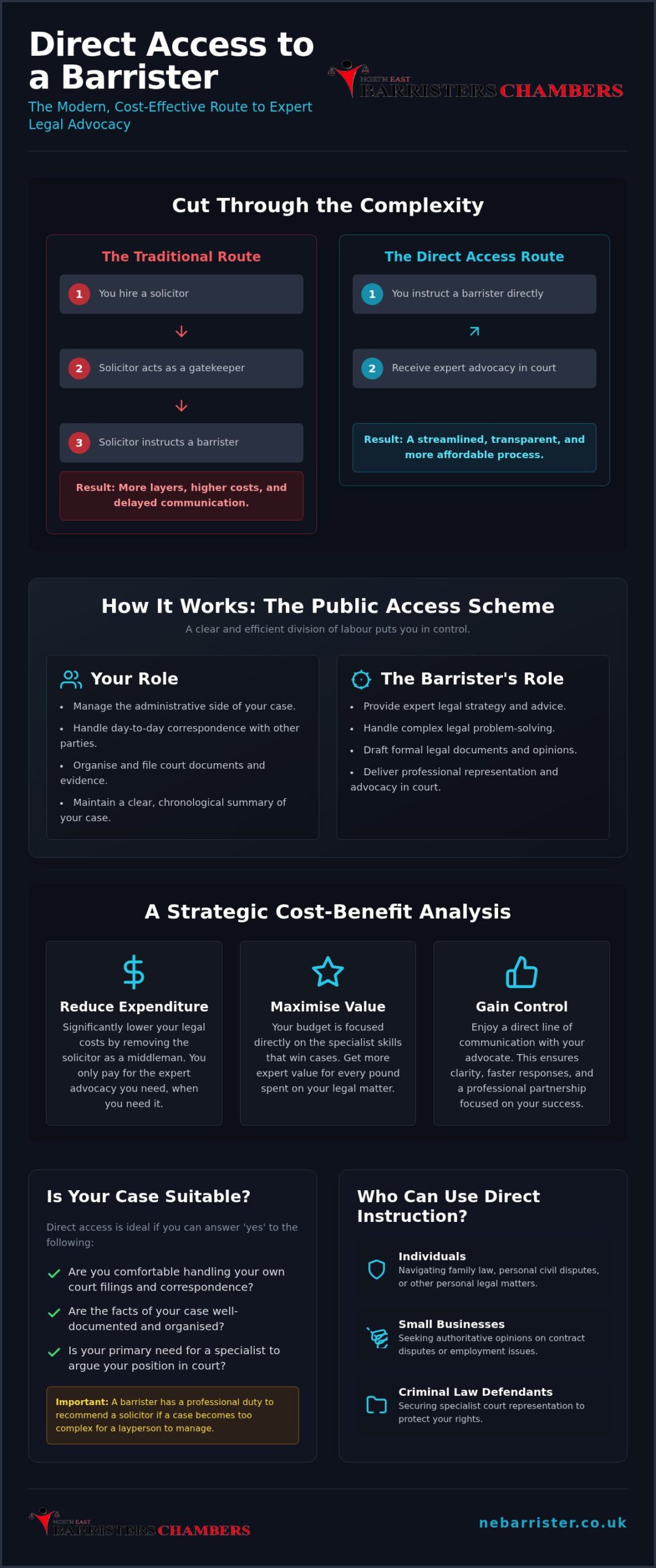
A barrister direct instruction is more than just a formal engagement; it’s a strategic partnership that puts you in control of your legal journey. Historically, the English legal system required you to hire a solicitor first, who would then act as a gatekeeper to find a barrister. This traditional model often added layers of unnecessary cost and delayed communication. The landscape has shifted. Now, you can come straight to the expert who will actually stand up for you in court, ensuring your voice is heard without being filtered through multiple parties.
By 2026, the shift towards “unbundled” legal services has become a preferred standard for efficiency and transparency. This modern approach means you only pay for the specific expertise you need, such as a formal written opinion or expert advocacy, rather than a full-service package that you might not fully utilise. It’s a pragmatic, agile solution for those who want professional results without the corporate overheads. I see this as a way to level the playing field, giving individuals and small businesses access to the same high-calibre advocacy once reserved for those with the deepest pockets.
The Public Access Scheme Explained
The Public Access Scheme framework is strictly regulated by the Bar Standards Board to ensure you receive the highest level of professional service. When you instruct me directly, the division of labour is clear and efficient. You take responsibility for the administrative side of your case, such as filing court documents and handling day-to-day correspondence. I handle the heavy lifting of legal strategy, complex problem-solving, and professional representation. This collaborative model is a primary reason why many people now choose to reduce UK legal costs through direct access. It allows you to focus your budget on the specialist skills that win cases.
Who Can Use Direct Instruction?
Direct instruction is a versatile tool available to a wide range of clients. I work with individuals navigating the emotional complexities of family law or personal civil disputes where clear, calm advocacy is vital. Small businesses also use this route to get quick, authoritative opinions on contract disputes or employment issues without the high fees of a large law firm. Additionally, if you are a defendant in a criminal case, you can secure specialist criminal law court representation to protect your rights. Whether the facts are straightforward or the stakes are high, the direct route offers a level of personal accountability and agility that traditional models simply cannot match.
The Direct Access Framework: When and How to Bypass a Solicitor
Bypassing a solicitor isn’t just about saving money; it’s about efficiency and clarity. When the facts of your case are well-documented and the primary need is for a specialist to argue your position, the direct route is often superior. Choosing to bypass a solicitor requires a pragmatic assessment of your own time and the complexity of the litigation. It is a decision that moves you away from the traditional, often slower, legal structures and into a more dynamic way of working. I see my role as providing the specialist firepower you need at the exact moment you need it. This isn’t about doing everything yourself; it’s about choosing where your budget provides the most impact.
I maintain a strict professional duty to ensure this path is always in your best interest. If a case grows too complex for a layperson to manage effectively, I am required by the Bar Standards Board to advise you to instruct a solicitor. This safety net ensures your legal rights are never compromised by the desire for cost-savings. Under the 2026 guidelines, the professional nature of a barrister direct instruction remains as robust and protected as any traditional legal engagement. You get the same high standard of care, but with a more direct line of communication.
Suitability Criteria for Your Case
Is your case ready for direct access barrister services? The answer depends on two factors: administrative capacity and the stage of the dispute. If you are comfortable handling your own court filings and managing correspondence with the opposing side, you are a strong candidate. This route is ideal for trials or specific hearings where the evidence is already gathered. I often find that well-organised clients find this process incredibly rewarding because it allows for a direct connection to the legal strategy. If the case involves heavy investigative work or managing hundreds of witnesses, I will be the first to tell you if a solicitor’s support is necessary.
The Barrister’s Role in Direct Instruction
Once we agree to proceed, our relationship is formalised through a Client Care Letter. This document is vital because it clearly defines what I will do and, just as importantly, what you will handle yourself. Under a barrister direct instruction, I provide the expert advocacy required in the courtroom and draft essential legal documents like witness statements or grounds of appeal. I act as your strategic guide, turning your evidence into a compelling legal argument whilst you maintain the day-to-day management of the file. If you are unsure about the next steps, starting a conversation today can clarify whether this agile approach is right for you.
Direct Instruction vs. Solicitor Referral: A Strategic Cost-Benefit Analysis
Choosing between a solicitor referral and a barrister direct instruction is often a choice between a traditional safety net and a modern, agile partnership. When a solicitor refers you, they handle the logistics, but they also add a layer of cost. This “middleman” fee can escalate quickly, especially in cases where the solicitor spends time simply passing information between you and your advocate. By removing this layer, you ensure that every pound of your legal budget is working harder for you. I see this as a way to focus your resources where they have the most impact: on the specialist legal brainpower that wins cases.
I often talk about the “Direct Access Premium.” This isn’t a surcharge; it’s the added value you receive when your entire fee goes directly to the person arguing your case. You aren’t paying for a law firm’s expensive city-centre office or a large administrative staff. You’re paying for expertise. Some worry that going direct means receiving a “lesser” version of legal help. This is a total misconception. I am the same advocate whether I am instructed by a solicitor or by you personally. My duty to the court and my commitment to your success remain identical regardless of the route you take.
Speed is another critical factor. In a traditional referral, communication can feel like a game of telephone. You tell the solicitor, they tell the barrister, and the answer comes back through the same slow chain. With a barrister direct instruction, we speak directly. This direct dialogue means I get the facts from the source, and you get my expert advice without delay. It’s a pragmatic way to manage a dispute that prioritises clarity and momentum.
Transparency in Legal Fees
Fixed-fee arrangements are a cornerstone of the public access model. Unlike the open-ended hourly billing common in many traditional firms, I provide budget certainty from the outset. When you know exactly what a piece of work will cost, you can plan your finances with confidence. Comparing the hourly rates of a senior partner in a law firm with a specialist barrister often reveals a surprising disparity in value. Direct access is often 30-50% more cost-effective for specific tasks like drafting witness statements or providing a formal legal opinion. You get more expertise for a lower total spend.
Control and Flexibility
The ability to “pick and choose” your level of support is a major strategic advantage. You might feel comfortable handling the initial paperwork but want me to step in for a high-stakes hearing. This flexibility allows you to stay in the driver’s seat. Many businesses find this particularly useful for civil negligence claims, where the internal team can gather evidence whilst I provide the expert analysis and advocacy. You maintain a direct line of communication, ensuring your goals and my strategy are always perfectly aligned.
A Step-by-Step Template for Your First Barrister Instruction
Preparing your first barrister direct instruction doesn’t need to be intimidating. It’s simply a matter of organisation. A clear, well-structured letter helps me understand your case quickly and allows me to provide an accurate fee quote without unnecessary back-and-forth. Think of this document as the foundation of our partnership. If the foundation is solid, the legal strategy we build on top of it will be far more effective.
I recommend following these four steps to ensure your instruction is professional and useful:
- Step 1: The Case Summary. Provide a concise, chronological narrative of the dispute. Start from the beginning and stick to the facts. A timeline of events is incredibly helpful here.
- Step 2: The Objectives. Clearly state what you want to achieve. Do you need a formal written opinion on your prospects of winning? Or do you require representation at a specific hearing?
- Step 3: The Documentation. List every relevant document you have, including previous court orders, contracts, or witness statements. Organise these so they are easy to navigate.
- Step 4: The Deadlines. Highlight any upcoming court dates or statutory time limits. I need to know these immediately to ensure I can meet your requirements.
Drafting the “Instruction to Counsel”
When you sit down to write, use a professional and factual tone. It’s natural to feel emotional about legal disputes, but I can help you best when the narrative is clear and objective. Don’t hide unfavourable facts. Full disclosure is vital; I need to know the weaknesses of your case as much as the strengths so I can protect your interests properly. If you’re sending a large volume of evidence, index it effectively. A simple table of contents for your documents saves time and ensures nothing important is missed whilst I review your file.
Key Details to Include
Ensure you include the full names of all parties involved and any case numbers already assigned by the court. I also need your preferred contact methods and your general availability for a conference, whether that’s in person or via video call. Finally, provide a specific list of questions you want me to answer in my written advice. This keeps the work focused and ensures you get the exact clarity you’re looking for. If you’re ready to move forward, you can instruct me today to begin reviewing your case details and preparing your strategy.
Choosing the Right Advocate: Why North East Barristers Chambers is Your Strategic Partner
Finding the right advocate is the final, most critical step in your legal journey. You don’t need a faceless corporate entity; you need a strategic partner who understands the practicalities of your situation. At North East Barristers Chambers, I provide expert legal minds without the archaic formality that often makes legal proceedings feel intimidating. This is what I call approachable pragmatism. It’s about being authoritative in court whilst remaining grounded and accessible to you. When you choose a barrister direct instruction through this chambers, you’re choosing an agile practitioner who adapts to your specific needs.
I’ve found that clients value this direct connection. They want someone who is mobile and modern. They want an advocate who can travel to meet them or join a video conference with minimal fuss. This agility is a hallmark of my practice. Every piece of advice I give is designed to be functional and declarative. I don’t use decorative prose or wasted space. I focus on results. This approach ensures that the professional relationship is built on reliability and a shared focus on your desired outcome.
Specialist Expertise Across the UK
My practice isn’t confined by geography or narrow specialisms. Whether you’re navigating the emotional waters of family disputes, managing a complex civil claim, or facing high-stakes criminal defence, I provide the same level of dedicated, specialist advocacy. If you’re based in the region and need a direct access barrister north east who can appear in local courts and tribunals, my practice is structured to meet that need efficiently. I have a proven track record of successful representation in courts and tribunals across the UK. Every case is handled with a commitment to clear, transparent pricing. You’ll always know where you stand, both legally and financially. This clarity is essential for a productive professional relationship that avoids the anxiety of hidden costs.
How to Get Started Today
The engagement process is designed to be as frictionless as possible. You can submit your case details via the website for a preliminary review. This isn’t a generic automated response; it’s a direct enquiry that I review to assess suitability. During our initial conference, we’ll discuss your objectives and refine the strategy we’ve built from your instruction letter. It’s a straightforward, business-like consultation that sets the tone for our work together. We’ll move quickly from defining the service to explaining the practicalities of the work. If you’re ready to take charge, you can instruct a barrister directly today to take control of your legal matter.
Take Decisive Action for Your Legal Future
Navigating the legal system doesn’t have to be a journey through a maze of high fees and confusing jargon. By mastering the barrister direct instruction process, you’ve taken the first step toward a more transparent and cost-effective legal strategy. You now understand how to bypass the traditional solicitor route, how to organise your evidence like a professional, and how to identify the cases that benefit most from this agile approach. This isn’t just about saving money; it’s about gaining direct access to the specialist advocacy you need to succeed.
I provide specialist court representation in criminal, civil, and family law with nationwide UK coverage. My commitment is to provide clear, pragmatic advice with transparent, fixed-fee options that give you total budget certainty. You don’t have to manage this alone. Whether you’re facing a complex hearing or simply need an expert written opinion, I am here to act as your strategic partner and guide. Enquire about Direct Access Barrister Services today to discuss your case and discover how we can secure the best possible outcome together. Your legal success is within reach, and I look forward to helping you achieve it.
Frequently Asked Questions
What is barrister direct instruction?
Barrister direct instruction is the formal process of engaging a specialist advocate under the Public Access Scheme without using a solicitor as a middleman. This allows you to work directly with the person who will be arguing your case in court. It’s a modern, streamlined way to access high-level legal expertise whilst maintaining personal control over your case’s direction and management.
Is it cheaper to hire a barrister directly than through a solicitor?
Generally, yes, because you avoid the additional hourly costs associated with a solicitor’s firm. By managing the administrative side of the case yourself, you ensure your budget is spent solely on specialist advocacy and expert legal opinions. This often results in a total saving on specific legal tasks compared to traditional referral routes because you aren’t paying for a solicitor’s overheads.
Can a barrister handle all types of legal cases under direct access?
A barrister can handle a vast range of matters in criminal, civil, and family law. However, certain cases, such as those involving Legal Aid or particularly complex investigative requirements, may not be suitable for the scheme. I will always conduct a preliminary review of your case details to ensure that the direct route is the most effective path for your specific situation.
Do I still need a solicitor if I have a direct access barrister?
You don’t need a solicitor if you are comfortable managing the “conduct of litigation” yourself. This means you’ll be responsible for filing documents with the court and communicating with the opposing party. If your case requires extensive day-to-day management or formal investigative powers, I may recommend that you instruct a solicitor to work alongside me to protect your interests.
What documents do I need to provide when instructing a barrister?
You should provide a clear, chronological summary of the facts and a bundle of all relevant evidence. This typically includes previous court orders, witness statements, contracts, and any correspondence with the other side. Providing an indexed set of documents allows me to review your case more efficiently and provide a more accurate assessment of your legal prospects from the outset.
Can a direct access barrister go to court for me?
Yes, representing you in court is the primary function of a barrister. Whether you’re attending a preliminary hearing, a full trial, or an employment tribunal, I can provide professional advocacy on your behalf. My role is to present your case persuasively and ensure your voice is heard clearly by the judge or panel, regardless of the complexity of the matter.
How are barrister fees calculated for direct instruction?
For a barrister direct instruction, fees are usually structured as fixed amounts for specific pieces of work. This might include a fixed fee for a written opinion or a brief fee for a day in court. This approach provides you with total budget certainty, as you know exactly what the costs will be before the work begins, avoiding the uncertainty of open-ended hourly rates.
What happens if my case becomes too complex for direct access?
If a case becomes too complex for you to manage the administrative side effectively, I am professionally required to advise you to instruct a solicitor. This safety net ensures that your legal rights are always protected. If the litigation becomes overwhelming, I’ll help you transition to a model where a solicitor handles the paperwork whilst I continue to provide the specialist advocacy in court.
