
What if a fixed fee gives you certainty about the price, but not about what your barrister will actually do? That is the key question when considering barrister fixed fee representation. It is reasonable to want control over legal spending, but quotes can cover very different work. A hearing fee, for example, may not include preparation or further hearings.
This guide explains how to check what a fixed-fee agreement covers, what may cost extra and which questions to ask before you instruct a barrister. You will also learn when direct access may be suitable, allowing you to instruct a barrister without a solicitor, and when your case may need additional support.
We look at the tasks a fee might cover, from advice and preparation to representation at court, and what to confirm about exclusions, VAT and changes to the work. The aim is to help you compare quotes on a like-for-like basis and decide whether a fixed fee fits your case. A fee brings clarity only when the agreed work is clear.
Key Takeaways
- Check whether the quote is a fixed fee, staged fee or estimate, and identify the specific work it covers.
- Use a written scope to confirm preparation, hearing coverage, VAT, disbursements and possible extra charges.
- Compare barrister fixed fee representation quotes by the work included, not just the headline figure.
- Consider whether direct access suits your case and whether you can manage tasks not covered by the barrister.
- Prepare a short case summary, key dates and relevant documents so you can discuss the proposed work clearly before instructing.
What does barrister fixed fee representation mean?
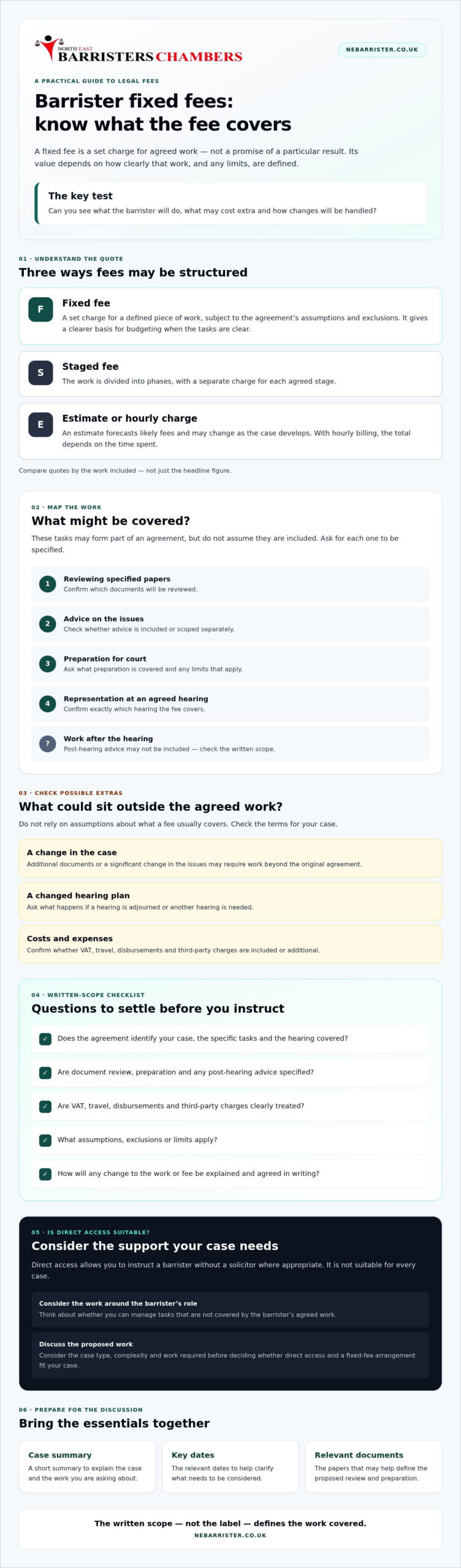
Barrister fixed fee representation means agreeing a charge for a defined piece of legal work. This might be advice on a particular issue or representation at an agreed hearing. The fee pays for the work, not a particular result. No fee structure can guarantee how a court will decide a case.
A fixed fee differs from other ways of charging. With hourly billing, the total depends on the time spent. A staged fee divides the work into phases, with a separate charge for each agreed stage. An estimate forecasts likely fees rather than setting a charge for defined work. A fixed fee gives you a clearer basis for budgeting only if you know exactly which tasks it covers.
The case type, complexity and work required all matter. A hearing with a clear, limited scope may be easier to define than a case where the issues, evidence or number of hearings could change. Direct access allows you to instruct a barrister without a solicitor where appropriate. The Barristers in England and Wales overview explains the barrister’s role and refers to the Public Access Scheme. Direct access and fixed-fee arrangements are not suitable for every case, so discuss the proposed work before deciding.
What work might a fixed-fee representation agreement cover?
Depending on the case and agreement, the work might include reviewing specified papers, advising on the issues, preparing for court and appearing at an agreed hearing. Do not assume these tasks are included. A fee for appearing at a hearing, for example, may not cover preparation or advice afterwards.
Ask the barrister to set out the tasks and limits in writing. Check whether preparation, the hearing itself and any post-hearing advice are included. Also confirm what happens if the hearing is adjourned or the work changes. The written scope is what makes the fee meaningful.
How is a fixed fee different from an estimate?
An estimate forecasts what the work may cost, but the eventual fee can change as the case develops. A fixed fee applies to the work agreed, subject to the assumptions and exclusions in the agreement. Ask what would trigger an additional charge, and confirm the VAT treatment and any expenses directly with the barrister.
A fixed fee is a set charge for agreed work; an estimate forecasts likely fees; an hourly charge depends on time spent. Keep that distinction in mind when comparing options. A clear agreement helps you understand both the price and the work you can expect.
What should a barrister fixed fee include and exclude?
A quote is useful only if it makes clear what the fee buys. Ask for the proposed work to be recorded in writing, with enough detail to identify your case, the legal tasks covered and any hearing included. It should also state the assumptions the fee depends on, such as which documents will be provided or which issues are expected to be considered. This gives you a basis for checking whether the quote matches what you need.
Look beyond the word “representation”. It might mean advocacy at one agreed hearing, while preparation, advice or drafting is scoped separately. Confirm whether the fee includes VAT, travel, disbursements and any third-party charges, or whether these are additional. Do not assume a charge is included or excluded without checking the written terms.
Which questions clarify the agreed scope?
Ask which papers the barrister will review and how much preparation is covered. Check whether advice, document drafting, conferences and advocacy are included or quoted separately. If the case changes, ask how the barrister will explain any revised work and fee, and whether you will receive the change in writing before proceeding.
Use this checklist when reviewing a proposed fee:
- Does it identify the case, agreed tasks and hearing covered?
- Are document review, preparation and any post-hearing advice specified?
- Is VAT included, and how are travel, disbursements and third-party charges treated?
- What assumptions, exclusions or limits apply?
- What happens if there is an adjournment, another hearing or a material change to the case?
- How will any change to the work or fee be agreed?
What can fall outside a fixed fee?
Extra hearings, adjournments, additional documents or a significant change in the issues may require work beyond the original agreement. They are not always excluded, so check the terms for your case rather than relying on assumptions about what a barrister’s fee usually covers.
The written scope, not the label, defines the work covered. That is the practical test for barrister fixed fee representation: can you see what the barrister will do, what may cost extra and how changes will be handled? If you are unsure, raise each point before instructing. You can also use this checklist to discuss your proposed fee scope and clarify what is included.
How to compare fixed-fee barrister representation fairly
Two quotes are comparable only if they cover similar work. One may include reviewing papers and preparing for a hearing; another may cover advocacy only. Compare the same case stage, hearing type and expected tasks before weighing the headline fee. If a quote is unclear, ask for the details in writing instead of filling gaps with assumptions.
Use a simple table to record what each barrister has proposed. Mark each detail as “included”, “excluded” or “to be confirmed” so you can see where the differences lie.
| Compare | What to check |
|---|---|
| Scope | Which case stage and legal tasks are covered? |
| Preparation | Which documents will be reviewed, and what preparation is included? |
| Hearing | Does the fee cover the same type of hearing and the same attendance? |
| VAT and expenses | Are VAT, travel and disbursements included, excluded or unconfirmed? |
| Changes | What happens if the hearing is adjourned or the case changes? |
| Experience and fit | Does the barrister have relevant experience for the legal issues and hearing? |
Which fee details belong in a like-for-like comparison?
Check that each quote relates to the same stage of your case and a comparable hearing. Note whether preparation is limited by the papers or information provided, and whether expenses and VAT are treated consistently. Ask how an adjournment or a material change would affect the work and fee. If those terms are unclear, the quotes are not yet like for like.
Experience matters too, but it is not a promise of success. Ask about the barrister’s experience with the relevant area of law and type of hearing, then consider how clearly they explain the proposed work. The right comparison takes suitability as well as cost into account.
Does a fixed fee mean the case will cost no more?
A fixed fee applies to the work and assumptions agreed. If new issues arise or further work is needed, the barrister may propose a separate agreement. That is not inevitable, but you should understand how changes would be discussed and approved before instructing.
A clear scope matters more than a fixed-fee label because it shows what the agreed charge actually covers. For more ways to assess the direct access route and manage legal spending, read our guide to reducing UK legal costs with direct access. Comparing like with like helps you judge the value of barrister fixed fee representation without assuming the lowest quote is the best fit.
Is direct access fixed-fee representation suitable for your case?
Direct access lets you instruct a barrister yourself, without a solicitor, where the route is permitted and appropriate. Whether it suits you depends on the case, the work needed and your ability to handle tasks outside the barrister’s agreed role. A fixed fee can help define a specific piece of work, but it does not by itself make a case suitable for direct access.
Start by considering what help you need. If your main requirement is advice or advocacy at a particular hearing, direct access may be worth discussing. If the case involves extensive procedural administration or several stages that need coordinating, ask who will handle each task. Barristers provide legal advice and advocacy, but they do not automatically provide solicitor services or conduct litigation. Make sure the role and any limits are clear from the outset.
What responsibilities may remain with the client?
Depending on the agreement, you may need to gather and organise documents, give instructions, keep track of dates and manage case administration. Ask the barrister to identify any procedural tasks outside the proposed representation. Be realistic about whether you can complete them accurately and on time. If you are unsure, raise that before agreeing the scope rather than assuming the barrister will take on tasks that have not been discussed.
When might other legal support be needed?
Complex procedural requirements, multiple connected issues or substantial ongoing case administration may mean you need support beyond the barrister’s agreed work. The barrister can discuss whether your requested tasks fit their role and whether another form of legal support may be needed. This is a case-specific decision, not a reason to rule out direct access in every complex matter.
Check the jurisdiction and court process that apply to your case, as well as the court coverage and work the barrister is able to undertake. The details may differ between matters. For examples of how direct access may apply, read the guides to criminal law court representation and financial remedy representation.
Before deciding, write down the tasks you expect to manage yourself and those you want the barrister to cover. This makes it easier to assess whether barrister fixed fee representation fits both the case and your circumstances. Discuss your case and the proposed work before instructing.
How to instruct a barrister for fixed-fee representation
A clear enquiry helps the barrister assess whether they can take on the work and what a defined fee might cover. You do not need to send every document straight away. Start with a concise summary, key dates and the help you are seeking.
What information should you prepare before enquiring?
Gather a brief timeline, relevant court details, upcoming deadlines and the outcome you are seeking. List the documents you have, such as court papers or key correspondence, and flag any urgent procedural dates. Do not send sensitive material until the barrister has explained how to submit it securely.
You can then follow a straightforward process:
- Make an initial enquiry. Summarise the case, the legal issue and the representation or advice you are looking for.
- Complete conflict checks. Provide the names and details requested so the barrister can check whether they are able to consider the matter.
- Discuss suitability and availability. Confirm that the barrister can undertake the proposed work, is available for relevant dates and has appropriate experience and court coverage for your case.
- Agree the scope. Identify the specific tasks, preparation and hearing, if applicable. Clarify what you will manage yourself and what sits outside the proposed work.
- Review the written terms. Check the fee, VAT treatment, assumptions, exclusions and how any additional work or changed circumstances will be discussed.
- Confirm instruction. Proceed only once you understand and accept the written agreement and know what information or documents are needed next.
What should the written agreement confirm?
Before accepting, make sure the agreement describes the case and work precisely. Check that it records the agreed fee and whether VAT is included, along with relevant assumptions and exclusions. It should also explain how further work will be discussed and agreed if the case develops or the original scope changes. If any term is unclear, ask for an explanation before you commit.
This process helps you assess whether barrister fixed fee representation suits your needs, rather than relying on a headline fee alone. North East Barristers Chambers provides direct access legal advice and court representation in criminal, civil and family matters, where appropriate. You can discuss your case and ask about representation, including the proposed scope and fee terms, before deciding how to proceed.
Make your next step with greater clarity
A fixed fee is useful when you understand the work it covers. Before you instruct, check the written scope, VAT treatment and any exclusions, then compare quotes based on the same tasks and hearing requirements. The fee label alone will not tell you whether an arrangement fits your case.
Barrister fixed fee representation may suit a defined piece of work, but direct access is not right for every case or every client. Consider what you can manage yourself and confirm whether the barrister can undertake the work you need.
North East Barristers Chambers provides direct access legal advice and court representation to individuals and businesses across the UK, with services in criminal, civil and family law. You can discuss your case and clarify the proposed fee scope before deciding whether to proceed.
A clear conversation can help you understand your options and take the next step with confidence.
Frequently Asked Questions
What is barrister fixed fee representation?
Barrister fixed fee representation is an agreed charge for specific legal work, such as reviewing defined papers, giving advice or representing you at an agreed hearing. It covers the work described in the agreement, not a particular result. Before accepting, check the tasks, assumptions and exclusions in writing. This helps you understand what the fee covers and identify circumstances, such as extra hearings or changed instructions, that may need separate discussion.
Does a fixed fee include court representation and preparation?
Not necessarily. A fixed fee may cover preparation and advocacy at an agreed hearing, or it may cover only one of those tasks. Check what documents the barrister will review, what preparation is included and which hearing the fee relates to. Ask whether conferences, drafting and advice after the hearing are included too. The written agreement should set out the scope so you can see what work is covered before you instruct.
Can a barrister offer a fixed fee for any type of case?
No. Whether a fixed fee is suitable depends on the case, its complexity and whether the required work can be clearly defined. A specific task or hearing may have a more identifiable scope than work that could expand as issues develop. A barrister can discuss whether a fixed fee is appropriate for the work you need. Confirm what happens if the case changes, and do not assume every matter can be offered on this basis.
Can I instruct a barrister directly without a solicitor?
In some cases, you can instruct a barrister directly without a solicitor. This is known as direct access, and suitability depends on your case and the work required. The barrister can explain whether they can undertake the requested advice or court representation and what tasks may remain your responsibility. Direct access does not mean solicitor services are included. Confirm the relevant jurisdiction, court process and any limits on the work before proceeding.
Can a fixed fee change after I have instructed a barrister?
The agreed fee applies to the work and assumptions set out in your agreement. If the case changes, extra work is needed or another hearing is required, the original fee may not cover it. Check the terms for how additional work will be identified and priced. Ask the barrister to explain any proposed change and agree the revised scope and fee with you before the additional work proceeds, where possible.
Does a barrister fixed fee include VAT and other expenses?
It depends on the terms of the quote. Check whether the stated fee includes VAT or whether VAT will be added, and ask how travel, disbursements and third-party charges are treated. These costs may be addressed separately from the barrister’s fee, so do not rely on the headline figure alone. Ask for included or excluded expenses to be identified in writing, and clarify anything marked as unconfirmed before accepting the quote.
How do I compare fixed-fee barrister quotes?
Compare quotes for the same case stage, hearing type and expected work. Record what each includes for document review, preparation and advocacy, then check VAT, expenses, exclusions and terms for adjournments or changes. Consider the barrister’s relevant experience and fit for your case, not just the headline figure. If a quote is unclear, ask for a written breakdown. A lower fee may cover less work, so compare the agreed scope as well as the price.