
Can a barrister represent you in an Employment Tribunal without a solicitor? Yes. A barrister for employment tribunal matters can advise on your case and represent you at a hearing through direct access. The important question is whether that route suits your claim and the work you need done.
Tribunal procedure, advocacy and the tasks you must manage can feel unfamiliar. Effective representation starts well before the hearing, with a clear understanding of the issues, relevant documents and preparation required. Direct instruction can provide focused legal support, but you should understand what your barrister will handle and what remains your responsibility.
This guide explains what an Employment Tribunal barrister can do before, during and after a hearing, when direct representation may suit your circumstances, and how to prepare for your next step. It also covers the key dates, documents and information to organise so you can approach the process with clearer expectations.
Key Takeaways
- A barrister for employment tribunal cases can advise on your claim, represent you at a hearing, or support both stages, depending on the work agreed.
- Direct access and solicitor-led support involve different case-management responsibilities. The right fit depends on your case’s complexity and the procedural steps you can manage.
- Build a clear timeline of events and gather relevant documents, checking that dates, names and records are consistent.
- Before proceeding, summarise the dispute, share key documents and identify your case stage so the proposed work and responsibilities are clear.
When can a barrister for an employment tribunal help with your case?
A workplace dispute can be difficult enough before it becomes a formal tribunal claim. Once legal documents, evidence and hearing dates are involved, it may be hard to know what support would help most. A barrister for employment tribunal matters can assess the issues, advise you, represent you, or assist at several stages. Start by identifying the work your case needs, rather than focusing only on how soon the hearing is.
This applies whether you’re an employee or worker bringing a claim, or an employer responding to one. Your position will shape the questions to examine. A claimant may need to assess whether the evidence supports the complaint, while an employer may need to consider its response and prepare its evidence. In either case, the right support depends on the claim, its current stage and the tasks you want the barrister to undertake.
What employment tribunal cases may involve
Employment tribunals hear certain workplace disputes, but not every disagreement at work belongs there. Examples of claims include unfair dismissal, discrimination and unpaid wages. The relevant facts and legal questions vary. A dismissal dispute may turn on the events and reasons surrounding the decision, while a discrimination claim may involve evidence about treatment and its connection to a protected characteristic.
An unpaid wages dispute may require close attention to what was due and what was paid. These are examples, not a complete list. The label given to a disagreement doesn’t establish by itself that a tribunal claim is available or suitable. The Employment tribunals in the UK overview provides background on the tribunal system, but your circumstances need to be considered on their own facts.
What the barrister’s role can include
A barrister can analyse the information available, explain the legal issues in plain English and advise on possible strengths, weaknesses and next steps. A review may help you identify which evidence matters, what needs clarification and whether further preparation is required. Advice can be useful before a claim is issued, while a response is being prepared, or as the hearing approaches.
If representation is part of the agreed work, the barrister can present your case and address the tribunal on your behalf. Tribunal advocacy means putting your position, evidence and legal arguments before the tribunal clearly, and responding to the issues it must decide. It is professional representation, not a promise of a particular result.
Timing matters. Early advice may help clarify the issues and plan a proportionate response. Focused preparation closer to the hearing may be more useful if your main need is presenting evidence. Some people need advice only, others need advocacy, and some benefit from both. Agreeing the scope of work makes clear which tasks the barrister will undertake and which procedural or preparation responsibilities remain with you.
What does an employment tribunal barrister do before and during a hearing?
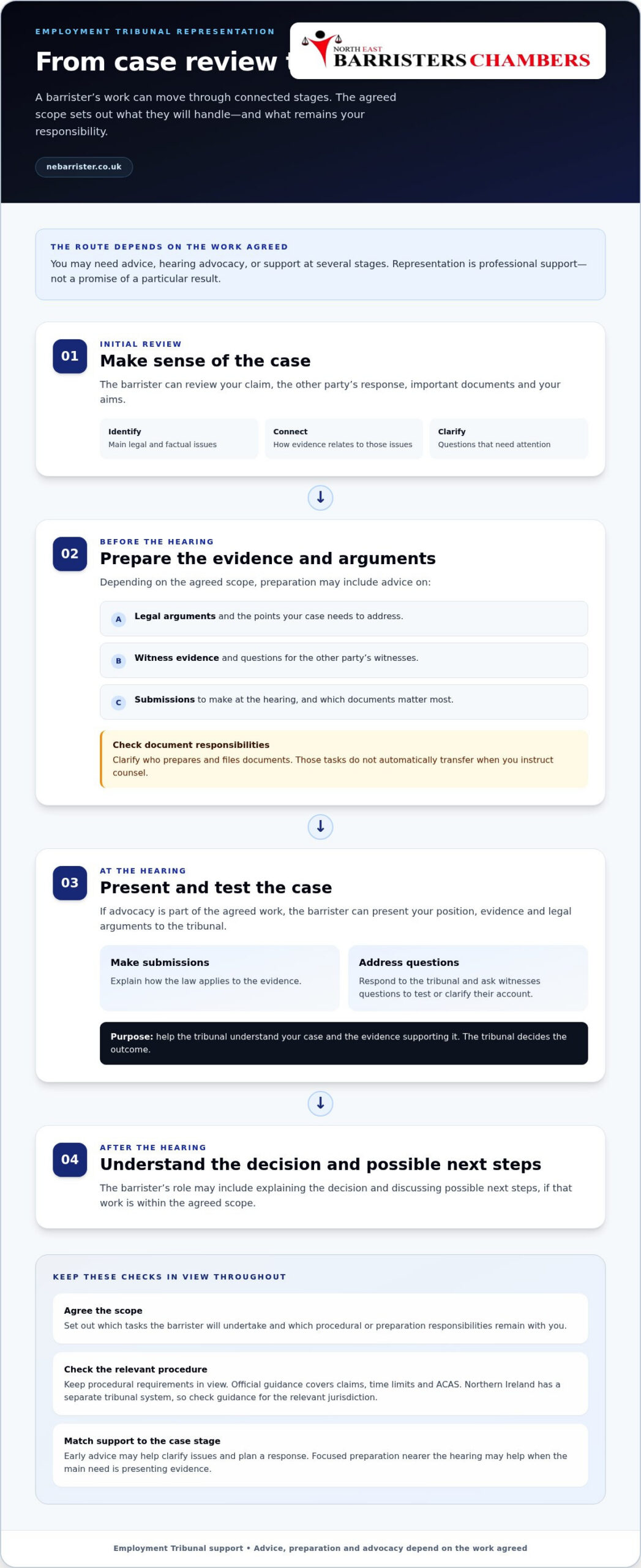
Tribunal representation involves connected tasks, from understanding the case to presenting it clearly. A barrister for employment tribunal work can advise on specific stages or support you from an initial review through to the hearing. The agreed scope determines what the barrister will do, what you’ll need to prepare and who is responsible for each document or procedural step.
Initial review and advice
The barrister can review the claim, the other party’s response, important documents and your aims. They can identify the main legal and factual issues, explain how the evidence relates to them and advise on questions that need attention. This can turn a large bundle of emails, letters and notes into a clearer account of the points the tribunal may need to decide.
Preparation before the hearing
Preparation focuses on what will help present those issues. Depending on the agreed scope, this may include advice on legal arguments, witness evidence, questions for the other party’s witnesses or submissions to make at the hearing. You may also receive guidance on which documents matter most and how they support a particular point. Clarify who is responsible for preparing and filing documents. Those tasks don’t automatically transfer simply because you’ve instructed counsel.
Keep procedural requirements in view alongside the substance of your case. The Official guidance on employment tribunal claims explains key information about claims, time limits and ACAS. Procedure can depend on where the case is heard. Northern Ireland has a separate tribunal system, so check guidance for the relevant jurisdiction rather than assuming every detail applies across the UK.
Advocacy at the hearing
At the hearing, an advocate presents submissions: concise arguments about how the law applies to the evidence. They may address the tribunal’s questions and ask witnesses questions to test or clarify their account. Witness evidence is information a person gives about what they saw, did or experienced. The barrister’s role is to help the tribunal understand your case and the evidence supporting it.
Advocacy means presenting and testing the case before the tribunal; it cannot guarantee the tribunal’s decision. The hearing format and issues covered depend on the case, so preparation should focus on the directions and questions in your proceedings.
After the hearing
After the hearing, the barrister’s role may include explaining the decision and discussing possible next steps, if that work is within the agreed scope. Before instructing a direct access employment tribunal barrister, set out the stage your case has reached and the support you need. Agreeing what preparation, advocacy and follow-up involve helps make responsibilities clear and practical.
Direct access or solicitor: which route fits an employment tribunal case?
You don’t have to assume that every Employment Tribunal case must begin with a solicitor. Direct access allows you to instruct a barrister yourself for agreed legal advice or representation. A solicitor-led route is another option: the solicitor typically manages the wider case and involves a barrister when specialist advice or advocacy is needed. Neither route is automatically better. Consider who will do the work your case requires and whether you can manage the responsibilities that remain yours.
What direct instruction changes for the client
With direct access, you communicate with the barrister about the work you’ve agreed. This can make the distinction between legal advice and your own case administration clearer, but it doesn’t mean every task is automatically handled for you. Depending on the arrangement, you may remain responsible for organising documents, keeping track of tribunal correspondence and completing filing tasks.
Agree the scope at the start. Clarify which tasks are included, what information you need to provide, who will handle each procedural step and how you’ll communicate about deadlines. A direct access barrister guide explains how this way of instructing counsel works. The Bar Council also provides information about the role of barristers in employment law.
When a solicitor-led route may be worth considering
A solicitor-led arrangement may suit someone who needs extensive ongoing case administration, help coordinating different types of legal work or regular support with procedural tasks. It may also be worth considering if the case involves substantial evidence or complex issues and you have limited time to manage correspondence and preparation yourself. The value of this route depends on the support needed, not simply on how serious the dispute feels.
Compare the practical responsibilities before deciding:
- Tasks: Direct instruction can focus on defined advice or advocacy. A solicitor-led arrangement may cover broader case management, with a barrister brought in for particular work.
- Communication: With direct access, you discuss the agreed work with the barrister. In a solicitor-led route, the solicitor may coordinate communication and preparation.
- Administration: With direct access, you may need to manage more of the paperwork and tribunal timetable yourself. In a solicitor-led arrangement, administrative support may form part of the agreed work.
Think honestly about the case’s complexity and your capacity. Can you keep on top of the steps and deadlines while preparing evidence and managing work or personal commitments? If so, focused advice or representation from a barrister for employment tribunal matters may fit your needs. If coordinating the case would be difficult, a route with wider case-management support may be more suitable. The right choice depends on the work involved, the time you have available and the responsibilities you’re comfortable taking on.
How to prepare for employment tribunal representation
Good preparation helps a barrister understand the dispute and focus advice on the issues that matter. You don’t need to resolve every legal question before seeking help. Start by organising what you have, noting what’s missing and setting out what you need the tribunal to decide.
Documents and information to organise
Work through these steps in order. A clear, organised file is more useful than a large bundle without explanation.
- Collect the key case papers. Gather your claim or response, tribunal correspondence and any orders or directions you’ve received. Add relevant employment documents, such as your contract, payslips, workplace policies, emails, letters, meeting notes and records linked to the dispute. Keep original files where possible.
- Build a concise chronology. List events in date order, noting the people involved and briefly describing what happened. Separate what you know from a document or direct observation from what you remember, were told or believe. If you’re unsure of a date, mark it as approximate rather than presenting it as certain.
- Label and organise your records. Use clear file names that identify the date and subject, such as “12 March, meeting notes”. Group related documents and note where each came from. This makes it easier to connect a record to an event and spot conflicting dates, names or accounts.
- Record gaps and questions. Note documents you expected to find but can’t locate, missing dates, unclear wording and information you may need from someone else. Don’t fill gaps with assumptions. Flag them for discussion so they can be assessed accurately.
Questions to resolve before the hearing
Once your materials are in order, identify the decisions and evidence that matter. Write down the outcome you’re seeking and the points you and the other party disagree about. For each disputed point, note the document or witness that may help explain it. This gives a barrister for employment tribunal proceedings a focused starting point for advice.
- What do you want the tribunal to decide? Summarise your main points without trying to write a full legal argument.
- Which facts are disputed? Separate agreed events from contested accounts and identify what evidence could clarify each disagreement.
- Who may have relevant evidence? List potential witnesses and briefly note what each person saw, heard, did or recorded. Avoid assuming what a witness will say.
- What needs checking next? Note deadlines, hearing directions and procedural requirements. Check current official guidance and the documents issued in your case, as requirements can depend on the tribunal and jurisdiction.
Focused preparation can make legal advice more productive by directing attention to the real issues and gaps. This guide to reducing UK legal costs also explains why planning the work carefully matters. If you’ve organised your papers and want advice on the next step, discuss direct access employment tribunal support.
How to take the next step with a barrister for an employment tribunal
Once you’ve gathered the basics of your case, the next step can be a focused conversation about the help you need. You don’t need to have every detail resolved first. A concise summary, a few key documents and a clear note of your case stage can help clarify the work involved and what should happen next.
What to include in an initial enquiry
Prepare a short outline rather than sending a long narrative. Include your role in the dispute, what happened, the main issue and what you’re hoping to achieve. Keep the facts distinct from your interpretation of them. This gives the barrister a starting point without assuming what the evidence or legal position will show.
Include the key dates and procedural information you have available:
- Case stage: Say whether you’re considering a claim, have submitted one, are responding to a claim or have a hearing listed.
- Important dates: Note the events behind the dispute, any upcoming hearing and any deadline or tribunal direction you’re aware of. Check dates and procedural requirements against current official guidance and your tribunal correspondence, as they can depend on the claim and jurisdiction.
- Relevant papers: Identify documents such as the claim or response, tribunal orders, key correspondence and records central to the dispute. Share documents through an appropriate secure channel and avoid sending unrelated personal information.
- Your main questions: List what you need advice on, such as the issues in dispute, preparation priorities or representation at a particular hearing.
Clear, consistent information helps keep the discussion focused. If you’re unsure about a date or document, say so rather than guessing. Flagging an uncertainty is more useful than presenting an estimate as confirmed fact.
Agreeing the scope and moving forward
Before instructing a barrister, make sure you understand the proposed work and its limits. It may include advice on particular issues, help preparing for a hearing or advocacy on the day. Clarify what you’ll need to do yourself, who is responsible for case administration or filing, and how communication will work as the matter progresses.
Discuss the fee arrangements before proceeding, including which work they cover and how additional tasks would be agreed. The scope should reflect the stage and needs of your case, rather than assume every matter requires the same support. A barrister can provide practical advice and representation, but no discussion can promise a particular tribunal decision.
If you’re ready to explore direct access support, discuss your employment tribunal matter. Sharing a brief summary and the key papers you have can help start a clear conversation about the next step.
Make your next step a considered one
You don’t need every answer before seeking legal support. Decide what you need help with now, whether that’s understanding a difficult point, preparing for a hearing or considering your options. A clear focus helps you assess whether the proposed work matches your priorities.
Choosing a barrister for employment tribunal support is a practical decision, not a commitment to a particular outcome. You can take it one stage at a time, with a clear understanding of the work and responsibilities involved. If you’re ready to explore your options, discuss your employment tribunal matter with North East Barristers Chambers. A clear next step can make the process feel more manageable.
Frequently Asked Questions
Can a barrister represent me at an employment tribunal without a solicitor?
Yes, in suitable cases you can instruct a barrister directly through the Public Access scheme. A barrister for employment tribunal proceedings may advise you, prepare agreed parts of your case or represent you at a hearing. Direct instruction doesn’t automatically transfer every procedural task, such as filing documents or monitoring tribunal correspondence. Before proceeding, clarify the work included, what you’ll manage yourself and whether the proposed support fits your case.
How much time do I have to make an employment tribunal claim?
It depends on the claim and when the events giving rise to it occurred. In Great Britain, the time limit for most claims is six months for events on or after 1 October 2026; earlier events may be subject to the previous three-month limit. A separate change applies to breach of contract claims in Scotland from 9 November 2026. ACAS Early Conciliation can affect the calculation, so check your precise deadline promptly against current official guidance.
What is ACAS Early Conciliation before an employment tribunal claim?
ACAS Early Conciliation gives parties an opportunity to explore resolving an employment dispute before a tribunal claim proceeds. The process can affect the time available to bring a claim, so keep a record of when it started and ended, along with any reference information you receive. As of October 2026, it can last up to 12 weeks and pauses the claim time limit. Check current ACAS guidance to understand how it applies to your circumstances.
Are employment tribunal hearings open to the public?
Generally, Employment Tribunal hearings are public, but exceptions or restrictions may apply in particular circumstances. This can matter if the case involves sensitive personal, health or workplace information. Don’t assume a hearing will be private simply because the evidence is personal. Check the rules for the relevant jurisdiction and raise any privacy concerns when preparing your case, so they can be considered in light of the circumstances and applicable procedure.
Can an employment tribunal award compensation?
Yes, a tribunal may award compensation where the claim, evidence and applicable law support that remedy. The available outcome depends on the type of claim and the tribunal’s findings; compensation isn’t automatic just because a claim has been made. Other remedies may be available in some cases. Avoid relying on a general example to estimate what your own case could produce, and seek advice on the remedies relevant to your specific claim.
What happens if the other party does not attend an employment tribunal hearing?
The tribunal decides how to proceed, taking account of the circumstances, its directions and the evidence available. It may continue in a party’s absence, but non-attendance doesn’t automatically mean the other side wins. If you’re attending, follow the hearing notice and be ready to present your case as directed. If the other party is absent, note what happens and use the tribunal’s official process for follow-up or questions about next steps.
Can I appeal an employment tribunal decision?
You may be able to appeal, but an appeal isn’t a fresh hearing to repeat the same evidence or arguments. It generally needs to identify an error of law, and strict rules and deadlines apply. Read the written decision and any accompanying appeal information as soon as you receive them. Check the current deadline and procedure for the relevant appeal route, then obtain advice on whether the issue you’ve identified may provide grounds to appeal.