
Could waiting for a clear picture of an estate put a potential claim at risk? A claim under the Inheritance (Provision for Family and Dependants) Act 1975 generally needs to be issued within six months of the grant of representation. If you’re unsure whether you qualify or what to do next, a barrister for inheritance act claim advice can help you understand your position and the steps available.
It’s understandable to feel uncertain. Eligibility depends on your relationship with the deceased, and the court considers whether the will or intestacy rules made reasonable financial provision for you. The test differs for spouses and civil partners compared with other eligible applicants. Evidence about your circumstances, the estate and the needs of others can all matter.
This guide explains the main legal framework in England and Wales, who may bring a claim and what the court considers. It also covers useful documents to gather, why the deadline matters and how direct access to a barrister works. You’ll learn how a barrister can provide focused advice or court representation, and what to consider before deciding whether to instruct one directly.
Key Takeaways
- Find out whether your relationship with the deceased may make you eligible to apply under the Inheritance Act in England and Wales.
- Understand why the court weighs statutory factors and evidence, rather than deciding a claim on a simple test of fairness.
- Learn how a barrister for inheritance act claim can assess the case, advise on options and provide court representation.
- Gather key documents, including the will, grant details and information about the estate, to help assess the claim or response.
- Note the usual six-month deadline from the grant of representation and consider your next steps promptly.
What does an Inheritance Act claim involve, and who may need a barrister?
An Inheritance Act claim asks the court to make financial provision from a deceased person’s estate. It may apply when a will, or the intestacy rules used if there is no valid will, has not made reasonable provision for someone entitled to apply. The claim concerns provision from the estate. It does not, by itself, challenge whether the will is valid.
The relevant law is the Inheritance (Provision for Family and Dependants) Act 1975, which applies in England and Wales. It is not a UK-wide statute. An applicant may seek provision, while the estate’s personal representatives and beneficiaries may need to respond to the application.
What is the Inheritance (Provision for Family and Dependants) Act 1975?
The Act gives the court power to consider whether an estate should provide for an eligible applicant. It does not simply overturn a will because someone considers its terms unfair. Instead, the court examines the circumstances, decides whether provision should be made under the Act and, if so, what form it should take.
This differs from a challenge to a will’s validity, which may involve questions such as whether the will was properly made or whether the person making it had capacity. The two types of dispute raise different legal questions, even if they concern the same estate. For background on the statute, see the Inheritance (Provision for Family and Dependants) Act 1975 overview.
Who may be able to bring a claim?
The Act sets out categories of people who may apply. These include a spouse or civil partner, certain former spouses or civil partners, a child of the deceased, and a person treated as a child of the family in a marriage or civil partnership. A person who was being maintained by the deceased may also qualify.
Some applicants must meet specific statutory conditions. For example, a former spouse’s eligibility can depend on whether they have remarried, while a cohabiting partner must meet the Act’s requirements about living with the deceased. A dependant must show that the deceased was maintaining them, wholly or partly, immediately before death. Eligibility depends on the statutory conditions and the individual facts.
- Spouses and civil partners: may apply under the Act.
- Former spouses or civil partners: may qualify if the statutory conditions are met.
- Children: this can include adult children.
- People treated as a child of the family: the relationship must fall within the Act’s wording.
- Qualifying dependants: the deceased must have maintained them in the required circumstances.
- Certain cohabiting partners: the statutory living-together conditions apply.
Being within one of these categories gives someone the right to apply. It does not establish that the court will make an award or determine its amount. A barrister for inheritance act claim advice can help clarify how the statutory test may apply to the facts and whether the case calls for focused legal analysis or court representation.
How does the court assess reasonable financial provision?
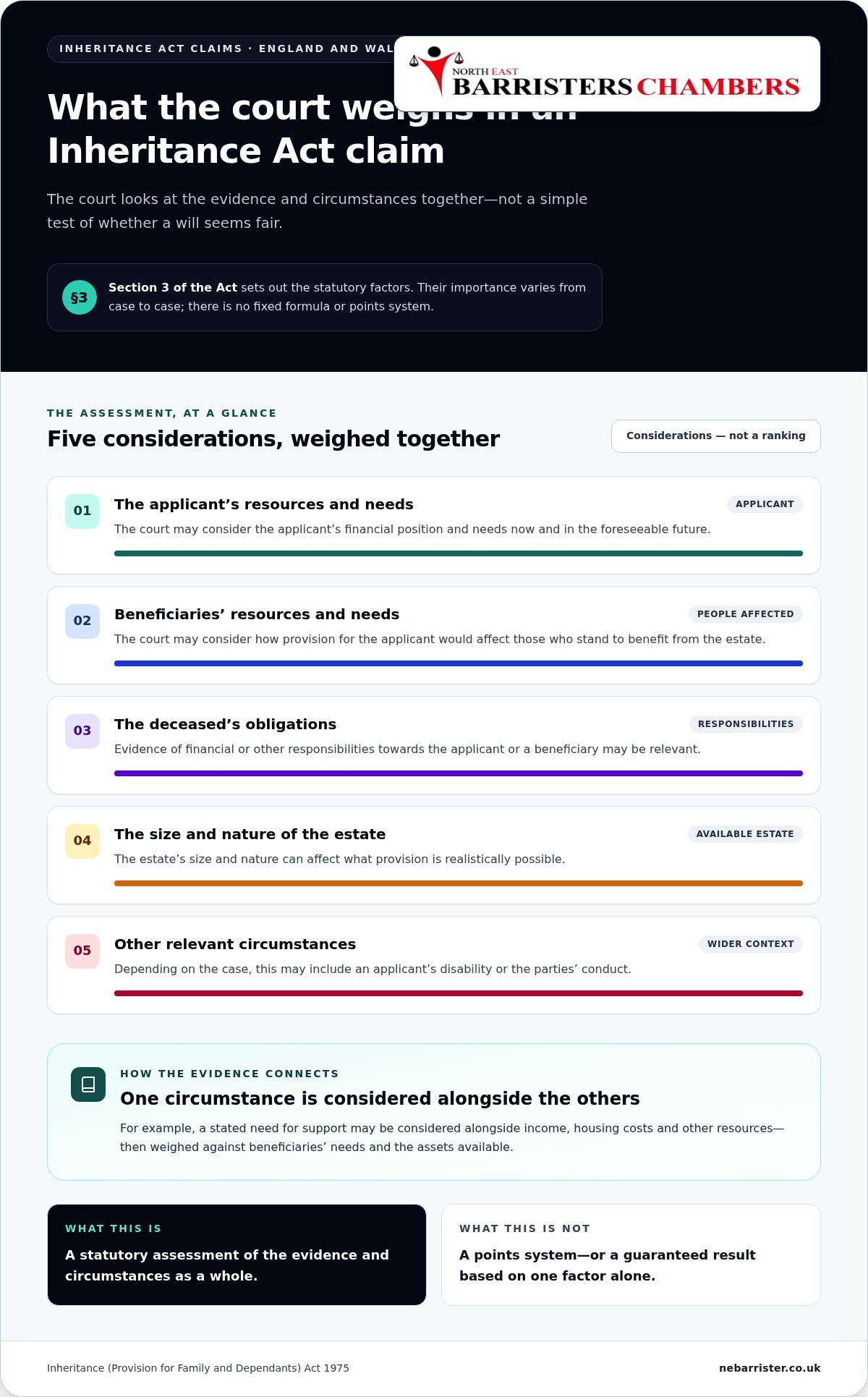
The court doesn’t decide an Inheritance Act claim simply by asking whether the will seems fair. It applies the statutory test to the evidence and the circumstances of the applicant, the beneficiaries and the estate. The relevant factors are set out in section 3 of the Act. Their importance varies from case to case, so there’s no fixed formula that guarantees a particular result.
Which factors may the court consider?
The court considers the applicant’s financial position alongside the resources and needs of other people who may be affected. It also considers the deceased’s responsibilities towards the applicant or beneficiaries, the size and nature of the estate, and any other relevant circumstances. The official legislation sets out the statutory framework in full.
- The applicant’s resources and needs: including their financial position and needs now and in the foreseeable future.
- Beneficiaries’ resources and needs: the court may consider how provision would affect those who stand to benefit from the estate.
- The deceased’s obligations: evidence of financial or other responsibilities towards the applicant or a beneficiary may be relevant.
- The estate: its size and nature can affect what provision is realistically possible.
- Other relevant circumstances: the court may take account of factors such as an applicant’s disability or, where relevant, the parties’ conduct.
For example, an applicant’s stated need for support may need to be considered alongside their income, housing costs and other resources. The court may weigh those circumstances against the needs of beneficiaries and the assets available. These aren’t separate boxes to tick. Evidence needs to show how the circumstances fit together, and the weight given to each factor depends on the case.
The statutory list guides the court’s assessment; it is not a points system. A close family relationship, financial difficulty or a small inheritance doesn’t determine the outcome by itself. The court considers the evidence and applies the legal test to the circumstances as a whole. You can consult the official text of the Inheritance Act 1975 for the legislation and its provisions.
Does the same standard apply to every claimant?
No. For a surviving spouse or civil partner, reasonable financial provision is assessed by reference to what is reasonable in all the circumstances, whether or not it is needed for maintenance. The court may consider factors such as the length of the relationship, the standard of living during it and contributions made by each person.
For other applicant categories, the standard is generally provision that is reasonable for the applicant’s maintenance. Maintenance doesn’t mean a guaranteed sum or a promise to preserve a particular lifestyle. What it requires depends on the applicant’s circumstances and evidence. A barrister for inheritance act claim advice can explain how the relevant standard and factors may apply. If you need to understand your options, direct access barrister advice can help you discuss the legal issues and possible next steps.
What can a barrister do in an Inheritance Act claim?
A barrister can help you understand the legal issues and prepare a focused approach to an Inheritance Act dispute. Through direct access, you can instruct a barrister without first instructing a solicitor. A barrister can assess the strengths and weaknesses of your position, advise on evidence, support negotiations and represent you in court. The work will depend on the needs of the case and the agreed scope.
Direct access doesn’t automatically mean the barrister will manage every part of the case. Some administrative and litigation tasks may need to be handled by you or another legal professional. Agreeing responsibilities at the outset helps prevent missed steps and misunderstandings.
When can direct access to a barrister be useful?
Direct instruction may suit someone who wants specialist advice on a defined legal question, help evaluating evidence or preparation for a hearing. For example, a barrister can review financial records and correspondence, identify material relevant to the issues and advise on how to present the case. A barrister may also assist with settlement discussions or provide advocacy at a hearing where appropriate.
It can be a practical route if you’re comfortable organising documents, keeping track of correspondence and carrying out agreed administrative tasks. A case with complex procedural demands may require a different arrangement or additional support. A barrister can explain what the case involves, but suitability depends on the procedure and what you can manage yourself.
What is the difference between advocacy and conducting litigation?
Advocacy means presenting your case or legal submissions to the court. Conducting litigation means taking responsibility for managing proceedings, including procedural steps, formal correspondence and case administration. These are related roles, but they aren’t the same. The work a barrister can undertake depends on the scope of the instruction and the applicable rules.
A simple way to think about the division is:
- You may handle: gathering records, sharing instructions, checking correspondence and completing agreed practical tasks.
- A barrister may assist with: legal analysis, advice on evidence, negotiation support and court advocacy.
- Procedural management: clarify who is responsible for each filing, deadline and communication. Don’t assume these tasks are included just because you have instructed a barrister.
Before proceeding, make sure the proposed work and each person’s responsibilities are clear. This helps you decide whether direct access fits your circumstances and where you may need further procedural support. A direct access barrister can provide focused legal advice and court representation, without promising a particular outcome.
What evidence and deadlines should you prepare for an Inheritance Act claim?
Start by establishing the estate position and the date the grant of representation was issued. These details help identify what documents are available and the usual time limit. A barrister can consider the material alongside your circumstances and explain which evidence may be most relevant. Keep copies of documents and note what is missing rather than waiting until you have a complete file.
What documents and information may help assess the case?
Gather the core estate records first, then organise evidence about your finances and relationship with the deceased. A clear timeline can connect the documents to events and help explain any support, responsibilities or expectations involved.
- Locate the will or intestacy information. Include any available codicils and details of how the estate is being dealt with.
- Record the grant details. Note whether a grant of probate or letters of administration has been issued, and the date. Keep a copy if you have one.
- Collect estate information. Gather correspondence about the estate, available information about its assets and liabilities, and communications from personal representatives.
- Set out your financial position. Relevant records may include income, regular outgoings, housing costs, debts, savings and other resources. Include information about current needs and foreseeable commitments.
- Organise relationship and support evidence. Keep relevant correspondence, records of financial support, shared expenses or other evidence of the relationship and any obligations the deceased had towards you.
Not every document will be available at the outset. Make a short list of what you have, what you’ve requested and what remains unknown. This gives a barrister for inheritance act claim advice a practical starting point for assessing the issues and identifying important gaps.
How should you think about the claim deadline?
In England and Wales, a claim under the Inheritance (Provision for Family and Dependants) Act 1975 generally needs to be issued within six months of the date of the grant of representation. The period usually runs from the grant, not the date of death. If you’re unsure whether a grant has been made or when it was issued, make finding out an early priority.
The court may permit a claim to proceed after the usual period, but permission is not automatic. A late applicant may need to explain the delay, and the court decides whether to allow the claim to continue. Don’t assume that discussions with beneficiaries or a standstill agreement, if one is reached, changes the court deadline. The effect of any agreement and the steps needed to protect your position require legal assessment.
Prompt advice can help you understand the deadline, organise evidence and plan what needs to happen next. If you’re concerned about the grant date or the documents you have, seek direct barrister advice on your potential claim and the steps available.
How can a barrister for an Inheritance Act claim help with your next steps?
An initial discussion gives you a chance to explain what has happened and identify the legal questions that need attention. You don’t need every document or a fully formed case before seeking advice. A clear account of the key events, what the estate has provided and what you believe is missing can help the barrister focus on the issues.
What should you explain when seeking barrister advice?
Start with the essentials: who died, when they died, your connection to them and whether there was a will. Explain what provision the will or intestacy rules made for you, and why you believe it may not meet your needs. Be open about facts that could help or complicate your position. A balanced account is more useful than presenting only the strongest points.
If available, have the grant date, relevant estate correspondence and key documents to hand. A short chronology can make the discussion clearer. Note what outcome you’re seeking, such as financial provision for a particular need, and flag any immediate concern about a hearing, a response date or another procedural step. If you don’t know an answer, say so. The discussion can help identify what information is needed next.
What happens after an initial assessment?
The barrister can identify the legal issues raised by your account, consider the available evidence and explain where further information may be needed. You may receive advice on the merits, possible arguments and practical next steps. If representation or further work is appropriate, the scope can be discussed in light of the case and the tasks involved.
Direct instruction can suit matters where you want focused legal advice or advocacy and can manage the necessary practical steps yourself. If the case involves complex procedure or substantial administration, that may affect the support required. The barrister can clarify their role and the agreed work, but won’t promise that a claim will succeed or that the court will make a particular award. Advice helps you make an informed decision; it cannot guarantee an outcome.
A focused legal assessment can replace guesswork with a clearer view of the questions, evidence and options before you. It can also help you decide whether direct barrister instruction fits your situation and what responsibilities you would need to manage. If you’re ready to discuss your circumstances, consider direct access barrister advice from North East Barristers Chambers. Bring the key facts you have and use the discussion to clarify your next steps.
Take a clear next step with your inheritance concerns
Uncertainty can make it difficult to decide what to do, especially when family relationships and an estate are involved. You don’t need to resolve every issue before seeking advice. A focused conversation can help turn your concerns into clear questions and identify what information to gather next.
If you’re considering a barrister for inheritance act claim advice, think about what you need to understand first. You may want an assessment of your position, guidance on the evidence or advice about representation. Be ready to explain your main concern and the outcome you hope to achieve. A barrister can advise on the issues and possible next steps, but no professional can promise what a court will decide.
North East Barristers Chambers provides direct access legal advice and court representation for individuals and businesses across the UK. You can discuss your Inheritance Act claim with a barrister and explore whether focused advice or representation suits your circumstances. Take the next step by discussing your circumstances with the chambers.
Frequently Asked Questions
Can an adult child make an Inheritance Act claim?
Yes, an adult child may apply, but being the deceased’s child doesn’t guarantee provision. The court considers the applicable legal test and evidence about the applicant’s financial circumstances, alongside the wider facts of the case. Estrangement or past financial support may form part of the picture, but neither determines the result on its own. A barrister for inheritance act claim advice can help assess how the facts may affect an individual application.
Can I make an Inheritance Act claim if there is no will?
Yes, a claim may be possible even if the deceased left no will. The estate is then distributed under intestacy rules, and the Act may still allow an eligible person to ask the court for provision. The key questions are whether the person meets the statutory conditions and whether the distribution provides appropriately in their circumstances. This differs from arguing that a will is invalid, which raises separate issues.
How long does an Inheritance Act claim take?
There’s no set duration for every claim. A dispute resolved by agreement may take a different course from one requiring detailed evidence or a court hearing. The availability of estate information and the parties’ ability to narrow their differences can also affect progress. Don’t confuse the time needed to resolve a claim with the deadline for starting one. Get advice promptly, especially if a grant has already been issued.
Can an Inheritance Act claim be settled without a court hearing?
Yes, the parties may reach a settlement through negotiation or another resolution process, so a final court hearing isn’t inevitable. Before accepting or making an offer, consider what it means in practical terms, including how it addresses the issues in dispute and whether the agreement will resolve the matter. An offer isn’t automatically suitable just because it avoids a hearing. Case-specific legal advice can help you weigh the options.
Can a barrister represent me directly in court for an Inheritance Act claim?
A barrister may be instructed directly to advise you and, where appropriate, represent you in court. The work depends on the barrister’s authorisation, the needs of the case and the agreed scope. Direct instruction doesn’t automatically cover every filing, communication or administrative task. Clarify who will manage each procedural responsibility, particularly if the case has several deadlines or requires ongoing administration.
What happens if I miss the Inheritance Act claim deadline?
If the usual deadline has passed, you may need the court’s permission to proceed with a late claim. Permission isn’t automatic, and the court considers the circumstances and relevant legal principles. An agreement with other parties shouldn’t be treated as changing the court deadline. If you think time has run out, seek advice promptly and explain when the grant was issued, when you became aware of the issue and why there was a delay.